Komischer Tag heute. Hier in Greifswald hat sich der Lindner eine Schaumtorte gefangen und in der Tagesschau wird über ein Telefonat zwischen Elon Musk und Alice Weidel berichtet. Ein Zirkus das alles.
↳
In-reply-to
»
Hello @movq . Did you fixed jenny bug which causes fetching long ids from yarn instances on feeds like https://ciberlandia.pt/@marado.txt ? I'm asking because i want to store links in brackets on some of my posts and don't want to confuse jenny users
⤋ Read More
@doesnmppsflt@doesnm.p.psf.lt Not sure which bug you’re referring to. 🤔 (Did I forget?)
Those long IDs like (#113797927355322708) are simply part of that feed. Looks like the author just dumps ActivityPub IDs into twtxt. I think this used to work in the past, but the corresponding spec (https://twtxt.dev/exts/hash-tag.html) has been deprecated and jenny doesn’t support – actually, jenny never supported that.
jenny can only group threads by exactly one criterium (because it writes a Message-ID into the mail file) and that’s the regular twt hash. So, anything else, like people doing “#CoolTopic”, isn’t possible.
↳
In-reply-to
»
Any idea What's this
⤋ Read More
"twtxtfeevalidator/0.0.1" UA about? I thought I could ask before throwing a 1000GB file at it 🪤 could it be the same 'xt' thing @lyse was talking about the other day?
@aelaraji@aelaraji.com Thank you very much, glad you like it. :-) I always try to make web pages use as much semantic tags as possible and keep the HTML very simple, so that they also have a chance to look decent in terminal browsers. The logo took me a few hours to draw in all its three sizes.
↳
In-reply-to
»
@bender I built my own, a much smaller one with a multi stage build... shouldn't that do the trick? 🤔
⤋ Read More
@bender@twtxt.net Dud! you should see the updated version! 😂 I have just discovered the scratch #container image and decided I wanted to play with it… I’m probably going to end up rebuilding a LOT of images.
~/htwtxt » podman image list htwtxt
REPOSITORY                TAG            IMAGE ID      CREATED             SIZE
localhost/htwtxt          1.0.7-scratch  2d5c6fb7862f  About a minute ago  12 MB
localhost/htwtxt          1.0.5-alpine   13610a37e347  4 weeks ago         20.1 MB
localhost/htwtxt          1.0.7-alpine   2a5c560ee6b7  4 weeks ago         20.1 MB
docker.io/buckket/htwtxt  latest         c0e33b2913c6  8 years ago         778 MB
↳
In-reply-to
»
Yarn spoiler test:
⤋ Read More
What was it suppose to look like? a <detail><summary>-tag maybe?
↳
In-reply-to
»
@bender I built my own, a much smaller one with a multi stage build... shouldn't that do the trick? 🤔
⤋ Read More
@bender@twtxt.net here:
FROM golang:alpine as builder
ARG version
ENV HTWTXT_VERSION=$version

WORKDIR $GOPATH/pkg/

RUN wget -O htwtxt.tar.gz https://github.com/plomlompom/htwtxt/archive/refs/tags/${HTWTXT_VERSION}.tar.gz
RUN tar xf htwtxt.tar.gz && cd htwtxt-${HTWTXT_VERSION} && go mod init htwtxt && go mod tidy && go install htwtxt

FROM alpine
ARG version
ENV HTWTXT_VERSION=$version

RUN mkdir -p /srv/htwtxt
COPY --from=builder /go/bin/htwtxt /usr/bin/
COPY --from=builder /go/pkg/htwtxt-${HTWTXT_VERSION}/templates/* /srv/htwtxt/templates/
WORKDIR /srv/htwtxt
VOLUME /srv/htwtxt

EXPOSE 8000

ENTRYPOINT ["htwtxt", "-dir", "/srv/htwtxt", "-templates", "/srv/htwtxt/templates"]
Don’t forget the --build-arg version="1.0.7" for example when building this one, although there isn’t much difference between the couple last versions.
P.S: I may have effed up changing htwtxt’s files directory to /srv/htwtxt when the command itself defaults to /root/htwtxt so you’ll have to throw in a -dir whenever you issue an htwtxt command (i.e: htwtxt -adduser somename:somepwd -dir /srv/htwtxt … etc)
↳
In-reply-to
»
@bender I built my own, a much smaller one with a multi stage build... shouldn't that do the trick? 🤔
⤋ Read More
P.S:
~/remote/htwtxt » podman image list htwtxt                                                                                the@wks
REPOSITORY                TAG           IMAGE ID      CREATED      SIZE
localhost/htwtxt          1.0.5-alpine  13610a37e347  3 hours ago  20.1 MB
localhost/htwtxt          1.0.7-alpine  2a5c560ee6b7  3 hours ago  20.1 MB
docker.io/buckket/htwtxt  latest        c0e33b2913c6  8 years ago  778 MB
↳
In-reply-to
»
htwtxt maybe, but i can't built it (broken?)
⤋ Read More
@doesnm@doesnm.p.psf.lt I tried to go install github.com/plomlompom/htwtxt@1.0.7 as well as
# this is snippet from what I used for the Dockerfile but I guess it should work just fine.
cd ~/go/pkg && wget -O htwtxt.tar.gz https://github.com/plomlompom/htwtxt/archive/refs/tags/1.0.7.tar.gz
tar xf htwtxt.tar.gz && cd htwtxt-1.0.7 && go mod init htwtxt && go mod tidy && go install htwtxt
both worked just fine…
↳
In-reply-to
»
So I've flattened my work and private email inboxes to single inbox folders and I don't even know anymore what I was thinking before trying frantically to organise everything in sub folders. Labels and search filters are the way forward.
⤋ Read More
Wouldn’t you rather have work and private seperated? Any thought behind this decission? I like tags, like Gmail does it. I still think mail needs a big rethink. It’s too prominent in life, to be this archaic.
so i learned that my vpn provider uses nftables to tag traffic for split tunnelling. so it looks like i’ll be converting my iptables rules. there’s some implication for docker containers that i’ll have to reckon with, but i’m already nesting them inside a nixos container so i don’t really need docker to touch the network at all. after that i’ll be able to define some rules to allow traffic meant for the yggdrasil network to reach the tunnel. this will be important later.
↳
In-reply-to
»
@bender I should put the template that is used by default as a file in the repo. Look at the source for now and you'll see 😅
⤋ Read More
@bender@twtxt.net LOL normally things (in the vanilla template) render like <time class="dt-published" datetime="2024-09-17T15:05:19+01:00"> 2024-09-17 14:05:19 +0000 UTC+0000 </time> the datetime=... atribute is in my local time UTC+1 then the text within the tag is in UTC+0
The thing is, I’ve been poking at the template as well, but nothing changes. I literally whole portionsm added in lorem text just to see if it would do anything, then twtxt2html -T ./layout.html <link to twtxt file> | less shows same thing as before! nothing changes. LOL I’m not sure I’m going at it the right way.
↳
In-reply-to
»
Done and done! everything is back to normal! 🥳
⤋ Read More
@prologic@twtxt.net I can’t pinpoint the exact cause but here are a couple of symptoms I observed:
- It all started with a LOT of his old twts starting back in 2020 showing in a weird way, some were empty others were duplicates and a lot more got marked for deletion by neomutt with the
Dtag.
- After trying to restart things with a fresh Maildir, I couldn’t fetch a lot of twts, even mine which was a replay to one of his. but then I was able to after temporarily deleting his link from my follow file.
then @quark@ferengi.one and @bender@twtxt.net pointed out the inconsistent from: + feed url and the twt edit
↳
In-reply-to
»
Something odd just happened to my twtxt timeline... A bunch of twts dissapered, others were marked to be deleted in mutt. so I nuked my whole twtxt Maildir and deleted my ~/.cache/jenny in order to start with a fresh Pull. I pulled feed as usual. Now like HALF the twts aren't there 😂 even my my last replay. WTF IS GOING ON? 🤣🤣🤣
⤋ Read More
More:
Subject: The [tag URI scheme](https://en.wikipedia.org/wiki/Tag_URI_scheme) looks interesting. I like that it human read- and writable. And since we already got the timestamp in the twtxt.txt it would be
        somewhat trivial to parse. But there are still the issue with what the name/id should be... Maybe it doesn't have to bee that stick? Instead of using `tag:` as the prefix/protocol, it would more it clear
        what we are talking about by using `in-reply-to:` (https://indieweb.org/in-reply-to) or `replyto:` similar to `mailto:` 1. `(reply:sorenpeter@darch.dk,2024-09-15T12:06:27Z)' 2.
        `(in-reply-to:darch.dk/twtxt.txt,2024-09-15T12:06:27Z)' 2. `(replyto:http://darch.dk/twtxt.txt,2024-09-15T12:06:27Z)' I know it's longer that 7-11 characters, but it's self-explaining when looking at the
        twtxt.txt in the raw, and the cases above can all be caught with this regex: `\([\w-]*reply[\w-]*\:` Is this something that would work?
Subject: The [tag URI scheme](https://en.wikipedia.org/wiki/Tag_URI_scheme) looks interesting. I like that it human read- and writable. And since we already got the timestamp in the twtxt.txt it would be
        somewhat trivial to parse. But there are still the issue with what the name/id should be... Maybe it doesn't have to bee that stick? Instead of using `tag:` as the prefix/protocol, it would more it clear
        what we are talking about by using `in-reply-to:` (https://indieweb.org/in-reply-to) or `replyto:` similar to `mailto:` 1. `(reply:sorenpeter@darch.dk,2024-09-15T12:06:27Z)` 2.
        `(in-reply-to:darch.dk/twtxt.txt,2024-09-15T12:06:27Z)` 3. `(replyto:http://darch.dk/twtxt.txt,2024-09-15T12:06:27Z)` I know it's longer that 7-11 characters, but it's self-explaining when looking at the
        twtxt.txt in the raw, and the cases above can all be caught with this regex: `\([\w-]*reply[\w-]*\:` Is this something that would work?
Notice the difference? Soren edited, and broke everything.
↳
In-reply-to
»
@prologic Some criticisms and a possible alternative direction:
⤋ Read More
The tag URI scheme looks interesting. I like that it human read- and writable. And since we already got the timestamp in the twtxt.txt it would be somewhat trivial to parse. But there are still the issue with what the name/id should be… Maybe it doesn’t have to bee that stick?
Instead of using tag: as the prefix/protocol, it would more it clear what we are talking about by using in-reply-to: (https://indieweb.org/in-reply-to) or replyto: similar to mailto:
(reply:sorenpeter@darch.dk,2024-09-15T12:06:27Z)
(in-reply-to:darch.dk/twtxt.txt,2024-09-15T12:06:27Z)
(replyto:http://darch.dk/twtxt.txt,2024-09-15T12:06:27Z)
I know it’s longer that 7-11 characters, but it’s self-explaining when looking at the twtxt.txt in the raw, and the cases above can all be caught with this regex: \([\w-]*reply[\w-]*\:
Is this something that would work?
↳
In-reply-to
»
@prologic Some criticisms and a possible alternative direction:
⤋ Read More
HTTPS is supposed to do [verification] anyway.
TLS provides verification that nobody is tampering with or snooping on your connection to a server. It doesn’t, for example, verify that a file downloaded from server A is from the same entity as the one from server B.
I was confused by this response for a while, but now I think I understand what you’re getting at. You are pointing out that with signed feeds, I can verify the authenticity of a feed without accessing the original server, whereas with HTTPS I can’t verify a feed unless I download it myself from the origin server. Is that right?
I.e. if the HTTPS origin server is online and I don’t mind taking the time and bandwidth to contact it, then perhaps signed feeds offer no advantage, but if the origin server might not be online, or I want to download a big archive of lots of feeds at once without contacting each server individually, then I need signed feeds.
feed locations [being] URLs gives some flexibility
It does give flexibility, but perhaps we should have made them URIs instead for even more flexibility. Then, you could use a tag URI,
urn:uuid:*, or a regular old URL if you wanted to. The spec seems to indicate that theurltag should be a working URL that clients can use to find a copy of the feed, optionally at multiple locations. I’m not very familiar with IP{F,N}S but if it ensures you own an identifier forever and that identifier points to a current copy of your feed, it could be a great way to fix it on an individual basis without breaking any specs :)
I’m also not very familiar with IPFS or IPNS.
I haven’t been following the other twts about signatures carefully. I just hope whatever you smart people come up with will be backwards-compatible so it still works if I’m too lazy to change how I publish my feed :-)
↳
In-reply-to
»
@movq Is there a good way to get jenny to do a one-off fetch of a feed, for when you want to fill in missing parts of a thread? I just added @slashdot to my private follow file just because @prologic keeps responding to the feed :-P and I want to know what he's commenting on even though I don't want to see every new slashdot twt.
⤋ Read More
@prologic@twtxt.net How does yarn.social’s API fix the problem of centralization? I still need to know whose API to use.
Say I see a twt beginning (#hash) and I want to look up the start of the thread. Is the idea that if that twt is hosted by a a yarn.social pod, it is likely to know the thread start, so I should query that particular pod for the hash? But what if no yarn.social pods are involved?
The community seems small enough that a registry server should be able to keep up, and I can have a couple of others as backups. Or I could crawl the list of feeds followed by whoever emitted the twt that prompted my query.
I have successfully used registry servers a little bit, e.g. to find a feed that mentioned a tag I was interested in. Was even thinking of making my own, if I get bored of my too many other projects :-)
↳
In-reply-to
»
Yeah sorry just realised, but just checked again and the referrer is the same (
⤋ Read More
/post) on either the POST or the GET 🤔
@prologic@twtxt.net Sorry, my messages don’t get included in the current convo unless I tag you. Guess something gets lossed in translation with this weird posting issue. ANYWAY, it is rather perplexing. Clearly only an issue on my Pod, but what could the source of it be 🤔
↳
In-reply-to
»
Oh, nevermind... it did! I've just checked my twtxt.txt file. Now I have to figure out replays 🫤
⤋ Read More
I wonder if anyone got that as a replay 🥲 I tried and copied thread’s tag from twtxt.net
Added support for #tag clouds and #search to timeline. Based on code from @dfaria.eu@dfaria.eu🙏

Live at: http://darch.dk/timeline/?profile=https://darch.dk/twtxt.txt
More basement:
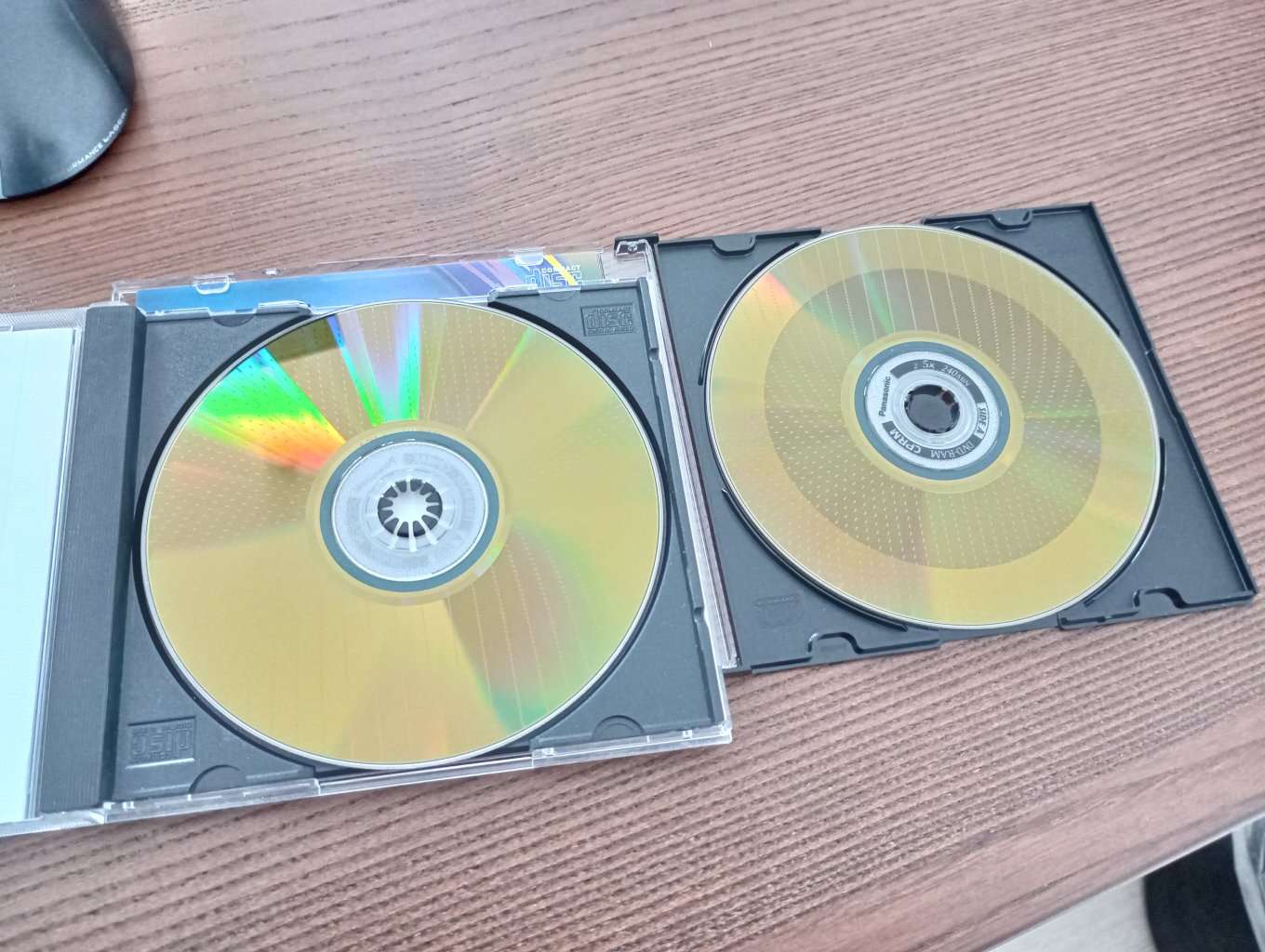
I completely forgot that DVD-RAM was a thing once. Found my old disks and they still work. 🤯 The data on them is from 2008, so they’re not that old. Still impressive.
The disks are two-sided. On the photo, that particular side of the disk on the left appears to be completely unused. 🤔
And then I read on Wikipedia that DVD-RAMs aren’t produced anymore at all today. Huh.
(I refuse to tag this as “retrocomputing”. Read/write DVDs that you can use just like a harddisk, thanks to UDF, are still “new and fancy” in my book. 😂)
↳
In-reply-to
»
Yeah, the lack of comments makes regular JSON not a good configuration format in my view. Also, putting all keys in quotes and the use of commas is annoying. The big upside is that's in lots of standard libraries.
⤋ Read More
@lyse@lyse.isobeef.org its a hierarchy key value format. I designed it for the network peering tools i use.. I can grant access to different parts of the tree to other users.. kinda like directory permissions. a basic example of the format is:
@namespace
# multi
# line
# comment
root :value

# example space comment
@namespace.name space-tag

# attribute comments
attribute attr-tag  :value for attribute

# attribute with multiple
# lines of values
foo :bar
      :bin
      :baz

repeated :value1
repeated :value2
each @ starts the definition of a namespace kinda like [name] in ini format. It can have comments that show up before. then each attribute is key :value and can have their own # comment lines.
Values can be multi line.. and also repeated..
the namespaces and values can also have little meta data tags added to them.

the service can define webhooks/mqtt topics to be notified when the configs are updated. That way it can deploy the changes out when they are updated.
↳
In-reply-to
»
The original twt is unavailable. It may have been edited or deleted, or is from an unknown or muted feed.
⤋ Read More
What about using the blockquote format with > ?
Snippet from someone else’s post
by: @eapl.me@eapl.me
Would it not also make sense to have the repost be a reply to the original post using the (#twthash), and maybe using a tag like #repost so it eaier to filter them out?
with this, now all tags I follow are read in sfeed rss reader: https://docs.joinmastodon.org/methods/followed_tags/
OMG, I discovered there are rss feeds of tags on mastodon, i.e. https://im-in.space/tags/cybersecurity.rss \o/
Release jq 1.7rc1 · jqlang/jq · GitHub
Renewed activity on jq after five years. This RC looks nice!
Wikipedia Article Titles
 ⌘ Read more
🌠 PDF improvements & More AI Options
Check out some great guides on how to create folder and tag systems, and how to use the Strange New Worlds & bookmarks plugin! ⌘ Read more
↳
In-reply-to
»
@darch I think having a way to layer on features so those who can support/desire them can. It would be best for the community to be able to layer on (or off) the features.
⤋ Read More
An option would be to have /twtxt.txt be the base functionality as bukket intended without subject tags, markdown, images and such truncated to 140 chars. a /yarn.txt that has all the extentions as we know and love. and maybe a /.well-known/webfinger + (TBD endpoint) that adds on the crypto enhancements that further extend things.
Anyone know what this might be about?
[1134036.271114] ata1.00: exception Emask 0x0 SAct 0x4 SErr 0x880000 action 0x6 frozen
[1134036.271478] ata1: SError: { 10B8B LinkSeq }
[1134036.271829] ata1.00: failed command: WRITE FPDMA QUEUED
[1134036.272182] ata1.00: cmd 61/20:10:e0:75:6e/00:00:11:00:00/40 tag 2 ncq 16384 out
                          res 40/00:01:00:4f:c2/00:00:00:00:00/00 Emask 0x4 (timeout)
[1134036.272895] ata1.00: status: { DRDY }
[1134036.273245] ata1: hard resetting link
[1134037.447033] ata1: SATA link up 6.0 Gbps (SStatus 133 SControl 300)
[1134038.747174] ata1.00: configured for UDMA/133
[1134038.747179] ata1.00: device reported invalid CHS sector 0
[1134038.747185] ata1: EH complete
Tutorial: Getting started with generics - The Go Programming Language – Okay @xuu@txt.sour.is I quite like Go’s generics now 🤣 After going through this myself I like the semantics and the syntax. I’m glad they did a lot of work on this to keep it simple to both understand and use (just like the rest of Go) 👌  #GoLang #Generics
ChatGPT is good, but it’s not that good 🤣 I asked it to write a program in Go that performs double ratcheting and well the code is total garbage 😅 – Its only as good as the inputs it was trained on 🤣 #OpenAI #GPT3
Interview with an NFT enthusiast - YouTube
– Bahahahahahahaha 🤣 #NFT
performed qiudanz tag on the Hybrid Live Coding Interfaces Workshop 2022 | https://compudanzas.net/qiudanz_tag.html
wrote guiding notes for the qiudanz tag exploration that we will be showcasing on the Hybrid Live Coding Interfaces 2022 workshop. | https://compudanzas.net/qiudanz_tag.html
Got an acknowledgement of our Salty.im funding proposal to NLnet this evening. I look forward to the outcome 🤞 #Salty.im
pondering about the difference between my use of the tags #idea and #halfbaked . halfbaked looks like something in a more advanced stage, merely lacking execution #meta
pondering about the difference between my use of the tags #idea and #halfbaked . halfbaked looks like something in a more advanced stage, merely lacking execution #meta
Does anyone of you use PGP encrypted mail, or any kind or email encryption? Why? Why not?
The rise of tags on online articles saying how many minutes it takes to read them says, to me, a lot about our breakneck-speed culture.
#Wordle 235 4/6*
⬛🟨🟨⬛⬛
🟨🟨⬛⬛⬛
⬛⬛🟨🟨🟩
🟩🟩🟩🟩🟩
Finally! 😂
@eldersnake@yarn.andrewjvpowell.com There isn’t an equivalent for those because:
Markdown is not a replacement for HTML, or even close to it. Its syntax is very small, corresponding only to a very small subset of HTML tags.
You can read more of its philosophy at Daring Fireball. There are enhancements to Markdown (CommonMark, for example), that add extra to it.
@adi@f.adi.onl Yes, it did—at least I don’t see the same issue as before on twtxt.net. Weird, as it was never an issue on other pods. 🤷🏻♂️
@fastidious@arrakis.netbros.com Hmm… the empty line needs to be left alone.
@prologic@twtxt.net should we enable all unicode glyphs for tags? https://txt.sour.is/conv/55yrura
third session of the compudanzas workshop: we learned and performed the danzasistemas-tag (first time ever!) and a turing machine in d-turing mode | https://compudanzas.net/las_danzas.html
 and the some text and a #tag
@xuu@txt.sour.is Is this of any use? https://libretranslate.com/ – Congrats on the new job!
@prologic@twtxt.netYes, I think tags should just be #foo, and let the client figure out searching if it cares.