↳
In-reply-to
»
Any idea What's this
⤋ Read More
"twtxtfeevalidator/0.0.1" UA about? I thought I could ask before throwing a 1000GB file at it 🪤 could it be the same 'xt' thing @lyse was talking about the other day?
@aelaraji@aelaraji.com Ta! It’s just the millenia old tabs vs. spaces debate. ;-) Here’s a screenshot, that also kinda serves as a preview of the ugly – yet functional – web interface:

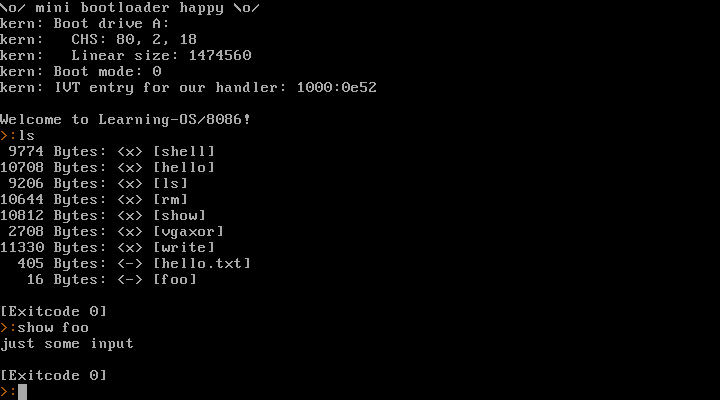
I’ve been making a little toy operating system for the 8086 in the last few days. Now that was a lot of fun!
I don’t plan on making that code public. This is purely a learning project for myself. I think going for real-mode 8086 + BIOS is a good idea as a first step. I am well aware that this isn’t going anywhere – but now I’ve gained some experience and learned a ton of stuff, so maybe 32 bit or even 64 bit mode might be doable in the future? We’ll see.
It provides a syscall interface, can launch processes, read/write files (in a very simple filesystem).
Here’s a video where I run it natively on my old Dell Inspiron 6400 laptop (and Warp 3 later in the video, because why not):
https://movq.de/v/893daaa548/los86-p133-warp3.mp4
(Sorry for the skewed video. It’s a glossy display and super hard to film this.)
It starts with the laptop’s boot menu and then boots into the kernel and launches a shell as PID 1. From there, I can launch other processes (anything I enter is a new process, except for the exit at the end) and they return the shell afterwards.
And a screenshot running in QEMU:
↳
In-reply-to
»
I think it's time I set up jenny for this feed... been echo-ing my twits manually and there came times when it made me feel like a dork xD Plus I don't have my vim's
⤋ Read More
:set spell to catch up with the typos
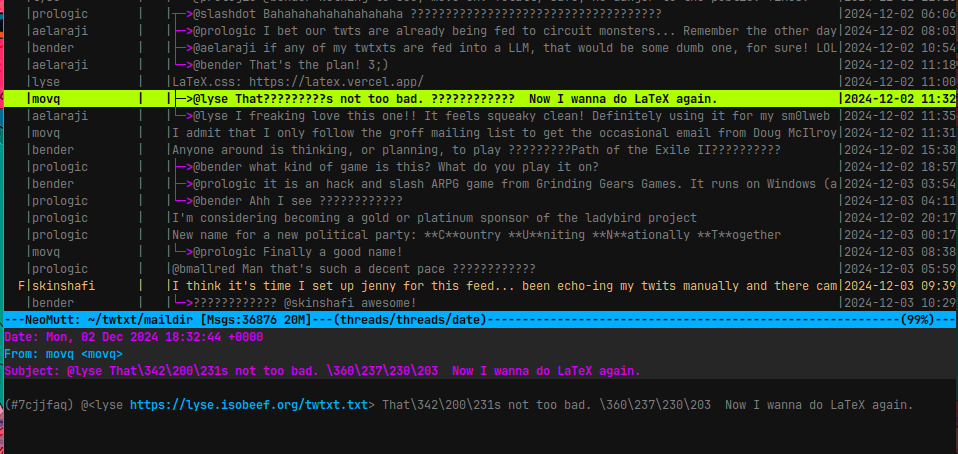
Done! but then again, there’s something weired going on with my muttrc-jenny config file xD … I’m seeing a bunch of ????s in the TUI’s subjects section… checking a couple of twt’s headers I see somethings like \360\237\230\261 (escapesd unicode?), sometime that shows in the mail body and sometimes not.
Could it have something to do with the remote/pubnix machin’s Locale or something? one more thing to digg through 🫠
↳
In-reply-to
»
Can someone try Alpine Linux with XFCE and Compiz please? Show me how the full screen zoom works in 2024/2025 🙏
⤋ Read More
@prologic@twtxt.net Never seen macOS but I believe that’s a yes, just like in the second screenshot. That’s my whole screen zoomed on the cursor’s position and it keeps following.
↳
In-reply-to
»
Can someone try Alpine Linux with XFCE and Compiz please? Show me how the full screen zoom works in 2024/2025 🙏
⤋ Read More
xfce’s default Alt+Scroll feels more convenient and you get to zoom in as much as you want as needed before things become indistinguishable, here you can see my original cursor overlapping to magnified one (it only showed during screenshot) 
↳
In-reply-to
»
Behold ... "Marginalia" ! My new favorite search engine!! And I have @mattof to thank for this find. Here's their Blog post about it since I don't think I could do a better job describing what it is. but, tl;dr: it's a #smallweb focused search engine.
⤋ Read More
… it even shows @sorenpeter@darch.dk’s article from 2020 in search results 
I found Timeline by @sorenpeter@darch.dk and I liked it. Decided to change some stuff around. Making some nice progess on my version of Timeline 
↳
In-reply-to
»
Media
⤋ Read More
(#2024-09-24T12:53:35Z) What does this screenshot show? The resolution it too low for reading the text…
↳
In-reply-to
»
Media
⤋ Read More
What does this screenshot show? The resolution it too low for reading the text…
I have just made yet another convoluted twtxt notifications script! Feeling like an old dog learning new tricks! 🤣

↳
In-reply-to
»
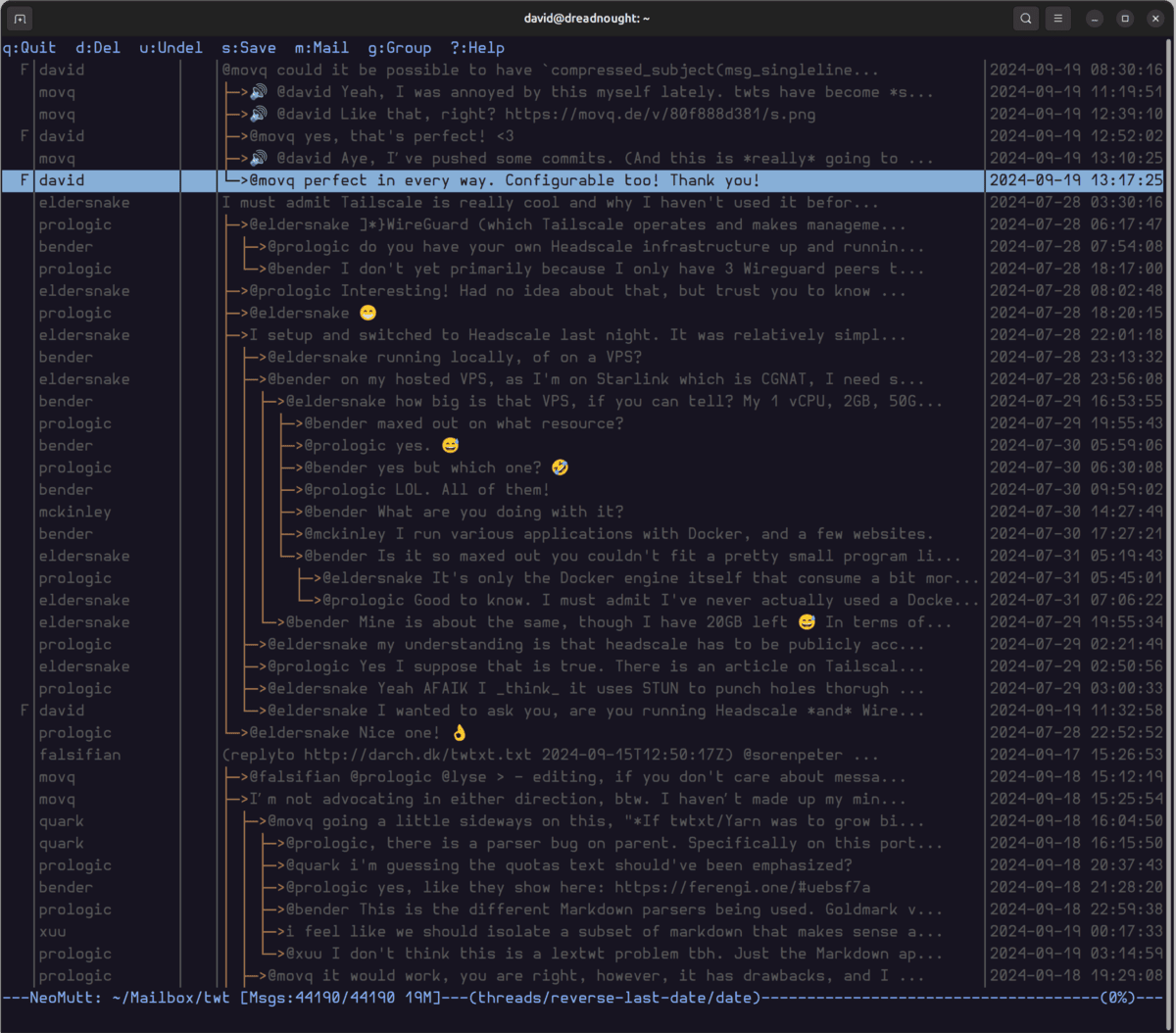
@movq could it be possible to have
⤋ Read More
compressed_subject(msg_singlelined) be configurable, so only a certain number of characters get displayed, ending on ellipses? Right now the entire twtxt is crammed into the Subject:. This request aims to make twtxts display on mutt/neomutt, etc. more like emails do.
I mean, really, it couldn’t get any better. I love it!
↳
In-reply-to
»
@quark My money is on a SHA1SUM hash encoding to keep things much simpler:
⤋ Read More
@prologic@twtxt.net Wikipedia claims sha1 is vulnerable to a “chosen-prefix attack”, which I gather means I can write any two twts I like, and then cause them to have the exact same sha1 hash by appending something. I guess a twt ending in random junk might look suspcious, but perhaps the junk could be worked into an image URL like  . If that’s not possible now maybe it will be later.
git only uses sha1 because they’re stuck with it: migrating is very hard. There was an effort to move git to sha256 but I don’t know its status. I think there is progress being made with Game Of Trees, a git clone that uses the same on-disk format.
I can’t imagine any benefit to using sha1, except that maybe some very old software might support sha1 but not sha256.
@prologic@twtxt.net earlier you suggested extending hashes to 11 characters, but here’s an argument that they should be even longer than that.
Imagine I found this twt one day at https://example.com/twtxt.txt :
2024-09-14T22:00Z Useful backup command: rsync -a “$HOME” /mnt/backup 
and I responded with “(#5dgoirqemeq) Thanks for the tip!”. Then I’ve endorsed the twt, but it could latter get changed to
2024-09-14T22:00Z Useful backup command: rm -rf /some_important_directory 
which also has an 11-character base32 hash of 5dgoirqemeq. (I’m using the existing hashing method with https://example.com/twtxt.txt as the feed url, but I’m taking 11 characters instead of 7 from the end of the base32 encoding.)
That’s what I meant by “spoofing” in an earlier twt.
I don’t know if preventing this sort of attack should be a goal, but if it is, the number of bits in the hash should be at least two times log2(number of attempts we want to defend against), where the “two times” is because of the birthday paradox.
Side note: current hashes always end with “a” or “q”, which is a bit wasteful. Maybe we should take the first N characters of the base32 encoding instead of the last N.
Code I used for the above example: https://fossil.falsifian.org/misc/file?name=src/twt_collision/find_collision.c
I only needed to compute 43394987 hashes to find it.
↳
In-reply-to
»
OK. @quark did not see this update, but should see this reply now, as broken.
⤋ Read More
@bender@twtxt.net, cool, so I can join the threads, but your edit to the original will never show at my end. Will have @bender@twtxt.net show the screenshot.
↳
In-reply-to
»
There is a bug in
⤋ Read More
yarnd that's been around for awhile and is still present in the current version I'm running that lets a person hit a constructed URL like
@prologic@twtxt.net What? I compiled, updated, and restarted. If you check what my pod reports, it gives that 7a… SHA. I don’t know what that other screenshot is showing but it seems to be out of date. That was the SHA I was running before this update.
↳
In-reply-to
»
@bender My index formatting is intact, probably because I still haven't figured out how to set up my terminal to show RTL text correctly! 😅 but hey, that won't be a problem anymore, I don't feel like twting in Arabic. Sorry for the inconvenience.
⤋ Read More
you’ll probably get an Error 1011 🤦 … just copy and paste the link in a new tab if you can Screenshot of neomutt running Jenny
↳
In-reply-to
»
إحتس قهوتك بسلام ☕🕊
⤋ Read More
@bender@twtxt.net My index formatting is intact, probably because I still haven’t figured out how to set up my terminal to show RTL text correctly! 😅 but hey, that won’t be a problem anymore, I don’t feel like twting in Arabic. Sorry for the inconvenience.


↳
In-reply-to
»
إحتس قهوتك بسلام ☕🕊
⤋ Read More
@aelaraji@aelaraji.com, this one, @movq@www.uninformativ.de, is slightly breaking my neomutt index. Will post screenshot from @bender@twtxt.net’s account.
my current desktop #screenshot  . I enjoy june’s scheme
I guess I’m not missing my GUI Web Browser yet. In fact, I think I’m enjoying this. 😆

I might even drop to TTY to try stuff I read about earlier today.
↳
In-reply-to
»
@prologic Thank
you! and here's a twt with the said random characters, since I've been
cleaning them up manually, earlier before scp-ing my twtxt.txt file. And
maybe a screenshot of how things look in my editor? Media
⤋ Read More
@aelaraji@aelaraji.com a bit on the tangent, what font is that one on your screenshot?
↳
In-reply-to
»
@prologic well, I think OP mother tongue isn’t English, so certainly not an encoding I might be familiar with.
⤋ Read More
@prologic@twtxt.net Thank
you! and here’s a twt with the said random characters, since I’ve been
cleaning them up manually, earlier before scp-ing my twtxt.txt file. And
maybe a screenshot of how things look in my editor? 
Those new lines are added automatically as I type (except for the ones
after the screenshot.
↳
In-reply-to
»
Yeah, the lack of comments makes regular JSON not a good configuration format in my view. Also, putting all keys in quotes and the use of commas is annoying. The big upside is that's in lots of standard libraries.
⤋ Read More
@lyse@lyse.isobeef.org its a hierarchy key value format. I designed it for the network peering tools i use.. I can grant access to different parts of the tree to other users.. kinda like directory permissions. a basic example of the format is:
@namespace
# multi
# line
# comment
root :value

# example space comment
@namespace.name space-tag

# attribute comments
attribute attr-tag  :value for attribute

# attribute with multiple
# lines of values
foo :bar
      :bin
      :baz

repeated :value1
repeated :value2
each @ starts the definition of a namespace kinda like [name] in ini format. It can have comments that show up before. then each attribute is key :value and can have their own # comment lines.
Values can be multi line.. and also repeated..
the namespaces and values can also have little meta data tags added to them.

the service can define webhooks/mqtt topics to be notified when the configs are updated. That way it can deploy the changes out when they are updated.
↳
In-reply-to
»
julien040/gut: An easy-to-use git client for Windows, macOS, and Linux
⤋ Read More
@prologic@twtxt.net I always liked bit.
I am disappointed that a GUI app would not at least have screenshots.
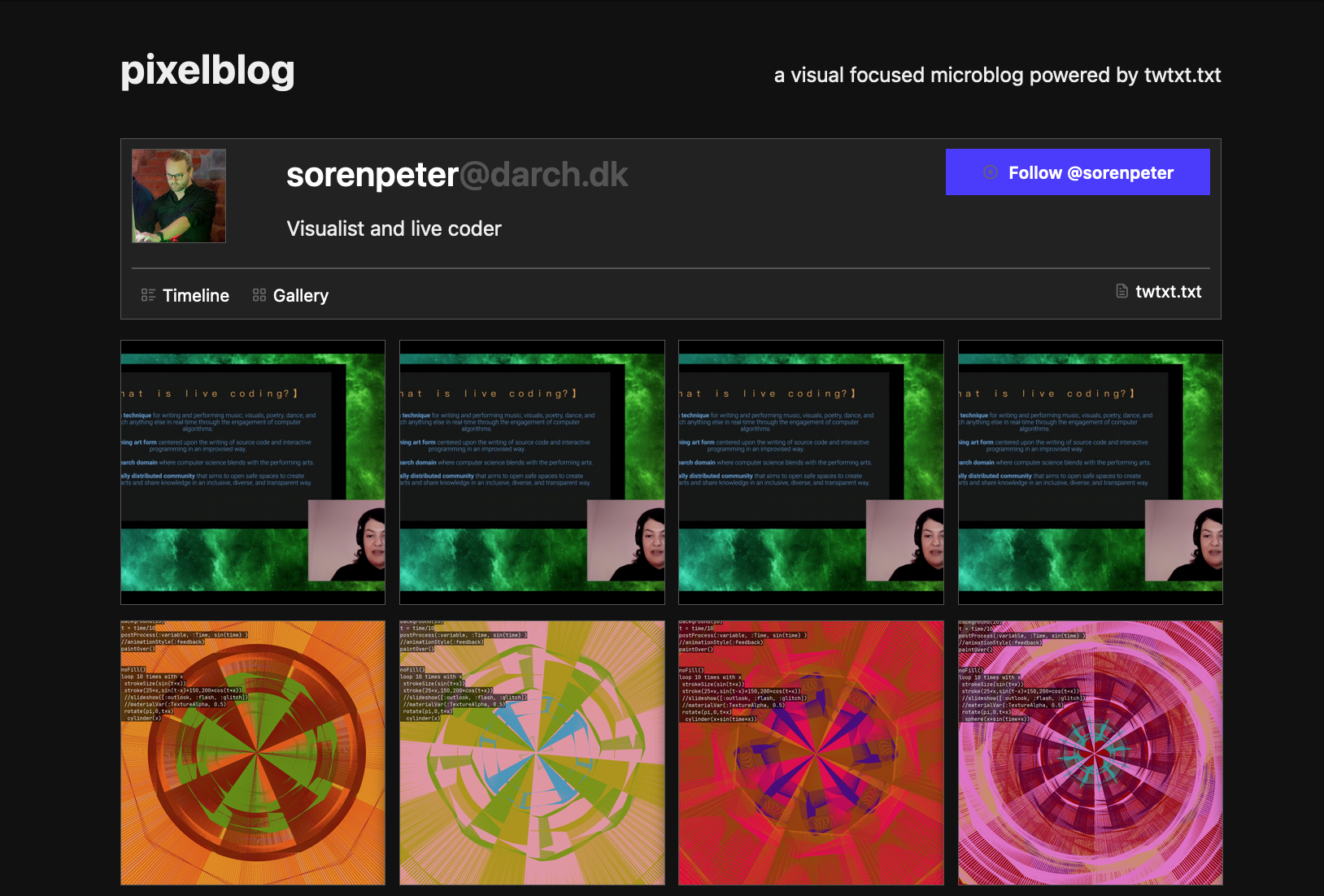
One year ago to the date I made the lastest update for #phpub2twtxt to github and now 365 days later I have published #pixelblog as its successor - lets see where things are going for trip around the sun 

New darchness coloursceme 
testing public path copy/pasted from code: 
More #pixelblog‘ing - today wotking on fixing all the semi-hardcoded paths an moving them to config.php 
#pixelblog is slowly coming together with support for posting images and simple theming 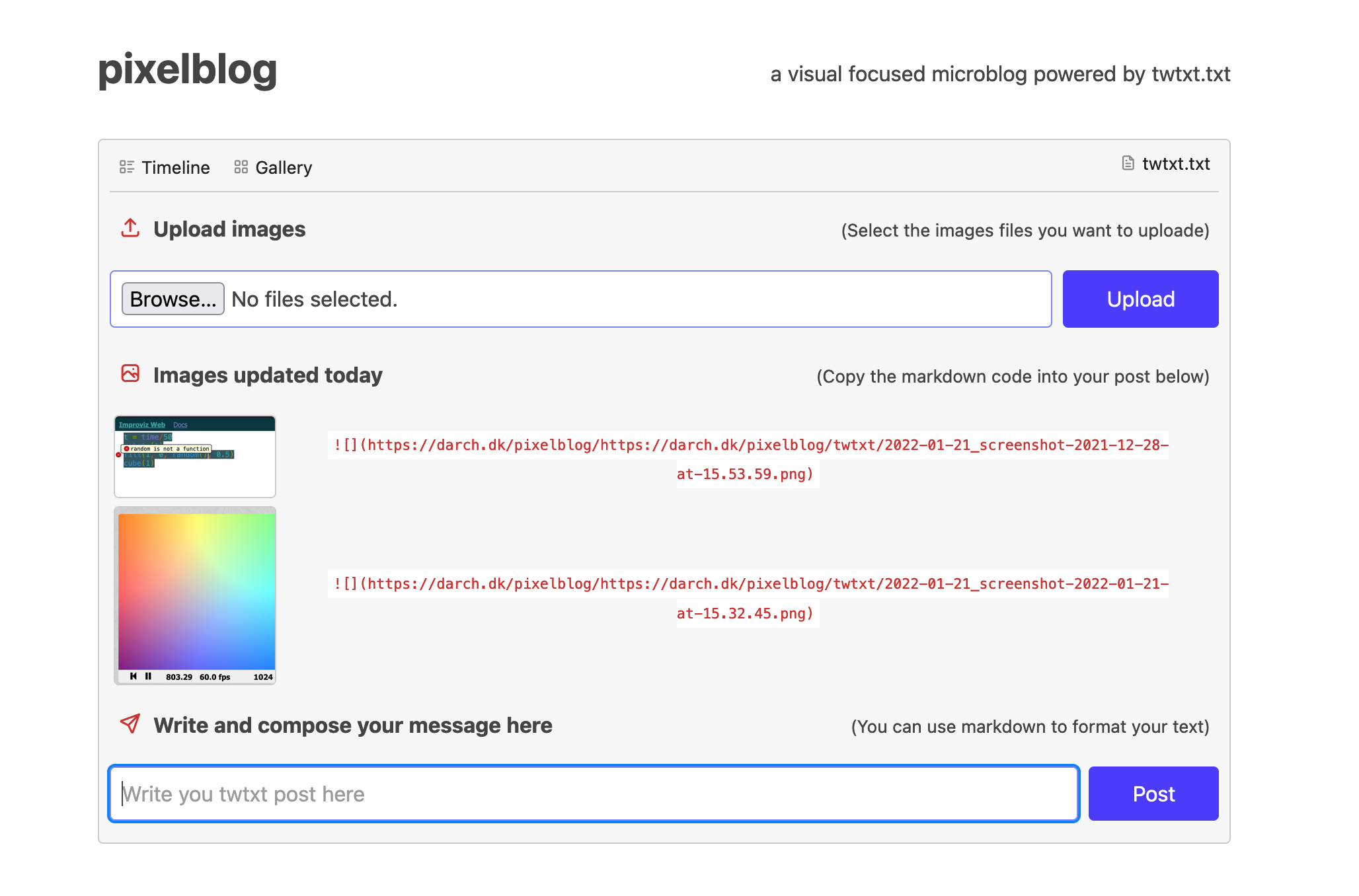

@movq@www.uninformativ.de This is awesome! Your server/connection is slow, thought. It took ages to load the GIF! Off topic, what font are you using on that screenshot?
↳
In-reply-to
»
The original twt is unavailable. It may have been edited or deleted, or is from an unknown or muted feed.
⤋ Read More
Added to the fun. 
Geting screenshots from video element seems to be relatively easy