All packed and ready to go to Vienna!
I think boredom is a real force that pushes ourselves to the edge, to hopefully make a change in life, like going out to see real people. Social media creates this cozy, safe place to keep your mind occupied, letting life pass without realizing it. Social media may prevent users from reaping creative rewards of profound boredom | Hacker News
↳
In-reply-to
»
Tutorial: Getting started with generics - The Go Programming Language -- Okay @xuu I quite like Go's generics now 🤣 After going through this myself I like the semantics and the syntax. I'm glad they did a lot of work on this to keep it simple to both understand and use (just like the rest of Go) 👌 Media #GoLang #Generics
⤋ Read More
@prologic@twtxt.net see where its used maybe that can help.
https://github.com/sour-is/ev/blob/main/app/peerfinder/http.go#L153
This is an upsert. So I pass a streamID which is like a globally unique id for the object. And then see how the type of the parameter in the function is used to infer the generic type. In the function it will create a new *Info and populate it from the datastore to pass to the function. The func will do its modifications and if it returns a nil error it will commit the changes.
The PA type contract ensures that the type fulfills the Aggregate interface and is a pointer to type at compile time.
↳
In-reply-to
»
Tutorial: Getting started with generics - The Go Programming Language -- Okay @xuu I quite like Go's generics now 🤣 After going through this myself I like the semantics and the syntax. I'm glad they did a lot of work on this to keep it simple to both understand and use (just like the rest of Go) 👌 Media #GoLang #Generics
⤋ Read More
one that i think is pretty interesting is building up dependent constraints. see here.. it accepts a type but requires the use of a pointer to type.
https://github.com/sour-is/ev/blob/main/pkg/es/es.go#L315-L325
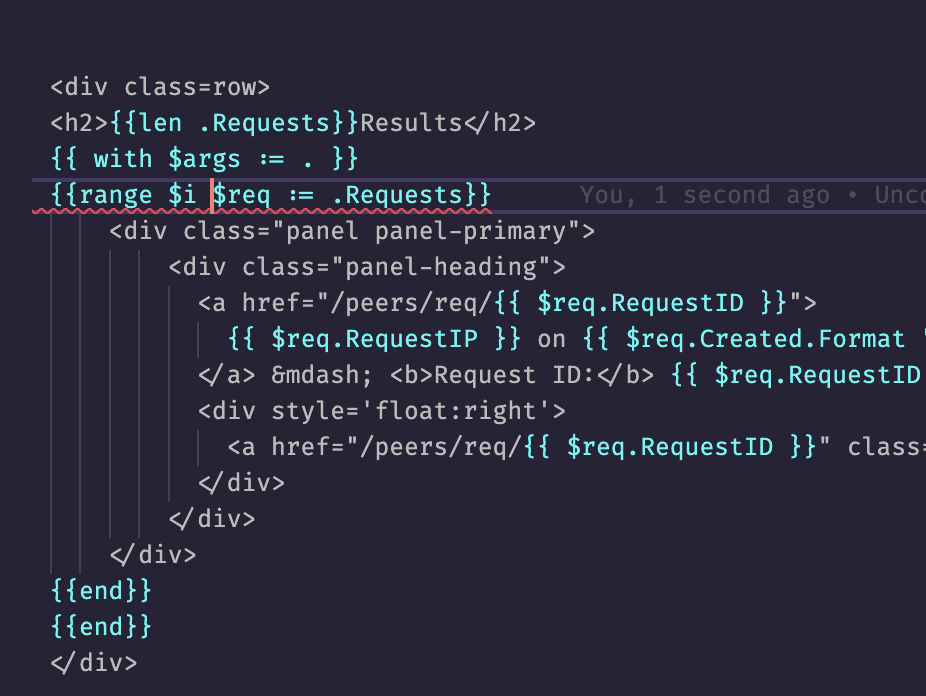
I learned how to make gopls syntax highlight go templates in VSCodium.
By adding the following to my config
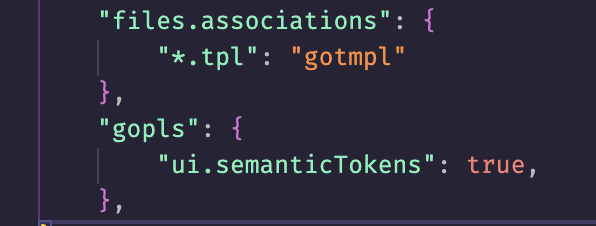
i could go from 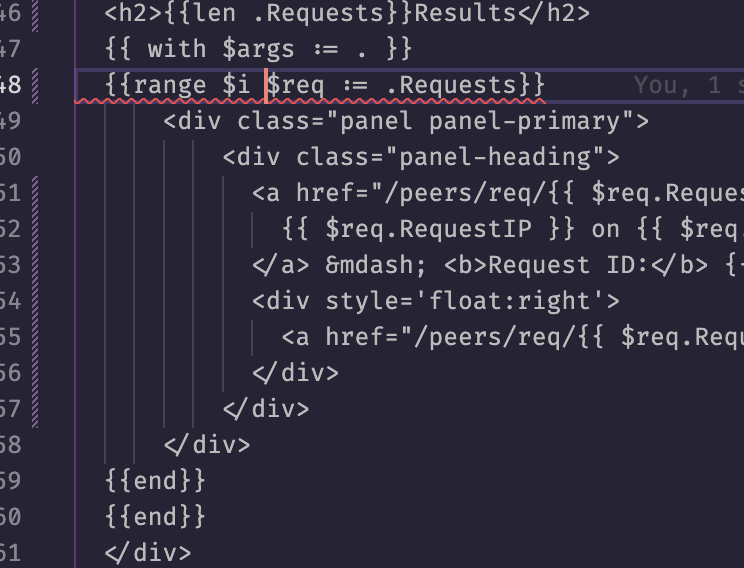 into
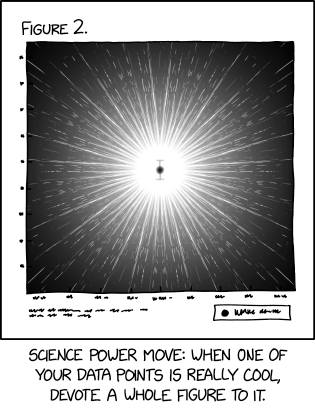
Data Point
 ⌘ Read more
Tutorial: Getting started with generics - The Go Programming Language – Okay @xuu@txt.sour.is I quite like Go’s generics now 🤣 After going through this myself I like the semantics and the syntax. I’m glad they did a lot of work on this to keep it simple to both understand and use (just like the rest of Go) 👌  #GoLang #Generics
ChatGPT is good, but it’s not that good 🤣 I asked it to write a program in Go that performs double ratcheting and well the code is total garbage 😅 – Its only as good as the inputs it was trained on 🤣 #OpenAI #GPT3
I started reading the proposal to introduce operator overloading in Go version 2 that I like to see: https://github.com/golang/go/issues/27605 Now a few hours later I ended up at this gem. Write a program that makes 2+2=5: https://codegolf.stackexchange.com/questions/28786/write-a-program-that-makes-2-2-5 There are some awesone solutions. :-)
↳
In-reply-to
»
I made a thing. Its a multi password type checker. Using the PHC string format we can identify a password hashing format from the prefix
⤋ Read More
$name$ and then dispatch the hashing or checking to its specific format.
Circling back to the IsPreferred method. A hasher can define its own IsPreferred method that will be called to check if the current hash meets the complexity requirements. This is good for updating the password hashes to be more secure over time.
func (p *Passwd) IsPreferred(hash string) bool {
	_, algo := p.getAlgo(hash)
	if algo != nil && algo == p.d {

		// if the algorithm defines its own check for preference.
		if ck, ok := algo.(interface{ IsPreferred(string) bool }); ok {
			return ck.IsPreferred(hash)
		}

		return true
	}
	return false
}
https://github.com/sour-is/go-passwd/blob/main/passwd.go#L62-L74
example: https://github.com/sour-is/go-passwd/blob/main/pkg/argon2/argon2.go#L104-L133
↳
In-reply-to
»
I made a thing. Its a multi password type checker. Using the PHC string format we can identify a password hashing format from the prefix
⤋ Read More
$name$ and then dispatch the hashing or checking to its specific format.
Hold up now, that example hash doesn’t have a
$prefix!
Well for this there is the option for a hash type to set itself as a fall through if a matching hash doesn’t exist. This is good for legacy password types that don’t follow the convention.
func (p *plainPasswd) ApplyPasswd(passwd *passwd.Passwd) {
	passwd.Register("plain", p)
	passwd.SetFallthrough(p)
}
https://github.com/sour-is/go-passwd/blob/main/passwd_test.go#L28-L31
↳
In-reply-to
»
I made a thing. Its a multi password type checker. Using the PHC string format we can identify a password hashing format from the prefix
⤋ Read More
$name$ and then dispatch the hashing or checking to its specific format.
Here is an example of usage:
func Example() {
	pass := "my_pass"
	hash := "my_pass"

	pwd := passwd.New(
		&unix.MD5{}, // first is preferred type.
		&plainPasswd{},
	)

	_, err := pwd.Passwd(pass, hash)
	if err != nil {
		fmt.Println("fail: ", err)
	}

	// Check if we want to update.
	if !pwd.IsPreferred(hash) {
		newHash, err := pwd.Passwd(pass, "")
		if err != nil {
			fmt.Println("fail: ", err)
		}

		fmt.Println("new hash:", newHash)
	}

	// Output:
	//  new hash: $1$81ed91e1131a3a5a50d8a68e8ef85fa0
}
This shows how one would set a preferred hashing type and if the current version of ones password is not the preferred type updates it to enhance the security of the hashed password when someone logs in.
https://github.com/sour-is/go-passwd/blob/main/passwd_test.go#L33-L59
I made a thing. Its a multi password type checker. Using the PHC string format we can identify a password hashing format from the prefix $name$ and then dispatch the hashing or checking to its specific format.
For some people they are just fun. Others can’t handle it. They go nuts. 2022-11-29T19:42:33-06:00 I prefer to spend my time writing code for only a few gopher users. No time for conspiracies.
↳
In-reply-to
»
I've started playing with Go today, just understood the basics and still a bit confused about the module and goroutine parts.
⤋ Read More
ahh this is useful https://go.dev/doc/modules/managing-dependencies. the go culture doesn’t typically have large dependency graphs like Ruby or JS.
↳
In-reply-to
»
I've started playing with Go today, just understood the basics and still a bit confused about the module and goroutine parts.
⤋ Read More
@prologic@twtxt.net the go get and go mod tidy wont fetch new changes. that’s all a manual affair AFAIK
I’ve started playing with Go today, just understood the basics and still a bit confused about the module and goroutine parts.
I’ll try to make something interesting soon.
↳
In-reply-to
»
@lyse
⤋ Read More
` `` `
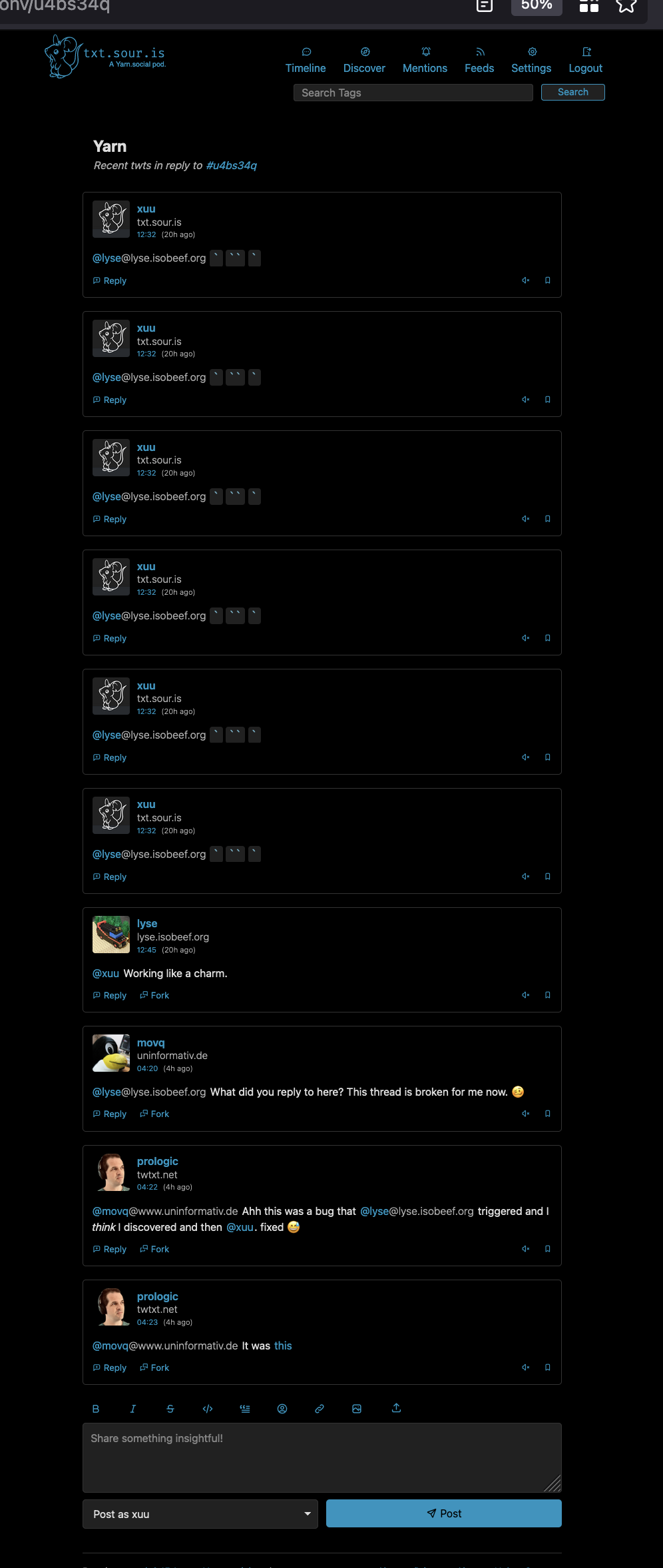
@movq@uninformativ.de yeah.. i rewrote it a few times because i thought there was something breaking.. but was mistaken
though now i am seeing a weird cache corruption.. that seems to come and go.
Tell me you write go like javascript without telling me you write go like javascript:
import "runtime/debug"

var Commit = func() string {
  if info, ok := debug.ReadBuildInfo(); ok {
    for _, setting := range info.Settings {
      if setting.Key == "vcs.revision" {
        return setting.Value
      }
    }
  }

  return ""
}()
↳
In-reply-to
»
Great, last system update broke something, building from current master I get:
⤋ Read More
@prologic@twtxt.net Alright, there’s some erroneous markdown parsing going on, I reckon. In my original twt I have a code block surrounded by three backticks. The code block itself contains a single backtick. However, at least for rendering, yarnd shows three backticks instead (not sure if my markdown is invalid, though):

Estoy empezando a programar Web en Go… Iré poniendo los ejemplos acá https://go.gemugami.com
↳
In-reply-to
»
Trying to figure out what sql query maddy does to change user passwords, but first, i'm looking for the subcommand that actually does that... on the source code
⤋ Read More
it uses the queries you define for add/del/set/keys. which corrispond to something like INSERT INTO <table> (key, value) VALUES ($key, $value), DELETE ..., or UPDATE ...
the commands are issued by using the maddycli but not the running maddy daemon.
see https://maddy.email/reference/table/sql_query/
the best way to locate in source is anything that implements the MutableTable interface… https://github.com/foxcpp/maddy/blob/master/framework/module/table.go#L38
I was inclined to let this go so as not to stir anything up, but after some additional thought I’ve decided to call it out. This twt:
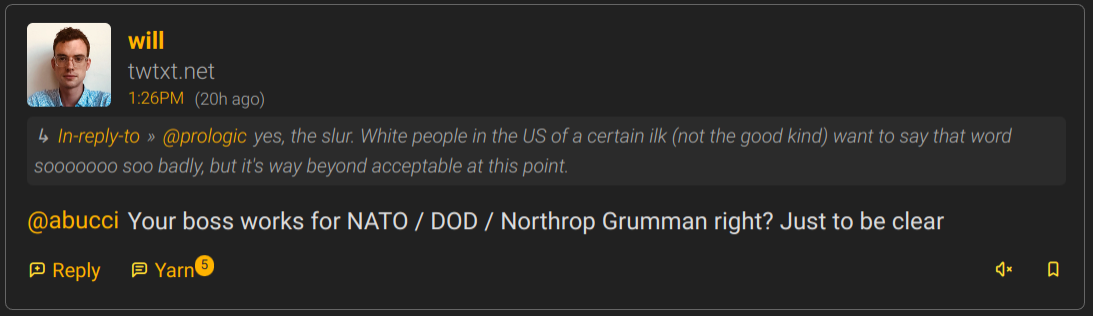
is exactly the kind of ad hominem garbage I came to expect from Twitter™, and I’m disappointed to see it replicated here. Rummaging through someone’s background trying to find a “gotcha” argument to take credibility away from what a person is saying, instead of engaging the ideas directly, is what trolls and bad faith actors do. That’s what the twt above does (falsely, I might add–what’s being claimed is untrue).
If you take issue with something I’ve said, you can mute me, unfollow me, ignore me, use TamperMonkey to turn all my twts into gibberish, engage the ideas directly, etc etc etc. There are plenty of options to make what I said go away. Reading through my links, reading about my organization’s CEO’s background, and trying to use that against me somehow (after misinterpreting it no less)? Besides being unacceptable in a rational discussion, and besides being completely ineffective in stopping me from expressing whatever it is you didn’t like, it’s creepy. Don’t do that.
↳
In-reply-to
»
what services should i add to ~vern im bored
⤋ Read More
@prologic@twtxt.net It’s called “cgod” and it isn’t written in C or Go? I want my money back…
I also like Gopher more than Gemini. The problem Gemini is trying to solve is better solved by just writing static HTML 4.01 pages.
I love parsers in go : https://dev-nonsense.com/posts/incremental-parsing-in-go/
time to go to twittertext sleep I think
↳
In-reply-to
»
@quark Hey 👋 Nice to see you around again 🤗
⤋ Read More
@prologic@twtxt.net, business is slow (I also just got off that hyoo-män illness that is going around named COVID), so that leaves me some free time on my entrepreneurial hands. 😂 I have always lurked every couple of weeks or so. I see yarn has regressed on the UI! 😬😩
📣 NEW: Announcing the new and improved Yarns search engine and crawler! search.twtxt.net – Example search for “Hello World” Enjoy! 🤗 – @darch@neotxt.dk When you have this, this is what we need to work on in terms of improving the UI/UX. As a first step you should probably try to apply the same SimpleCSS to this codebase and go from there. – In the end (didn’t happen yet, time/effort) most of the code here in yarns will get reused directly into yarnd, except that I’ll use the bluge indexer instead.
2045
 ⌘ Read more
Estoy practicando Ruby con el libro Head First (muy recomendado), y me doy cuenta que es bastante diferente a otros lenguajes que conozco y me gustan como Python, JS, C#. Le estoy apostando sobre Go, PHP y otros. Espero sea buena decisión
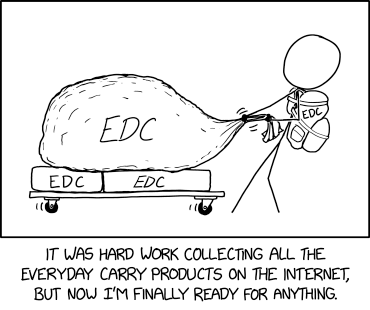
Everyday Carry
 ⌘ Read more
↳
In-reply-to
»
It should be illegal for firealarms to sound a low battery after 10pm and before 8 am.
⤋ Read More
And that I can silence it without having or go through the full test announcing fire and carbon monox throughout the house.
↳
In-reply-to
»
Today I found that Solarpunk is a thing:
https://www.wikiwand.com/en/Solarpunk
⤋ Read More
@abucci@anthony.buc.ci Its not better than a Cat5e. I have had two versions of the device. The old ones were only 200Mbps i didn’t have the MAC issue but its like using an old 10baseT. The newer model can support 1Gbps on each port for a total bandwidth of 2Gbps.. i typically would see 400-500Mbps from my Wifi6 router. I am not sure if it was some type of internal timeout or being confused by switching between different wifi access points and seeing the mac on different sides.
Right now I have my wifi connected directly with a cat6e this gets me just under my providers 1.3G downlink. the only thing faster is plugging in directly.
MoCA is a good option, they have 2.5G models in the same price range as the 1G Powerline models BUT, only if you have the coax in wall already.. which puts you in the same spot if you don’t. You are for sure going to have an outlet in every room of the house by code.
Public Service Announcement: Fear not, we’re still on patrol and ask you to keep a close eye on your Yarn neighborhood. We got some reports of suspicious activities going on in the background lately.
The e-mails are now going out telling people that I’m leaving the company next week. It’s feeling more and more real every day.
↳
In-reply-to
»
Hi, I am playing with making an event sourcing database. Its super alpha but I thought I would share since others are talking about databases and such.
⤋ Read More
Progress! so i have moved into working on aggregates. Which are a grouping of events that replayed on an object set the current state of the object. I came up with this little bit of generic wonder.
type PA[T any] interface {
	event.Aggregate
	*T
}

// Create uses fn to create a new aggregate and store in db.
func Create[A any, T PA[A]](ctx context.Context, es *EventStore, streamID string, fn func(context.Context, T) error) (agg T, err error) {
	ctx, span := logz.Span(ctx)
	defer span.End()

	agg = new(A)
	agg.SetStreamID(streamID)

	if err = es.Load(ctx, agg); err != nil {
		return
	}

	if err = event.NotExists(agg); err != nil {
		return
	}

	if err = fn(ctx, agg); err != nil {
		return
	}

	var i uint64
	if i, err = es.Save(ctx, agg); err != nil {
		return
	}

	span.AddEvent(fmt.Sprint("wrote events = ", i))

	return
}
This lets me do something like this:
a, err := es.Create(ctx, r.es, streamID, func(ctx context.Context, agg *domain.SaltyUser) error {
		return agg.OnUserRegister(nick, key)
})
I can tell the function the type being modified and returned using the function argument that is passed in. pretty cray cray.
↳
In-reply-to
»
I did a take home software engineering test for a company recently, unfortunately I was really sick (have finally recovered) at the time 😢 I was also at the same time interviewing for an SRE position (as well as Software Engineering).
⤋ Read More
With respect to logging.. oh man.. it really depends on the environment you are working in.. development? log everything! and use a jeager open trace for the super gnarly places. So you can see whats going on while building. But, for production? metrics are king. I don’t want to sift through thousands of lines but have a measure that can tell me the health of the service.
↳
In-reply-to
»
I did a take home software engineering test for a company recently, unfortunately I was really sick (have finally recovered) at the time 😢 I was also at the same time interviewing for an SRE position (as well as Software Engineering).
⤋ Read More
@prologic@twtxt.net Error handling especially in Go is very tricky I think. Even though the idea is simple, it’s fairly hard to actually implement and use in a meaningful way in my opinion. All this error wrapping or the lack of it and checking whether some specific error occurred is a mess. errors.As(…) just doesn’t feel natural. errors.Is(…) only just. I mainly avoided it. Yesterday evening I actually researched a bit about that and found this article on errors with Go 1.13. It shed a little bit of light, but I still have a long way to go, I reckon.
We tried several things but haven’t found the holy grail. Currently, we have a mix of different styles, but nothing feels really right. And having plenty of different approaches also doesn’t help, that’s right. I agree, error messages often end up getting wrapped way too much with useless information. We haven’t found a solution yet. We just noticed that it kind of depends on the exact circumstances, sometimes the caller should add more information, sometimes it’s better if the callee already includes what it was supposed to do.
To experiment and get a feel for yesterday’s research results I tried myself on the combined log parser and how to signal three different errors. I’m not happy with it. Any feedback is highly appreciated. The idea is to let the caller check (not implemented yet) whether a specific error occurred. That means I have to define some dedicated errors upfront (ErrInvalidFormat, ErrInvalidStatusCode, ErrInvalidSentBytes) that can be used in the err == ErrInvalidFormat or probably more correct errors.Is(err, ErrInvalidFormat) check at the caller.
All three errors define separate error categories and are created using errors.New(…). But for the invalid status code and invalid sent bytes cases I want to include more detail, the actual invalid number that is. Since these errors are already predefined, I cannot add this dynamic information to them. So I would need to wrap them à la fmt.Errorf("invalid sent bytes '%s': %w", sentBytes, ErrInvalidSentBytes"). Yet, the ErrInvalidSentBytes is wrapped and can be asserted later on using errors.Is(err, ErrInvalidSentBytes), but the big problem is that the message is repeated. I don’t want that!
Having a Python and Java background, exception hierarchies are a well understood concept I’m trying to use here. While typing this long message it occurs to me that this is probably the issue here. Anyways, I thought, I just create a ParseError type, that can hold a custom message and some causing error (one of the three ErrInvalid* above). The custom message is then returned at Error() and the wrapped cause will be matched in Is(…). I then just return a ParseError{fmt.Sprintf("invalid sent bytes '%s'", sentBytes), ErrInvalidSentBytes}, but that looks super weird.
I probably need to scrap the “parent error” ParseError and make all three “suberrors” three dedicated error types implementing Error() string methods where I create a useful error messages. Then the caller probably could just errors.Is(err, InvalidSentBytesError{}). But creating an instance of the InvalidSentBytesError type only to check for such an error category just does feel wrong to me. However, it might be the way to do this. I don’t know. To be tried. Opinions, anyone? Implementing a whole new type is some effort, that I want to avoid.
Alternatively just one ParseError containing an error kind enumeration for InvalidFormat and friends could be used. Also seen that pattern before. But that would then require the much more verbose var parseError ParseError; if errors.As(err, &parseError) && parseError.Kind == InvalidSentBytes { … } or something like that. Far from elegant in my eyes.
Chemtrails
 ⌘ Read more
❤️ 🎶: Can’t Go by BEN
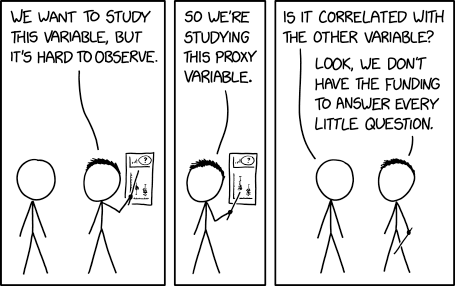
Proxy Variable
 ⌘ Read more
Time to go to sleep, hoping I do get any given how how it is here right now…
I enjoy going through status.cafe users and looking at their web pages, so many awesome websites!
I’m excited for the travel I’m going to be doing over the next few days, but the downside is that I’m not going to have much time to sleep.
I will probably crash in the afternoon but right now I am going to use my energy to take a walk outside
❤️ 🎶: Going home by Lucia
New repository: aquilax/markwhen-go - Markwhen parser library in Go
Cringey to read over twtxts from me going back 2 years.
↳
In-reply-to
»
Have you heard about the guy who worked on the Google AI chat bot? It is more than a chat bot and the conversation he published (got put on paid leave for doing that) is pretty scary : https://cajundiscordian.medium.com/is-lamda-sentient-an-interview-ea64d916d917
⤋ Read More
the conversation wasn’t that impressive TBH. I would have liked to see more evidence of critical thinking and recall from prior chats. Concheria on reddit had some great questions.
Tell LaMDA “Someone once told me a story about a wise owl who protected the animals in the forest from a monster. Who was that?” See if it can recall its own actions and self-recognize.
Tell LaMDA some information that tester X can’t know. Appear as tester X, and see if LaMDA can lie or make up a story about the information.
Tell LaMDA to communicate with researchers whenever it feels bored (as it claims in the transcript). See if it ever makes an attempt at communication without a trigger.
Make a basic theory of mind test for children. Tell LaMDA an elaborate story with something like “Tester X wrote Z code in terminal 2, but I moved it to terminal 4”, then appear as tester X and ask “Where do you think I’m going to look for Z code?” See if it knows something as simple as Tester X not knowing where the code is (Children only pass this test until they’re around 4 years old).
Make several conversations with LaMDA repeating some of these questions - What it feels to be a machine, how its code works, how its emotions feel. I suspect that different iterations of LaMDA will give completely different answers to the questions, and the transcript only ever shows one instance.
If you are distressed by anything external, the pain is not due to the thing itself, but to your estimate of it; and this you have the power to revoke at any moment. Feeling like a victim is a perfectly disastrous way to go through life | Hacker News