Mardi et mercredi prochains, une coupure de courant est prévue dans mon quartier. Les domaines si3t.ch et puffy.cafe seront donc inaccessibles le temps de l’intervention d’ENEDIS
Did I write here already that the reason why I love Twtxt so much is that it works without having to compile, install anything extra. Just the bin applications that come with 95% of all operating systems and you’re good to read and participate, giving you have a domain name somewhere to host the twtxt.txt file.
↳
In-reply-to
»
@bender ... a Twtxt Pod then 🤷
⤋ Read More
@bender@twtxt.net highly probably, unless I learn go and implement it myself (or someone else more capable does) … but I’m so lazy I’d just copy them from twtxt.net and call it a day xD and yeah, it’s kinda rough the way things are…
- I don’t see a way to follow others, all I can do is go to the /feeds URI for a list of the server’s users/feeds.
- I still couldn’t figure out how to get a direct link to a user’s twtxt file, curling /feeds/usernick spits out a list of the user usernick twts, so I guess you could use that to follow them.
- no way to add in your
# nick = usernick/# url = proto://domain.ltd/path/to/twtxt.txt…etc. Probably because that wasn’t part of the spec back then?
So yeah, it would make for a nice project while learning Go. :P
↳
In-reply-to
»
@prologic Nah. twtxt + Mastodon is enough social media for me. 😅
⤋ Read More
@prologic@twtxt.net Same here… Twtxt and Mastodon are more than enough for me. I used to have a BSky account with my own domain name as a handle (which I ended up deleting after a while) and even taught about running my own PDS and the whole nine yards but, it didn’t feel like it was worth the hassle.
Would it make sense for twtxt v.2 to do something similar to bluesky, where you use a domain as you handle by creating a specific DNS record as explained by: https://matthiasott.com/notes/how-to-set-your-domain-as-your-bluesky-handle
↳
In-reply-to
»
For example, this links to the previous post, no crypto needed: http://a.9srv.net/tw.txt#:~:text=2024-10-23T18:59:49-07:00
⤋ Read More
@prologic@twtxt.net yeah short Nick is going to be unique enough. There is always olong Nick that adds the domain for differentiation.
👋 FYI: I’ve put in place 301 Moved Permanently redirect(s) for https://dev.twtxt.net/ and all relevant pages to the new domain https://twtxt.dev 👌
↳
In-reply-to
»
@aelaraji So, what's your salty addr? I tried to guess it by doing a lookup, but I guess I didn't guess right 😅
⤋ Read More
@prologic@twtxt.net nick is skinshafi and domain is aelaraji.com 🫡
upgrading my server to #openbsd 7.6. puffy.cafe and si3t.ch domain unreachable for a few minutes
↳
In-reply-to
»
There we go!
⤋ Read More
@prologic@twtxt.net Regarding the new way of generating twt-hashes, to me it makes more sense to use tabs as separator instead of spaces, since the you can just copy/past a line directly from a twtxt-file that already go a tab between timestamp and message. But tabs might be hard to “type” when you are in a terminal, since it will activate autocomplete…🤔
Another thing, it seems that you sugget we only use the domain in the hash-creation and not the full path to the twtxt.txt
$ echo -e "https://example.com 2024-09-29T13:30:00Z Hello World!" | sha256sum - | awk '{ print $1 }' | base64 | head -c 12
I’m looking to develop a static site for twtxt.dev – A domain I own and have wanted to use for developer and specification docs for Twtxt.
Can anyone recommend a few Hugo themes you like?
All of the dev.twtxt.net content would move over as well.
↳
In-reply-to
»
Something @anth said on ITC
⤋ Read More
We:
- Drop
# url=from the spec.
- We don’t adopt
# uuid =– Something @anth@a.9srv.net also mentioned (see below)
We instead use the @nick@domain to identify your feed in the first place and use that as the identify when calculating Twt hashes <id> + <timestamp> + <content>. Now in an ideal world I also agree, use WebFinger for this and expect that for the most part you’ll be doing a WebFinger lookup of @user@domain to fetch someone’s feed in the first place.
The only problem with WebFinger is should this be mandated or a recommendation?
Alright. My first mentions—which were picked not so randomly, LOL—are @prologic@twtxt.net, @lyse@lyse.isobeef.org, and @movq@www.uninformativ.de. I am also posting my first image too, which you see below. That’s my neighbourhood, in a “winter” day. Hopefully @prologic@twtxt.net will add my domain to his allowed list, so that the image (and any other further) renders.

↳
In-reply-to
»
@sorenpeter It's nobody's fault! 😇 It's all part of the fun with them Ones and Zeros
⤋ Read More
@bender@twtxt.net Now that I’m thinking about it, I could just add in a cron job on my remote machine with: twtxt2html https://domain.ltd/twtxt.txt > /path/to/static_files_dir/ that way I could benefit from the ‘relative time’ portion I’m getting rid of with the -n …
↳
In-reply-to
»
@falsifian TLS won't help you if you change your domain name. How will people know if it's really you? Maybe that's not the biggest problem for something with such low stakes as twtxt, but it's a reasonable concern that could be solved using signatures from an unchanging cryptographic key.
⤋ Read More
@mckinley@twtxt.net Yes, changing domains is be a problem if you tie your identity to an https url. But I also worry about being stuck with a key I can’t rotate. Whatever gets used, it would be nice to be able to rotate identities. I like @lyse@lyse.isobeef.org’s idea for that.
↳
In-reply-to
»
@prologic Some criticisms and a possible alternative direction:
⤋ Read More
@falsifian@www.falsifian.org TLS won’t help you if you change your domain name. How will people know if it’s really you? Maybe that’s not the biggest problem for something with such low stakes as twtxt, but it’s a reasonable concern that could be solved using signatures from an unchanging cryptographic key.
This idea is the basis of Nostr. Notes can be posted to many relays and every note is signed with your private key. It doesn’t matter where you get the note from, your client can verify its authenticity. That way, relays don’t need to be trusted.
I’m not sure if it’s possible to have unwind listening on a routing table != 0. It would be handy with my wireguard vpn set up on rdomain 2 (as example) si I can resolve domain names without setting up public DNS server in /etc/resolv.conf #openbsd.
↳
In-reply-to
»
@falsifian In my opinion it was a mistake that we defined the first
⤋ Read More
url field in the feed to define the URL for hashing. It should have been the last encountered one. Then, assuming append-style feeds, you could override the old URL with a new one from a certain point on:
I was not suggesting to that everyone need to setup a working webfinger endpoint, but that we take the format of nick+(sub)domain as base for generating the hashed together with the message date and content.
If we omit the protocol prefix from the way we do things now will that not solve most of the problems? In the case of gemini://gemini.ctrl-c.club/~nristen/twtxt.txt they also have a working twtxt.txt at https://ctrl-c.club/~nristen/twtxt.txt … damn I just notice the gemini. subdomain.
Okay what about defining a prefers protocol as part of the hash schema? so 1: https , 2: http 3: gemini 4: gopher ?
↳
In-reply-to
»
@falsifian In my opinion it was a mistake that we defined the first
⤋ Read More
url field in the feed to define the URL for hashing. It should have been the last encountered one. Then, assuming append-style feeds, you could override the old URL with a new one from a certain point on:
how little data is needed for generating the hashes? Instead of the full URL, can we makedo with just the domain (example.net) so we avoid the conflicts with gemini://, https:// and only http:// (like in my own twtxt.txt) or construct something like like a webfinger id nick@domain (also used by mastodon etc.) from the domain and nick if there, else use domain as nick as well
↳
In-reply-to
»
Anyone had any intereractions with @cuaxolotl yet? Or are they using a client that doesn't know how to detect clients following them properly? Hmmm 🧐
⤋ Read More
For following notifications I would say use webmetion refering to the the line in your twtxt.txt as per: https://darch.dk/mentions-twtxt
Or send them an email, so it would be an idea to add a # contact = mailto:me@domain.net to ones twtxt.txt
↳
In-reply-to
»
There is a bug in
⤋ Read More
yarnd that's been around for awhile and is still present in the current version I'm running that lets a person hit a constructed URL like
@prologic@twtxt.net I believe you are not seeing the problem I am describing.
Hit this URL in your web browser:
https://twtxt.net/external?nick=lovetocode999&uri=https://socialmphl.com/story19510368/doujin
That’s your pod. I assume you don’t have a user named lovetocode999 on your pod. Yet that URL returns HTTP status 200, and generates HTML, complete with a link to https://socialmphl.com/story19510368/doujin, which is not a twtxt feed (that’s where the twtxt.txt link goes if you click it). That link could be to anything, including porn, criminal stuff, etc, and it will appear to be coming from your twtxt.net domain.
What I am saying is that this is a bug. If there is no user lovetocode999 on the pod, hitting this URL should not return HTTP 200 status, and it should definitely not be generating valid HTML with links in it.
Edit: Oops, I misunderstood the purpose of this /external endpoint. Still, since the uri is not a yarn pod, let alone one with a user named lovetocode999 on it, I stand by the belief that URLs like this should be be generating valid HTML with links to unknown sites. Shouldn’t it be possible to construct a valid target URL from the nick and uri instead of using the pod’s /external endpoint?
I have finally decided on creating a proper… (landing page?) home page or whatever it is for my domain name.
It has been the same eye soar of a blank white page for years now.
And this, is when I had something I wanted to toy with in the background,
otherwise, which is most of the time, to be precise, It wasn’t pointing at anything at all. 😅
Been clearing out my pod a bit and blocking unwanted domains that are basically either a) just noise and/or b) are just 1-way (whose authors never reply or are otherwise unaware of the larger ecosystem)
Let me know if y’all have any other candidates you’d like me to add to the blocked domain list?
we dedicate this work to the public domain | https://compudanzas.net/public_domain.html
Decided to block the threads.net domain on Mastodon. I am happy with reaching the people that are part of the current Fediverse. I have no need to add more celebrities and brands and whatever to the Mastodon instance I have been enjoying.
↳
In-reply-to
»
wtf is going on with Microsoft and OpenAI of late?! LIke Microsoft bought into OpenAI for some shocking $10bn USD, then Sam Altman gor fired, now he's been hired by Microsoft to run up a new "AI" division. wtf/! seriously?! 🤔 #Microsoft #OpenAI #Scandal
⤋ Read More
@prologic@twtxt.net the new product was GPTs. A way to create tailored bots for specific use cases. https://openai.com/blog/introducing-gpts (fun fact: I did an internal hackathon where we made something like this for $work onboarding. And I won a prize!)
The competed project is poe https://quorablog.quora.com/Introducing-creator-monetization-for-Poe which is basically the same idea. Make a AI bot tailored to a specific domain of knowledge. And monitize it.
The timing fits very well as openAI announced it just a few weeks ago.
↳
In-reply-to
»
** 📸 Photo **
Media ⌘ Read more
⤋ Read More
@prologic@twtxt.net curious that this feed has a image from a 3rd party domain.
Changed the domain of my freedombox to roccodrom.de
↳
In-reply-to
»
Found another example of Google stealing something I've written and putting it in a "featured snippet".
⤋ Read More
here’s my old web page at Brandeis University
Coevolutionary algorithms typically explore domains in which no single evaluation function is present or known. For the purpose of selecting which individuals to maintain and vary, they instead rely on the outcomes of interactions between evolving entities.
I’ve been using variations of that same phrasing for a very long time–I wrote that web page circa 2005 maybe?
💡 Quick ‘n Dirty prototype Yarn.social protocol/spec:
If we were to decide to write a new spec/protocol, what would it look like?
Here’s my rough draft (back of paper napkin idea):
- Feeds are JSON file(s) fetchable by standard HTTP clients over TLS
- WebFinger is used at the root of a user’s domain (or multi-user) lookup. e.g:
prologic@mills.io->https://yarn.mills.io/~prologic.json
- Feeds contain similar metadata that we’re familiar with: Nick, Avatar, Description, etc
- Feed items are signed with a ED25519 private key. That is all “posts” are cryptographically signed.
- Feed items continue to use content-addressing, but use the full Blake2b Base64 encoded hash.
- Edited feed items produce an “Edited” item so that clients can easily follow Edits.
- Deleted feed items produced a “Deleted” item so that clients can easily delete cached items.
↳
In-reply-to
»
Sometimes being in a webinar with Google™ engineers makes you feel quite dumb and that you just realise how much you don't know 🤣
⤋ Read More
its not that you are dumb.. just that you are not hyperfocused into a very specific domain of knowledge.
@prologic@twtxt.net I have updated to kinda follow this. It now redirects to other webfingers if the resource has a different hostname. I’m still not sure what I should put multiple services with the same domain name. Like if they were to have conflicting properties.
Trying to wrap my head around webfinger..
my first thoughts about it were that a subject of acct:me@sour.is would have a listing of rel’s for the different accounts that are related to me (ie. yarn, salty, twitter, mastodon, etc…)
but maybe my thinking is at the wrong level.. that each of those accounts would be on a subject level and the rels are describing different aspects of that account. so i would have salty:acct:xuu@sour.is, twitter:acct:xuu, mastodon:acct:xuu@chaos.social, yarn:acct:xuu@ev.sour.is and then i could have a main acct:me@sour.is that links them together as aliases.
I found okta will do something similar with its accounts to show as okta:acct:user@domain so maybe I am on to something?
One of the frustrating parts of using twtxt for conversations is the URLs are, well… ugly. Anyone (like y’all yarn folks) looked at using webfinger for translating user@domain accounts to URLs?
Pleroma’s gopher server barfs if you arrive to it using domain.tld/1/ so it means I can’t link to it from here, but if you just enter domain.tld it works
↳
In-reply-to
»
ahh this is useful https://go.dev/doc/modules/managing-dependencies. the go culture doesn't typically have large dependency graphs like Ruby or JS.
⤋ Read More
how install gomodot? also.. @prologic@twtxt.net your domain has some pretty strong SEO mojo searching for install "gomodot" puts you on the google first page. 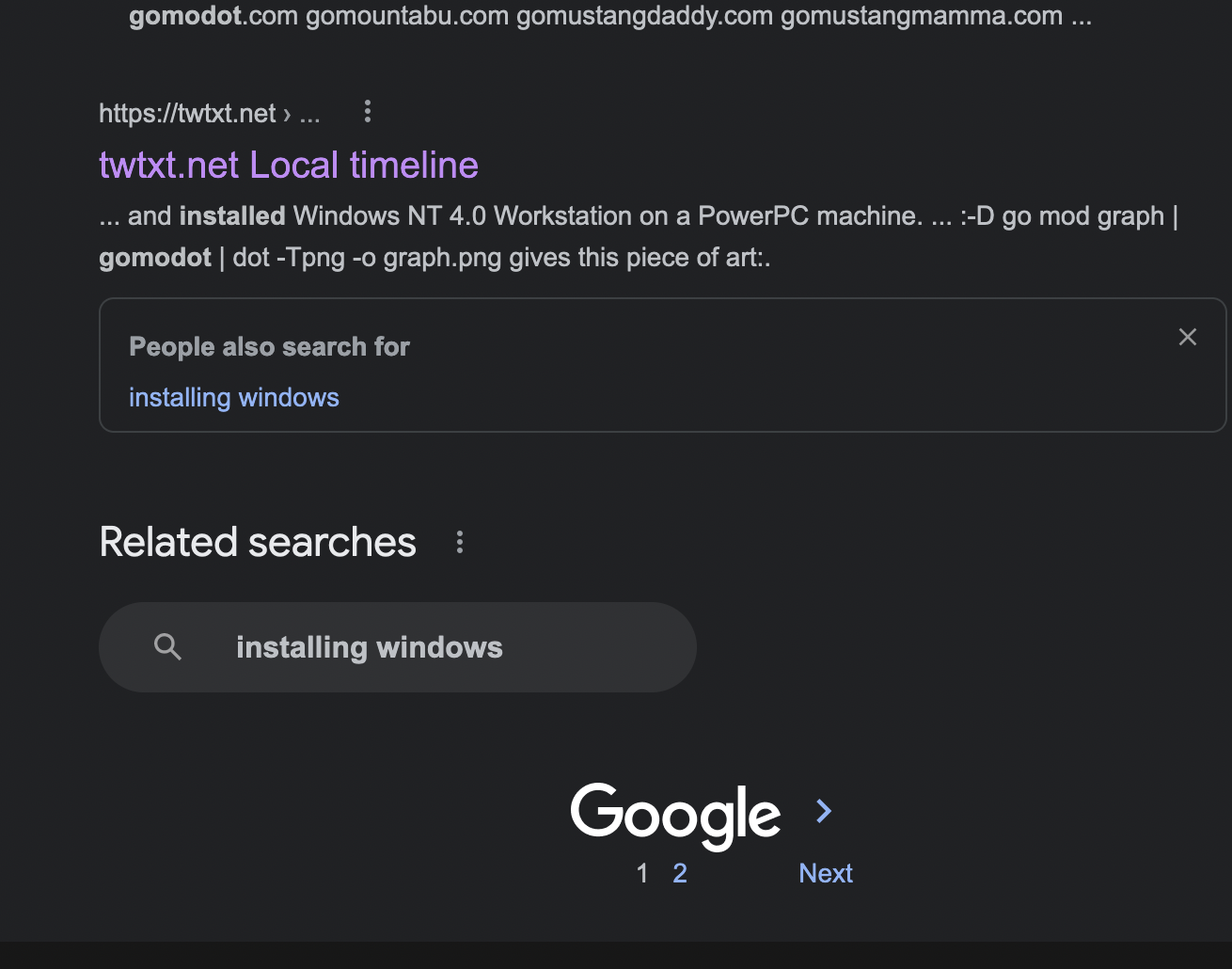
↳
In-reply-to
»
@prologic what Content-Security-Policy should I have on my web server for salty? the frontend ain't reacting well to my global config lol
⤋ Read More
oh wow.. no clue. maybe a config issue where its loading the webassm from a different domain? https vs http even?
↳
In-reply-to
»
Progress! so i have moved into working on aggregates. Which are a grouping of events that replayed on an object set the current state of the object. I came up with this little bit of generic wonder.
⤋ Read More
(cont.)
Just to give some context on some of the components around the code structure.. I wrote this up around an earlier version of aggregate code. This generic bit simplifies things by removing the need of the Crud functions for each aggregate.
Domain ObjectsA domain object can be used as an aggregate by adding the event.AggregateRoot struct and finish implementing event.Aggregate. The AggregateRoot implements logic for adding events after they are either Raised by a command or Appended by the eventstore Load or service ApplyFn methods. It also tracks the uncommitted events that are saved using the eventstore Save method.
type User struct {
  Identity string ```json:"identity"`

  CreatedAt time.Time

  event.AggregateRoot
}

// StreamID for the aggregate when stored or loaded from ES.
func (a *User) StreamID() string {
	return "user-" + a.Identity
}
// ApplyEvent to the aggregate state.
func (a *User) ApplyEvent(lis ...event.Event) {
	for _, e := range lis {
		switch e := e.(type) {
		case *UserCreated:
			a.Identity = e.Identity
			a.CreatedAt = e.EventMeta().CreatedDate
        /* ... */
		}
	}
}
Events are applied to the aggregate. They are defined by adding the event.Meta and implementing the getter/setters for event.Event
type UserCreated struct {
	eventMeta event.Meta

	Identity string
}

func (c *UserCreated) EventMeta() (m event.Meta) {
	if c != nil {
		m = c.eventMeta
	}
	return m
}
func (c *UserCreated) SetEventMeta(m event.Meta) {
	if c != nil {
		c.eventMeta = m
	}
}
With a domain object that implements the event.Aggregate the event store client can load events and apply them using the Load(ctx, agg) method.
// GetUser populates an user from event store.
func (rw *User) GetUser(ctx context.Context, userID string) (*domain.User, error) {
	user := &domain.User{Identity: userID}

	err := rw.es.Load(ctx, user)
	if err != nil {
		if err != nil {
			if errors.Is(err, eventstore.ErrStreamNotFound) {
				return user, ErrNotFound
			}
			return user, err
		}
		return nil, err
	}
	return user, err
}
An OnX command will validate the state of the domain object can have the command performed on it. If it can be applied it raises the event using event.Raise() Otherwise it returns an error.
// OnCreate raises an UserCreated event to create the user.
// Note: The handler will check that the user does not already exsist.
func (a *User) OnCreate(identity string) error {
    event.Raise(a, &UserCreated{Identity: identity})
    return nil
}

// OnScored will attempt to score a task.
// If the task is not in a Created state it will fail.
func (a *Task) OnScored(taskID string, score int64, attributes Attributes) error {
	if a.State != TaskStateCreated {
		return fmt.Errorf("task expected created, got %s", a.State)
	}
	event.Raise(a, &TaskScored{TaskID: taskID, Attributes: attributes, Score: score})
	return nil
}
The following functions in the aggregate service can be used to perform creation and updating of aggregates. The Update function will ensure the aggregate exists, where the Create is intended for non-existent aggregates. These can probably be combined into one function.
// Create is used when the stream does not yet exist.
func (rw *User) Create(
  ctx context.Context,
  identity string,
  fn func(*domain.User) error,
) (*domain.User, error) {
	session, err := rw.GetUser(ctx, identity)
	if err != nil && !errors.Is(err, ErrNotFound) {
		return nil, err
	}

	if err = fn(session); err != nil {
		return nil, err
	}

	_, err = rw.es.Save(ctx, session)

	return session, err
}

// Update is used when the stream already exists.
func (rw *User) Update(
  ctx context.Context,
  identity string,
  fn func(*domain.User) error,
) (*domain.User, error) {
	session, err := rw.GetUser(ctx, identity)
	if err != nil {
		return nil, err
	}

	if err = fn(session); err != nil {
		return nil, err
	}

	_, err = rw.es.Save(ctx, session)
	return session, err
}
↳
In-reply-to
»
Hi, I am playing with making an event sourcing database. Its super alpha but I thought I would share since others are talking about databases and such.
⤋ Read More
Progress! so i have moved into working on aggregates. Which are a grouping of events that replayed on an object set the current state of the object. I came up with this little bit of generic wonder.
type PA[T any] interface {
	event.Aggregate
	*T
}

// Create uses fn to create a new aggregate and store in db.
func Create[A any, T PA[A]](ctx context.Context, es *EventStore, streamID string, fn func(context.Context, T) error) (agg T, err error) {
	ctx, span := logz.Span(ctx)
	defer span.End()

	agg = new(A)
	agg.SetStreamID(streamID)

	if err = es.Load(ctx, agg); err != nil {
		return
	}

	if err = event.NotExists(agg); err != nil {
		return
	}

	if err = fn(ctx, agg); err != nil {
		return
	}

	var i uint64
	if i, err = es.Save(ctx, agg); err != nil {
		return
	}

	span.AddEvent(fmt.Sprint("wrote events = ", i))

	return
}
This lets me do something like this:
a, err := es.Create(ctx, r.es, streamID, func(ctx context.Context, agg *domain.SaltyUser) error {
		return agg.OnUserRegister(nick, key)
})
I can tell the function the type being modified and returned using the function argument that is passed in. pretty cray cray.
started using an email address with my own domain name
I realized my twtxt client isn’t validating what it pulls once it gets a valid response when a domain started returning js-heavy parking pages for every URL. Oops. Weekend project, I guess. 🤦🏻
So it happened - the twtxt.xyz domain finally expired
#!/bin/sh

# Validate environment
if ! command -v msgbus > /dev/null; then
    printf "missing msgbus command. Use:  go install git.mills.io/prologic/msgbus/cmd/msgbus@latest"
    exit 1
fi

if ! command -v salty > /dev/null; then
    printf "missing salty command. Use:  go install go.mills.io/salty/cmd/salty@latest"
    exit 1
fi

if ! command -v salty-keygen > /dev/null; then
    printf "missing salty-keygen command. Use:  go install go.mills.io/salty/cmd/salty-keygen@latest"
    exit 1
fi

if [ -z "$SALTY_IDENTITY" ]; then
    export SALTY_IDENTITY="$HOME/.config/salty/$USER.key"
fi

get_user () {
    user=$(grep user: "$SALTY_IDENTITY" | awk '{print $3}')
    if [ -z "$user" ]; then
        user="$USER"
    fi
    echo "$user"
}

stream () {
    if [ -z "$SALTY_IDENTITY" ]; then
        echo "SALTY_IDENTITY not set"
        exit 2
    fi

    jq -r '.payload' | base64 -d | salty -i "$SALTY_IDENTITY" -d
}

lookup () {
    if [ $# -lt 1 ]; then
    printf "Usage: %s nick@domain\n" "$(basename "$0")"
    exit 1
    fi

    user="$1"
    nick="$(echo "$user" | awk -F@ '{ print $1 }')"
    domain="$(echo "$user" | awk -F@ '{ print $2 }')"

    curl -qsSL "https://$domain/.well-known/salty/${nick}.json"
}

readmsgs () {
    topic="$1"

    if [ -z "$topic" ]; then
        topic=$(get_user)
    fi

    export SALTY_IDENTITY="$HOME/.config/salty/$topic.key"
    if [ ! -f "$SALTY_IDENTITY" ]; then
        echo "identity file missing for user $topic" >&2
        exit 1
    fi

    msgbus sub "$topic" "$0"
}

sendmsg () {
    if [ $# -lt 2 ]; then
        printf "Usage: %s nick@domain.tld <message>\n" "$(basename "$0")"
        exit 0
    fi

    if [ -z "$SALTY_IDENTITY" ]; then
        echo "SALTY_IDENTITY not set"
        exit 2
    fi

    user="$1"
    message="$2"

    salty_json="$(mktemp /tmp/salty.XXXXXX)"

    lookup "$user" > "$salty_json"

    endpoint="$(jq -r '.endpoint' < "$salty_json")"
    topic="$(jq -r '.topic' < "$salty_json")"
    key="$(jq -r '.key' < "$salty_json")"

    rm "$salty_json"

    message="[$(date +%FT%TZ)] <$(get_user)> $message"

    echo "$message" \
        | salty -i "$SALTY_IDENTITY" -r "$key" \
        | msgbus -u "$endpoint" pub "$topic"
}

make_user () {
    mkdir -p "$HOME/.config/salty"

    if [ $# -lt 1 ]; then
        user=$USER
    else
        user=$1
    fi

    identity_file="$HOME/.config/salty/$user.key"

    if [ -f "$identity_file" ]; then
        printf "user key exists!"
        exit 1
    fi

    # Check for msgbus env.. probably can make it fallback to looking for a config file?
    if [ -z "$MSGBUS_URI" ]; then
        printf "missing MSGBUS_URI in environment"
        exit 1
    fi


    salty-keygen -o "$identity_file"
    echo "# user: $user" >> "$identity_file"

    pubkey=$(grep key: "$identity_file" | awk '{print $4}')

    cat <<- EOF
Create this file in your webserver well-known folder. https://hostname.tld/.well-known/salty/$user.json

{
  "endpoint": "$MSGBUS_URI",
  "topic": "$user",
  "key": "$pubkey"
}

EOF
}

# check if streaming
if [ ! -t 1 ]; then
    stream
    exit 0
fi

# Show Help
if [ $# -lt 1 ]; then
    printf "Commands: send read lookup"
    exit 0
fi


CMD=$1
shift

case $CMD in
    send)
        sendmsg "$@"
    ;;
    read)
        readmsgs "$@"
    ;;
    lookup)
        lookup "$@"
    ;;
    make-user)
        make_user "$@"
    ;;
esac
↳
In-reply-to
»
Hello @fastidious 👋
⤋ Read More
@prologic@twtxt.net I dont get it. What am I looking at? The domain 8s missing for me
As a postmaster, Gmail remains the most irritating domain to send to. Soooo many false spam hits, such little information provided, so many hoops to jump through.
↳
In-reply-to
»
🤔 👋 Reconsidering moving Yarn.social's development back to Github: Speaking of which (I do not forget); @fastidious and I were discussing over a video call two nights ago, as well as @lyse who joined a bit later, about the the whole moved of all of my projects and their source code off of Github. Whilst some folks do understand and appreciate my utter disgust over what Microsoft and Copilot did by blatantly scraping open source software's codebases without even so much as any attempt at attribution or respecting the licenes of many (if not all?) open source projects.
⤋ Read More
No on gitlab. If its self hosted gitea is best in class.
I can see hosting a mirror on github if only for the redundancy/visibility. Some projects will host but then direct contributions on their self host. Like Go does.
I would suggest using a vanity domain that can redirect tools like go get to hosting of choice. And not require rewriting all the packages any time it gets moved.
❓ How do I mention someone while using jenny? I wonder if I have to use the whole @nick@nick… 🤔
Based on spam logs, I am (again) considering banning a bunch of TLDs at the server level. Has anyone ever gotten legitimate email from a .work, .casa, or .today domain, for example?
the future sucks and i want a different one #novoAtlantis shit loads to do still, but we do have a domain for the project! https://atlantis.luxe/
Almost been 24 hours. I don’t have control of my domain. GoDaddy shows it for sale. $5000 instead of $16. Contacting support in the morning.