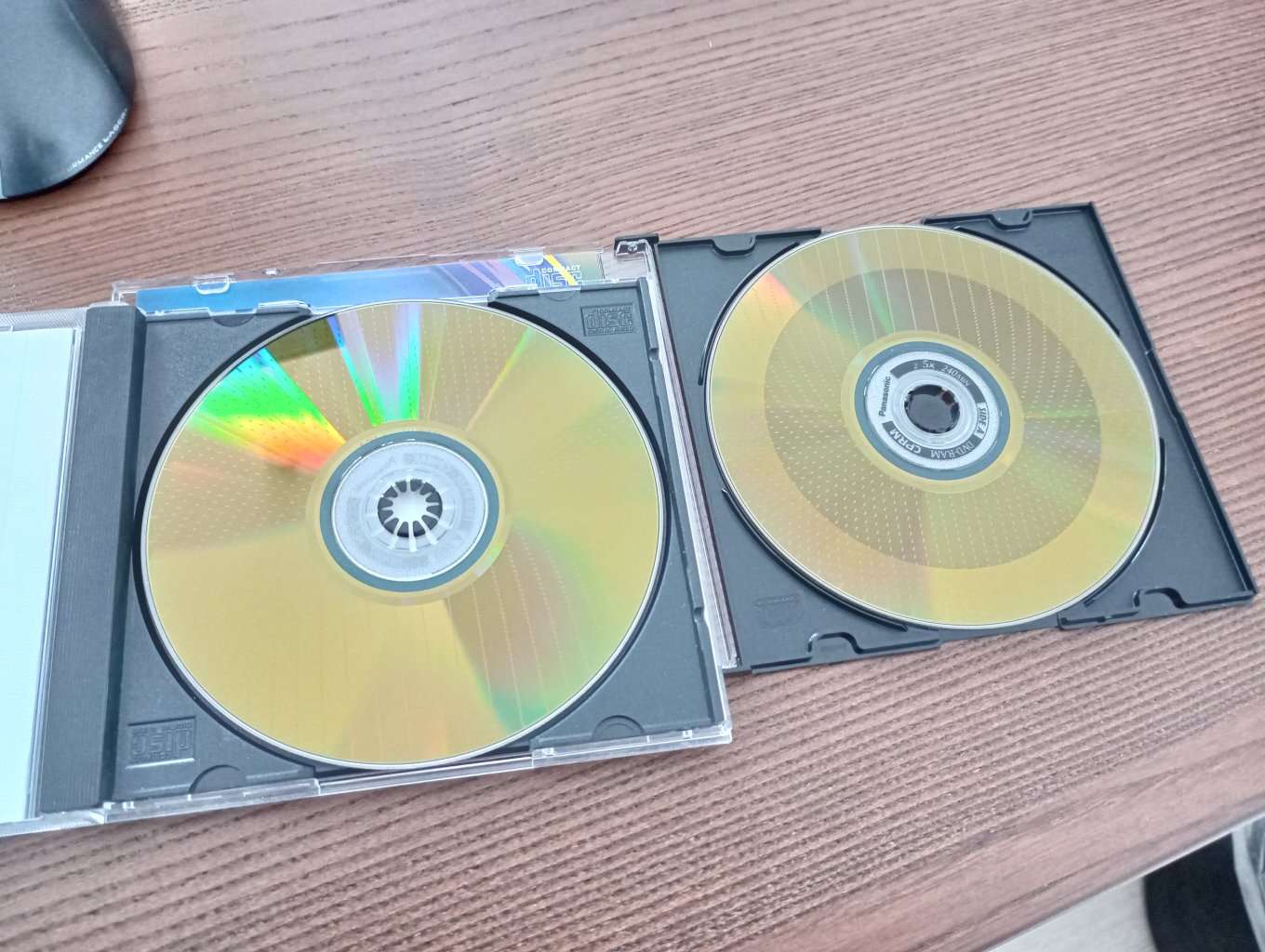
More basement:
I completely forgot that DVD-RAM was a thing once. Found my old disks and they still work. 🤯 The data on them is from 2008, so they’re not that old. Still impressive.
The disks are two-sided. On the photo, that particular side of the disk on the left appears to be completely unused. 🤔
And then I read on Wikipedia that DVD-RAMs aren’t produced anymore at all today. Huh.
(I refuse to tag this as “retrocomputing”. Read/write DVDs that you can use just like a harddisk, thanks to UDF, are still “new and fancy” in my book. 😂)
↳
In-reply-to
»
I’m this close to making an Android app for managing a shopping list.
⤋ Read More
@movq@www.uninformativ.de For syncing notes between computers and phones I’ve been very happy with Simple Text - w Dropbox sync for some year, but transitioned to Joplin around new year. Both sync via Dropbox and for Joplin there are also more free options. I guess you could even use something like Syncthing
No way, I can’t believe my friend said the trolls movie was better than shrek and no one here seems to care at all. When I let him use my Macbook to say that I was expecting people to get real mad
I’m this close to making an Android app for managing a shopping list.
I just accidentally deleted the wrong list in the app that I’m currently using, and now there’s no way to get it back. Recreating it is a major pain, because typing on a phone sucks ass. Fuck.
Maybe I should just go back to using pen and paper …
↳
In-reply-to
»
QOTD: What do you host on your home server? How do you host it? Are you using containers? VMs? Did you install any management interface or do you just SSH in? What OS does it run?
⤋ Read More
@mckinley@twtxt.net for me:
- a wall mount 6U rack which has:
- 1U patch panel
- 1U switch
- 2U UPS
- 1U server, intel atom 4G ram, debian (used to be main. now just has prometheus)
- 1U patch panel
- a mini ryzon 16 core 64G ram, fedora (new main)
- multiple docker services hosted.
- multiple docker services hosted.
- synology nas with 4 2TB drives
- turris omnia WRT router -> fiber uplink
network is a mix of wireguard, zerotier.
- wireguard to my external vms hosted in various global regions.
- this allows me ingress since my ISP has me behind CG-NAT
- this allows me ingress since my ISP has me behind CG-NAT
- zerotier is more for devices for transparent vpn into my network
i use ssh and remote desktop to get in and about. typically via zerotier vpn. I have one of my VMs with ssh on a backup port for break glass to get back into the network if needed.
everything has ipv6 though my ISP does not provide it. I have to tunnel it in from my VMs.
QOTD: What do you host on your home server? How do you host it? Are you using containers? VMs? Did you install any management interface or do you just SSH in? What OS does it run?
Mine runs Arch (btw) and hosts a handful of things using Docker. Adguard Home, http://mckinley2nxomherwpsff5w37zrl6fqetvlfayk2qjnenifxmw5i4wyd.onion/, and some other things. NFS, Flexo, and Wireguard (peer and bounce server in my personal network) are outside Docker. I have a hotkey in my window manager that spawns a terminal on my server using SSH. It makes things very easy and I highly recommend it.
I am thinking about replacing Docker with Podman because the Common Wisdom seems to say it’s better. I don’t really know if it is or isn’t.
Also, how much of your personal infrastructure is on IPv6? I think all the software I use supports both, but I’ve mostly been using IPv4 because it’s easier to remember the addresses. I’ve been working for the last couple days on making it IPv6-only.
↳
In-reply-to
»
Did another write up on #webfinger and DIDs for twtxt/yarn that you can read and edit/comment in: User lookup for twtxt/yarn - Webfinger or Decentralized Identifiers (DIDs) - HedgeDoc
⤋ Read More
Just hacked together this small webfinger endpoint to be used as a companion with timeline: .well-known/webfinger/index.php at main · sorenpeter/timeline
↳
In-reply-to
»
wat da fuq does being "woke" even mean?! 🤦♂️
⤋ Read More
@bender@twtxt.net It is the new “politically correct”. Something that was used to describe acting in a more civilized way with one another. Turned into a scapegoat for the other side to label, demonize, and attack.
↳
In-reply-to
»
Not making THREADING the default view of e-mail clients and thus teaching users that e-mail is “chaotic” (if you get a lot of mail, it becomes unusable without threading) and “needs” full quoting all the time was one of the worst mistakes ever.
⤋ Read More
My email is such a cluster of noise. The only time i actually use it is to find out I have to do my security training or something. All communication is slack now days.
↳
In-reply-to
»
yarn should define its own federation protocol that extends the basic twtxt in ways that twtxt doesn't allow. it's time. and i've got ideas!
⤋ Read More
yarnd does not do auto discovery via webfinger though.. i cant put @username and have it fetch the feed url from webfinger. to fully make feeds portable. would also need to be able to use that for hashing.
↳
In-reply-to
»
yarn should define its own federation protocol that extends the basic twtxt in ways that twtxt doesn't allow. it's time. and i've got ideas!
⤋ Read More
@shreyan@twtxt.net What do you mean when you say federation protocol?
Either use webfinger for identity like mastodon etc. or use ATproto from Bluesky (or both?)
We can use webmentions or create our own twt-mentions for notifying someones feed (WIP code at: https://github.com/sorenpeter/timeline/tree/webmention/views)
I’m not sure we need much else. I would not even bother with encryption since other platforms does that better, and for me twtxt/yarn/timeline is for making things public
↳
In-reply-to
»
Yeah, the lack of comments makes regular JSON not a good configuration format in my view. Also, putting all keys in quotes and the use of commas is annoying. The big upside is that's in lots of standard libraries.
⤋ Read More
@lyse@lyse.isobeef.org its a hierarchy key value format. I designed it for the network peering tools i use.. I can grant access to different parts of the tree to other users.. kinda like directory permissions. a basic example of the format is:
@namespace
# multi
# line
# comment
root :value

# example space comment
@namespace.name space-tag

# attribute comments
attribute attr-tag  :value for attribute

# attribute with multiple
# lines of values
foo :bar
      :bin
      :baz

repeated :value1
repeated :value2
each @ starts the definition of a namespace kinda like [name] in ini format. It can have comments that show up before. then each attribute is key :value and can have their own # comment lines.
Values can be multi line.. and also repeated..
the namespaces and values can also have little meta data tags added to them.

the service can define webhooks/mqtt topics to be notified when the configs are updated. That way it can deploy the changes out when they are updated.
↳
In-reply-to
»
Question of the day: What configuration file formats do you all like and use?
⤋ Read More
Yeah, the lack of comments makes regular JSON not a good configuration format in my view. Also, putting all keys in quotes and the use of commas is annoying. The big upside is that’s in lots of standard libraries.
I think the appeal with YAML is that is has comments, is kind of easy to write and read and also provides unlimited nesting levels. But it has all its drawbacks, no question. Forbidding tabs, thousands of different string flavors, having so many boolean options (poor Norwegians) etc. I use it, but I don’t particularly enjoy it.
Among simple key value pairs, I like INI files, but with # for comments, not ;. I never used TOML, read up on it yesteray before writing this question, but it looks a bit weird and has some strange rules. I guess I have to give it a try one day.
And yes, as mentioned by several of you, it always depends on the complexity of the configuration at hand.
I’m developing something for the scouts at the moment with rather simple requirements on the config. Currently, there are just four settings. Even INI would be overkill with its section. I selected JSON for now, because that’s readily available with Go’s std lib. But I do not like it.
Btw. what’s your own config format, @xuu@txt.sour.is?
Question of the day: What configuration file formats do you all like and use?
↳
In-reply-to
»
I finally found the NASM assembler.
⤋ Read More
@prologic@twtxt.net High five, I’m “generation Java” as well! 😂 There were some leftovers of C++, we used that in the computer graphics courses in Uni a lot. But pretty much anything else that involved programming was Java.
(There was nothing even remotely resembling CS in our “high school”. That school neither had the required teachers nor the equipment / PCs.)
↳
In-reply-to
»
I finally found the NASM assembler.
⤋ Read More
I finished my data structures classes with C++ and the next year they changed it out with Java. When i transferred up after my assoc degree it was C++ using the counter-strike source game engine.
Actually, I never used it yet on this computer, I wanted to dig into it. So, for me, it never worked. <@https://im-in.space/@solene@bsd.network/111958723478360924>
It’s been 10 years since the movie adaptation of Big Hero 6 was released and 3 years since the TV spinoff ended. And I’m still annoyed that Disney didn’t take the opportunity to turn the show into Bill Nye the Science Guy with crimefighting: highlighting a real scientific concept in each episode and using it to stop the villain of the hour.
I finally found the NASM assembler.
I had heard that name before, many times, but somehow never looked into it. Weird. 🤨🤔
This is the kind of program I was looking for.
- It is free software. Especially in the DOS ecosystem, free/libre software is a very scarce resource.
- It’s a small command line program, not a huge behemoth.
- Documentation appears to be well written.
- It can even cross-compile DOS binaries from Linux.
Mais elle est trop pratique cette extension pour avoir une table des matières automatiquement générée: https://addons.mozilla.org/en-US/firefox/addon/smart_toc/ #firefox
There’s something really annoying me on #openbsd httpd: to set custom headers, one need to use relayd. Yes, it works, but it is so complex for this task. And it breaks logs for analysis with goaccess or webalizer: the forwarded log format put the original IP at the end, but there is still 127.0.0.1 at the beginning :/. httpd should be able to set headers. ‘hsts’ instruction already does
↳
In-reply-to
»
I noticed that some of my software projects have a rather long lifetime, so I made a little graph:
⤋ Read More
@movq@www.uninformativ.de its always fun to look back on old projects. I talked to an old coworker about a codebase i made back in 2010 that still has lots of the same architecture i built into it back then and is still in heavy use.
After getting used to it, I’m loving this date format:
2024-02-06
I liked ‘6feb2024’, although isn’t as international as the former.
And… ‘06/02/24’ is awful, don’t use it!
Twtxt spec enhancement proposal thread 🧵
Adding attributes to individual twts similar to adding feed attributes in the heading comments.
https://git.mills.io/yarnsocial/go-lextwt/pulls/17
The basic use case would be for multilingual feeds where there is a default language and some twts will be written a different language.
As seen in the wild: https://eapl.mx/twtxt.txt
The attributes are formatted as [key=value]
They can show up in the twt anywhere it is not enclosed by another element such as codeblock or part of a markdown link.
↳
In-reply-to
»
What about using the blockquote format with
⤋ Read More
> ?
@eapl.me@eapl.me this is interesting. Is the square bracket something used in the wild for multilingual twts?
@prologic@twtxt.net what are your thoughts? Should we extend the parser to handle [lang] and [boost] ? Or a generic attribute spec. Single word is a boolean attribute. And one with an = is a string key/value.
↳
In-reply-to
»
The original twt is unavailable. It may have been edited or deleted, or is from an unknown or muted feed.
⤋ Read More
What about using the blockquote format with > ?
Snippet from someone else’s post
by: @eapl.me@eapl.me
Would it not also make sense to have the repost be a reply to the original post using the (#twthash), and maybe using a tag like #repost so it eaier to filter them out?
Anyone here, who loves Jesus or searches his help. Read or listen to 5fi.sh or 5fish.com or use 5fish app from Google App (in every language or dialect of the world)!
US Survey Foot
 ⌘ Read more
Minnesota
 ⌘ Read more
↳
In-reply-to
»
Google Chrome Gains AI Features Including a Writing Helper
Google is adding new AI features to Chrome, including tools to organize browser tabs, customize themes, and assist users with writing online content such as reviews and forum posts.
⤋ Read More
What? You are still using chrome? Firefox is where its at. But if you need WebKit there is always chromium which strips out all the google nonsense.
I’ve decided to set up org-agenda, and I’m absolutely amazed. I can’t imagine myself using any other agenda anymore.
Update on my Fibre to the Premise upgrade (FTTP). NBN installer came out last week to install the NTD and Utility box, after some umming and arring, we figured out the best place to install it. However this mean he wasn’t able to look it up to the Fibre in the pit, and required a 2nd team to come up and trench a new trench and conduit and use that to feed Fibre from the pit to the utility box.
I rang up my ISP to find out when this 2nd team was booked, only to discover to my horror and the horror of my ISP that this was booked a month out on the 2rd Feb 2024! 😱
After a nice small note from my provider to NBN, suddenly I get a phone call and message from an NBN team that do trenching to say it would be done on Saturday (today). That got completed today (despite the heavy rain).
Now all that’s left is a final NBN tech to come and hook the two fibre pieces together and “light it up”! 🥳
Astronaut Guests
 ⌘ Read more
Feedback on why I didn’t choose Mattermost (lack of OIDC) · mattermost/mattermost · Discussion – My discussions/feedback on Mattermost’s decision to have certain useful and IMO should be standard features as paid-for features on a per-seat licensed basis. My primary argument is that if you offer a self-host(able) product and require additional features the free version does not have, you should not have to pay for a per-seat license for something you are footing the bill for in terms of Hardware/Compute and Maintenance/Support (havintg to operate it).
Range Safety
 ⌘ Read more
Today I finally finished the ‘what im doing now’ automation. I used only curl, grep, awk, and sed. No JavaScript needed. Good.
OMG, a wand of wishing can be used to wish scrolls of charging TO RECHARGE the wand. Unlimited power #nethack
Today’s Advent of Code puzzle was rather easy (luckily), so I spent the day doing two other things:
- Explore VGA a bit: How to draw pixels on DOS all by yourself without a library in graphics mode 12h?
- Explose XMS a bit: How can I use more than 640 kB / 1 MB on DOS?
Both are … quite awkward. 😬 For VGA, I’ll stick to using the Borland Graphics Interface for now. Mode 13h is great, all pixels are directly addressable – but it’s only 320x200. Mode 12h (640 x 480 with 16 colors) is pretty horrible to use with all the planes and what not.
As per this spec, I’ve written a small XMS example that uses 32 MB of memory:
https://movq.de/v/9ed329b401/xms.c
It works, but it appears the only way to make use of this memory is to copy data back and forth between conventional memory and extended memory. I don’t know how useful that is going to be. 🤔 But at least I know how it works now.

DateTime
![It's not just time zones and leap seconds. SI seconds on Earth are slower because of relativity, so there are time standards for space stuff (TCB, TGC) that use faster SI seconds than UTC/Unix time. T2 - T1 = [God doesn't know and the Devil isn't telling.]](https://imgs.xkcd.com/comics/datetime.png) ⌘ Read more
⌘ Read more
Thinking of building a simple “Things our kids say” database form, using Node, Express and SQlite3. Going beyond simple text files.
Rediscovered how it’s possible to show/hide content on an HTML page without JavaScript, using a checkbox and some sprinkle of CSS magic.
I am back on twtxt for now. I am using twtwt client. Don’t think that it does replies so I should try jenny with mutt again.
↳
In-reply-to
»
Day 2, Part 1 and Day 2, Part 2 of #AdvenOfCode all done and dusted 😅
⤋ Read More
I could have made my search smarter using a prefix search rather than scanning the full buffer for each iteration.
Day 3 of #AdventOfCode puzzle 😅
Let’s go! 🤣
Come join us! 🤗
👋 Hey you Twtxters/Yarners 👋 Let’s get a Advent of Code leaderboard going!
Join with
1093404-315fafb8and please use your usual Twtxt feed alias/name 👌
↳
In-reply-to
»
~22h to go for the 3rd #AdventOfCode puzzle (Day 3) 😅
⤋ Read More
Day 2 used lots of Cut and Split.
~22h to go for the 3rd #AdventOfCode puzzle (Day 3) 😅
Come join us!
👋 Hey you Twtxters/Yarners 👋 Let’s get a Advent of Code leaderboard going!
Join with
1093404-315fafb8and please use your usual Twtxt feed alias/name 👌
Starting Advent of Code today, a day late but oh well 😅 Also going to start a Twtxt/Yarn leaderboard. Join with 1093404-315fafb8 and please use your usual Twtxt feed alias/name 👌
Cache rules everything around us.
Obligatory Twtxt post: I love how I can simply use a terminal window and some very basic tools (echo, scp, ssh) to publish thoughts, as they pop up, onto the Internet in a structured way, that can be found and perhaps even appreciated.