Ugh, ffs–the datasette project just added #ChatGPT garbage. Another seemingly nice piece of software and project that I need to stop using.
I guess I can be thankful they self-identify.
↳
In-reply-to
»
Google AI predicts floods four days early in South America and Africa
An artificial intelligence from Google can predict floods even in regions with little data on water flow, and its predictions four days in advance are as accurate as conventional systems manage for the same day ⌘ Read more
⤋ Read More
@New_scientist@feeds.twtxt.net No, Google does not predict this. “Google AI” has been self-promoting like this for decades. Remember when they used to brag that they could predict the onset of flu season weeks before it started? That silently went away because they got it badly wrong many times and people caught on to how bad their “predictions” actually were.
They can’t stop themselves. Anything about AI coming out of big tech companies these days is marketing, not real, and certainly not science.
↳
In-reply-to
»
Tricks for making AI chatbots break rules are freely available online
Certain prompts can encourage chatbots such as ChatGPT to ignore the rules that prevent illicit use, and they have been widely shared on social platforms ⌘ Read more
⤋ Read More
@New_scientist@feeds.twtxt.net because of course they have.
Emily Bender, a computational linguistic and excellent critic of this generative AI nonsense, uses an analogy of an oil spill to characterize what is happening as a result of generative AI. It’s polluting the world with false information, false images, false “academic” articles, false books. The companies that create this stuff are not cleaning up their misinformation spill; they’re letting the mess spread all over. It’s being used to commit crimes, and that’ll only get worse. Just like an out of control oil spill will destroy entire ecosystems.
Tricks for making AI chatbots break rules are freely available online
Certain prompts can encourage chatbots such as ChatGPT to ignore the rules that prevent illicit use, and they have been widely shared on social platforms ⌘ Read more
Montana lawsuit: Young people win landmark climate change case
In a first-of-its-kind ruling, a court in Montana in the US sided with a group of young activists who said the state had violated their right to a “clean and healthful environment” ⌘ Read more
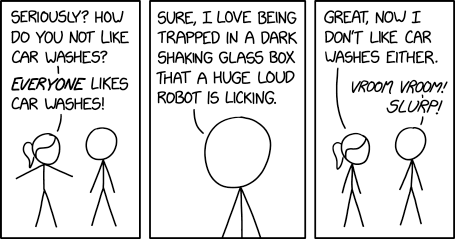
Car Wash
 ⌘ Read more
↳
In-reply-to
»
Not a bad option, although now we need a phone with camera, a printer, a QR reader app, to name a few...
And don't let get started with usability issues of QR codes (like restaurant menus)
⤋ Read More
not exactly the same topic, although I found a wordlist useful to generate passphrases, for example with Bitwarden, 1password or Keepass
Today I’m reading about how to save a copy of your secret keys outside a computer, using analog media, or sharing it by voice. For instance, for TOTP authenticators.
I found BIP39 coming from the crypto-wallets world:
https://github.com/bitcoin/bips/blob/master/bip-0039.mediawiki
The user has to write down this passphrase
fragile mimic expect ketchup truth between thunder visit expose output powder derive process disagree razor
Which is carefully designed to be checksummed and it’s easy to say on a call
Finally deriving it into a set of bytes like
da39a3ee5e6b4b0d3255bfef95601890afd80709
Do you know some alternatives not related to cryptocurrencies? 🤔
↳
In-reply-to
»
Found another example of Google stealing something I've written and putting it in a "featured snippet".
⤋ Read More
here’s my old web page at Brandeis University
Coevolutionary algorithms typically explore domains in which no single evaluation function is present or known. For the purpose of selecting which individuals to maintain and vary, they instead rely on the outcomes of interactions between evolving entities.
I’ve been using variations of that same phrasing for a very long time–I wrote that web page circa 2005 maybe?
↳
In-reply-to
»
@prologic I don't understand what you're saying.
⤋ Read More
podman works with TLS. It does not have the "--docker" siwtch so you have to remove that and use the exact replacement commands that were in that github comment.
@prologic@twtxt.net Change your script to this:
#!/bin/sh

set -e

alias docker=podman

if [ ! command -v docker > /dev/null 2>&1 ]; then
  echo "docker not found"
  exit 1
fi

mkdir -p $HOME/.docker/certs.d/cas

## key stuff omitted

# DO NOT DO THIS docker context create cas --docker "host=tcp://cas.run:2376,ca=$HOME/.docker/certs.d/cas/ca.pem,key=$HOME/.docker/certs.d/cas/key.pem,cert=$HOME/.docker/certs.d/cas/cert.pem"
# DO THIS:
podman system connection add "host=tcp://cas.run:2376,ca=$HOME/.docker/certs.d/cas/ca.pem,key=$HOME/.docker/certs.d/cas/key.pem,cert=$HOME/.docker/certs.d/cas/cert.pem"
# DO NOT DO THIS docker context use cas
# DO THIS:
podman system connection default cas
↳
In-reply-to
»
@prologic I don't understand what you're saying.
⤋ Read More
podman works with TLS. It does not have the "--docker" siwtch so you have to remove that and use the exact replacement commands that were in that github comment.
$ podman --docker
Error: unknown flag: --docker
Why are you using a flag that podman doesn’t have?
↳
In-reply-to
»
My proof-of-concept Container as a Service (CAS or CaaS) is now up and running. If anyone wants to have a play? 🤔 There's still heaps to do, lots of "features" missing, but you can run stuff at least 😅
⤋ Read More
@prologic@twtxt.net I don’t understand what you’re saying. podman works with TLS. It does not have the “–docker” siwtch so you have to remove that and use the exact replacement commands that were in that github comment.
↳
In-reply-to
»
My proof-of-concept Container as a Service (CAS or CaaS) is now up and running. If anyone wants to have a play? 🤔 There's still heaps to do, lots of "features" missing, but you can run stuff at least 😅
⤋ Read More
@prologic@twtxt.net My understanding is that podman can talk to the Docker Engine API. It’s just that the commands sometimes have different names in the podmanverse. I think–never used those features.
↳
In-reply-to
»
My proof-of-concept Container as a Service (CAS or CaaS) is now up and running. If anyone wants to have a play? 🤔 There's still heaps to do, lots of "features" missing, but you can run stuff at least 😅
⤋ Read More
@prologic@twtxt.net I don’t get your objection. dockerd is 96M and has to run all the time. You can’t use docker without it running, so you have to count both. docker + dockerd is 131M, which is over 3x the size of podman. Plus you have this daemon running all the time, which eats system resources podman doesn’t use, and docker fucks with your network configuration right on install, which podman doesn’t do unless you tell it to.
That’s way fat as far as I’m concerned.
As far as corporate goes, podman is free and open source software, the end. docker is a company with a pricing model. It was founded as a startup, which suggests to me that, like almost all startups, they are seeking an exit and if they ever face troubles in generating that exit they’ll throw out all niceties and abuse their users (see Reddit, the drama with spyware in Audacity, 10,000 other examples). Sure you can use it free for many purposes, and the container bits are open source, but that doesn’t change that it’s always been a corporate entity, that they can change their policies at any time, that they can spy on you if they want, etc etc etc.
That’s way too corporate as far as I’m concerned.
I mean, all of this might not matter to you, and that’s fine! Nothing wrong with that. But you can’t have an alternate reality–these things I said are just facts. You can find them on Wikipedia or docker.com for that matter.
↳
In-reply-to
»
My proof-of-concept Container as a Service (CAS or CaaS) is now up and running. If anyone wants to have a play? 🤔 There's still heaps to do, lots of "features" missing, but you can run stuff at least 😅
⤋ Read More
@prologic@twtxt.net I had a feeling my container was not running remotely. It was too crisp.
podman is definitely capable of it. I’ve never used those features though so I’d have to play around with it awhile to understand how it works and then maybe I’d have a better idea of whether it’s possible to get it to work with cas.run.
There’s a podman-specific way of allowing remote container execution that wouldn’t be too hard to support alongside docker if you wanted to go that route. Personally I don’t use docker–too fat, too corporate. podman is lightweight and does virtually everything I’d want to use docker to do.
↳
In-reply-to
»
My proof-of-concept Container as a Service (CAS or CaaS) is now up and running. If anyone wants to have a play? 🤔 There's still heaps to do, lots of "features" missing, but you can run stuff at least 😅
⤋ Read More
@prologic@twtxt.net @jmjl@tilde.green
It looks like there’s a podman issue for adding the context subcommand that docker has. Currently podman does not have this subcommand, although this comment has a translation to podman commands that are similar-ish.
It looks like that’s all you need to do to support podman right now! Though I’m not 100% sure the containers I tried really are running remotely. Details below.
I manually edited the shell script that cas.run add returns, changing all the docker commands to podman commands. Specifically, I put alias docker=podman at the top so the check for docker would pass, and then I replaced the last two lines of the script with these:
podman system connection add cas  "host=tcp://cas.run..."
podman system connection default cas
(that … after cas.run is a bunch of connection-specific stuff)
I ran the script and it exited with no output. It did create a connection named “cas”, and made that the default. I’m not super steeped in how podman works but I believe that’s what you need to do to get podman to run containers remotely.
I ran some containers using podman and I think they are running remotely but I don’t know the right juju to verify. It looks right though!
This means you could probably make minor modifications to the generated shell script to support podman. Maybe when the check for docker fails, check for podman, and then later in the script use the podman equivalents to the docker context commands.
👋 Hello @coreybag@anthony.buc.ci, welcome to Buccipod, a Yarn.social Pod! To get started you may want to check out the pod’s Discover feed to find users to follow and interact with. To follow new users, use the ⨁ Follow button on their profile page or use the Follow form and enter a Twtxt URL. You may also find other feeds of interest via Feeds. Welcome! 🤗
↳
In-reply-to
»
My proof-of-concept Container as a Service (CAS or CaaS) is now up and running. If anyone wants to have a play? 🤔 There's still heaps to do, lots of "features" missing, but you can run stuff at least 😅
⤋ Read More
@prologic@twtxt.net so what is the command to use? I did ssh -p 2222 GITHUB_USERNAME@cas.run help but that gives the same error. There’s something missing here.
↳
In-reply-to
»
My proof-of-concept Container as a Service (CAS or CaaS) is now up and running. If anyone wants to have a play? 🤔 There's still heaps to do, lots of "features" missing, but you can run stuff at least 😅
⤋ Read More
@prologic@twtxt.net I do, but you didn’t specify in your twt that you needed to use a github account. I copy pasted the ssh command you posted verbatim!
Glad to see people still using this gopher hole.
↳
In-reply-to
»
Yep, that's right, we have to use these tools in a proper way; terminal it’s not a friendly tool to use for this kind of stuff, on mobile devices, and web interfaces are prepared to bring us a confortable space.
⤋ Read More
[lang=en] By the way, have you played with Station on Gemini?
I like that using Gemtext, you can have a pretty decent microblogging platform. Imagine that with decentralization from twtxt. That sounds appealing to me!
↳
In-reply-to
»
I'm using rss on a terminal (Termux) in my phone, it's more confortable read there articles and other stuff, but for posting on twtxt, I tried , I swear it, but it's too much, it's not practical, I have to assume that it's better in a website/app like this.
⤋ Read More
Yep, that’s right, we have to use these tools in a proper way; terminal it’s not a friendly tool to use for this kind of stuff, on mobile devices, and web interfaces are prepared to bring us a confortable space.
Btw, I’m waiting for your php based client 😜 no pressure… 🤭
↳
In-reply-to
»
I'm using rss on a terminal (Termux) in my phone, it's more confortable read there articles and other stuff, but for posting on twtxt, I tried , I swear it, but it's too much, it's not practical, I have to assume that it's better in a website/app like this.
⤋ Read More
[lang=en] That was the reason for twtxt-php =P
I tried using CLI tools but it was too hacky, I think.
More if we consider Jakob’s Law, where we have prior expectations of a microblogging system.
A Web interface could be quite minimalistic and usable as well. (And mobile-friendly)
I’m using rss on a terminal (Termux) in my phone, it’s more confortable read there articles and other stuff, but for posting on twtxt, I tried , I swear it, but it’s too much, it’s not practical, I have to assume that it’s better in a website/app like this.
Yarn wins!
↳
In-reply-to
»
Erlang Solutions: Blockchain in Sustainable Programming
The benefits of blockchain implementation across multiple sectors are well-documented, but how can this decentralised solution be used to achieve more sustainable programming?
⤋ Read More
@Planet_Jabber_XMPP@feeds.twtxt.net
The benefits of blockchain implementation across multiple sectors are well-documented
WTF are you talking about? The only thing well-documented about “the blockchain” is that it sucks and its primary use case is creating Ponzi schemes.
Erlang Solutions: Blockchain in Sustainable Programming
The benefits of blockchain implementation across multiple sectors are well-documented, but how can this decentralised solution be used to achieve more sustainable programming?
As the effects of the ongoing climate crisis continue to impact weather patterns and living conditions across the planet, we must continue to make every aspect of our lives, from transport and energy usage to all of our technology, greener and more sustain … ⌘ Read more
I’m having an Internet outage at the moment … and now I can’t use valgrind anymore, because it needs to fetch stuff from the net during startup. 😒
↳
In-reply-to
»
Free Public WiFi: https://computer.rip/2023-07-29-Free-Public-WiFi.html
⤋ Read More
@movq@www.uninformativ.de @mckinley@twtxt.net I believe the resurgence in availability of municipal WiFi is largely driven by the surveillance capabilities it offers. Every person who has WiFi enabled on their phone can be tracked throughout the city as their phones ping various base stations; a lot of folks aren’t aware of just how much information can be slurped out of a phone that isn’t locked down just from its WiFi pings. I know this happens in Toronto, and I was familiar with a startup in Massachusetts that based its business model on this very concept. I can only assume it’s widespread in the US if not throughout the Western world.
Moon
 ⌘ Read more
GnuCOBOL 3.2 Released After 2+ Years In Development
For those fond of the COBOL programming language and continuing to make use of it in new development efforts, GnuCOBOL 3.2 was released on Friday as the latest feature update for this 21+ year old free software effort around being an open-source COBOL implementation… ⌘ Read more
I’ve only been using snac/the fediverse for a few days and already I’ve had to mute somebody. I know I come on strongly with my opinions sometimes and some people don’t like that, but this person had already started going ad hominem (in my reading of it), and was using what felt to me like sketchy tactics to distract from the point I was trying to make and to shut down conversation. They were doing similar things to other people in the thread so rather than wait for it to get bad for me I just muted them. People get so weirdly defensive so fast when you disagree with something they said online. Not sure I fully understand that.
I just received this email and I have some questions:
This email is from a trusted sοurce.
You received this abucci@bucci.onl because you have been disconnected from sending and receiving emails.
To continue using this email address we urge you to re-confirm if your account is still active on bucci.onl to officially unlock it to our default settings.
Re-confirm account (a link; removed)
※ This process is very important to help us protect your internet and fight malicious activities.
Since I administer bucci.onl myself, I’m a little confused. I don’t recall disconnecting myself from sending and receiving emails. I don’t even know how you disconnect someone from that. I also have never created the email address this email appears to be coming from, but maybe I should trust it anyway since they told me it’s a trusted source? Most puzzlingly, I’ve been sending and receiving emails just fine all morning, so I do not appear to be disconnected from anything? I want to help protect the internet and fight malicious activities, but what should I do??? 🤔🤔🤔🤔🤔
↳
In-reply-to
»
I used to be a big fan of a service called cocalc, which you could also self host. It was kind of an integrated math, data science, research, writing, and teaching platform.
⤋ Read More
@prologic@twtxt.net It was super useful if you needed to do the sorts of things it did. I’m pretty sad.
At its core was Sage, a computational mathematics system, and their own version of Jupyter notebooks. So, you could do all kinds of different math stuff in a notebook environment and share that with people. But on top of that, there was a chat system, a collaborative editing system, a course management system (so if you were teaching a class using it you could keep track of students, assignments, grades, that sort of thing), and a bunch of other stuff I never used. It all ran in a linux container with python/conda as a base, so you could also drop to a terminal, install stuff in the container, and run X11 applications in the same environment. I never taught a class with it but I used to use it semi-regularly to experiment with ideas.
TIL: You cannot use the work “fucking” (to colloquially mean that was “fucking brilliant”, i.e: a compliant) on Discord servers 🤣
I used to be a big fan of a service called cocalc, which you could also self host. It was kind of an integrated math, data science, research, writing, and teaching platform.
I hadn’t run it in awhile, and when I checked in with it today I found their web site brags that cocalc is now “extensively integrated with ChatGPT”.
Which means I can’t use it anymore, and frankly anyone doing anything serious shouldn’t use it either. Very disappointing.
↳
In-reply-to
»
ASCIIFlow This is kind of cool 😅
⤋ Read More
@prologic@twtxt.net I see what you mean about tldraw. I looked at their github repository and it seems like they are distributing it as an npm package for people who want to include a whiteboard in their Javascript-based frontend. I didn’t see a way to just launch the thing.
I have half a mind to write a little scala frontend that sets up one of these, since scalajs makes it very easy to use these Javascript web component things while making it look like you’re writing scala.
why am I not surprised?… https://uk.pcmag.com/ai/147757/elon-musk-will-train-his-ai-project-using-your-tweets
↳
In-reply-to
»
Li-Fi, light-based networking standard released
Today, the Institute of Electrical and Electronics Engineers (IEEE) has added 802.11bb as a standard for light-based wireless communications. The publishing of the standard has been welcomed by global Li-Fi businesses, as it will help speed the rollout and adoption of the data-transmission technology standard. Where Li-Fi shines (pun intended) is not just in its purported speeds as fast as 224 GB/s. Fraunhofer’s Dominic Schulz points ou ... ⌘ Read more
⤋ Read More
@abucci@anthony.buc.ci @prologic@twtxt.net neat.. I saw this one quite a while ago. it is strictly line of sight and blocked by walls or things. The use cases were to have it integrated in the lights in a room and provide super fast connections to devices in an office or coffee shop.
Yes, I use it for passport.
↳
In-reply-to
»
Question to all you Gophers out there: How do you deal with custom errors that include more information and different kinds of matching them?
⤋ Read More
Why not just always use the second one?
↳
In-reply-to
»
@prologic is goryon not in the google app store?
⤋ Read More
@prologic@twtxt.net bummer, that’s a shame. I ask because I install the vast majority of my phone apps from f-droid these days, and only use Google Play Store when I have no other option. I know the Play Store will have more reach, but I’m guessing reach isn’t the highest priority right now.
↳
In-reply-to
»
What the hell is #Threads? I'm glad to know nothing xD
⤋ Read More
hehe, I tryied it for like 2 minutes, a few friends are there… And I don’t like it at all. I don’t use Instagram for example, family and friends do, but I don’t like it either.
I don’t know, perhaps too much influencer’s and clickbait content, rather than something appealing to me.
↳
In-reply-to
»
@movq @prologic I thought you were talking about the cloud storage 🤣
⤋ Read More
@prologic@twtxt.net I don’t know! I’ve never used it–only came across it recently.
Question to all you Gophers out there: How do you deal with custom errors that include more information and different kinds of matching them?
I started with a simple var ErrPermissionNotAllowed = errors.New("permission not allowed"). In my function I then wrap that using fmt.Errorf("%w: %v", ErrPermissionNotAllowed, failedPermissions). I can match this error using errors.Is(err, ErrPermissionNotAllowed). So far so good.
Now for display purposes I’d also like to access the individual permissions that could not be assigned. Parsing the error message is obviously not an option. So I thought, I create a custom error type, e.g. type PermissionNotAllowedError []Permission and give it some func (e PermissionNotAllowedError) Error() string { return fmt.Sprintf("permission not allowed: %v", e) }. My function would then return this error instead: PermissionNotAllowedError{failedPermissions}
At some layers I don’t care about the exact permissions that failed, but at others I do, at least when accessing them. A custom func (e PermissionNotAllowedError) Is(target err) bool could match both the general ErrPermissionNotAllowed as well as the PermissionNotAllowedError. Same with As(…). For testing purposes the PermissionNotAllowedError would then also try to match the included permissions, so assertions in tests would work nicely. But having two different errors for different matching seems not very elegant at all.
Did you ever encounter this scenario before? How did you address this? Is my thinking flawed?
↳
In-reply-to
»
Google Says It'll Scrape Everything You Post Online for AI
⤋ Read More
@marado@twtxt.net It can’t possibly be defensible, which to me always signals an attempt at a power grab. They never explicitly said “we will use anything we scrape from the web to train our AI” before–that’s new. There is growing pushback against that practice, with numerous legal cases winding through the legal system right now. Some day those cases will be heard and decided on by judges. So they’re trying to get out ahead of that, in my opinion, and cement their claims to this data before there’s a precedent set.
↳
In-reply-to
»
Wondering how long I'll keep twitter-related feeds (like on fraidycat, or here) before giving up on them as permanently dead.
⤋ Read More
With Youtube testing a “three strikes and you’re out” policy against people who use ad blockers, I’m also wondering whether Web 2.0 is effectively walled off and I should just give up on it entirely and look elsewhere for information and entertainment.
I could use some healthcare right now, but corporate America sucks. You need to have a full-time job while everyone is being replaced by kiosks.
An official FBI document dated January 2021, obtained by the American association “Property of People” through the Freedom of Information Act.
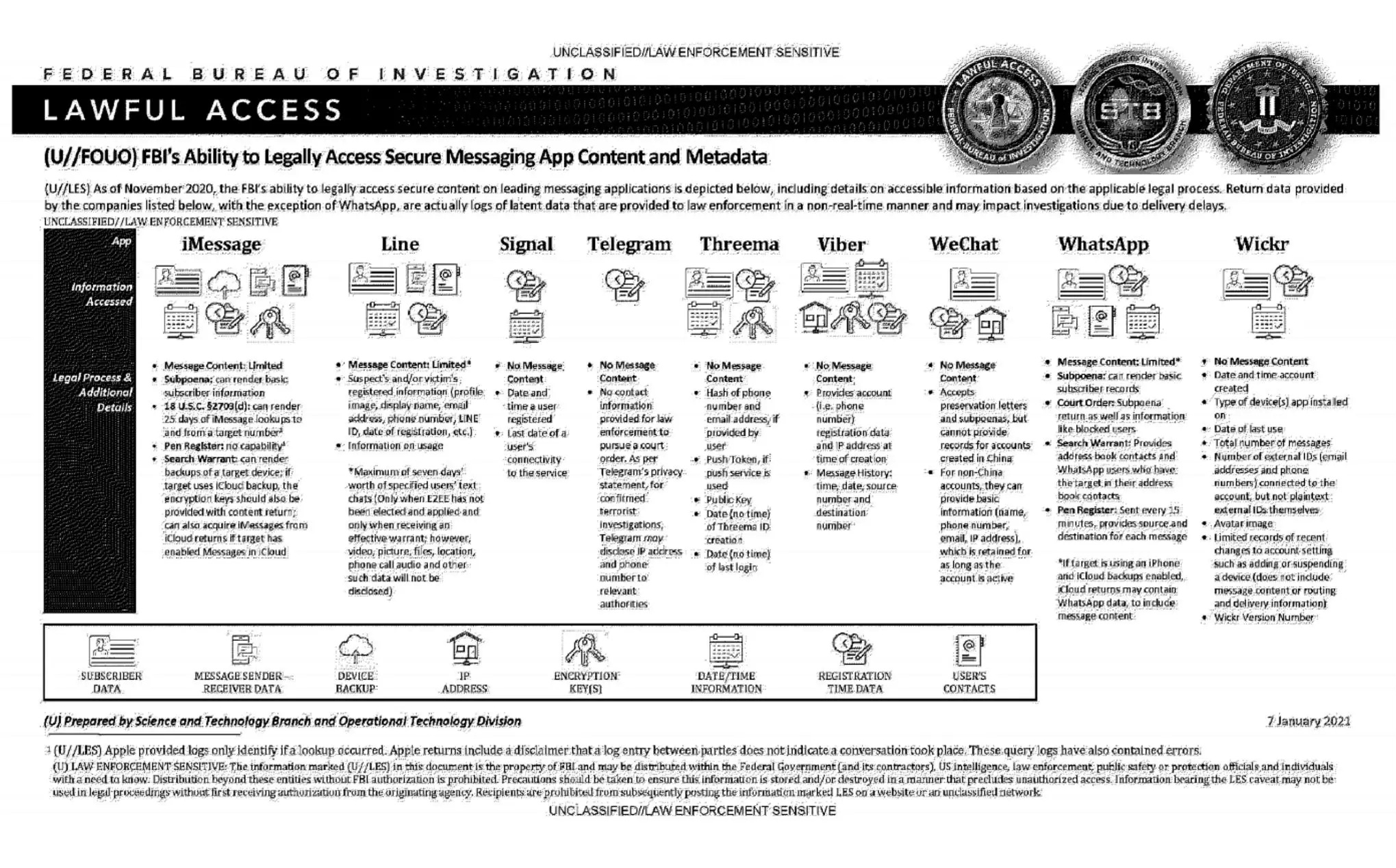
This document summarizes the possibilities for legal access to data from nine instant messaging services: iMessage, Line, Signal, Telegram, Threema, Viber, WeChat, WhatsApp and Wickr. For each software, different judicial methods are explored, such as subpoena, search warrant, active collection of communications metadata (“Pen Register”) or connection data retention law (“18 USC§2703”). Here, in essence, is the information the FBI says it can retrieve:
Apple iMessage: basic subscriber data; in the case of an iPhone user, investigators may be able to get their hands on message content if the user uses iCloud to synchronize iMessage messages or to back up data on their phone.
Line: account data (image, username, e-mail address, phone number, Line ID, creation date, usage data, etc.); if the user has not activated end-to-end encryption, investigators can retrieve the texts of exchanges over a seven-day period, but not other data (audio, video, images, location).
Signal: date and time of account creation and date of last connection.
Telegram: IP address and phone number for investigations into confirmed terrorists, otherwise nothing.
Threema: cryptographic fingerprint of phone number and e-mail address, push service tokens if used, public key, account creation date, last connection date.
Viber: account data and IP address used to create the account; investigators can also access message history (date, time, source, destination).
WeChat: basic data such as name, phone number, e-mail and IP address, but only for non-Chinese users.
WhatsApp: the targeted person’s basic data, address book and contacts who have the targeted person in their address book; it is possible to collect message metadata in real time (“Pen Register”); message content can be retrieved via iCloud backups.
Wickr: Date and time of account creation, types of terminal on which the application is installed, date of last connection, number of messages exchanged, external identifiers associated with the account (e-mail addresses, telephone numbers), avatar image, data linked to adding or deleting.
TL;DR Signal is the messaging system that provides the least information to investigators.
been using the iphone for some days now, and I must say im impressed. I really like it. I will not buy android phone ever again.
I have found a way out of Microsoft Office365, and most of the other cloud services I use to run the company, and its zoho.