↳
In-reply-to
»
Been missing you, friends! I hope life's been treating you well. What did I miss?
⤋ Read More
@aelaraji@aelaraji.com hey, hey! I saw you tinkering with ActivityPub, so I know you were well.
Glad to have you back here! No much has happened on twtxt.net-world. @prologic@twtxt.net is quite busy with large language models, and seeking further independence through capitalistic ways. @lyse@lyse.isobeef.org continues dazzling us with his clicks, @movq@www.uninformativ.de brings us interesting music, videos to see, and a sprinkle of home made computing here and there, and me… well, I continue bending (or trying to) things! 😂
There was an endless coming and going of sun, clouds and rain. Not to forget about the wind. I called it quits a bit earlier and went into the woods.
Towards the end I was completeley surrounded by rain curtains in all directions. This looked super cool. I thought I might make it home just in time without having to use my umbrella, but the rain clouds were way quicker than I anticipated. Just after the rain hit me, I met an acquaintance who just started his walk. The wind picked up hard and rain hammered down, mixed with snow. Holding the umbrella was a workout. Shortly after I returned, the rain stopped again.
I didn’t notice the kestrel sitting on the tree when I took the last photo. That was a nice surprise when I sorted through the nearly 300 pics.
↳
In-reply-to
»
The original twt is unavailable. It may have been edited or deleted, or is from an unknown or muted feed.
⤋ Read More
@movq@www.uninformativ.de There are always some folks who would appreciate that. But I fear they are the minority. The rest just doesn’t give a shit.
The selfcontradiction is that those who proudly use and promote AI also claim to be sustainable and green and so on. I’ve no clue how this is not considered fraud, but there we are.
The fact that Canada and US do basic mathematical operations algorithms upwards always boggles my mind.
↳
In-reply-to
»
hi guys! how did we like bad bunny's halftime show?
⤋ Read More
@bender@twtxt.net it was great! I loved how he used such a big platform to send such an important message!!
nutts.org now has /whoami, /books, and /uses pages
Fuck me dead! I accidentally confused an HTML file for a YAML file and manually opened it in my browser. Unfortunately, I clicked on the OK button of the popped up dialog a bit too fast, it just caught me off guard. It asked which program to open the YAML file in. Of course Firefox thought that it could handle that and suggested itself by default. Conveniently, the “don’t prompt me again and always use this selection from now on” checkbox was enabled.
And then the endless loop of death started. Turns out, this fucking browser can’t do shit with YAML files and delegated to what had been just configured. Oh, would you look at that!? Firefox! Empty tabs after empty tabs appeared. Killing and restarting Firefox just loaded the last session with all the tabs and the loop continued.
Some bloody snakeoil on my work machine slows down link openening requests by two, three seconds. It’s always absolutely anoying, but luckily, it actually limited the rate of new tabs popping up. I still could not close the many tabs fast enough that had accumulated before I noticed what was going on in the background.
Going to the settings to change them was always interrupted with a new tab opening in the foreground.
Finally, killing Firefox and renaming the file on disk before restarting Firefox did the trick and broke the loop. I was still holding down Ctrl+W for a minute or so to get rid of the useless tabs. I didn’t want to loose the important tabs, so just ditching the session wasn’t an option.
↳
In-reply-to
»
I spent the day today integrating @xuu's double ratcheting work and ratchet library back into the reference client/broker implementation saltyim as a v2 branch. I completely redesigned and rewrite the
⤋ Read More
salty-chat TUI client as well, which now includes proper notifications and a background agent that keeps running so you never miss any messages. It all "just works"™ and I'm quite happy with the outcome! 🤩 #saltyim #revamp
@bender@twtxt.net Whwn do i see you start to use Salty IM more? 😅
↳
In-reply-to
»
The original twt is unavailable. It may have been edited or deleted, or is from an unknown or muted feed.
⤋ Read More
@movq@www.uninformativ.de Nice, it’s coming together! Despite it being ages ago that I used a hex editor or viewer, these different representations of information appear very handy to me. If I had to mess around on binary formats, I’d definitely appreciate them. I can’t remember if the hex viewer back then had these options. Don’t even recall what software that was. :-)
I, too, only very, very rarely use the mouse in the terminal. Apart from selecting text to copy into the clipboard. But that probably has the potential for trouble and interference with button clicks, etc. If one isn’t careful.
How did the startup times develop?
Hmmm, that’s a pity. I never realized that before. The following Go code
var b bool
…
b |= otherBool
results in a compilation error:
invalid operation: operator | not defined on b (variable of type bool)
I cannot use || for assignments as in ||= according to https://go.dev/ref/spec#Assignment_statements. Instead, I have to write b = b || otherBool like a barbarian. Oh well, probably doesn’t happen all that often, given that I only now run into this after all those many years.
Ah, nothing quite like a cold beer after a day of moving house without the use of a vehicle.
↳
In-reply-to
»
The original twt is unavailable. It may have been edited or deleted, or is from an unknown or muted feed.
⤋ Read More
@shinyoukai@yume.laidback.moe I don’t have a use for it, just curious, why did you fork it?
Going to use Tor. I hope Dread will help me find what I want.
What a beautiful, beautiful 0°C Sunday arvo and evening! The weather forecast delayed the snow by the minute. An hour or so after it finally started very, very lightly, I headed off for the woods to check out the lake again. Unfortunately, with the fresh snow layer, the crazy wild surface texture of the ice sheet wasn’t visible anymore. But it brought some other nice views and photo opportunities.
I initially thought that I just go for a quick turn. However, with the snowfall a wee bit increasing I was hooked and kept going. Visibility was poor, but the snow blankets just looked too stunning. The road surfaces were quite slippery, so I often just walked alongside the pathways. On downhill slopes I had some good fun sliding down the road on my feet. With varying success. Luckily, I managed not to fall.
On the summit of the mountain the twigs had those absolutely magnificently looking windblown crystal coverings. Awwwwwww! They never get old. It was already getting dark, so the camera was tired and wanted to sleep. The snow program then made use of the flash and I’m quite pleased with how these shots turned out.
Two deer crossed the road in front of me and ran into the woods, that was sight for sore eyes. Although I felt bad that they had to flee from me in this white terrain. By the time I got home, the snow had accumulated around eight centimeters in height, even in town down in the valley. Walking on this fresh snow is just amazing. And I love the sound it makes. Today, the snow consistency must have been just right, because the crushing sound was really loud.
I cannot recall that I had frozen hair and beard before, but today, there was a thick ice buildup. In case I had, it was definitely never this much. Felt really cool.
Enough of this preliminary skirmishing, there ya go: https://lyse.isobeef.org/waldspaziergang-2026-01-25/
↳
In-reply-to
»
This weekend, I'm building a service that turns PDFs into chaptered, audiobook‑quality narration in minutes—upload, listen in a built‑in player, and download MP3/M4B files with clean metadata.
⤋ Read More
Has a bit of a long history story behind this, where last year at work we were reading this book called Engineering a Safer World and initially came across a service called Speech Reply that allowed me to upload a PDF copy of the book and start to read it, but unfortunately, the free trial right now before I can finish reading it turns out that Speech Reply service cost a whopping US$30 a month and expected me to pay a full year upfront, which was well over US$300 just for one fucking book! So I sent their sales and support staff a message kindly asking if it were possible to just pay for the audio transcription of just a single book or to change to a monthly subscription fee, to which they refused, so basically in the end I got very angry and told them to go fuck themselves and built my own service. A year later here we are :-)
you are anonymous, if you use tor and the onion site of magical.fish. But never look to more than one site.
70% of people are paranoid and believe paranoid ideas. Thats my idea. Use your brain, study history and science and talk with other people, who have not your ideas.
My mate and I went on a hike earlier. Yesterday, we had lovely 12°C. But today, it was down to at most 4°C. Oh well. At least the sun was out and and there was just a tiny bit of wind. We knew upfont that scarf, beanie and gloves were mandatory. Especially at the more windy sections like up top the hills. The view was absolutely terrible, but we made the best of it.
With the sun shining on us during our lunch break at a forest edge bench, we still enjoyed the lookout in 01. I brought some old carpet scraps to sit on and was happily surprised that they isolated even better than I had hoped for. Some hot tea helped us staying warm.
After five hours we returned just after sunset. I’m quite tired now, completely out of shape.
↳
In-reply-to
»
Some work on the menu system to brighten my mood a little bit. No mouse support yet.
⤋ Read More
@bender@twtxt.net I’m already using it for tracktivity (meant for tracking activities and events, like weather, food consumption, stuff like that), which is basically a somewhat-fancy CSV editor:
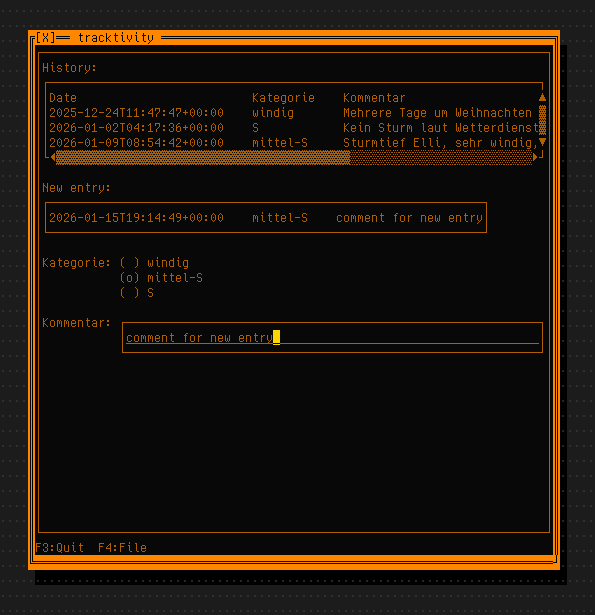
I have a couple of other projects where I could use it, because they are plain curses at the moment. Like, one of them has an “edit box”, but you can’t enter Unicode, because it was too complicated. That would benefit from the framework.
Either way, it’s the most satisfying project in a long time and I’m learning a ton of stuff.
I’m trying to implement configurable key bindings in tt. Boy, is parsing the key names into tcell.EventKeys a horrible thing. This type consists of three information:
- maybe a predefined compound key sequence, like Ctrl+A
- maybe some modifiers, such as Shift, Ctrl, etc.
- maybe a rune if neither modifiers are present nor a predefined compound key exists
It’s hardcoded usage results in code like this:
func (t *TreeView[T]) InputHandler() func(event *tcell.EventKey, setFocus func(p tview.Primitive)) {
    return t.WrapInputHandler(func(event *tcell.EventKey, setFocus func(p tview.Primitive)) {
        switch event.Key() {
        case tcell.KeyUp:
            t.moveUp()
        case tcell.KeyDown:
            t.moveDown()
        case tcell.KeyHome:
            t.moveTop()
        case tcell.KeyEnd:
            t.moveBottom()
        case tcell.KeyCtrlE:
            t.moveScrollOffsetDown()
        case tcell.KeyCtrlY:
            t.moveScrollOffsetUp()
        case tcell.KeyTab, tcell.KeyBacktab:
            if t.finished != nil {
                t.finished(event.Key())
            }
        case tcell.KeyRune:
            if event.Modifiers() == tcell.ModNone {
                switch event.Rune() {
                case 'k':
                    t.moveUp()
                case 'j':
                    t.moveDown()
                case 'g':
                    t.moveTop()
                case 'G':
                    t.moveBottom()
                }
            }
        }
    })
}
This data structure is just awful to handle and especially initialize in my opinion. Some compound tcell.Keys are mapped to human-readable names in tcell.KeyNames. However, these names always use - to join modifiers, e.g. resulting in Ctrl-A, whereas tcell.EventKey.Name() produces +-delimited strings, e.g. Ctrl+A. Gnaarf, why this asymmetry!? O_o
I just checked k9s and they’re extending tcell.KeyNames with their own tcell.Key definitions like crazy: https://github.com/derailed/k9s/blob/master/internal/ui/key.go Then, they convert an original tcell.EventKey to tcell.Key: https://github.com/derailed/k9s/blob/b53f3091ca2d9ab963913b0d5e59376aea3f3e51/internal/ui/app.go#L287 This must be used when actually handling keyboard input: https://github.com/derailed/k9s/blob/e55083ba271eed6fc4014674890f70c5ed6c70e0/internal/ui/tree.go#L101
This seems to be much nicer to use. However, I fear this will break eventually. And it’s more fragile in general, because it’s rather easy to forget the conversion or one can get confused whether a certain key at hand is now an original tcell.Key coming from the library or an “extended” one.
I will see if I can find some other programs that provide configurable tcell key bindings.
The modern world seems to want to separate the concepts of beauty and utility. We’re fine with having things that are aesthetic but don’ do anything useful, while the tools of society that get work done are often very ugly–visually, socially and metaphorically. Beauty without utility is worthless; utility without beauty is meaningless. We can’t treat them independently.
↳
In-reply-to
»
@lyse
⤋ Read More
@movq@www.uninformativ.de Sorry, I meant the builtin module:
$ python3 -m pep8 file.py
/usr/lib/python3/dist-packages/pep8.py:2123: UserWarning:

pep8 has been renamed to pycodestyle (GitHub issue #466)
Use of the pep8 tool will be removed in a future release.
Please install and use `pycodestyle` instead.

  $ pip install pycodestyle
  $ pycodestyle ...
I can’t seem to remember the name pycodestyle for the life of me. Maybe that’s why I almost never use it.
You+can+tell+the+browser+I+am+using+sucks+lol
I just tried serving gopher maps on ipfs using IPNS, works like a charm.
Testing a post using my new gopher client…
Since I used so much Rust during the holidays, I got totally used to rustfmt. I now use similar tools for Python (black and isort).
What have I been doing all these years?! I never want to format code manually again. 🤣😅
Let us troll some companies by snail-mail. That can be fun!
↳
In-reply-to
»
@lyse Ah, the lower right corner is different on purpose: It’s where you can click and drag to resize the window. https://movq.de/v/cbfc575ca6/vid-1767977198.mp4 Not sure how to make this easier to recognize. 🤔 (It’s the only corner where you can drag, btw.)
⤋ Read More
@lyse@lyse.isobeef.org It’s not super comfortable, that’s right.
But these mouse events come with a caveat anyway:
ncurses uses the XM terminfo entry to enable mouse events, but it looks like this entry does not enable motion events for most terminal emulators. Reporting motion events is supported by, say, XTerm, xiate, st, or urxvt, it just isn’t activated by XM. This makes all this dragging stuff useless.
For the moment, I edited the terminfo entry for my terminal to include motion events. That can’t be a proper solution. I’m not sure yet if I’m supposed to send the appropriate sequence manually …
And the terminfo entries for tmux or screen don’t include XM at all. tmux itself supports the mouse, but I’m not sure yet how to make it pass on the events to the programs running inside of it (maybe that’s just not supported).
To make things worse, on the Linux VT (outside of X11 or Wayland), the whole thing works differently: You have to use good old gpm to get mouse events (gpm has been around forever, I already used this on SuSE Linux). ncurses does support this, but this is a build flag and Arch Linux doesn’t set this flag. So, at the moment, I’m running a custom build of ncurses as a quick hack. 😅 And this doesn’t report motion events either! Just clicks. (I don’t know if gpm itself can report motion events, I never used the library directly.)
tl;dr: The whole thing will probably be “keyboard first” and then the mouse stuff is a gimmick on top. As much as I’d like to, this isn’t going to be like TUI applications on DOS. I’ll use “Windows” for popups or a multi-window view (with the “WindowManager” being a tiny little tiling WM).
Who uses irc.com ?
The use of radio signals can lead to identification and data leakage.
↳
In-reply-to
»
@movq I noticed that your feed's last modification timestamp was missing in my database. I cannot tell for certain, but I think it did work before. Turns out, your
⤋ Read More
httpd now sends the Last-Modified with UTC instead of GMT. Current example:
@shinyoukai@neko.laidback.moe Not using OpenBSD or httpd? Yeah. It’s been working quite well since ~2017, so, meh, too lazy to switch now. But nothing is set in stone, of course.
↳
In-reply-to
»
More widget system progress:
⤋ Read More
And now the event loop is not a simple loop around curses’ getch() anymore but it can wait for events on any file descriptor. Here’s a simple test program that waits for connections on a TCP socket, accepts it, reads a line, sends back a line:
https://movq.de/v/93fa46a030/vid-1767547942.mp4
And the scrollbar indicators are working now.
I’ll probably implement timer callbacks using timerfd (even though that’s Linux-only). 🤔
More widget system progress:
https://movq.de/v/87e2bce376/vid-1767467193.mp4
I like the oldschool shadow effect. 😅 Not sure if I’ll keep it, but it’s neat.
The menu bar is still fake.
Had to spend quite a bit of time optimizing the rendering today. This can get really slow really quickly.
Unicode is Pain.
I might be able to start porting my first program (currently uses urwid) soon. 🤔
@movq@www.uninformativ.de I noticed that your feed’s last modification timestamp was missing in my database. I cannot tell for certain, but I think it did work before. Turns out, your httpd now sends the Last-Modified with UTC instead of GMT. Current example:
Sat, 03 Jan 2026 06:50:20 UTC
I’m not a fan of this timestamp format at all, but according to the HTTP specification, HTTP-date must always use GMT for a timezone, nothing else: https://httpwg.org/specs/rfc9110.html#http.date
↳
In-reply-to
»
With RAM crazy prices being what they are, I guess my PC is gonna be stuck on 16GB RAM for some time. I originally bought the DDR4 16GB kit for like $49 AUD, and I thought I'd just buy another 16GB or more later down the track (this was like a year and a half ago), thinking it would be similarly priced or even cheaper...
⤋ Read More
@eldersnake@we.loveprivacy.club
Steps to world domination:
- “Invent” “AI” (by using other people’s data).
- Get people hyped about it and ideally hooked on it.
- Only provide it as a cloud service. But hey, if you want to, you can run it locally!
- Buy all hardware available on the market, so that nobody but you can build more systems.
- All PCs of consumers and competitors are too weak now and can’t be upgraded anymore.
- Everybody depends on your cloud service! Win!
All of that is possible because corporations don’t have a “conscience” in capitalism. Nobody forces the RAM manufacturers to sell all their stuff to just one or two buyers, but since the only goal of that manufacturer is to make money, they do it.
↳
In-reply-to
»
The original twt is unavailable. It may have been edited or deleted, or is from an unknown or muted feed.
⤋ Read More
@shinyoukai@neko.laidback.moe I can’t believe Trace and Edgewall Software is still around and in use 🤣
On my way to having windows and mouse support:
https://movq.de/v/95bbbbd3e8/basic-windows.mp4
It would be cool to have something like Turbo Vision eventually.
(I considered just using Turbo Vision, but it’s a C++ library and that’s not quite what I’m looking for. But it’s not yet completely off the table.)
↳
In-reply-to
»
@lyse You actually have a Markdown parser/renderer in there? Oh dear. I would have been (well, I am) way too lazy for that. 😅
⤋ Read More
@movq@www.uninformativ.de Well, just a very limited subset thereof:
- inline and multiline code blocks using single/double/triple backticks (but no code blocks with just indentation)
- markdown links using using
[text](url)
- markdown media links using

And that’s it. No bold, italics, lists, quotes, headlines, etc.
Just like mentions, plain URLs, markdown links and markdown media URLs are highlighted and available in the URLs View. They’re also colored differently, similarly to code segments.
I definitely should write some documentation and provide screenshots.
Hurray, I finally fixed another rendering bug in tt that was bugging me for a long time. Previously, when there were empty lines in a markdown multiline code block, the background color of the code block had not been used for the empty lines. So, this then looked as if there were actually several code blocks instead of a single one.

mu (µ) now has builtin code formatting and linting tools, making µ far more useful and useable as a general purpose programming language. Mu now includes:
- An interpreter for quick “scriptinog”
- A native code compiler for building native executables (Darwin / macOS only for now)
- A builtin set of developer tools, currently: fmt (-fmt), check (-check) and test (-test).
↳
In-reply-to
»
The original twt is unavailable. It may have been edited or deleted, or is from an unknown or muted feed.
⤋ Read More
@shinyoukai@neko.laidback.moe Because you might not want to commit all changed files in a single commit. I very often make use of this and create several commits. In fact, I like to git add --patch to interactively select which parts of a file go in the next commit. This happens most likely when refactoring during a feature implementation or bug fix. I couldn’t live without that anymore. :-)
If you have a much more organized way of working where this does not come up, you can just git commit --all to include all changed files in the next commit without git adding them first. But new files still have to be git added manually once.
↳
In-reply-to
»
Hmm, mine also resolves a leading tilde in these variables. And if
⤋ Read More
$HOME is not specified it tries to resolve the user's home directory by user.Current().HomeDir. Maybe that's overkill, I have to check the XDG spec.
Ok, the standard library implementation is wonky at best, at least in regards to XDG, because it really doesn’t implement it properly. https://github.com/golang/go/issues/62382 I stick to my own code then. It doesn’t properly support anything else than Linux or Unixes that use XDG, but personally, I don’t care about them anyway. And the cross-platform situation is a giant mess. Unsurprisingly.
↳
In-reply-to
»
@lyse Well, I used SnipMate years ago (until 2012). IIRC, it’s more than just “insert a bit of text here”, it can also jump to the correct next location(s) and stuff like that. Don’t remember why I stopped using it.
⤋ Read More
@movq@www.uninformativ.de Thanks! I’ll have a look at SnipMate. Currently, I’m (mis)using the abbreviation mechanism to expand a code snippet inplace, e.g.
autocmd FileType go inoreab <buffer> testfunc func Test(t *testing.T) {<CR>}<ESC>k0wwi
or this monstrosity:
autocmd FileType go inoreab <buffer> tabletest for _, tt := range []struct {<CR> name string<CR><CR><BS>}{<CR> {<CR> name: "",<CR><BS>},<CR><BS>} {<CR> t.Run(tt.name, func(t *testing.T) {<CR><CR>})<CR><BS>}<ESC>9ki<TAB>
But this of course has the disadvantage that I still have to remove the last space or tab to trigger the expansion by hand again. It’s a bit annoying, but better than typing it out by hand.
↳
In-reply-to
»
Question to my fellow Vimers: Which snippet insertion mechanism are you using or can you (not) recommend?
⤋ Read More
@lyse@lyse.isobeef.org Well, I used SnipMate years ago (until 2012). IIRC, it’s more than just “insert a bit of text here”, it can also jump to the correct next location(s) and stuff like that. Don’t remember why I stopped using it.
Then I used nothing for a long time. Just before Christmas, I made my own plugin (… of course …), which does everything I need at the moment (and nothing more).
It can insert simple templates and then jump to the next location:
https://movq.de/v/67cdf7c827/sisni%2Dpython.mp4
And replace a string after insertion:
https://movq.de/v/67cdf7c827/sisni%2Dheader.mp4
(It’s not public (yet?) and it also uses vim9script, so I guess it wouldn’t work on your system.)
Question to my fellow Vimers: Which snippet insertion mechanism are you using or can you (not) recommend?
↳
In-reply-to
»
The
⤋ Read More
tt URLs View now automatically selects the first URL that I probably are going to open. In decreasing order, the URL types are:
@lyse@lyse.isobeef.org That sounds useful. 🤔
↳
In-reply-to
»
@lyse Yeah I remember you said some days back that your interest in compilers was rekindled by my work on mu (µ) 😅
⤋ Read More
@lyse@lyse.isobeef.org I can tell you this right now, writing assembly / machine code is fucking hard work™ 😓 I’m sure @movq@www.uninformativ.de can affirm 🤣 And when it all goes to shit™ (which it does often), man is debugging fucking hard as hell! Without debug symbols I can’t use the regular tools like lldb or gdb 😂
↳
In-reply-to
»
Whoo! I fixed one of the hardest bugs in mu (µ) I think I've had to figure out. Took me several days in fact to figure it out. The basic problem was,
⤋ Read More
println(1, 2) was bring printed as 1 2 in the bytecode VM and 1 nil when natively compiled to machine code on macOS. In the end it turned out the machine code being generated / emitted meant that the list pointers for the rest... of the variadic arguments was being slot into a register that was being clobbered by the mu_retain and mu_release calls and effectively getting freed up on first use by the RC (reference counting) garbage collector 🤦♂️
@prologic@twtxt.net Tada, congratulations! I find that rather interesting, thanks for telling us. :-)
Whoo! I fixed one of the hardest bugs in mu (µ) I think I’ve had to figure out. Took me several days in fact to figure it out. The basic problem was, println(1, 2) was bring printed as 1 2 in the bytecode VM and 1 nil when natively compiled to machine code on macOS. In the end it turned out the machine code being generated / emitted meant that the list pointers for the rest... of the variadic arguments was being slot into a register that was being clobbered by the mu_retain and mu_release calls and effectively getting freed up on first use by the RC (reference counting) garbage collector 🤦♂️
↳
In-reply-to
»
@lyse while caching those is a good idea the problem is baking data that can be calculated into the database instead of some cache, because post hashes are not fixed and change for every post edit. you can always easily look up other twts by hash with a cached lookup table, but now you're not locked into them so supporting hashv2 or other hash variants or any other solution becomes far easier
⤋ Read More
@zvava@twtxt.net By hashing definition, if you edit your message, it simply becomes a new message. It’s just not the same message anymore. At least from a technical point of view. As a human, personally I disagree, but that’s what I’m stuck with. There’s no reliable way to detect and “correct” for that.
Storing the hash in your database doesn’t prevent you from switching to another hashing implementation later on. As of now, message creation timestamps earlier than some magical point in time use twt hash v1, messages on or after that magical timestamp use twt hash v2. So, a message either has a v1 or a v2 hash, but not both. At least one of them is never meaningful.
Once you “upgrade” your database schema, you can check for stored messages from the future which should have been hashed using v2, but were actually v1-hashed and simply fix them.
If there will ever be another addressing scheme, you could reuse the existing hash column if it supersedes the v1/v2 hashes. Otherwise, a new column might be useful, or perhaps no column at all (looking at location-based addressing or how it was called). The old v1/v2 hashes are still needed for all past conversation trees.
In my opinion, always recalculating the hashes is a big waste of time and energy. But if it serves you well, then go for it.