↳
In-reply-to
»
The original twt is unavailable. It may have been edited or deleted, or is from an unknown or muted feed.
⤋ Read More
@david@daiwei.me since I became linuxpilled and embraced SSH, I do my Wordles through https://late.sh/
Can strongly recommend it, even has all the other daily puzzles: minesweeper, sudoku, solitaire, nonogram (kinda hate those),…
Maybe not the best family activity, the chat can be somewhat spicy and so can the collaborative ASCII art drawing game.
Many ASCII art with humorous russian words
↳
In-reply-to
»
My first pull request to Perl has been merged! https://github.com/Perl/perl5/commit/2aea97bf3f5c2ea62cf5e701858694b7378ed58c
⤋ Read More
@lyse@lyse.isobeef.org Oops, I guess the new text is a bit obscure. If you follow the link, the text is a bit more explicit, but you still need to know what a lexical scope is. Anyway, this is part of Perl moving very carefully toward being UTF-8 by default while also not breaking code written in the 90s. If you name a recent version like “use v5.42;” then Perl stops letting you use non-ASCII characters unless you also say “use utf8;”. The “lexically” part basically means that strictness continues until the next “}”, or the end of the program. That lets you fix up old code one block at a time, if you aren’t ready to apply the new strictness to a whole file at once.
Does the twtxt program support ASCII, or does it require Unicode?
↳
In-reply-to
»
Task for this weekend:
⤋ Read More
@prologic@twtxt.net No, this is a Linux manpage from the man-pages project: https://git.kernel.org/pub/scm/docs/man-pages/man-pages.git/tree/man/man7/ascii.7
I do have an idea what’s going on. Could be an unfortunate interaction between the table preprocessor tbl and the man macro package. 🤔
Task for this weekend:
https://movq.de/v/b05a7ce782/vid-1758959332.mp4
When you call man ascii, you get this nice table, but there’s a weird vertical line at the bottom. That line is supposed to be a vertical rule and is supposed to go from the bottom of the table all the way to the top.
Let’s see if I can debug this. (Not getting my hopes up at this point, but I’ll try.)
↳
In-reply-to
»
The original twt is unavailable. It may have been edited or deleted, or is from an unknown or muted feed.
⤋ Read More
@movq@www.uninformativ.de I tried making an ascii scribble of penguin waving back at you but I gave up halfway through my first try xD … HI! 👋
↳
In-reply-to
»
is there consensus on what characters should(n't) be allowed in
⤋ Read More
nicks? i remember reading somewhere whitespace should not be allowed, but i don't see it in the spec on twtxt.dev — in fact, are there any other resources on twtxt extensions outside of twtxt.dev?
@lyse@lyse.isobeef.org @movq@www.uninformativ.de bbycll’s nickname regex is /^([-_\p{N}\p{L}])+$/iu because i don’t like how english-centric only allowing ascii letters/numbers is though this only applies to local users as of now, currently all nicknames are tolerated when parsing remote feeds and i just do mentions how yarn does (just the feed url)
in the wild, i’ve noticed a texedus feed with spaces in the nick (where its spec explicitly disallows whitespace in the nick) and feeds with other symbols in the nick too. honestly, i think we should just tolerate arbitrary nicknames for sake of user expression (while stripping or converting unreasonable characters) and just leave them out of mentions
↳
In-reply-to
»
is there consensus on what characters should(n't) be allowed in
⤋ Read More
nicks? i remember reading somewhere whitespace should not be allowed, but i don't see it in the spec on twtxt.dev — in fact, are there any other resources on twtxt extensions outside of twtxt.dev?
@zvava@twtxt.net Good question. This is the spec, I think:
https://twtxt.dev/exts/metadata.html#nick
It doesn’t say much. 🤔
In the wild, I’ve only seen “traditional” nick names, i.e. ASCII 0x21 thru 0x7E.
My client removes anything but r'[a-zA-Z0-9]' from nick names.
↳
In-reply-to
»
@prologic Hmm, good question. I haven’t checked the market, I got mine from someone I know. But to be honest, I’d suspect that buying a used one is actually your best shot, because there is virtually no market for these devices anymore, meaning new ones are very, very expensive. 🫤
⤋ Read More
@prologic@twtxt.net It’s quite similar to how escape sequences work in a terminal. ASCII text is printed as ASCII text and then an escape sequence can make it bold or underline and so on. Other escape sequences allow you to say “the following $n bytes are part of a bitmap image”, and then this gets printed at whatever the current position is (somewhat similar to SIXEL in a terminal).
It’s just that the units are a bit weird, because this is all done in bloody inch. 😅
↳
In-reply-to
»
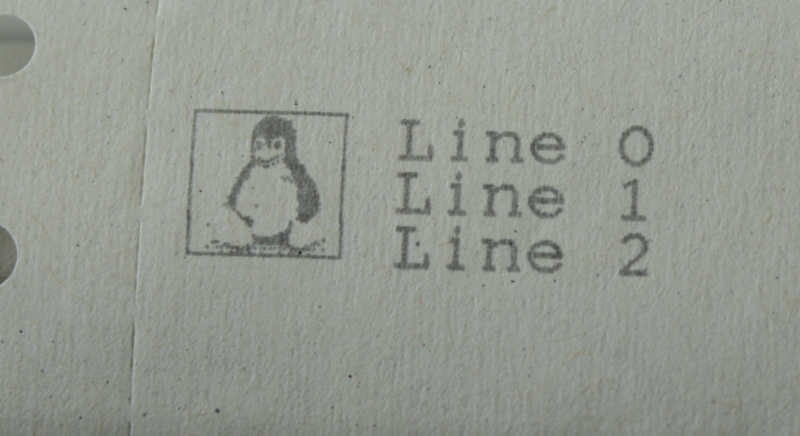
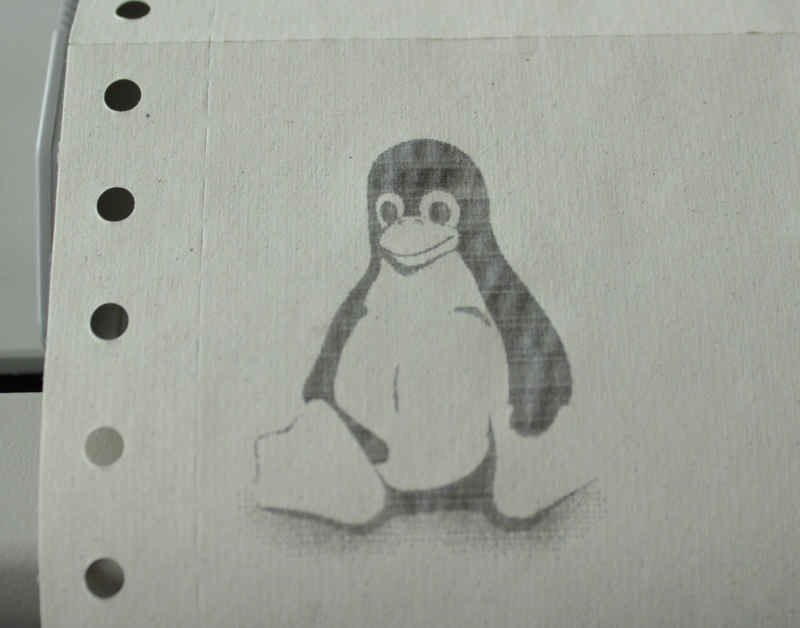
Sooooooooo, things happened, and I now have a dot matrix printer again. 😍😂
⤋ Read More
This is why I love tech from that era.
Write bytes to a parallel port and stuff happens. If it’s just ASCII bytes, then it will print ASCII text. Even the simplest programs can use a printer this way.
With a little bit of ESC/P, you can print images and other fancy stuff. That’s what I did this morning – never worked with ESC/P before, now I can print images. It’s not that hard.
Hayes-compatible modems are similar: Write some AT commands to the serial port and the modem does things. This isn’t even arcane knowledge, it’s explained in the printed manual.
Maybe I’m wearing rose-tinted glasses here, but I think with all this old stuff, you get useful results very quickly and the manuals are usually actually helpful. It’s so much easier to get started and to use this hardware to the full extent. Much less complexity than what we have today, not a ton of libraries and dependencies and SDKs and cloud services and what not.
↳
In-reply-to
»
trying to start a new habit of taking daily notes in obsidian... i really hope i can make it stick!
⤋ Read More
@kingdomcome@yarn.girlonthemoon.xyz I REPLIED TO THIS AND NOW IT’S NOT SHOWING WTFFFF anyway what i said was that i have some fun stuff in the daily note template already like ASCII weather forecast from wttr AND a jenny holzer quote from fortune!!! i should add more fun stuff!!!
↳
In-reply-to
»
Test: Just ASCII
⤋ Read More
@movq@www.uninformativ.de and, finally, I see the ASCII. :-)
Test: Just ASCII
Perfect ASCII diagram builder
#ascii
↳
In-reply-to
»
this is sooo cute and so fun i got it for timer stuff bc lord knows i need a timer on my computer and now i'm staring at animated ASCII cats that kiss https://github.com/poetaman/arttime
⤋ Read More
@kat@yarn.girlonthemoon.xyz just spent like an hour playing with this and adding newjeans ASCII art this is the cutest shit ever
this is sooo cute and so fun i got it for timer stuff bc lord knows i need a timer on my computer and now i’m staring at animated ASCII cats that kiss https://github.com/poetaman/arttime
↳
In-reply-to
»
I think it's time I set up jenny for this feed... been echo-ing my twits manually and there came times when it made me feel like a dork xD Plus I don't have my vim's
⤋ Read More
:set spell to catch up with the typos
charset used to be "us-ascii" but setting it to "utf-8" changed nothing… 🤔
skinshafi@thunix:~$ neomutt -Q charset
set charset = "us-ascii"
skinshafi@thunix:~$ neomutt -Q charset
set charset = "utf-8"
Notes on monospace, fonts, ascii, unicode | https://wonger.dev/posts/monospace-dump
↳
In-reply-to
»
Hmmmm, I somehow run into an encoding problem where my inserted data end up mangled in the database. But, both SQLite and Go use UTF-8. What's happening here? :-?
⤋ Read More
@movq@www.uninformativ.de Non-ASCII characters were broken. Like U+2028, degrees (°), etc.
Turns out I used a silly library to detect the encoding and transform to UTF-8 if needed. When there is no Content-Type header, like for local files, it looks at the first 1024 bytes. Since it only saw ASCII in that region, the damn thing assumed the data to be in Windows-1252 (which for web pages kinda makes sense):
// TODO: change default depending on user's locale?
return charmap.Windows1252, "windows-1252", false
https://cs.opensource.google/go/x/net/+/master:html/charset/charset.go;l=102
This default is hardcoded and cannot be changed.
Trying to be smart and adding automatic support for other encodings turned out to be a bad move on my end. At least I can reduce my dependency list again. :-)
I now just reject everything that explicitly specifies something different than text/plain and an optional charset other than utf-8 (ignoring casing). Otherwise I assume it’s in UTF-8 (just like the twtxt file format specification mandates) and hope for the best.
↳
In-reply-to
»
@shreyan The only problem is that there is no such thing as “plain text”. Is it ASCII? UTF-8? DOS or UNIX line endings? Something else?
⤋ Read More
@movq@www.uninformativ.de the true 7 bit ascii
↳
In-reply-to
»
Check out the Nex Protocol. It's designed to be even simpler than Gemini and Gopher. What do you think? Could be great to host a twtxt feed on.
⤋ Read More
@shreyan@twtxt.net The only problem is that there is no such thing as “plain text”. Is it ASCII? UTF-8? DOS or UNIX line endings? Something else?
.txt or “plain text” are ambiguous terms, I’m afraid. 🫤
Other than that, it looks neat and interesting. 😅
↳
In-reply-to
»
My kid just uncovered a bug in a program I wrote by grabbing my laptop and smacking the keyboard a bunch. Biological input fuzzing; a real-life chaos monkey.
⤋ Read More
“ç”, I think. Anything above 7-bit ASCII would’ve done it, though.
New repository: aquilax/img2ascii - Image to ascii converter/library