↳
In-reply-to
»
The original twt is unavailable. It may have been edited or deleted, or is from an unknown or muted feed.
⤋ Read More
@itsericwoodward@itsericwoodward.com Haha, we had the same joke. :-D Took them also many attempts to include a timestamp datatype in the standard library that is halfway usable.
↳
In-reply-to
»
🎶 "Falling to Pieces" - Faith No More (1989) https://music.youtube.com/watch?v=j5Z8X-dm3w8&si=Ig-oAL4kpDHcy5QF
⤋ Read More
@lyse@lyse.isobeef.org Yeah, it’s what we use for streaming. We’ve had a YouTube Faamily plan for years (we originally signed up to keep the ads away from the younglings), and it’s included as part of the deal. I also have some hard-to-find music I uploaded to it back when it was Google Play Music. Still, I wouldn’t recommend it to anyone, per se.
Just some light Sunday afternoon entertainment: Printing from NetBSD on the dotmatrix printer by dumping data to /dev/ulpt0. The netbook doesn’t have a parallel port, so this must be done over USB. NetBSD.escp was created by a little custom ESC/P converter written in C. 🥳
https://movq.de/v/14b09c47a5/print-small.mp4
Video description:
Video begins with a view of the netbook’s screen: 3 windows are open, one of them showing the typical NetBSD logo to print, the other one shows the commands I ran in preparation:
magick /usr/X11R7/include/X11/pixmaps/NetBSD.xpm -depth 8 -alpha set /tmp/NetBSD.pam
./pam2escp /tmp/NetBSD.pam /tmp/NetBSD.escp
The other terminal shows a root shell with this command:
cat /tmp/NetBSD.escp >/dev/ulpt0I hit Enter, the printer starts printing.
Camera pans to show the printer, an Oki ML 3390. Continuous paper. Once finished, I manually feed the paper a little bit to better show the result.
(If you turn up the volume enough, you can hear “Leaving” by “Chill Carrier” from 2008.)
↳
In-reply-to
»
@lyse What is that crazy large Dino Chicken in 23.jpg? :D
⤋ Read More
@lyse@lyse.isobeef.org Ahh, ohh! Thanks! :D
Both of these scenarios is mindboggling – imagine such a world:
Gastornis species were very large birds that were traditionally thought to have been predators of various smaller mammals, such as ancient, diminutive equids. However, several lines of evidence, including the lack of hooked claws (in known Gastornis footprints), studies of their beak structure and isotopic signatures of their bones, have caused scientists to now consider that these birds were probably herbivorous, feeding on tough plant material and seeds.
If they ever invent a time machine, I wanna go back to the Dinos. 🦕
Had no clue @prologic@twtxt.net has his own computer mouse brand now, straight up giving them away, for under $3 a piece.
I got one and well pleasantly surprised, especially for the price. It fits perfectly in the hand, decent rubber, weighs nothing, clicks very silently. The scroll wheel is where you can feel some of the cost cutting, it’s pretty wonky, but good enough.
Classic cheap thin long cable, you better like 1600 DPI, cause there’s no button to change that. Sensor is the usual red light, but works on all surfaces, bedsheets included. Gliders are small and not around the sensor, but at this weight, that makes next to no difference.
Decent 8/10 option

Had no clue @prologic@twtxt.net has his own computer mouse brand now, straight up giving them away, for under $3 a piece.
I got one and well pleasantly surprised, especially for the price. It fits perfectly in my hand, decent rubber, weighs nothing, clicks very silently. The scroll wheel is where you can feel some of the cost cutting, it’s pretty wonky, but good enough.
Classic cheap thin long cable, you better like 1600 DPI, cause there’s no button to change that. Sensor is the usual red light, but works on all surfaces, bedsheets included. Gliders are small and not around the sensor, but at this weight, that makes next to no difference.
Decent 8/10 option

Real tired of doing these, but here’s another Android developers vs Google update, this time there’s both good and bad news.
The good:
-Users will be able to enable “sideloading” for all current and future devices, attached to their Google account, rather than having to undergo the tedious 24 hour wait including process, on each device.
-Rather than these changes to “sideloading” and “advanced workflows” being implemented at random different dates, in different countries, we’ll all get them come 2027.
The bad:
As GrapheneOS developers recently mentioned “Google replaced pushing Git tags for certain source code with obtaining source code via Google Drive after making a request through Google Forms. It’s completely ridiculous and they’ve gradually become very slow at handling requests. They’re in clear violation of the GPLv2 now.”
whole thread: https://grapheneos.social/@GrapheneOS/117057099753905023
Just printed and sleeved some proxies for tomorrow night’s #Magic games, including this one from my Guardians of the Multiverse deck:

He’s Spider-Man Supreme, from Clash of the Champions - a Spider-Man from a universe where Peter Parker is also the Sorcerer Supreme of his Earth. He’s one of my favorite characters in the game, and I thought he’d be an appropriate proxy for Cosmic Spider-Man (the best card from the Spider-Man set, but only really useful for a tribal Spiders deck).
↳
In-reply-to
»
Germans love consonants – and it’s the opposite with Scandinavian languages, isn’t it? 😅 This is so crazy for me to listen to:
⤋ Read More
@lyse@lyse.isobeef.org there is a Czech song, intentionally written to include no vowels except “a”, with “a” being included in every word, except the one letter long ones:
https://youtu.be/eB1cL4I5OZ8
This is obviously not common, and the author is a legend for accomplishing this.
↳
In-reply-to
»
The original twt is unavailable. It may have been edited or deleted, or is from an unknown or muted feed.
⤋ Read More
@david@daiwei.me if you have some weekend home type place, with no Internet, getting TV through an antenna and a DVBT box, my recommendation is to just buy some old Dell monitor with HDMI to 3.5mm audio output built in, so you can connect speakers to it.
Doesn’t have to be Dell, but you can often just buy one of those from your employer, for under $25 here.
Were this sadly makes much less sense, in with Internet TV services. Those usually need a dedicated TV app to function and while that can be replaced with a $200 TV box, that some providers force you to rent, thus making you pay more for your Internet TV forever - this also means giving up the “archive app”, that gives you access to all the on demand content, included in the price of your mandatory TV license. None of these overpriced boxes come with it, as they’d mauch rather make you pay, for yet another subscription service instead.
So yes, you can kinda do it with an Internet TV too, assuming you trust the expensive box to not spy on you, but in that case you’re mostly just paying a whole lot more, for a lot less, than you would be, with the LG TV.
↳
In-reply-to
»
Hmm …
⤋ Read More
For the tags feed it would be cool to include the actual changelog entries
Did that now:

🥳
↳
In-reply-to
»
Advertise in ChatGPT | Hacker News Seriously?! 😳 wut da actual fuq?! 😱
⤋ Read More
@prologic@twtxt.net Our company is paying a shitload of money for all these (different) AI tools … I’m probably not allowed to tell you the exact number, but it is a lot. The only other way would be to lay off employees, so we can pay even more for AI. (Needless to say, that would be the worst possible move.)
For a private person, $20 a month is also pretty expensive, isn’t it? And then assume that you maybe need more than one AI tool. You’re quickly up to $50 a month or much more. This isn’t something that I, as a private person, will ever be willing to spend for this kind of stuff.
“AI” is just expensive as fuck. On every level. They will have to (ab)use every possible way to squeeze more money out of it, and that includes ads and what not.
↳
In-reply-to
»
Hmm …
⤋ Read More
@movq@www.uninformativ.de Good question. Tarballs are probably not needed, but might be convenient for people who don’t want to or can use a version control system. Not sure if there are non-techies who use your software. Tarballs for branches are overkill, though, I agree.
Looking at this more closely: As for the feeds, how about filenames “tags.atom” and “commits.atom”? Unless, of course, they were already named like that before.
For the tags feed it would be cool to include the actual changelog entries to be more useful if somebody takes this approach to get notified of new versions. But that would mean you have to duplicate the changelog entry into the annotated tag. And then you can’t fix changelog typos in the feed anymore. Alternatively, the feed generation would need to extract the section from the the CHANGES file. That has the benefit of automatically providing changelogs for past versions in the feed.
↳
In-reply-to
»
Hmm …
⤋ Read More
@david@daiwei.me Oh, that is a good idea. This could be included here, yeah. 🤔
Okay, so, my website also includes my code / git repos, and those are made browsable by stagit. What I don’t like about this (these days) is that this includes all the diffs of my commits. In other words: All my code.
This makes it super easy for malicious crawlers to slurp up valuable data. I don’t like that.
I’m thinking about switching to this instead:
It still shows project infos and there are Atom feeds, but to get the code, you have to actually clone the repos.
🤔
(If you spot any bugs, let me know.)
↳
In-reply-to
»
Another post, to show @prologic I am around. I am not dead! Not for 9 days!
⤋ Read More
@prologic@twtxt.net that are included, part of the first round. LOL.
↳
In-reply-to
»
The original twt is unavailable. It may have been edited or deleted, or is from an unknown or muted feed.
⤋ Read More
@david@daiwei.me Right now, tt’s theme is baked into the binary. I have to edit the ui/styles.go and recompile. Luckily, this almost takes no time. But my todo list already includes a bullet point to make this customizable via the configuration file. :-)
↳
In-reply-to
»
(Just a brain dump, nobody needs to read this.)
⤋ Read More
@movq@www.uninformativ.de My grief with Java is that it’s sooo verbose. Sure, all the enterprise garbage makes it a hell lot more terrible, but even regular Java feels always so lengthy. And back in the days when I was using it daily, I missed so many convenient things in the stdlib after having experienced Python’s “batteries included”. Not sure if or how recent Java versions caught up.
↳
In-reply-to
»
I don't think I'm going to add edit and delete support in this app because I think it was a horrible mistake to add those features to a client 🤣
⤋ Read More
The only place where this would be an issue is the Twtxt Search Engine – But as the GDPR also points out:
Art. 17
The one place the “it propagated and I can’t recall it” problem is legally acknowledged is Art. 17(2), and it explicitly scales to what’s technically feasible:
“…the controller, taking account of available technology and the cost of implementation, shall take reasonable steps, including technical measures, to inform controllers which are processing the personal data that the data subject has requested the erasure…”
Best-effort, given the technology. A decentralised, append-only, content-addressed feed is the available technology, and its limits are baked into the standard the law applies. Nobody — not the user, not you — is obliged to guarantee every cached copy vanishes.
↳
In-reply-to
»
test
⤋ Read More
@kat@yarn.girlonthemoon.xyz omg i haven’t been here in FOREVER i’m sorry yarn friends!!! i’ve had a lot going on including being extremely depressed :(
↳
In-reply-to
»
⤋ Read More
+00:00 vs Z should be treated as equivalent UTC 🤦♂️ I'll take a look at the timestamp parsing in Yarnd 🧐
@prologic@twtxt.net For what it’s worth, the twt hash extension is specifically modeled after yarnd’s implementation with all the quirks coming from Go’s stdlib: https://twtxt.dev/exts/twt-hash.html#timestamp-format
“All timezones representing UTC must be formatted using the designated Zulu indicator Z rather than the numeric offsets +00:00 or -00:00. If the timestamp does not explicitly include any timezone information, it must be assumed to be in UTC.”
Hello everyone ! 👋 Behold I bring you (after many years) the launch of the Twtxt App 😅 – Ye, this is a Desktop and Mobile app built as a Progressive Web App (PWA) using a little framework (Swag) I put together iafter some experiments @xuu@txt.sour.is and I did in Go and HTMX and Service Workers.
The App is offline-first and supports installing to Desktop and Mobile (add to Home screen) and supports a number of publishing backends, including Yarn.social’s yarnd Pod, Github, Codeberg/Gitea, and a little tiny twtd Twtxt server (See: https://git.mills.io/yarnsocial/twtd).
Please try it out, no need for any account(s) or such, works with your existing feed(s) (as long as the publishing backends work well enough for you!). Please give me feedback! 🙏
Also, did you know the Twtxt Search Engine is back? 🎉
This is a neat tool for comparing several public DNS resolvers (some of which were new to me) on various criteria; includes a speed test. https://evilbit.de/dns-resolver-guide.html
↳
In-reply-to
»
Finally finished another meme one, I always wanted. It took forever, to get it right, so I really hope people get the reference.
Media
⤋ Read More
@lyse@lyse.isobeef.org Thanks! You had one of the strangest guesses so far, first one I had to look up. 😄 It is a reference to a (human) cop/detective, from a 2019 videogame. Since there’s no spoilers tag on Twtxt, the name of the file on my site, includes the correct answer.
↳
In-reply-to
»
I complain about this a lot:
⤋ Read More
@movq@www.uninformativ.de Oooph! Web development is tidious.
I also include width and height from now on in my galleries.
↳
In-reply-to
»
Numbered headings in blog posts, yay or nay?
⤋ Read More
@movq@www.uninformativ.de I reckon section numbers are not really needed for articles. But if you number them, the anchors should probably not contain the section number, just the title. Especially for articles that may receive updates.
It’s probably another story for specifications. They’re kinda fixed and thus I found it useful in the past to include the section numbers in the anchors, so they show up in URLs when linking to specific sections. W3C RFCs only include the numbering in the anchors. This makes URLs fairly short, but it would be also nice to directly see what kind of section that URL actually links to.
↳
In-reply-to
»
@movq Yeah, that would also be fine with me. I certainly do like the "arbitrary" in your comment.
⤋ Read More
I now decided to include the alternatives: https://lyse.isobeef.org/code-readability/#alternative-timestamp-formattings
So I’ve been working on GoNIX the last few days… Which is derived from µLinux – At least it’s entire build process. GoNIX however has a 100% Go userland, including the init process, package and service management.
Now… As an experiment, because I was able to make much process on enhancing the build tools and package management, I decided to see if I could build a “Desktop” Gui of sorts…
I still wanted it to be fairly minimal and lightweight. So I went with wayland (of course) and labwc and yambar. So far I’m liking the result 👌 42 packages in the wayland-desktop meta port. Not too bad. Not sure if I can slim that down anymore… But trying to avoid Mesa/GL as that drags in far too much “cruft”.
balloon added a twtxt central page, including a timeline.
Nightfall Shore resident balloon has been doing a lot of work improving the district! balloon added a twtxt central page, including a timeline.
↳
In-reply-to
»
Oh boy, I absolutely hate this stupid trend of not writing changelogs anymore! Why the fuck would one seriously consider it to be a viable option to just let some shitty bot spew all merge requests on a goddamn GitHub release?! First of all, these merge request titles suck balls. The order of the changes in this "changelog" is completely random (well, probably merge time, which is as useless as the dick on the Pope). They are not grouped by anything at all. Additions, changes, removals, deprecations, etc. randomly mixed up in one giant list. And then "Add feature X", seventeen kilometers further down "Revert 'Add feature X'". Fuck you! Don't include this shit in the first place!
⤋ Read More
@movq@www.uninformativ.de I just ran across another thing. At least I personally couldn’t care less about CI infrastructure changes. Whether they’re using github action a or b or c or version v or w, it is not of my interest. At all. (It might be useful to estimate the supply chain attack risk, though.) If the maintainers want to include them in the changelog – and there are probably people to whom this information is crucial – it’s probably best to document CI infrastructure changes in their own section.
↳
In-reply-to
»
Oh boy, I absolutely hate this stupid trend of not writing changelogs anymore! Why the fuck would one seriously consider it to be a viable option to just let some shitty bot spew all merge requests on a goddamn GitHub release?! First of all, these merge request titles suck balls. The order of the changes in this "changelog" is completely random (well, probably merge time, which is as useless as the dick on the Pope). They are not grouped by anything at all. Additions, changes, removals, deprecations, etc. randomly mixed up in one giant list. And then "Add feature X", seventeen kilometers further down "Revert 'Add feature X'". Fuck you! Don't include this shit in the first place!
⤋ Read More
@movq@www.uninformativ.de You may want to include another antipattern to avoid in your article:
- bump $same_dependency from 1.0.0 to 1.0.1
- bump $same_dependency from 1.0.1 to 1.0.2
- bump $same_dependency from 1.0.2 to 1.1.0
- bump $same_dependency from 1.1.0 to 1.2.0
Oh boy, I absolutely hate this stupid trend of not writing changelogs anymore! Why the fuck would one seriously consider it to be a viable option to just let some shitty bot spew all merge requests on a goddamn GitHub release?! First of all, these merge request titles suck balls. The order of the changes in this “changelog” is completely random (well, probably merge time, which is as useless as the dick on the Pope). They are not grouped by anything at all. Additions, changes, removals, deprecations, etc. randomly mixed up in one giant list. And then “Add feature X”, seventeen kilometers further down “Revert ‘Add feature X’”. Fuck you! Don’t include this shit in the first place!
Fits absolutely perfect in the pattern of rapid decline.
I must rip out all dependencies as soon as possible whose maintainers just don’t give a shit.
I was just about to stop my feature freeze and include standard.site in the IndieConnector. Almost.https://maurice-renck.de/en/blog/2026/indieconnector-and-standard-site
↳
In-reply-to
»
@lyse Ah, I almost thought so (that you wrote it by hand), but then I looked at the source code and saw the TOC and I was like: “Naah, probably not. I would be way too lazy to do that manually.” 😅 And indeed … ha.
⤋ Read More
@lyse@lyse.isobeef.org Switching to Make might be a good idea, though, because the whole thing is purely sequential at the moment … It takes close to 20 seconds (including the w3c verification which runs the Java checker). It’s not unusable, but it could be better. 😅
↳
In-reply-to
»
@movq Thanks. I noticed the
⤋ Read More
<updated> of the feed, too. But for some reason, some articles were suddenly marked as new.
Aha, yesterday’s newly added support for LC_TIME to render localized timestamps also broke the feed parsing with my LANG=de_DE.UTF-8 and LC_CTYPE=de_DE.UTF-8 environment. :-)
Atom feeds make use of RFC 3339 timestamps. They are first converted into RFC 882 timestamp representation, which is the one that RSS feeds use. However, this conversion now results in localized RFC 882 timestamps, which cannot be parsed into Unix timestamp numbers via curl_getdate(…). I bet that it doesn’t know about the localization at all and expects English month and weekday names. Looking at its docs, I reckon that function was selected because of its myriad of supported timestamp formats: https://curl.se/libcurl/c/curl_getdate.html RFC 3339 is not included, though, hence the transformation up front.
The intermediate Item objects in the parser domain use std::string for the timestamp representation. This isn’t all that silly, because Newsboat supports all sorts of different feed formats with different timestamp formats. These RFC 883 timestamps are centrally parsed into time_t.
Speaking of time: It’s time to go to bed after this late bug hunting fun. :-)
↳
In-reply-to
»
@lyse (Do you want to be linked on that page? Do you want your name to be there at all? 🤔)
⤋ Read More
@movq@www.uninformativ.de I really like your style of writing, btw. It’s much calmer and less aggressive then mine. :-) When I turned my bullet points into paragraphs, I got a bit mad in the process.
Sure, feel free to include anything you want. Regarding citing, this is where twtxt falls short in my opinion. Especially with feed rotation, classic links die quickly. Message hashes only help so much. Nobody outside the twtxt universe knows how to deal with them. So, not perfect for inclusion on a web page. Linking to a thread or message on some yarnd instance might be the more user-friendly option. But the disadvantage is that it’s “just” a mirror, not the primary or original source. In all reality, this could be considered splitting hairs, though.
I should have probably written a proper article. That would have given me time to review the result more carefully, too. ;-) Perhaps that’s something for the future. But honestly, I’m not sure if I really want to waste my time and energy on that subject. So many other fun or useless things come to mind right away that I could do instead. 8-)
So, yeah, do whatever feels best to you. I don’t mind being cited or linked, but I also don’t mind not to be cited or not to be linked to. :-D Not a helpful answer, I know. Sorry. ;-) But anyway, thanks for asking, mate! I do appreciate it.
To finish my thought, linking to my frontpage is probably also useless, since I deliberatly do not have a table of contents there. In fact, my entire frontpage is rather silly.
↳
In-reply-to
»
I’ve started collecting reasons against AI usage here, so I don’t have to repeat myself all the time:
⤋ Read More
Of course, @movq@www.uninformativ.de! Most of my points are also included in your list.
First of all, programming is what I really do enjoy the most. So, it doesn’t make any sense at all to not do this anymore. “But you could use your now free time to do something much cooler and more valuable!”, others might reply. Fuck no, I don’t want to waste my time with other shit that doesn’t fulfill me, why on earth would I want to do that?
All this hallucination reduces quality badly. In my experience, it’s also happening much more rapidly than I expected. Even though developers are still supposed to own and understand whatever has been generated under their name and even be responsible for that, the sad reality is that teammates often blindly trust the AI output. “But I asked the AI and it told me that $this was impossible”, “I’ve no idea either, but the AI just generated it” are responses I get more often. What really makes my angry is when I point out a flaw and suggest an alternative and this is the reaction. It happened several times that just trying it out and seeing it clearly work to proof my point only took me half a minute, but people still did something handwavy else instead.
The learning effect is drastically reduced. The more time I spend on a topic, the better the odds that whatever I learned actually makes it over into long-term memory. It’s like if a collegue just says “do it like that” or “this solves your problem”, but neither explains the why or how. Somehow, people are still convinced that it’s a completely different story when you replace the human counterpart with a computer program in this equation.
Skills are unlearned. It’s like with automation in general, just much worse. You end up in a state where you’ve no clue how anything works under the hood or how to actually find out important information that are needed to solve your problem. You’re screwed when a process breaks out of the blue. Even though it can become also rather terrible, with classical automation you’re typically still be able to decipher how exactly the thing was supposed to do something.
The energy consumption is sooo high, I absolutely do not want to be a part in burning down our planet. I’m sure I find (and probably have long found without knowing) other ways to contribute to worsen our climate crisis.
The scraper part is already covered in detail in your list. :-)
I’m convinced that license and copyright violations are only played down or even refused entirely because companies want to make big money quickly. With the work of others of course. Their double standards are obvious, they still try to actively keep their own stuff secret and out of any training sets. At most for internal use only. Virtually noone in charge is interested in good long-term solutions. Short-term for the win, when disaster eventually strikes, the causers are long gone, the responsibilities in other hands.
Vendor lock-in is something that lots of folks are only realizing very slowly. It’s completely crazy to me. This drug dealer routine should be well-known by now. It’s fucking everywhere. Yet, people are always surprised when they found themselves caught in it.
Adding new AI stuff only increases complexity. But complexity is the enemy that everybody should fear and reduce as much as possible. Of course, this is not limited to AI at all. And everywhere I look around, people in charge looooove to make things way more complicated than they ever need to be. Yet, simplicity is the real art and much harder to achieve.
I don’t understand why we have to go back full force to the ambiguity of natural languages. This alone should be more than enough to realize what a stupid idea all that is. Linked to that is that the “instruction set” is interpreted differently with newer model versions. I mean, is has to be. Why else would somebody want to upgrade in the first place than to get more Powerful™ Features™?
Some people argue that with AI the democratization is empowered. However, in my view, the exact opposite is the case. Models are getting so large that you can basically not run them locally or even train them. So, you have to rely on whatever the vendor offers you and runs for you. In the end, this only gives the owners more power, the multi billionaires. Not exactly what I understand by democratization.
Finally, technology assessments are missing completely. Or they are faked such that mostly only the (questionable) benefits are listed. But all the negative impact is just ignored.
Let’s keep some popcorn around for when this all explodes. :-)
I’m pleased to announce that express-twtkpr (my ExpressJS library for hosting, editing, and posting to a twtxt.txt file) continues to crawl towards a full release with another (pre-alpha) update published to NPM. This update includes a whole new plugin system, and even a (little) more documentation. Check it out, if you dare (and use it at your own risk): https://www.npmjs.com/package/express-twtkpr
And speaking of plugins, here’s where the fun’s at: announcing express-twtkpr-core-plugins, a set of 3 plugins for your TwtKpr install: emojiButton, uploadButton, and postToMastodon. Like express-twtkpr, this set of plugins is still in pre-alpha, and lacks documentation, examples, tests, installation flexibility, or polish (so also use them at your own risk). Other than that, they work great: https://www.npmjs.com/package/express-twtkpr-core-plugins

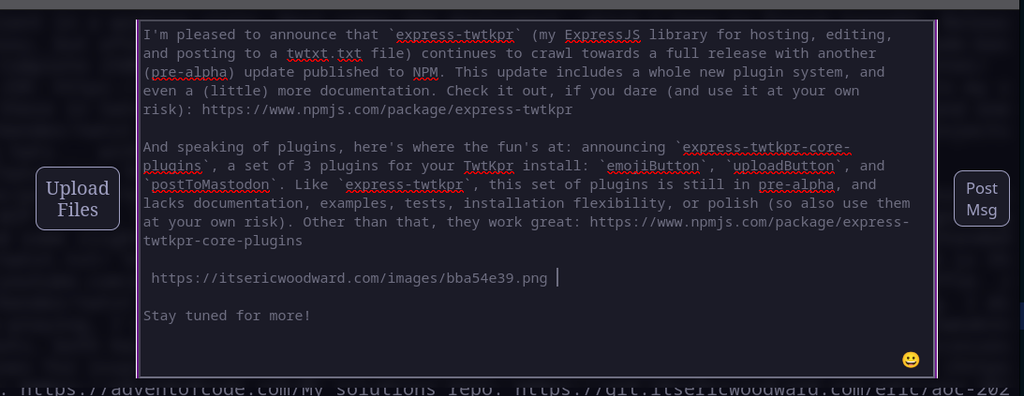
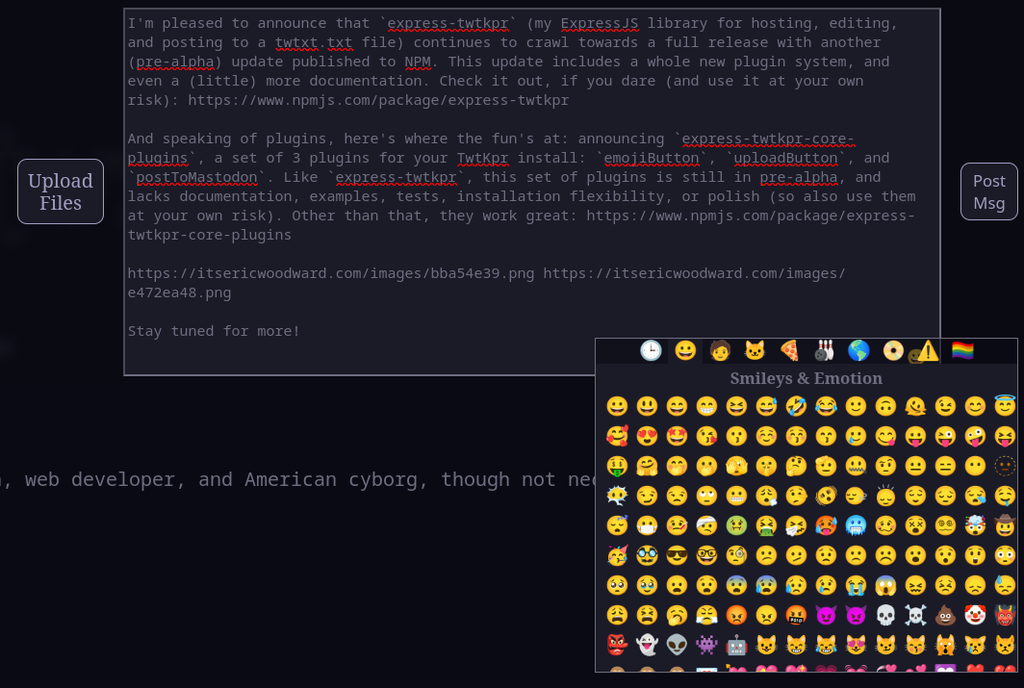
Stay tuned for more! 🤘
↳
In-reply-to
»
been a while, what's everyone been working on lately?
⤋ Read More
@kiwu@twtxt.net Working on my game Frontier Crown – Going to push a new version today hopefully that includes much improved graphics, expanded ruleset and scope.
The auDA, and some 3rd-party identify service and my Registrar are a joke!
WOW! I just had to share this little story I ran into today.
I tried to register a .AU Domain the other day, only for it to instantly fail.
I emailed support, which took several days to respond, only for them to respond by saying (paraphased):
We’re sorry, but the identify checks failed. The 3rd-aprty service doesn’t tell us why, But, please make sure that the ID you used matches the Full Name, including any Middle name(s).
I used my Passport number. Which of course has my First, Middle and Last Name.
I can only assume at this point that the checks failed on the missing “Middle name”. Why? Because the Registrar I use has a database and user interface for “contacts” that only have support for First name and Last name. NO Middle Name.
🤦♂️ This is basically stupid at this point. Systems cannot be trusted at the most fundamental level, no matter how good they are.
Until we figure out how to build a system that allows an individual to prove to another entity that they are who they say they are without a shred of doubt (i.e: cryptographically), we’re stuffed.
There is literally nothing I can do in this case. The auDA are at fault. The 3rd-party identify service (unknown) are at fault. The registrar are at fault. Hell, even the Passport office are at fault for even bothering to or requiring a Middle name.
How has “identity” come to this?
I won our only game of Magic for this week with my (yet-to-be published) “Bolas Triumphant” deck: 5 players over 3 hours, including 4 board wipes (one of which came from my Nicol Bolas, God-Pharaoh), and I even got to cast Omniscience via a Fae of Wishes. I can’t speak for everyone, but I know I had a good time. 😁
↳
In-reply-to
»
Just cancelled my sponsorship of two developers on Github, sorry 😞 -- I'm not going to sponsor going forward if no-one else can be bothered to. It seems silly to be the sole sponsor of another's work or project 🤦♂️
⤋ Read More
@prologic@twtxt.net I sponsor no one. If getting paid is the aim, form a business, or sell a product. I donate to just causes, though, including sponsorship to the dispossessed.
↳
In-reply-to
»
Eehhh, what the hell is going on here!?
⤋ Read More
@lyse@lyse.isobeef.org AI result ahead, feel free to ignore.
I “asked” the AI at work the same question out of morbid curiousity. It “said” that SQLite converts that integer to floating point internally on overflows and then, when converting back, the x86 instruction cvttsd2si will turn it into 0x8000000000000000, even if the actual floating point value is outside of that range. So, yes, it allegedly actually saturates, as a side effect of the type conversion.
I couldn’t find anything about that automatic conversion in SQLite’s manual, yet, but an experiment looks like it might be true:
sqlite> select typeof(1 << 63);
╭─────────────────╮
│ typeof(1 << 63) │
╞═════════════════╡
│ integer         │
╰─────────────────╯

sqlite> select typeof((1 << 63) - 1);
╭──────────────────────╮
│ typeof((1 << 63) ... │
╞══════════════════════╡
│ real                 │
╰──────────────────────╯
As for cvttsd2si, this source confirms the handling of 0x8000000000000000 on range errors: https://www.felixcloutier.com/x86/cvttsd2si
The following C program also confirms it (run through gdb to see cvttsd2si in action):
<a href="https://yarn.girlonthemoon.xyz/search?q=%23include">#include</a> <stdint.h>
<a href="https://yarn.girlonthemoon.xyz/search?q=%23include">#include</a> <stdio.h>

int
main()
{
    int64_t i;
    double d;

    /* -3000 instead of -1, because `double` can’t represent a
     * difference of -1 at this scale. */
    d = -9223372036854775808.0 - 3000;

    i = d;
    printf("%lf, 0x%lx, %ld\n", d, i, i);

    return 0;
}
(Remark about AI usage: Fine, I got an answer and maybe it’s even correct. But doing this completely ruined it for me. It would have been much more satisfying to figure this out myself. I actually suspected some floating point stuff going on here, but instead of verifying this myself I reached for the unethical tool and denied myself a little bit of fun at the weekend. Won’t do that again.)
What do the Gopher Troopers think of the following? The Gopher protocol is a nearly-forgotten network protocol from the early 1990s, designed to serve and navigate text-based menus and documents over the Internet. While its far less common than HTTP/HTTPS today, there are still some security risks associated with Gopher and Gopher space. Lets break them down carefully: 1. Lack of Encryption Problem: Gopher was designed long before widespread use of SSL/TLS. All dataincluding credentials, file transfers, and menu selectionsis transmitted in plaintext. Impact: Anyone intercepting traffic (e.g., via a network sniffer, public Wi-Fi, or a compromised router) can read sensitive information, including usernames and passwords. 2. No Authentication or Access Control Problem: Gopher servers rarely implement robust authentication; access control is usually limited or non-existent. Impact: Unauthorized users might browse sensitive directories or download private files, particularly if servers are misconfigured. 3. Server Software Vulnerabilities Problem: Modern OSes can still run legacy Gopher servers, but the software is often unmaintained. Impact: Old software may contain buffer overflows, directory traversal bugs, or command injection vulnerabilities that attackers could exploit. 4. Malicious Gopher Links Problem: Gopher menus can contain links that point to scripts or other servers, similar to hyperlinks in HTTP. A client following a malicious link could inadvertently: Download malware Access sensitive internal network resources (server-side request forgery) Impact: Could serve as a vector for attacks if a user opens content from untrusted sources. 5. Legacy Protocol Weaknesses Problem: Gopher lacks modern web security mechanisms like: Content security policies Same-origin policies Cross-site request forgery protection Impact: If Gopher is bridged to other services (like modern browsers via gateways), old vulnerabilities may be exposed. 6. Information Leakage Problem: Gopher servers often provide directory listings without restriction. Impact: Sensitive files, backup directories, and internal documents may be exposed unintentionally. 7. Bridging Risks Problem: Some modern browsers access Gopher via gateways (HTTP-to-Gopher proxies). These bridges may: Expose sensitive internal resources to the gateway Introduce logging or tracking that wouldnt exist on pure Gopher Impact: Attacks could occur indirectly through insecure intermediaries. Key Takeaways Gopher is inherently insecure due to its design in a pre-HTTPS era. Main threats: eavesdropping, unauthorized access, malware delivery, and exploitation of unpatched server software. Safe practice: Use Gopher only in isolated, trusted environments, or through secure HTTP(S) gateways with proper sanitization.
↳
In-reply-to
»
For the first time in years, I managed to get out and throw a round of disc golf. Had a good time playing Vietnam Veterans Park in Kannapolis, throwing +10 over 9 holes, with my only par being thanks to a 40' "putt" with my MRV. And the weather was perfect.
⤋ Read More
@lyse@lyse.isobeef.org For reasons I can’t fully explain, we have a bunch of courses in the area, most in public parks (they integrate nicely since they can be built with the existing landscape, only adding some yellow baskets, concrete starting pads, and maybe signs).
In my experience, the main difference between a disc golfer and a frisbee thrower is that the disc golfer will often have a bag full of different shapes of discs (including drivers of varying ranges and/or putters). Even in my small bag, I’ve got some long range drivers (a Beast, a Cheetah, a Valkyrie, and a Wraith), my aforementioned MRV (Mid-Range Vector), an ultralight Aero (which feels similar to a “standard” frisbee), and 2 “rubber” putters (softer plastic, less “bouncy”).

↳
In-reply-to
»
In the interest of fairness and hopefully for the last time, I ever have to address this, Google has flip-flopped again and promised "sideloading" will not be removed from their version of Android, but instead have to be enabled in the developer settings, using the following "advanced flow":
Media
To be perfectly clear, this still falls short of what I wanted, but at this point, it is a compromise I'm willing to take, over further pursuing this, through the various available European courts, myself.
⤋ Read More
@bender@twtxt.net both, but neither directly. I know every workaround there is, including those used by developers, to test apps, while working on them. However if “sideloading” becomes so tedious, even the more technical users, cannot be bothered to do it, competing appstores and independent developers, not wanting to send their money and ID to Google, loose users at such rate, they likely won’t be able to justify continuing to maintain their projects, people like me rely on.
↳
In-reply-to
»
Hello twtxt! I still exist. I have a baby now and put some pictures at https://photos.falsifian.org/ . Album HTML loosely inspried by @lyse
⤋ Read More
@falsifian@www.falsifian.org Congrats, mate, no sleep at night anymore! ;-D That’s a cool age measuring blanket. Haven’t seen something like that before.
Btw. the index.html includes an out of place </ul>. And I just wanna let you know that the full-size photos don’t load for me over here across the pond. They always run into a timeout after a few slooow percent. But no worries. :-)
👋 Looking for other interested folks to continue to evolve the development of Salty.im 🙏 I’ve been hard™ at work on the v2 branch and @doesnm.p.psf.lt@doesnm.p.psf.lt has been incredibly helpful so far. Be great ot have a few more folks to join us, some of the v2 highlights include:
- Double Ratchet by default.
- Group Chat (sender/client fan-out for now)
- Much better TUI with background agent.
- Mobile App coming soon™ (iOS in progress, Android next, same codebase)
I spent the day today integrating @xuu@txt.sour.is’s double ratcheting work and ratchet library back into the reference client/broker implementation saltyim as a v2 branch. I completely redesigned and rewrite the salty-chat TUI client as well, which now includes proper notifications and a background agent that keeps running so you never miss any messages. It all “just works”™ and I’m quite happy with the outcome! 🤩 #saltyim #revamp