↳
In-reply-to
»
Yeah.. it is very similar to salty.im a smp is a relay queue for messages. You can self host one if you choose. They also have something called xftp for data storage and device state transfer. You can also self host one.
⤋ Read More
I think salty.im is simplest than simplex. But attempt to implement this i have problems than salty cli cant decrypt messages from another saltpack realization (and reverse) . Also simplex is more decentralized (like nostr?)
↳
In-reply-to
»
If we stuck with Blake2b for Twt Hash(es); what do we think we need to reasonably go to in bit length/size?
⤋ Read More
@prologic@twtxt.net I’m sure you can somehow install something that calculates blake2b on OpenBSD. But it’s not part of the base system as a standalone CLI tool, there only appear to be Perl modules for it. The other SHA tools do exist.
↳
In-reply-to
»
@eldersnake I wanted to ask you, are you running Headscale and WireGuard on the same VPS? I want to test Headscale, but currently run a small container with WireGuard, and I wonder if I need to stop (and eventually get rid of) the container to get Headscale going. Did you use the provided
⤋ Read More
.deb to install Headscale, or some other method?
I ended up installing Headscale on my little VPS. Just in case the collide, I turned off WireGuard. Turning that one off (which ran on a container) also frees some memory. Headscale is running quite well! Indeed, I have struggled getting any web management console to work, but it really isn’t needed. Everything needed to commandeer the server is available through the CLI.
Could someone knowledgable reply with the steps a grandpa will take to calculate the hash of a twtxt from the CLI, using out-of-the-box tools? I swear I read about it somewhere, but can’t find it.
↳
In-reply-to
»
@aelaraji how would that work exactly? Does that mean then that every user is required to have a cox side profile? Who maintains cox site? Is it centralized or decentralized can be relied upon?
⤋ Read More
@prologic@twtxt.net well…
how would that work exactly?
To my limited knowledge, Keyoxide is an open source project offering different tools for verifying one’s online persona(s). That’s done by either A) creating an Ariande Profile using the web interface, a CLI. or B) Just using your GPG key. Either way, you add in Identity claims to your different profiles, links and whatnot, and finally advertise your profile … Then there is a second set of Mobile/Web clients and CLI your correspondents can use to check your identity claims. I think of them like the front-ends of GPG Keyservers (which keyoxide leverages for verification when you opt for the GPG Key method), where you verify profiles using links, Key IDs and Fingerprints…
Who maintains cox site? Is it centralized or decentralized can be relied upon?
- Maintainers? Definitely not me, but here’s their Git stuff and OpenCollective page …
- Both ASP and Keyoxide Webtools can be self-hosted. I don’t see a central authority here… + As mentioned on their FAQ page the whole process can be done manually, so you don’t have to relay on any one/thing if you don’t want to, the whole thing is just another tool for convenience (with a bit of eye candy).
Does that mean then that every user is required to have a cox side profile?
Nop. But it looks like a nice option to prove that I’m the same person to whom that may concern if I ever change my Twtxt URL, host/join a yarn pod or if I reach out on other platforms to someone I’ve met in her. Otherwise I’m just happy exchanging GPG keys or confirm the change IRL at a coffee shop or something. 😁
↳
In-reply-to
»
On the Subject of Feed Identities; I propose the following:
⤋ Read More
@mckinley@twtxt.net To answer some of your questions:
Are SSH signatures standardized and are there robust software libraries that can handle them? We’ll need a library in at least Python and Go to provide verified feed support with the currently used clients.
We already have this. Ed25519 libraries exist for all major languages. Aside from using ssh-keygen -Y sign and ssh-keygen -Y verify, you can also use the salty CLI itself (https://git.mills.io/prologic/salty), and I’m sure there are other command-line tools that could be used too.
If we all implemented this, every twt hash would suddenly change and every conversation thread we’ve ever had would at least lose its opening post.
Yes. This would happen, so we’d have to make a decision around this, either a) a cut-off point or b) some way to progressively transition.
↳
In-reply-to
»
This tool, using age is pretty neat: https://github.com/ndavd/agevault. So simple, yet seemingly powerful!
⤋ Read More
@mckinley@twtxt.net agevault uses age, allegedly very secure (aiming to replace pgp/gpg). Comparing it with gocryptfs, from the user perspective, agevault seems simpler, though CLI exclusive. As the repository states, “Like age, it features no config options, allowing for a straightforward secure flow”. It would also run in all major OS platforms out of the box.
But agevault is also very new. Though age has been around for a while now, I don’t see an “audited” link (neither on agevault, nor age).
I just revisited my first script which posts to Mastodon and twtxt from CLI
installed verbiste to display the conjugation of French verbs from the cli https://yctct.com/french-conjugation
I’m still figuring out interactions mechanics on Twtxt, for example the at symbol is sufficient to mention someone you follow I guess, like @twtxt@buckket.org when using the twtwt cli. is that implemented in the twtxt cli as well? it wouldn’t heart to try
Good! I guess I’m done setting up my Twtxt. I’ll be juggling between the official CLI and Twixter, although I already have a favorite.
@orahcio@vaporhole.xyz recurso como barra de rolagem você tem modo cli via pageup pagedown
Found a new CLI timetracker assistant named Watson. Works really well.
My cli work-apps: note, plan, dlog (daily log), status and twt.
↳
In-reply-to
»
We're still here!
⤋ Read More
@prologic@twtxt.net I’ve even added the twthash message hash to my Twtxt bash CLI script so I can properly answer here.
Using the CLI to be in-dis-tractable
↳
In-reply-to
»
I'm using rss on a terminal (Termux) in my phone, it's more confortable read there articles and other stuff, but for posting on twtxt, I tried , I swear it, but it's too much, it's not practical, I have to assume that it's better in a website/app like this.
⤋ Read More
[lang=en] That was the reason for twtxt-php =P
I tried using CLI tools but it was too hacky, I think.
More if we consider Jakob’s Law, where we have prior expectations of a microblogging system.
A Web interface could be quite minimalistic and usable as well. (And mobile-friendly)
New repository: aquilax/hrana - D port of hranoprovod-cli
↳
In-reply-to
»
En un ejercicio de diseño, ¿que pasaría si hacemos el inicio de sesión solo con un código dinámico TOTP?
⤋ Read More
bueno, me he entretenido un montón creando un CLI en Python para los OTP pues el que usaba hecho en Go, se ha quedado muy corto.
Con ayuda de ChatGPT para encender una chispa, y unas búsquedas para corregir cosas, ha quedado en una hora. 🤔
↳
In-reply-to
»
En un ejercicio de diseño, ¿que pasaría si hacemos el inicio de sesión solo con un código dinámico TOTP?
⤋ Read More
bueno, me he entretenido un montón creando un CLI en Python para los OTP pues el que usaba hecho en Go, se ha quedado muy corto.
Con ayuda de ChatGPT para encender una chispa, y unas búsquedas para corregir cosas, ha quedado en una hora. 🤔

Ratchet CLI now supports salty or ratchet comms!
@prologic@twtxt.net @movq@www.uninformativ.de this is the default behavior of pass on my machine:
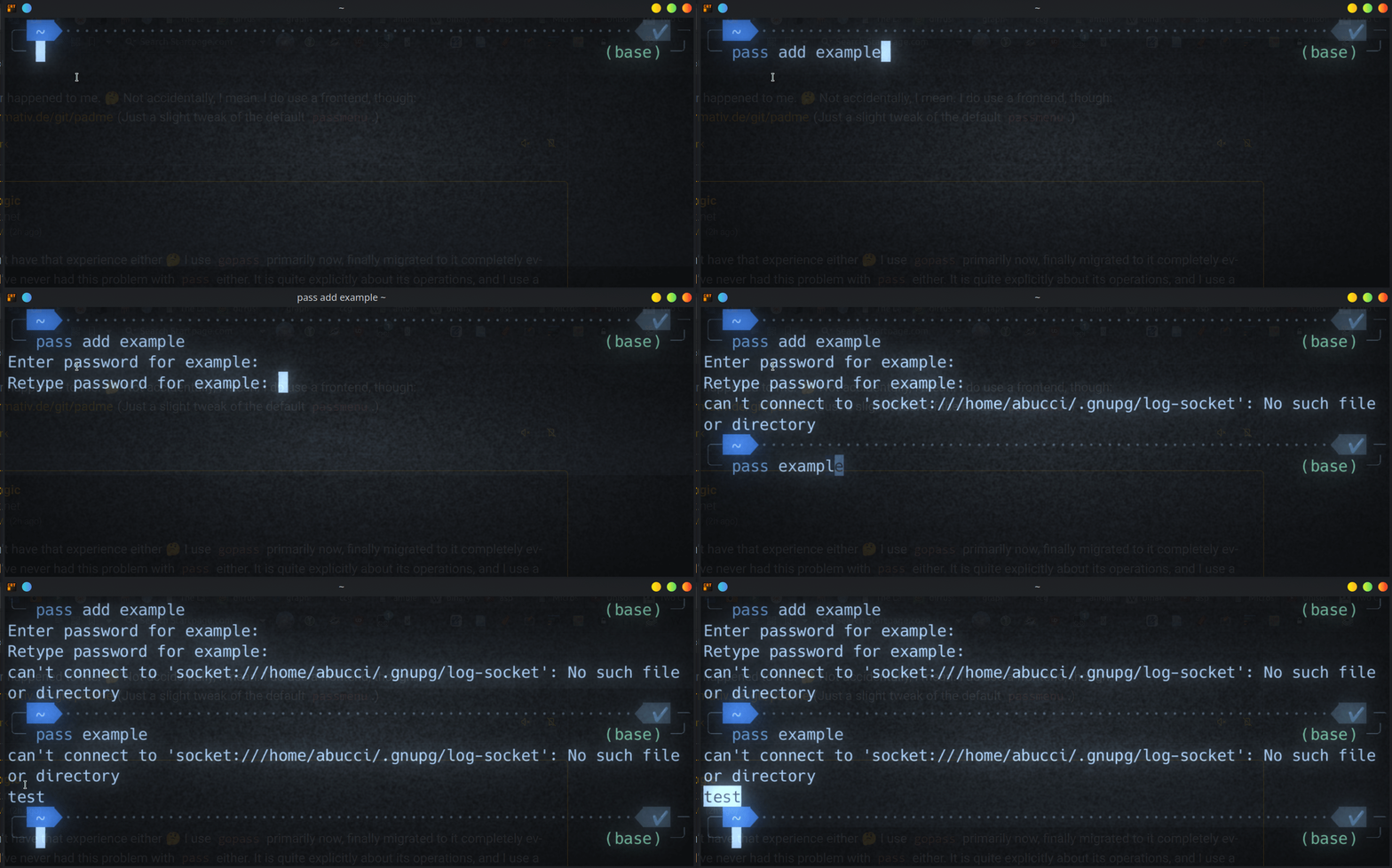
I add a new password entry named example and then type pass example. The password I chose, “test”, is displayed in cleartext. This is very bad default behavior. I don’t know about the other clis you both mentioned but I’ll check them out.
The browser plugin browserpass does the same kind of thing, though I have already removed it and I’m not going to reinstall it to make a movie. Next to each credential there’s an icon to copy the username to the clipboard, an icon to copy the password to the clipboard, and then an icon to view details, which shows you everything, including the password, in cleartext. The screencap in the Chrome store is out of date; it doesn’t show the offending link to show all details, which I know is there because I literally installed it today and played with it.
updated kalk, a minimal CLI RPN calculator with some extra quirky fuctionality. Pretty happy with its current status https://git.sr.ht/~noizhardware/kalk
updated kalk, a minimal CLI RPN calculator with some extra quirky fuctionality. Pretty happy with its current status https://git.sr.ht/~noizhardware/kalk
https://duckduckgo.com/tty/ duckduckgo mais en cli \o/
🥳 I am loving it. Woot, back to the CLI, it just feels good! 🙈
Hey @xuu@txt.sour.is another mention that didn’t render ☝️
@thewismit@twtxt.psynergy.io Hey! It’s easy. Just install the twt CLI with something like:
go get github.com/jointwt/twtxt/cmd/twt/...
Then use it in some hooks/scripts to post some content to your Pod.
New repository: aquilax/hranoprovod-cli - Diet tracker for the command line
Looking for a CLI bookmark manager, I found this: https://zachholman.com/boom/
New repository: aquilax/dirble-cli - Command line tool for accessing https://dirble.com API