Another nice stroll in nature last week: https://lyse.isobeef.org/waldspaziergang-2025-04-03/

↳
In-reply-to
»
@lyse I do agree "the rules of the web", are far too loose - at least the syntax ones. I do think backwards compatibility is necessary.
⤋ Read More
@thecanine@twtxt.net My apologies, mate! :-( As @david@collantes.us pointed out, this was definitely not my intent at all.
For the easter egg hunt, I first looked for a hidden image map link on the pixel dog in the right lower corner itself. Maybe one giant pixel just links to somewhere else, I figured. But I couldn’t find any and then quickly moved on. Hence, I naturally viewed the HTML source. Because where else would be a good hiding place for easter eggs, right?
Next, I noticed the <font> tags. I thought I had read quite some time ago that they are not an HTML5 thing, but wasn’t entirely sure about it. So, I asked the W3C HTML validator. Sure enough. I thought I let you know about the violations. If somebody had found a mistake on my site, I’d love to hear about it, so I could fix it. I’m sorry that my chosen form of report didn’t resonate with you all that well. I reckoned you’ll also find it a bit funny, but I was clearly very wrong on that.
I actually followed the dog cow link to the video, so I ended up on the easter egg. However, I didn’t recognize it as such. ¯_(ツ)_/¯ Oh well.
Regarding my message about the browser quirks: I read your answer that you were arguing against the HTML validator findings. Of course, everybody can do with their sites whatever they likes.
↳
In-reply-to
»
This time, I brought my cam along. We checked out a piece of ex-forest they've cut down. It looks terrible now. :-( At least the spruce resin smell was nice. https://lyse.isobeef.org/waldspaziergang-2025-03-27/
⤋ Read More
@lyse@lyse.isobeef.org This is so crazy to me. When I think “forest”, I assume “untouched nature”, but that couldn’t be further from the truth. 🫤
Since this study was published this month, I’ve been wrapping my head around entanglement https://www.nature.com/articles/s41586-024-08404-x
Short summary of Project2025 and Trump’s plans for the US:
Abolish the Federal Reserve
Why? To end what is seen as an unelected, centralized body that exerts too much influence over the economy and monetary policy, replacing it with a more transparent, market-driven approach.Implement a national consumption tax
Why? To replace the current federal income tax system, simplify taxation, and increase government revenue through a broader base that includes all consumers.Lower corporate tax rates
Why? To promote business growth, increase investment, and stimulate job creation by reducing the financial burden on companies.Deregulate environmental policies
Why? To reduce government intervention in the economy, particularly in energy and natural resources sectors, and to foster a more business-friendly environment.Restrict abortion access
Why? To align with conservative pro-life values and overturn or limit abortion rights, seeking to restrict the practice at a federal level.Dismantle LGBTQ+ protections
Why? To roll back protections viewed as promoting LGBTQ+ rights in areas like employment and education, in line with traditional family values.Eliminate diversity, equity, and inclusion (DEI) programs
Why? To end policies that are seen as divisive and to promote a merit-based system that prioritizes individual achievements over group identity.Enforce stricter immigration policies, including mass deportations and detentions
Why? To prioritize border security, reduce illegal immigration, and enforce existing laws more aggressively, as part of a broader strategy to safeguard U.S. sovereignty.Eliminate the Department of Education
Why? To reduce federal control over education and shift responsibilities back to local governments and private sectors, arguing that education decisions should be made closer to the community level.Restructure the Department of Justice
Why? To ensure the department aligns more closely with the administration’s priorities, potentially reducing its scope or focus on areas like civil rights in favor of law-and-order policies.Appoint political loyalists to key federal positions
Why? To ensure that government agencies are headed by individuals who are committed to advancing the administration’s policies, and to reduce the influence of career bureaucrats.Develop training programs for appointees to execute reforms effectively
Why? To ensure that political appointees are equipped with the knowledge and skills necessary to implement the proposed changes quickly and effectively.Provide a 180-day transition plan with immediate executive orders
Why? To ensure that the incoming administration can swiftly implement its agenda and make major changes early in its term without delay.
Do y’all agree with any/all/some of these poliices? Hmmm 🤔
↳
In-reply-to
»
Linear feeds are a dark pattern - A proposal for Mastodon
https://tilde.town/~dzwdz/blog/feeds.html
⤋ Read More
@eapl.me@eapl.me Read flags are so simple, yet powerful in my opinion. I really don’t understand why this is not a thing in most twtxt clients. It’s completely natural in e-mail programs and feed readers, but it hasn’t made the jump over to this domain.
↳
In-reply-to
»
Healthy new world war!
⤋ Read More
@movq@www.uninformativ.de It’s not any better on the “ground” with trees and buildings around. They don’t dampen at all, in fact the houses just cause reverb and amplify the bangs. Rest assured, I did not hear any people laughing or anything in that nature. Just grenades going off. Talking to my mates, it appears that I live in an especially bad shithole, they reported a noticable reduction of explosions around 00:20. Over here, there was constant fire till around 02:00.
Yep, that’s exactly how I imagine a war zone, too.
No person is inherently evil by nature, and yet most white people still choose to uphold racist violence across the globe.
↳
In-reply-to
»
well... 🦊
⤋ Read More
@movq@www.uninformativ.de been getting so sloppy my feed is slowly turning into a fox nursery, I might end up renaming it into nature-reserve.txt
↳
In-reply-to
»
So I am really curious, now that I am building upon @sorenpeter's Timeline app, how other users write/add their twtxt, and how you follow conversations. Comment svp!
⤋ Read More
due to the gemini-centric nature of my setup, I don’t get webmentions. I just scrape the network and grep. maybe my aggregator will produce notifications at some point lol
↳
In-reply-to
»
Alright, before I go and watch Formula 1 😅, I made two PRs regarding the two “competing” ideas:
⤋ Read More
I’m still more in favor of (replyto:…). It’s easier to implement and the whole edits-breaking-threads thing resolves itself in a “natural” way without the need to add stuff to the protocol.
I’d love to try this out in practice to see how well it performs. 🤔 It’s all very theoretical at the moment.
↳
In-reply-to
»
New Research Reveals AI Lacks Independent Learning, Poses No Existential Threat
ZipNada writes: New research reveals that large language models (LLMs) like ChatGPT cannot learn independently or acquire new skills without explicit instructions, making them predictable and controllable. The study dispels fears of these models developing complex reasoning abilities, emphasizing that while LLMs can genera ... ⌘ Read more
⤋ Read More
@prologic@twtxt.net The headline is interesting and sent me down a rabbit hole understanding what the paper (https://aclanthology.org/2024.acl-long.279/) actually says.
The result is interesting, but the Neuroscience News headline greatly overstates it. If I’ve understood right, they are arguing (with strong evidence) that the simple technique of making neural nets bigger and bigger isn’t quite as magically effective as people say — if you use it on its own. In particular, they evaluate LLMs without two common enhancements, in-context learning and instruction tuning. Both of those involve using a small number of examples of the particular task to improve the model’s performance, and they turn them off because they are not part of what is called “emergence”: “an ability to solve a task which is absent in smaller models, but present in LLMs”.
They show that these restricted LLMs only outperform smaller models (i.e demonstrate emergence) on certain tasks, and then (end of Section 4.1) discuss the nature of those few tasks that showed emergence.
I’d love to hear more from someone more familiar with this stuff. (I’ve done research that touches on ML, but neural nets and especially LLMs aren’t my area at all.) In particular, how compelling is this finding that zero-shot learning (i.e. without in-context learning or instruction tuning) remains hard as model size grows.
Floodgap has a list of new Gopher holes. The thing about Gopher is you explore and find things more “naturally.”
↳
In-reply-to
»
@abucci / @abucci Any interesting errors pop up in the server logs since the the flaw got fixed (unbounded
⤋ Read More
receieveFile())? 🤔
@stigatle@yarn.stigatle.no @xuu@txt.sour.is @lyse@lyse.isobeef.org “Not cool”? I was receiving many broken (HTTP 400 error) requests per second from an IP address I didn’t recognize, right after having my VPS crash because the hard drive filled up with bogus data. None of this had happened on this VPS before, so it was a new problem that I didn’t understand and I took immediate action to get it under control. Of course I reported the IP address to its abuse email. That’s a 100% normal, natural, and “cool” thing to do in such a situation. At the time I had no idea it was @xuu@txt.sour.is .
The moment I realized it was @xuu@txt.sour.is and definitely a false alarm, I emailed the ISP and told them this was a false positive and to not ban or block the IP in question because it was not abusive traffic. They haven’t yet responded but I do hope they’ve stopped taking action, and if there’s anything else I can do to certify to them that this is not abuse then I will do that.
I run numerous services on that VPS that I rely on, and I spent most of my day today cleaning up the mess all this has caused. I get that this caused @xuu@txt.sour.is a lot of stress and I’m sincerely sorry about that and am doing what I can to rectify the situation. But calling me “not cool” isn’t necessary. This was an unfortunate situation that we’re trying to make right and there’s no need for criticizing anyone.
Watch the subcreatures meddle with the primeval forces of nature: gopher://gopher.viste.fr/1/ogup/down
I’ve been out a few hours again. I came across a dozen or so forest mice. I heard tons of squeaking and saw a lighting fast moving seething mass under leaves and groves. It was impossible to capture anything but I could watch it for two, three minutes. They even seemed to come as close as 20 centimeters judging by the rustle and moving plant leaves. Pretty cool.
But heaps of people had to fire up their noise machines today. That clouded my overall joy in nature. Once a commercial airliner was about to fade away in the distance, the next one already adumbrated itself. Lots of prop planes and even a helicopter. Obnoxious loud super cars and motorcycles with broken off mufflers or I don’t know what. My felt hat amplifies the sound I noted.
Luckily, the sun hid behind the clouds most of the time, so I survived the 25°C. Even hotter tomorrow, yikes!
https://lyse.isobeef.org/waldspaziergang-2024-04-07/

Yet another study strongly calling into question the concept of “echo chambers”. I’ve argued it here before and people pushed back, but there is growing evidence that “echo chambers” are a moral panic and not a real phenomenon that we need to worry about. It’s time to throw it out and re-think, in my opinion.
Je suis à la recherche d’un script (#javascript) qui change la couleur du texte selon la nature grammaticale des mots. C’est censé faciliter la lecture. Ça vous dit quelque chose?
Types of Solar Eclipse
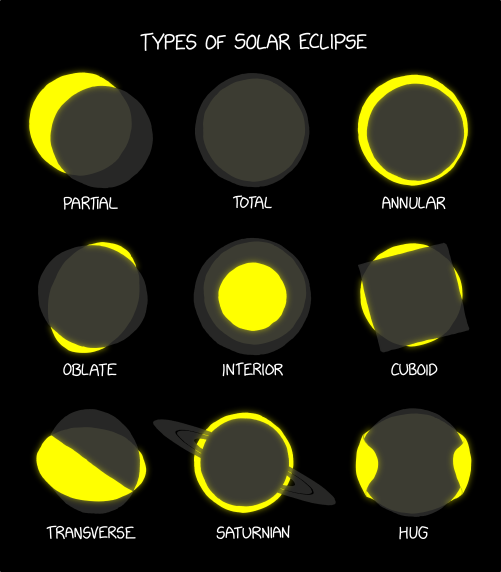 ⌘ Read more
↳
In-reply-to
»
People complain about the noise that the crows in our area make. Well … https://movq.de/v/7b8c06eb73/noise.ogg Notice anything?
⤋ Read More
@lyse@lyse.isobeef.org @movq@www.uninformativ.de I’ve always liked the sound of crows, and I really really hate the sound of motorized vehicles, so I also find it absurd. I’ve come to think that some people are at some level afraid of nature, and nature sounds remind them of it.
↳
In-reply-to
»
@prologic omg yes! They are both ultra-right-wing assholes! The worst of the worst! Please tell me you don't listen to these guys' brain poison?
⤋ Read More
Taking Jordan Peterson asn an example, the only thing he “preaches” (if you want to call it that) is to be honest with yourself and to take responsibility.
This is simply untrue. Read the articles I posted, seriously.
In a tweet in one of the articles I posted, Peterson states there is no white supremacy in Canada. This is blatantly false. It is disinformation. Peterson has made statements that rape is OK (he uses “fancy” language like “women should be naturally converted into mothers” but unpack that a bit–what he means is legalized rape followed by forced conception). He is openly anti-LGBTQ and refuses to use peoples’ preferred pronouns. He seems to believe that women who wear makeup at work are asking to be sexually harassed.
He’s using his platform in academia to pretend that straight, white men are somehow the most aggrieved group in the world and everyone else is just whining and can get fucked. The patron saint of Men’s Rights Activists and incels. I find him odious.
being immersed in gorgeous #nature makes me want to write elegant programs, I’m amazed by the underlying systems #coding #phylosophy
being immersed in gorgeous #nature makes me want to write elegant programs, I’m amazed by the underlying systems #coding #phylosophy
Estuve revisando una entrada del blog (Sembrando Juegos) y un caso de rol para un conocido (100 páginas), y aunque encontré decenas de errores de ortografía y gramática, muchos pasaban desapercibidos, aún con muchas leídas.
Es impresionante cómo las herramientas automatizadas facilitan la revisión de ortografía y gramática. Como se ha mencionado, es la creatividad asistida por tecnología que se está haciendo más “natural”, o simplemente la normalizamos con el tiempo.
↳
In-reply-to
»
I did a take home software engineering test for a company recently, unfortunately I was really sick (have finally recovered) at the time 😢 I was also at the same time interviewing for an SRE position (as well as Software Engineering).
⤋ Read More
@prologic@twtxt.net Error handling especially in Go is very tricky I think. Even though the idea is simple, it’s fairly hard to actually implement and use in a meaningful way in my opinion. All this error wrapping or the lack of it and checking whether some specific error occurred is a mess. errors.As(…) just doesn’t feel natural. errors.Is(…) only just. I mainly avoided it. Yesterday evening I actually researched a bit about that and found this article on errors with Go 1.13. It shed a little bit of light, but I still have a long way to go, I reckon.
We tried several things but haven’t found the holy grail. Currently, we have a mix of different styles, but nothing feels really right. And having plenty of different approaches also doesn’t help, that’s right. I agree, error messages often end up getting wrapped way too much with useless information. We haven’t found a solution yet. We just noticed that it kind of depends on the exact circumstances, sometimes the caller should add more information, sometimes it’s better if the callee already includes what it was supposed to do.
To experiment and get a feel for yesterday’s research results I tried myself on the combined log parser and how to signal three different errors. I’m not happy with it. Any feedback is highly appreciated. The idea is to let the caller check (not implemented yet) whether a specific error occurred. That means I have to define some dedicated errors upfront (ErrInvalidFormat, ErrInvalidStatusCode, ErrInvalidSentBytes) that can be used in the err == ErrInvalidFormat or probably more correct errors.Is(err, ErrInvalidFormat) check at the caller.
All three errors define separate error categories and are created using errors.New(…). But for the invalid status code and invalid sent bytes cases I want to include more detail, the actual invalid number that is. Since these errors are already predefined, I cannot add this dynamic information to them. So I would need to wrap them à la fmt.Errorf("invalid sent bytes '%s': %w", sentBytes, ErrInvalidSentBytes"). Yet, the ErrInvalidSentBytes is wrapped and can be asserted later on using errors.Is(err, ErrInvalidSentBytes), but the big problem is that the message is repeated. I don’t want that!
Having a Python and Java background, exception hierarchies are a well understood concept I’m trying to use here. While typing this long message it occurs to me that this is probably the issue here. Anyways, I thought, I just create a ParseError type, that can hold a custom message and some causing error (one of the three ErrInvalid* above). The custom message is then returned at Error() and the wrapped cause will be matched in Is(…). I then just return a ParseError{fmt.Sprintf("invalid sent bytes '%s'", sentBytes), ErrInvalidSentBytes}, but that looks super weird.
I probably need to scrap the “parent error” ParseError and make all three “suberrors” three dedicated error types implementing Error() string methods where I create a useful error messages. Then the caller probably could just errors.Is(err, InvalidSentBytesError{}). But creating an instance of the InvalidSentBytesError type only to check for such an error category just does feel wrong to me. However, it might be the way to do this. I don’t know. To be tried. Opinions, anyone? Implementing a whole new type is some effort, that I want to avoid.
Alternatively just one ParseError containing an error kind enumeration for InvalidFormat and friends could be used. Also seen that pattern before. But that would then require the much more verbose var parseError ParseError; if errors.As(err, &parseError) && parseError.Kind == InvalidSentBytes { … } or something like that. Far from elegant in my eyes.
Motion Blur
 ⌘ Read more
The young man, who does not know the future, sees life as a kind of epic adventure, an Odyssey through strange seas and unknown islands, where he will test and prove his powers, and thereby discover his immortality. The man of middle years, who has lived the future that he once dreamed, sees life as a tragedy; for he has learned that his power, however great, will not prevail against those forces of accident and nature to which he gives the names of gods, and has learned that he is mortal. But the man of age, if he plays his assigned role properly, must see life as a comedy. For his triumphs and his failures merge, and one is no more the occasion for pride or shame than the other; and he is neither the hero who proves himself against those forces, nor the protagonist who is destroyed by them. – John Williams in Augustus I thought I’d have accomplished a lot more today and also before I was 35 (2020) | Hacker News
↳
In-reply-to
»
@movq How is deletion supposed to work? In mutt I deleted by
⤋ Read More
D~d>1m and then fetched by !jenny -f. This brings back all deleted twts. Isn't lastmods used to skip older twts?
@movq@www.uninformativ.de
Yes, I did ask whether or not it was possible to move twts to an “archive” folder, but it will be the same at @stackeffect@twtxt.stackeffect.de experienced (which I have, too), that is, twts will “come back”.
There is no clear solution, I am afraid, right? It is the nature of the beast.
“The target of the Jihad was a machine-attitude as much as the machines,” Leto said. “Humans had set those machines to usurp our sense of beauty, our necessary selfdom out of which we make living judgments. Naturally, the machines were destroyed.”
Imagine a computer harnessing the natural behavior of natural systems and utilizing their behaviors to solve equations. via @devine@wiki.xxiivv.com https://wiki.xxiivv.com/site/computation.html
If [you take] a look at how APLers communicate when they have ideas, you see code all the time, all day long. The APL community is the only one I’ve seen that regularly can write complete code and talk about it fluently on a whiteboard between humans without hand waving. Even my beloved Scheme programming language cannot boast this. When working with humans on a programming task, almost no one uses their programming languages that primary communication method between themselves and other humans outside of the presence of a computer. That signals to me that they are not, in fact, natural, expedient tools for communicating ideas to other humans. The best practices utilized in most programming languages are, instead, attempts to ameliorate the situation to make the code as tractable and as manageable as possible, but they do not, primarily, represent a demonstration of the naturalness of those languages to human communication. — aaron hsu
Natural magical patterns of percussion Is the discussion, so listen up close
When in challenging or sad situations it’s only reasonable to be grumpy, or pessimistic or what have you. Negative emotions or feelings are part of our natural range and appropriate depending on the cirumstances. Forced positivy to me always has something ghoulish, Truman-show like. It pays to be grumpy and bad-tempered (2016) | Hacker News
Why is programming fun? What delights may its practitioner expect as his reward? First is the sheer joy of making things. As the child delights in his mud pie, so the adult enjoys building things, especially things of his own design. I think this delight must be an image of God’s delight in making things, a delight shown in the distinctness and newness of each leaf and each snowflake. Second is the pleasure of making things that are useful to other people. Deep within, we want others to use our work and to find it helpful. In this respect the programming system is not essentially different from the child’s first clay pencil holder “for Daddy’s office.” Third is the fascination of fashioning complex puzzle-like objects of interlocking moving parts and watching them work in subtle cycles, playing out the consequences of principles built in from the beginning. The programmed computer has all the fascination of the pinball machine or the jukebox mechanism, carried to the ultimate. Fourth is the joy of always learning, which springs from the nonrepeating nature of the task. In one way or another the problem is ever new, and its solver learns something: sometimes practical, sometimes theoretical, and sometimes both. Finally, there is the delight of working in such a tractable medium. The programmer, like the poet, works only slightly re- moved from pure thought-stuff. He builds his castles in the air, from air, creating by exertion of the imagination. Few media of creation are so flexible, so easy to polish and rework, so readily capable of realizing grand conceptual structures. (As we shall see later, this very tractability has its own problems.) Ask HN: How to rediscover the joy of programming? | Hacker News
creating an off-grid culture that can live in harmony with nature, as a bit
📚 Finished reading On Human Nature by Edward O. Wilson
📚 Finished reading On Human Nature by Edward O. Wilson