An official FBI document dated January 2021, obtained by the American association “Property of People” through the Freedom of Information Act.

This document summarizes the possibilities for legal access to data from nine instant messaging services: iMessage, Line, Signal, Telegram, Threema, Viber, WeChat, WhatsApp and Wickr. For each software, different judicial methods are explored, such as subpoena, search warrant, active collection of communications metadata (“Pen Register”) or connection data retention law (“18 USC§2703”). Here, in essence, is the information the FBI says it can retrieve:
Apple iMessage: basic subscriber data; in the case of an iPhone user, investigators may be able to get their hands on message content if the user uses iCloud to synchronize iMessage messages or to back up data on their phone.
Line: account data (image, username, e-mail address, phone number, Line ID, creation date, usage data, etc.); if the user has not activated end-to-end encryption, investigators can retrieve the texts of exchanges over a seven-day period, but not other data (audio, video, images, location).
Signal: date and time of account creation and date of last connection.
Telegram: IP address and phone number for investigations into confirmed terrorists, otherwise nothing.
Threema: cryptographic fingerprint of phone number and e-mail address, push service tokens if used, public key, account creation date, last connection date.
Viber: account data and IP address used to create the account; investigators can also access message history (date, time, source, destination).
WeChat: basic data such as name, phone number, e-mail and IP address, but only for non-Chinese users.
WhatsApp: the targeted person’s basic data, address book and contacts who have the targeted person in their address book; it is possible to collect message metadata in real time (“Pen Register”); message content can be retrieved via iCloud backups.
Wickr: Date and time of account creation, types of terminal on which the application is installed, date of last connection, number of messages exchanged, external identifiers associated with the account (e-mail addresses, telephone numbers), avatar image, data linked to adding or deleting.
TL;DR Signal is the messaging system that provides the least information to investigators.
I never paid a lot of attention to Ben Shapiro before, but what he says is so transparently asinine it boggles the senses. You really have to have a Fox-addled mind to believe that the search for the submersible was completely faked and that the powers-that-be knew the entire time that it had imploded. To believe that a vast conspiracy among hundreds, thousands (?) of people from several countries and spanning several days was orchestrated to lie to the public in order to…..uh, achieve what exactly? “Undermine institutional credibility”? What does that even mean?
This is “the moon landing was faked” levels of conspiracy theory.

I will probably have a harder time finding locals here than I didn on Mastodon and the fediverse
magical.fish/0/news/boingboing/2023/06/2023-06-19 Woman found alive in coffin during own wake definitely dead this time
Woman discovered alive at her wake is definitely dead this time…
People are happy if they are healthy, well fed, see the people they care about are happy, don’t live in anxiety all the time, and feel what they do day for day has some kind of meaning. Experiences won’t make you happier than possessions | Hacker News
↳
In-reply-to
»
How Ukraine's dam collapse could become the country's 'Chernobyl' | Time
⤋ Read More
Boy, the quality of Time is fallen from when it was the Time of its Time to being nearly the Time of our Time!
How Ukraine’s dam collapse could become the country’s ‘Chernobyl’ | Time
Chernobyl is in Ukraine you assholes 😆
❤️ 🎶: Adventure Time by shiru8bit
No smoke down here in FL, but I had a cockroach crawl on me while in bed a couple hours ago. Fun times…
It’s verified real time.
is it real time?
Crypto collapse? Get in loser, we’re pivoting to AI – Attack of the 50 Foot Blockchain
Someone on here gave me a hard time when I suggested that the crypto grifters were pivoting to AI after crypto collapsed. But, they were and they still are.
↳
In-reply-to
»
Russia blowing up the Nova Kakhovka dam is an incomprehensible war crime. Among other things, it drains water from the Zaporizhzhia nuclear power plant, water that is needed for cooling. They are trying to generate a widespread disaster.
⤋ Read More
@stigatle@yarn.stigatle.no I think I understand NATO’s hesitation, but at the same time if this drags on and on for years then it causes massive loss of life and is even more dangerous for everyone. If that nuclear power plant melts down, whether because Russia causes it directly or because of an “accident”, then all of Europe can be blanketed with fallout. The longer this goes on, the more likely that possibility (and worse ones!) becomes.
That is scary to be so close to Russia. I hope you’re doing OK.
is this real time?
↳
In-reply-to
»
People complain about the noise that the crows in our area make. Well … https://movq.de/v/7b8c06eb73/noise.ogg Notice anything?
⤋ Read More
@movq@www.uninformativ.de wow. I’d trade crow sounds for car sounds, or jet sounds, or leaf blower sounds, or lawn mower sounds, or…..100% of the time.
As far as fighting the birds goes, maybe they’re right, but probably it’d be better to re-balance the ecosystem so that crows aren’t so dominant? At least there are things to try. When it comes to reducing how much air travel people use, it takes a terrorist attack or a pandemic to affect it.
Erlang Solutions: How ChatGPT improved my Elixir code. Some hacks are included.
I have been working as an Elixir developer for quite some time and recently came across the ChatGPT model. I want to share some of my experience interacting with it.
During my leisure hours, I am developing an open-source Elixir initiative, Crawly, that facilitates the extraction of structured data from the internet.
Here I want to demonstrate how … ⌘ Read more
↳
In-reply-to
»
Media
⤋ Read More
@abucci@anthony.buc.ci buuuuut it show when winter!
In the time scale viewed from the planets perspective, the climate has changed many many times.. The issue is whether that change that will inevitability come is hospitable to us meat bags. Or if we are doomed to take part in the next mass extinction event.
↳
In-reply-to
»
Rebooting a LUKS Encrypted System Without Typing The Passphrase: https://mckinley.cc/blog/20230526.html
⤋ Read More
@mckinley@twtxt.net Yeah, that’s more clear. 👌
Systems that are on all the time don’t benefit as much from at-rest encryption, anyway.
Right, especially not if it’s “cloud storage”. 😅 (We’re only doing it on our backup servers, which are “real” hardware.)
The last time I connect to gopher was 30 years ago. Nice to see he’s alive.
I am alive. or was, last time I checked.
usually i like to savor it and leave some time before appetizer and main dish but today is kinda rushed

This guy is just such an idiot lol.
- There’s no such mass migration to “the south”. Tons of people are leaving Mississippi, Louisiana, Virginia, and New Mexico for instance. I don’t know enough about the states with net influxes like Texas and Florida but I suspect they have policies that make it attractive for people to move there
- Not everybody is able to take account of long-term trends when they make housing decisions. There are financial reasons, family reasons, educational reasons, etc that impact such decisions
- But of course, most laughably, cheap energy is fast becoming a thing of the past, and so the problem isn’t “solved” by cheap energy, it’s just kicked down the road. And ffs, cheap energy is literally causing the very heating that he pretends air conditioning will “solve”–like “solving” your drinking problem by staying drunk all the time
This oversimplification to drive some kind of political point is so embarrassing coming from someone who pretends to be a university professor. It sounds like a teenage doofus from a 1980s movie talking. He well knows all these things, but he decides to present these views anyway.
↳
In-reply-to
»
God, that’s brilliant. 😂
⤋ Read More
@movq@www.uninformativ.de I was visiting Germany once, and saw a guy try to load his bicycle onto the bike racks they have on the front of city buses. There were rules about when you could do that, which were posted on the bus stop sign, and I guess the guy thought this was a time when he could do that. But no, the bus driver disagreed. The bus driver got off the bus with a rule book, flipped it open to what I guess were the rules about bikes on the bus, and showed him the rules. The guy pointed at the sign, the bus driver said no and pointed at the book, and they went back and forth for I don’t know how long. It felt a lot like these videos lol
📣 Outage Notification: On Tuesday 23rd May 2023 between 7.30am to 5pm, there will be an outage of undefined length with no known start time due to planned power meter upgrades on the premises by the energy company.
You know, it’s one of those things where they give you a ~12hr window 🤦♂️ I will post here again once the technician is on-site and power down. I will power back up as soon as the work is complete.
According to the information I’ve received, the outage should be no more than ~1-2hrs.
Apologies for any inconvenience 🤗
↳
In-reply-to
»
Metaverse Could Contribute Up To 2.4% of US GDP By 2035, Study Shows
A study commissioned by Meta has found that the metaverse could contribute around 2.4% to U.S. annual GDP by 2035, equating to as much as $760 billion. Reuters reports: The concept of the metaverse includes augmented and virtual reality technologies that allow users to immerse themselves in a virtual world or overlay information digitally on ... ⌘ Read more
⤋ Read More
@stigatle@yarn.stigatle.no @prologic@twtxt.net @eldersnake@we.loveprivacy.club I love VR too, and I wonder a lot whether it can help people with accessibility challenges, like low vision.
But Meta’s approach from the beginning almost seemed like a joke? My first thought was “are they trolling us?” There’s open source metaverse software like Vircadia that looks better than Meta’s demos (avatars have legs in Vircadia, ffs) and can already do virtual co-working. Vircadia developers hold their meetings within Vircadia, and there are virtual whiteboards and walls where you can run video feeds, calendars and web browsers. What is Meta spending all that money doing, if their visuals look so weak, and their co-working affordances aren’t there?
On top of that, Meta didn’t seem to put any kind of effort into moderating the content. There are already stories of bad things happening in Horizon Worlds, like gangs forming and harassing people off of it. Imagine what that’d look like if 1 billion people were using it the way Meta says they want.
Then, there are plenty of technical challenges left, like people feeling motion sickness or disoriented after using a headset for a long period of time. I haven’t heard announcements from Meta that they’re working on these or have made any advances in these.
All around, it never sounded serious to me, despite how much money Meta seems to be throwing at it. For something with so much promise, and so many obvious challenges to attack first that Meta seems to be ignoring, what are they even doing?
↳
In-reply-to
»
Looks like Google's using this blog post of mine without my permission. I hate this kind of tech company crap so much.
⤋ Read More
I have no interest in doing anything about it, even if I had the time (which I don’t), but these kind of thing happen all day every day to countless people. My silly blog post isn’t worth getting up in arms about, but there are artists and other creators who pour countless hours, heart and soul into their work, only to have it taken in exactly this way. That’s one of the reasons I’m so extremely negative about the spate of “AI” tools that have popped up recently. They are powered by theft.
↳
In-reply-to
»
Looks like Google's using this blog post of mine without my permission. I hate this kind of tech company crap so much.
⤋ Read More
There’s a link to the blog post, but they extracted a summary in hopes of keeping people in Google properties (something they’ve been called out on many times).
I was never contacted to ask if I was OK with Google extracting a summary of my blog post and sticking it on the web site. There is a very clear copyright designation at the bottom of each page, including that one. So, by putting their own brand over my text, they violated my copyright. Straightforward theft right there.
Went to the barber shop today. Got a nice talk and, surprisingly, my first “contract” to 3D print something. So, I spent the last hour reading about QR codes, versions and patterns and rescue data to embed an image in the centre of the code. Then it took me some time to convert it from a PNG to an SVG to an STL, so I can put it into Tinkercad to design the new plate. I now have a baseplate, a backplate with the QRCode & two smaller plates which I have to glue into placeholders on the backplate.
↳
In-reply-to
»
DEEPL now has a Writer https://www.deepl.com/write - very nice, fast and available in multiple languages. Write better texts, instantly.
⤋ Read More
@prologic@twtxt.net @carsten@yarn.zn80.net
There is (I assure you there will be, don’t know what it is yet…) a price to be paid for this convenience.
Exactly prologic, and that’s why I’m negative about these sorts of things. I’m almost 50, I’ve been around this tech hype cycle a bunch of times. Look at what happened with Facebook. When it first appeared, people loved it and signed up and shared incredibly detailed information about themselves on it. Facebook made it very easy and convenient for almost anyone, even people who had limited understanding of the internet or computers, to get connected with their friends and family. And now here we are today, where 80% of people in surveys say they don’t trust Facebook with their private data, where they think Facebook commits crimes and should be broken up or at least taken to task in a big way, etc etc etc. Facebook has been fined many billions of dollars and faces endless federal lawsuits in the US alone for its horrible practices. Yet Facebook is still exploitative. It’s a societal cancer.
All signs suggest this generative AI stuff is going to go exactly the same way. That is the inevitable course of these things in the present climate, because the tech sector is largely run by sociopathic billionaires, because the tech sector is not regulated in any meaningful way, and because the tech press / tech media has no scruples. Some new tech thing generates hype, people get excited and sign up to use it, then when the people who own the tech think they have a critical mass of users, they clamp everything down and start doing whatever it is they wanted to do from the start. They’ll break laws, steal your shit, cause mass suffering, who knows what. They won’t stop until they are stopped by mass protest from us, and the government action that follows.
That’s a huge price to pay for a little bit of convenience, a price we pay and continue to pay for decades. We all know better by now. Why do we keep doing this to ourselves? It doesn’t make sense. It’s insane.
↳
In-reply-to
»
DEEPL now has a Writer https://www.deepl.com/write - very nice, fast and available in multiple languages. Write better texts, instantly.
⤋ Read More
I have to write so many emails to so many idiots who have no idea what they are doing
So it sounds to me like the pressure is to reduce how much time you waste on idiots, which to my mind is a very good reason to use a text generator! I guess in that case you don’t mind too much whether the company making the AI owns your prompt text?
I’d really like to see tools like this that you can run on your desktop or phone, so they don’t send your hard work off to someone else and give a company a chance to take it from you.
Started with

a concept sketch of a full body end-time factory worker on a distant planet, cyberpunk light brown suite, (badass), looking up at the viewer, 2d, line drawing, (pencil sketch:0.3), (caricature:0.2), watercolor city sketch,
Negative prompt: EasyNegativ, bad-hands-5, 3d, photo, naked, sexy, disproportionate, ugly
Steps: 20, Sampler: Euler a, CFG scale: 7, Seed: 2479087078, Face restoration: GFPGAN, Size: 512x768, Model hash: 2ee2a2bf90, Model: mimic_v10, Denoising strength: 0.7, Hires upscale: 1.5, Hires upscaler: Latent
↳
In-reply-to
»
@prologic yeah. I'd add "Big Data" to that hype list, and I'm sure there are a bunch more that I'm forgetting.
⤋ Read More
@prologic@twtxt.net I’m a bit of a GPU junkie (😳) and I have 3, 2019-era GPUs lying around. One of these days when I have Free Time™ I’ll put those together into some kind of cluster….
On LinkedIn I see a lot of posts aimed at software developers along the lines of “If you’re not using these AI tools (X,Y,Z) you’re going to be left behind.”
Two things about that:
- No you’re not. If you have good soft skills (good communication, show up on time, general time management) then you’re already in excellent shape. No AI can do that stuff, and for that alone no AI can replace people
- This rhetoric is coming directly from the billionaires who are laying off tech people by the 100s of thousands as part of the class war they’ve been conducting against all working people since the 1940s. They want you to believe that you have to scramble and claw over one another to learn the “AI” that they’re forcing onto the world, so that you stop honing the skills that matter (see #1) and are easier to obsolete later. Don’t fall for it. It’s far from clear how this will shake out once governments get off their asses and start regulating this stuff, by the way–most of these “AI” tools are blatantly breaking copyright and other IP laws, and some day that’ll catch up with them.
That said, it is helpful to know thy enemy.
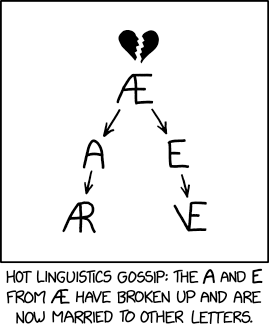
Linguistics Gossip
 ⌘ Read more
I played around with parsers. This time I experimented with parser combinators for twt message text tokenization. Basically, extract mentions, subjects, URLs, media and regular text. It’s kinda nice, although my solution is not completely elegant, I have to say. Especially my communication protocol between different steps for intermediate results is really ugly. Not sure about performance, I reckon a hand-written state machine parser would be quite a bit faster. I need to write a second parser and then benchmark them.
lexer.go and newparser.go resemble the parser combinators: https://git.isobeef.org/lyse/tt2/-/commit/4d481acad0213771fe5804917576388f51c340c0 It’s far from finished yet.
The first attempt in parser.go doesn’t work as my backtracking is not accounted for, I noticed only later, that I have to do that. With twt message texts there is no real error in parsing. Just regular text as a “fallback”. So it works a bit differently than parsing a real language. No error reporting required, except maybe for debugging. My goal was to port my Python code as closely as possible. But then the runes in the string gave me a bit of a headache, so I thought I just build myself a nice reader abstraction. When I noticed the missing backtracking, I then decided to give parser combinators a try instead of improving on my look ahead reader. It only later occurred to me, that I could have just used a rune slice instead of a string. With that, porting the Python code should have been straightforward.
Yeah, all this doesn’t probably make sense, unless you look at the code. And even then, you have to learn the ropes a bit. Sorry for the noise. :-)
My Favorite Things
 ⌘ Read more
Spreed the news by all channels: The RF is planning a genocide of the ukrainian people. Thats the message of the russian TV in last days. No matter how much time it will take
❤️ 🎶: Time to Go by DooRi
Presents for Biologists
 ⌘ Read more
I needed something to help with a morning schedule for two kiddos. It highlights the current 5-minute block as it goes. I think this was my first time reaching for JavaScript for a personal project. https://sidequest.club/stages.html
↳
In-reply-to
»
On the topic of Programming Languages and Telemetry. I'm kind of curious... Do any of these programming language and their toolchains collect telemetry on their usage and effectively "spy" on your development?
⤋ Read More
@prologic@twtxt.net I get the worry of privacy. But I think there is some value in the data being collected. Do I think that Russ is up there scheming new ways to discover what packages you use in internal projects for targeting ads?? Probably not.
Go has always been driven by usage data. Look at modules. There was need for having repeatable builds so various package tool chains were made and evolved into what we have today. Generics took time and seeing pain points where they would provide value. They weren’t done just so it could be checked off on a box of features. Some languages seem to do that to the extreme.
Whenever changes are made to the language there are extensive searches across public modules for where the change might cause issues or could be improved with the change. The fs embed and strings.Cut come to mind.
I think its good that the language maintainers are using what metrics they have to guide where to focus time and energy. Some of the other languages could use it. So time and effort isn’t wasted in maintaining something that has little impact.
The economics of the “spying” are to improve the product and ecosystem. Is it “spying” when a municipality uses water usage metrics in neighborhoods to forecast need of new water projects? Or is it to discover your shower habits for nefarious reasons?
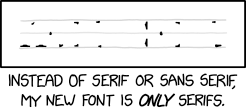
Only Serifs
 ⌘ Read more
❤️ 🎶: Timing by KOYO
↳
In-reply-to
»
Yes, but no. This didn’t happen before, it will drive me nuts. That search sucks, by the way. I know, I am being gentle. 😂
⤋ Read More
I’ve never liked the idea of having everything displayed all of the time for all of history.
And I still don’t: Search and Bookmarks are better tools for this IMO.
From a technical perspective however, we will not introduce any CGO dependencies into yarnd – It makes portability harder.
Also I hate SQL 😆
If you have time and the Courage to change, read the Bible at gopher://rbfh.de/1/Bible
↳
In-reply-to
»
Trying to wrap my head around webfinger..
⤋ Read More
@prologic@twtxt.net that worked.. But took crazy long time
New Year’s Eve 2023
![[Earlier, at the eye doctor] 'No, for the last time, the numerals on the paper aren't my prescription, it's the shape I want you to make with the laser.'](https://imgs.xkcd.com/comics/new_years_eve_2023.png) ⌘ Read more
⌘ Read more
The first 90 percent of the code accounts for the first 90 percent of the development time. The remaining 10 percent of the code accounts for the other 90 percent of the development time. Zeno’s Paradox and Why Modern Technology is Rubbish – Terence Eden’s Blog
It feels like every time I come across a Gemini capsule I find interesting, the owner suddenly stops posting and leaves the protocol. Maybe that’s a lesson for me: if I like their content, reach out to them and let them know.