↳
In-reply-to
»
hmm any ideas how to fix this case when there is no nick and it on a shared tilde hosting? http://darch.dk/timeline/profile?url=https://tilde.club/~deepend/twtxt.txt
⤋ Read More
@sorenpeter@darch.dk @bender@twtxt.net @prologic@twtxt.net Right. Also, generally speaking, if you come across a new feed URL, it’s probably either via some mention in another feed or the User-Agent in your access log. Both cases typically advertise also a display name. So, you just reuse whatever you’ve seen there.
China launches first batch of internet satellites + 2 more stories
China launches first 10 Guowang satellites for internet access; NASA’s Webb telescope challenges planet formation theories; NATO takes over coordination of Ukraine military aid. ⌘ Read more
Getting my knowledge refreshed on web accessibility through a course on deque university.
↳
In-reply-to
»
Fuck me dead, what a giant piece of shit. On my Linux work laptop I have the problem that some unknown snakeoil "security" junk is dropping any IPv4 connections to ports 80 and 443. All other ports and IPv6 seem unaffected. I get an immediate "connection refused" when trying to estabslish a connection.
⤋ Read More
Thank you, @movq@www.uninformativ.de! Luckily, I can disable it. I also tried it, no luck, though. But the problem is, I don’t really know how much snakeoil actually runs on my machine. There is definitely a ClownStrike infestation, I stopped the falcon sensor. But there might be even more, I’ve no idea. From the vague answers I got last time, it feels like even the UHD/IT guys don’t know what is in use. O_o
Yeah, it is definitely something on my laptop that rejects connections to IPv4 ports 80 and 443. All other devices here can access the stuff without issue, only this work machine is unable to. The “Connection refused” happens within a few milliseconds.
Unfortunately, I do not have the slightest idea how it works. But maybe I can look into that tomorrow. Kernel modules are a very good hint, thank you! <3
You’re right, it might be some sort of fail-safe mechanism. But then, why just block IPv4 and not also IPv6? But maybe because the VPN and company servers require IPv4, there is zero IPv6 support. (Yeah, don’t ask, I don’t understand it either.)
Infinite Armada Chess
 ⌘ Read more
↳
In-reply-to
»
Hi @prologic Hi @bender 😁 now, Why is my @ mention is all over the place? xD this feed has a
⤋ Read More
# nick = skinshafi so... should I scream buuug ? 🤔
@prologic@twtxt.net Twtxt wise, it was kind of disparate at first xD with no access to logs as you may have read on the alt-feed itself. But then, @sorenpeter@darch.dk’s script came to the rescue … like, just in time 😁 Otherwise, everything else is fun as publicised, exploring and learning along the way.
So, I don’t think there is a way for pubnix users to check who’s pulling their Twtxt feeds. “No access logs (for obvious reasons) so, no visibility on user-agent anouncements for me and no discovrability for you (actually, me)!” xD
↳
In-reply-to
»
@sorenpeter hey!
I'm watching that now your .txt is pointing to https://darch.dk/twtAgent.php
⤋ Read More
Yes it work: 2024-12-01T19:38:35Z twtxt/1.2.3 (+https://eapl.mx/twtxt.txt; @eapl) :D
The .log is just a simple append each request. The idea with the .cvs is to have it tally up how many request there have been from each client as a way to avoid having the log file grow too big. And that you can open the .cvs as a spreadsheet and have an easy overview and filtering options.
Access to those files are closed to the public.
↳
In-reply-to
»
"A minimalist social network powered by plain text files" - my talk about #twtxt from #Piksel24 Festival is now on YouTube and slides can be found at http://darch.dk/twtxtalk-piksel
⤋ Read More
@lyse@lyse.isobeef.org One person had came access it before, but no tried it
I’ve just unlocked access to my /timeline if anyone has been trying to access it earlier.
↳
In-reply-to
»
i am working on very smol deployments, where a server may use two or so replicated sqlite databases instead of a db server like postgres to seamlessly move from single to multi-node arrangements as needed. there is a clear performance limit here, but the goal is not to serve a huge number of clients. just to do as much as possible with a small number of useful components that can be upgraded to handle up to medium size workloads, without difficult data conversions or migrations. scaling beyond that point should be done via federation.
⤋ Read More
for example, ejabberd, redka, and litefs. all using sqlite+litefs for their database needs allows agents to communicate over xmpp, matrix, mqtt, and sip. other applications can use sqlite for storage or speak the redis protocol to redka. ejabberd can also handle file uploads, static file publishing, identity, and various other web application services. when scaling, litefs integrates with consul to manage replication which grants the network access to service disco, encrypted mesh networking, and various other features that can be used to build secure service grids. ejabberd and redka can be scaled to multiple nodes that coordinate over the litefs replication protocol without any changes to the db storage config. other components can be configured to plug into this framework fairly easily as well. we keep the network config fairly simple by linking nodes together with yggdrasil to flatten the address space and then linking app nodes together using consul to provide secure routing for the local grid service. yggdrasil also offers utility for buliding federated networks in a similarly flat address space, for more secure communications i2p is also available in yggdrasil mode. minibase is wonderful, and we have not even started to talk about secure IoT.
↳
In-reply-to
»
I've been thinking of a few improvements for the next generation of twtxt spec, let me know if these are useful or interesting :) https://text.eapl.mx/a-few-ideas-for-a-next-twtxt-version
⤋ Read More
Righto, @eapl.me@eapl.me, ta for the writeup. Here we go. :-)
Metadata on individual twts are too much for me. I do like the simplicity of the current spec. But I understand where you’re coming from.
Numbering twts in a feed is basically the attempt of generating message IDs. It’s an interesting idea, but I reckon it is not even needed. I’d simply use location based addressing (feed URL + ‘#’ + timestamp) instead of content addressing. If one really wanted to, one could hash the feed URL and timestamp, but the raw form would actually improve disoverability and would not even require a richer client. But the majority of twtxt users in the last poll wanted to stick with content addressing.
yarnd actually sends If-Modified-Since request headers. Not only can I observe heaps of 304 responses for yarnds in my access log, but in Cache.FetchFeeds(…) we can actually see If-Modified-Since being deployed when the feed has been retrieved with a Last-Modified response header before: https://git.mills.io/yarnsocial/yarn/src/commit/98eee5124ae425deb825fb5f8788a0773ec5bdd0/internal/cache.go#L1278
Turns out etags with If-None-Match are only supported when yarnd serves avatars (https://git.mills.io/yarnsocial/yarn/src/commit/98eee5124ae425deb825fb5f8788a0773ec5bdd0/internal/handlers.go#L158) and media uploads (https://git.mills.io/yarnsocial/yarn/src/commit/98eee5124ae425deb825fb5f8788a0773ec5bdd0/internal/media_handlers.go#L71). However, it ignores possible etags when fetching feeds.
I don’t understand how the discovery URLs should work to replace the User-Agent header in HTTP(S) requests. Do you mind to elaborate?
Different protocols are basically just a client thing.
I reckon it’s best to just avoid mixing several languages in one feed in the first place. Personally, I find it okay to occasionally write messages in other languages, but if that happens on a more regularly basis, I’d definitely create a different feed for other languages.
Isn’t the emoji thing “just” a client feature? So, feed do not even have to state any emojis. As a user I’d configure my client to use a certain symbol for feed ABC. Currently, I can do a similar thing in tt where I assign colors to feeds. On the other hand, what if a user wants to control what symbol should be displayed, similar to the feed’s nick? Hmm. But still, my terminal font doesn’t even render most of emojis. So, Unicode boxes everywhere. This makes me think it should actually be a only client feature.
Been curious to see if can filter out my access.log file and output a list of my twtxt followers just in case I’ve missed someone … I came up with this awk -F '\"' '/twtxt/ {print $(NF-1)}' /var/log/user.log | grep -v 'twtxt\.net' | sort -u | awk '{print $(NF-1) $NF}' | awk '/^\(/' spaghetti monster of a command and I’m wondering if there’s a more elegant way for achieving the same thing.
↳
In-reply-to
»
What are peoples #IRC setup? Do you have your own bouncer server or just have a you computer always on? And do you IRC on mobile?
⤋ Read More
@sorenpeter@darch.dk I’ve been using weechat for a while then when I started learning my way around Emacs I switched to Circe … a couple months later I setup ZNC, rolled with it for some time but wasn’t sure if I wanted to stick with it. Now I’m mainly using TheLounge and do find it convenient accessing it from anywhere. but quite honestly, I don’t have a preference.
↳
In-reply-to
»
@prologic I’m sure you can somehow install something that calculates blake2b on OpenBSD. But it’s not part of the base system as a standalone CLI tool, there only appear to be Perl modules for it. The other SHA tools do exist.
⤋ Read More
I mean sure if i want to run it over on my tooth brush why not use something that is accessible everywhere like md5? crc32? It was chosen a long while back and the only benefit in changing now is “i cant find an implementation for x” when the down side is it breaks all existing threads. so…
Did Apple Just Kill Social Apps?
Apple’s iOS 18 update has introduced changes to contact sharing that could significantly impact social app developers. The new feature allows users to selectively share contacts with apps, rather than granting access to their entire address book. While Apple touts this as a privacy enhancement, developers warn it may hinder the growth of new social platforms. Nikita Bier, a start-up founder, called it “the en … ⌘ Read more
Been curious about how people on Pubnix instances do manage their feed, if they have access to log? Sent in a req to join one still no res.
↳
In-reply-to
»
how to parse caddy access log with useragent tool? seems it dont detect anything in json
⤋ Read More
@doesnm@doesnm.p.psf.lt Fot a sample access log? Which tool are you using?
how to parse caddy access log with useragent tool? seems it dont detect anything in json
↳
In-reply-to
»
@prologic Do you have a link to some past discussion?
⤋ Read More
@xuu@txt.sour.is I think it is more tricky than that.
“A company or entity …”
Also, as I understand it, “personal or household activity” (as you called it) is rather strict: An example could be you uploading photos to a webspace behind HTTP basic auth and sending that link to a friend. So, yes, a webserver is involved and you process your friend’s data (e.g., when did he access your files), but it’s just between you and him. But if you were to publish these photos publicly on a webserver that anyone can access, then it’s a different story – even though you could say that “this is just my personal hobby, not related to any job or money”.
If you operate a public Yarn pod and if you accept registrations from other users, then I’m pretty sure the GDPR applies. 🤔 You process personal data and you don’t really know these people. It’s not a personal/private thing anymore.
↳
In-reply-to
»
@prologic Some criticisms and a possible alternative direction:
⤋ Read More
HTTPS is supposed to do [verification] anyway.
TLS provides verification that nobody is tampering with or snooping on your connection to a server. It doesn’t, for example, verify that a file downloaded from server A is from the same entity as the one from server B.
I was confused by this response for a while, but now I think I understand what you’re getting at. You are pointing out that with signed feeds, I can verify the authenticity of a feed without accessing the original server, whereas with HTTPS I can’t verify a feed unless I download it myself from the origin server. Is that right?
I.e. if the HTTPS origin server is online and I don’t mind taking the time and bandwidth to contact it, then perhaps signed feeds offer no advantage, but if the origin server might not be online, or I want to download a big archive of lots of feeds at once without contacting each server individually, then I need signed feeds.
feed locations [being] URLs gives some flexibility
It does give flexibility, but perhaps we should have made them URIs instead for even more flexibility. Then, you could use a tag URI,
urn:uuid:*, or a regular old URL if you wanted to. The spec seems to indicate that theurltag should be a working URL that clients can use to find a copy of the feed, optionally at multiple locations. I’m not very familiar with IP{F,N}S but if it ensures you own an identifier forever and that identifier points to a current copy of your feed, it could be a great way to fix it on an individual basis without breaking any specs :)
I’m also not very familiar with IPFS or IPNS.
I haven’t been following the other twts about signatures carefully. I just hope whatever you smart people come up with will be backwards-compatible so it still works if I’m too lazy to change how I publish my feed :-)
@sorenpeter@darch.dk !! I freaking love your Timeline … I kind of have an justified PHP phobia 😅 but, I’m definitely thinking about giving it a try!
/ME wondering if it’s possible to use it locally just to read and manage my feed at first and then maybe make it publicly accessible later.
↳
In-reply-to
»
Telegram founder Pavel Durov arrested at French airport
Article URL: https://www.theguardian.com/media/article/2024/aug/24/telegram-app-founder-pavel-durov-arrested-at-french-airport
⤋ Read More
@bender@twtxt.net and I saw some conspiracy theory that he knew he was going to be arrested. He was working with French intelligence on a plea deal to defect. And now Russia is freaking out that Ukraine allies can have war comms access.
Yikes! If only they had salty.im!
Nouveauté beta sur https://3r1c.net, la version TXT “smartphone” de chacun des articles. Accessible via le lien [M].
↳
In-reply-to
»
@shreyan Haha my criteria is being inactive for over two years 🤣
⤋ Read More
@prologic@twtxt.net Remember when we used to lose access to e-mail, IM and forum accounts after 30 days of inactivity? 😂 … Then storage became cheaper and companies figured out that any tiny bit of someone’s data is worth something to someone(thing) else. 🥲
↳
In-reply-to
»
@lyse Ahh so it's not just me! 😅
⤋ Read More
@prologic@twtxt.net @lyse@lyse.isobeef.org I checked my logs and all I see are 304 responses and a couple of delayed requests here and there due to rate limiting, but not that many. I’ll disable it (the rate limiting) for a couple of days, let me know if you still get the ‘forbidden access’ thing 🫣 I may have effed up my configuration trying to deal with some weird stuff.
↳
In-reply-to
»
I setup and switched to Headscale last night. It was relatively simple, I spent more time installing a web GUI to manage it to be honest, the actual server is simple enough. The native Tailscale Android app even works with it thankfully.
⤋ Read More
@prologic@twtxt.net Yes I suppose that is true. There is an article on Tailscale’s site that explains it all quite a bit: https://tailscale.com/blog/how-nat-traversal-works
To me, with CGNAT, it’s a small miracle that a direct connection can be made between peers (as opposed to going through a relay constantly) but it does indeed work. I guess to host it at home you would need to have it WAN accessible, and if you’ve already gone to the trouble of port forwarding etc… well 😅
Not that I could personally do that, but for those with static IPs etc.
↳
In-reply-to
»
The “Matrix Experiment”, i.e. running a Matrix server for our family, has failed completely and miserably. People don’t accept it. They attribute unrelated things to it, like “I can’t send messages to you, I don’t reach you! It doesn’t work!” Yes, you do, I get those messages, I just don’t reply quickly enough because I’m at work or simply doing something else.
⤋ Read More
I admit I’ve always compromised on this way too much myself, always to this day having Facebook Messenger just to communicate in my families group chats. Sure I run it in a Work profile on my GrapheneOS phone that I can switch off at any time, I can completely cut it off from network access any time as well, I can have a lot of rudimentary control over it, I use it as sparingly as possible, but it doesn’t change the fact everytime I use it we’re funneling private convos through bloody Meta’s servers and trackers etc.
Microsoft Outage Hits Users Worldwide, Leading To Canceled Flights
Microsoft grappled with a major service outage, leaving users across the world unable to access its cloud computing platforms and causing airlines to cancel flights. From a report: Thousands of users across the world reported problems with Microsoft 365 apps and services to Downdetector.com, a website that tracks service disruptions. “We’re inve … ⌘ Read more
It’s a shame that so many public Wi-Fi networks block traffic on ports 70 and 1965, completely cutting off both Gopher and Gemini. Restricting Internet access to only the “most common” use cases like YouTube and Wikipedia is a great way to ensure they eventually become the “only” use cases.
Hello @bmallred@staystrong.run I hope you’re doing well.
I dunno if it’s normal, but it seems like I am unable to access your twtxt.tx file… 😅
↳
In-reply-to
»
Is Yarn.social dead or just too niche? (uyrrria) 🧐
⤋ Read More
I think @abucci@anthony.buc.ci and @stigatle@yarn.stigatle.no are running snac? I didn’t have a closer look at snac (no intention of running it), but if that is a relatively small daemon (maybe comparable to Yarn?) that gives you access to the whole world of ActivityPub, then, well, yeah … That’s tough to beat.
Yes, I am running snac on the same VPS where I run my yarn pod. I heard of it from @stigatle@yarn.stigatle.no, so blame him 😏 snac is written in C and is one simple executable, uses very little resources on the server, and stores everything in JSON files (no databases or other integrations; easy to save and migrate your data) . It’s definitely like yarn in that respect.
I haven’t been around yarn much lately. Part of that is that I’ve been very busy at work and home and only have a limited time to spend goofing off on a social network. Part of it is that I’m finding snac very useful: I’ve connected with friends I’d previously lost touch with, I’ve found useful work-related information, I’ve found colleagues to follow, and even found interesting conferences to attend. There’s a lot more going on over there.
I guess if I had to put it simply, I’d say I have limited time to play and there are more kids in the ActivityPub sandbox than this one. That’s not a ding on yarn–I like yarn and twtxt–I’m just time constrained.
Even AI coding machines will need to rotate their access credentials every 90 days.
↳
In-reply-to
»
So what do we think of the Reddit IPO? 🤔
⤋ Read More
in the matter of political voice in the US money is speech and therefore companies use their “free speech” to donate and gain access to politicians. Therefore companies are people. Thanks a lot “citizens united”
published: digital accessibility & inclusivity https://yctct.com/digital-accessibility-and-inclusivity
↳
In-reply-to
»
Yeah, the lack of comments makes regular JSON not a good configuration format in my view. Also, putting all keys in quotes and the use of commas is annoying. The big upside is that's in lots of standard libraries.
⤋ Read More
@lyse@lyse.isobeef.org its a hierarchy key value format. I designed it for the network peering tools i use.. I can grant access to different parts of the tree to other users.. kinda like directory permissions. a basic example of the format is:
@namespace
# multi
# line
# comment
root :value

# example space comment
@namespace.name space-tag

# attribute comments
attribute attr-tag  :value for attribute

# attribute with multiple
# lines of values
foo :bar
      :bin
      :baz

repeated :value1
repeated :value2
each @ starts the definition of a namespace kinda like [name] in ini format. It can have comments that show up before. then each attribute is key :value and can have their own # comment lines.
Values can be multi line.. and also repeated..
the namespaces and values can also have little meta data tags added to them.

the service can define webhooks/mqtt topics to be notified when the configs are updated. That way it can deploy the changes out when they are updated.
Qnap’s Hybridmount feature makes it possible for me to access the files on OneDrive as if they were available from a local network drive on my Fedora PC. Pretty neat (when everything works).
Having fun with React - yet again. A large part of my job entails (re)learning technologies - luckily I have access to some good resources in the form of training- and tutorial sites, all provided by my employer.
Worked on expanding the scope of accessible alternative press in my RSS aggregator. The numbers reached were 215 media.
I’m telling ya guys 😅 plex.tv had way better shit™, Get it installed on your own server, get access to free content + your own + whatever and no stupid tracking and bullshit 🤣
Anyone have any ideas how you might identify processes (pids) on Linux machine that are responsible for most of the Disk I/O on that machine and subsequently causing high I/O wait times for other processes? 🤔
Important bit: The machine has no access to the internet, there are hardly any standard tools on it, etc. So I have to get something to it “air gapped”. I have terminal access to it, so I can do interesting things like, base64 encode a static binary to my clipboard and paste it to a file, then base64 decode it and execute. That’s about the only mechanisms I have.
Pensée désagréable du jour: le protocole #gemini n’est pas écologique car il n’est pas accessible sur du vieux matériel à cause du TLS forcé. Servir des fichiers textes écrits en gemtext en #http est mieux dans ce cas
↳
In-reply-to
»
@prologic I don't understand what you're saying.
⤋ Read More
podman works with TLS. It does not have the "--docker" siwtch so you have to remove that and use the exact replacement commands that were in that github comment.
@prologic@twtxt.net what do you mean when you say “Docker API”? There are multiple possible meanings for that. podman conforms to some of Docker’s APIs and it’s unclear to me which one you say it’s not conforming to.
You just have to Google “podman Docker API” and you find stuff like this: https://www.redhat.com/sysadmin/podman-rest-api
What is Podman’s REST API?Podman’s REST API consists of two components:
- A Docker-compatible portion called Compat API
- A native portion called Libpod API that provides access to additional features not available in Docker, including pods
Or this: https://docs.podman.io/en/latest/markdown/podman-system-service.1.html
The REST API provided by podman system service is split into two parts: a compatibility layer offering support for the Docker v1.40 API, and a Podman-native Libpod layer.
Question to all you Gophers out there: How do you deal with custom errors that include more information and different kinds of matching them?
I started with a simple var ErrPermissionNotAllowed = errors.New("permission not allowed"). In my function I then wrap that using fmt.Errorf("%w: %v", ErrPermissionNotAllowed, failedPermissions). I can match this error using errors.Is(err, ErrPermissionNotAllowed). So far so good.
Now for display purposes I’d also like to access the individual permissions that could not be assigned. Parsing the error message is obviously not an option. So I thought, I create a custom error type, e.g. type PermissionNotAllowedError []Permission and give it some func (e PermissionNotAllowedError) Error() string { return fmt.Sprintf("permission not allowed: %v", e) }. My function would then return this error instead: PermissionNotAllowedError{failedPermissions}
At some layers I don’t care about the exact permissions that failed, but at others I do, at least when accessing them. A custom func (e PermissionNotAllowedError) Is(target err) bool could match both the general ErrPermissionNotAllowed as well as the PermissionNotAllowedError. Same with As(…). For testing purposes the PermissionNotAllowedError would then also try to match the included permissions, so assertions in tests would work nicely. But having two different errors for different matching seems not very elegant at all.
Did you ever encounter this scenario before? How did you address this? Is my thinking flawed?
An official FBI document dated January 2021, obtained by the American association “Property of People” through the Freedom of Information Act.
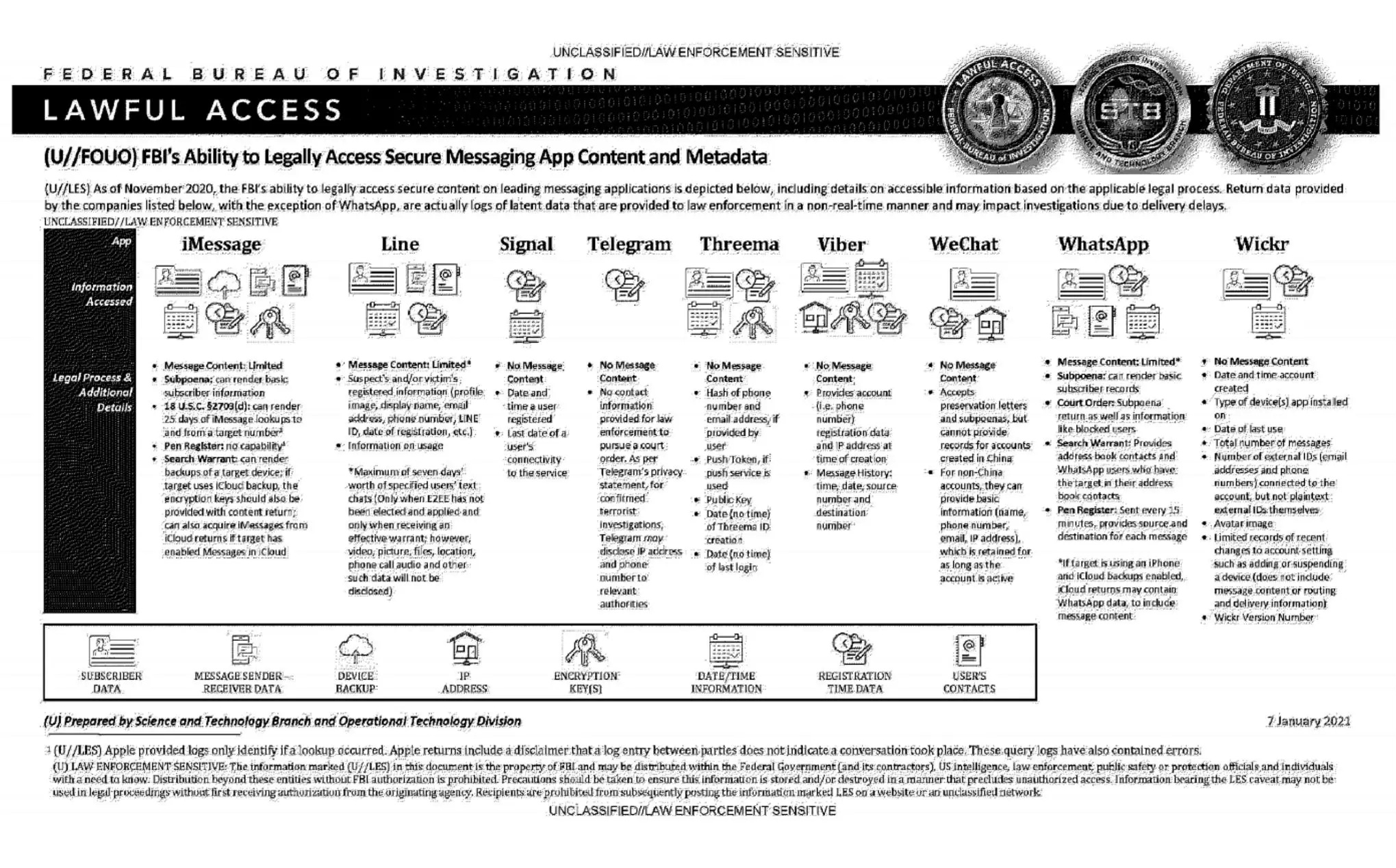
This document summarizes the possibilities for legal access to data from nine instant messaging services: iMessage, Line, Signal, Telegram, Threema, Viber, WeChat, WhatsApp and Wickr. For each software, different judicial methods are explored, such as subpoena, search warrant, active collection of communications metadata (“Pen Register”) or connection data retention law (“18 USC§2703”). Here, in essence, is the information the FBI says it can retrieve:
Apple iMessage: basic subscriber data; in the case of an iPhone user, investigators may be able to get their hands on message content if the user uses iCloud to synchronize iMessage messages or to back up data on their phone.
Line: account data (image, username, e-mail address, phone number, Line ID, creation date, usage data, etc.); if the user has not activated end-to-end encryption, investigators can retrieve the texts of exchanges over a seven-day period, but not other data (audio, video, images, location).
Signal: date and time of account creation and date of last connection.
Telegram: IP address and phone number for investigations into confirmed terrorists, otherwise nothing.
Threema: cryptographic fingerprint of phone number and e-mail address, push service tokens if used, public key, account creation date, last connection date.
Viber: account data and IP address used to create the account; investigators can also access message history (date, time, source, destination).
WeChat: basic data such as name, phone number, e-mail and IP address, but only for non-Chinese users.
WhatsApp: the targeted person’s basic data, address book and contacts who have the targeted person in their address book; it is possible to collect message metadata in real time (“Pen Register”); message content can be retrieved via iCloud backups.
Wickr: Date and time of account creation, types of terminal on which the application is installed, date of last connection, number of messages exchanged, external identifiers associated with the account (e-mail addresses, telephone numbers), avatar image, data linked to adding or deleting.
TL;DR Signal is the messaging system that provides the least information to investigators.
↳
In-reply-to
»
Metaverse Could Contribute Up To 2.4% of US GDP By 2035, Study Shows
A study commissioned by Meta has found that the metaverse could contribute around 2.4% to U.S. annual GDP by 2035, equating to as much as $760 billion. Reuters reports: The concept of the metaverse includes augmented and virtual reality technologies that allow users to immerse themselves in a virtual world or overlay information digitally on ... ⌘ Read more
⤋ Read More
@prologic@twtxt.net I think those headsets were not particularly usable for things like web browsing because the resolution was too low, something like 1080p if I recall correctly. A very small screen at that resolution close to your eye is going to look grainy. You’d need 4k at least, I think, before you could realistically have text and stuff like that be zoomable and readable for low vision people. The hardware isn’t quite there yet, and the headsets that can do that kind of resolution are extremely expensive.
But yeah, even so I can imagine the metaverse wouldn’t be very helpful for low vision people as things stand today, even with higher resolution. I’ve played VR games and that was fine, but I’ve never tried to do work of any kind.
I guess where I’m coming from is that even though I’m low vision, I can work effectively on a modern OS because of the accessibility features. I also do a lot of crap like take pictures of things with my smartphone then zoom into the picture to see detail (like words on street signs) that my eyes can’t see normally. That feels very much like rudimentary augmented reality that an appropriately-designed headset could mostly automate. VR/AR/metaverse isn’t there yet, but it seems at least possible for the hardware and software to develop accessibility features that would make it workable for low vision people.
↳
In-reply-to
»
Metaverse Could Contribute Up To 2.4% of US GDP By 2035, Study Shows
A study commissioned by Meta has found that the metaverse could contribute around 2.4% to U.S. annual GDP by 2035, equating to as much as $760 billion. Reuters reports: The concept of the metaverse includes augmented and virtual reality technologies that allow users to immerse themselves in a virtual world or overlay information digitally on ... ⌘ Read more
⤋ Read More
@stigatle@yarn.stigatle.no @prologic@twtxt.net @eldersnake@we.loveprivacy.club I love VR too, and I wonder a lot whether it can help people with accessibility challenges, like low vision.
But Meta’s approach from the beginning almost seemed like a joke? My first thought was “are they trolling us?” There’s open source metaverse software like Vircadia that looks better than Meta’s demos (avatars have legs in Vircadia, ffs) and can already do virtual co-working. Vircadia developers hold their meetings within Vircadia, and there are virtual whiteboards and walls where you can run video feeds, calendars and web browsers. What is Meta spending all that money doing, if their visuals look so weak, and their co-working affordances aren’t there?
On top of that, Meta didn’t seem to put any kind of effort into moderating the content. There are already stories of bad things happening in Horizon Worlds, like gangs forming and harassing people off of it. Imagine what that’d look like if 1 billion people were using it the way Meta says they want.
Then, there are plenty of technical challenges left, like people feeling motion sickness or disoriented after using a headset for a long period of time. I haven’t heard announcements from Meta that they’re working on these or have made any advances in these.
All around, it never sounded serious to me, despite how much money Meta seems to be throwing at it. For something with so much promise, and so many obvious challenges to attack first that Meta seems to be ignoring, what are they even doing?
↳
In-reply-to
»
So the news is telling me, Bluesky is the hottest new decentralized thing, with parole waiting month to join, or buying invite codes of ebay, for thousands of dollars.
⤋ Read More
They haven’t written the federation code yet. Its literally run on the staging instance. People are paying to access the alpha. Though if you want a code to see what all the fuss is about there are a few with invites around here.
There is a “right” way to make something like GitHub CoPilot, but Microsoft did not choose that way. They chose one of the most exploitative options available to them. For that reason, I hope they face significant consequences, though I doubt they will in the current climate. I also hope that CoPilot is shut down, though I’m pretty certain it will not be.
Other than access to the data behind it, Microsoft has nothing special that allows it to create something like CoPilot. The technology behind it has been around for at least a decade. There could be a “public” version of this same tool made by a cooperating group of people volunteering, “leasing”, or selling their source code into it. There could likewise be an ethically-created corporate version. Such a thing would give individual developers or organizations the choice to include their code in the tool, possibly for a fee if that’s something they want or require. The creators of the tool would have to acknowledge that they have suppliers–the people who create the code that makes their tool possible–instead of simply stealing what they need and pretending that’s fine.
This era we’re living through, with large companies stomping over all laws and regulations, blatantly stealing other people’s work for their own profit, cannot come to an end soon enough. It is destroying innovation, and we all suffer for that. Having one nifty tool like CoPilot that gives a bit of convenience is nowhere near worth the tremendous loss that Microsoft’s actions in this instace are creating for everyone.
↳
In-reply-to
»
💡 Quick 'n Dirty prototype Yarn.social protocol/spec:
⤋ Read More
I’m not super a fan of using json. I feel we could still use text as the medium. Maybe a modified version to fix any weakness.
What if instead of signing each twt individually we generated a merkle tree using the twt hashes? Then a signature of the root hash. This would ensure the full stream of twts are intact with a minimal overhead. With the added bonus of helping clients identify missing twts when syncing/gossiping.
Have two endpoints. One as the webfinger to link profile details and avatar like you posted. And the signature for the merkleroot twt. And the other a pageable stream of twts. Or individual twts/merkle branch to incrementally access twt feeds.