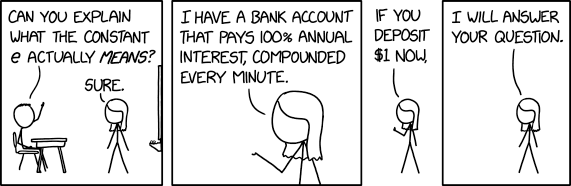
Definition of e
 ⌘ Read more
↳
In-reply-to
»
DEEPL now has a Writer https://www.deepl.com/write - very nice, fast and available in multiple languages. Write better texts, instantly.
⤋ Read More
@prologic@twtxt.net @carsten@yarn.zn80.net
There is (I assure you there will be, don’t know what it is yet…) a price to be paid for this convenience.
Exactly prologic, and that’s why I’m negative about these sorts of things. I’m almost 50, I’ve been around this tech hype cycle a bunch of times. Look at what happened with Facebook. When it first appeared, people loved it and signed up and shared incredibly detailed information about themselves on it. Facebook made it very easy and convenient for almost anyone, even people who had limited understanding of the internet or computers, to get connected with their friends and family. And now here we are today, where 80% of people in surveys say they don’t trust Facebook with their private data, where they think Facebook commits crimes and should be broken up or at least taken to task in a big way, etc etc etc. Facebook has been fined many billions of dollars and faces endless federal lawsuits in the US alone for its horrible practices. Yet Facebook is still exploitative. It’s a societal cancer.
All signs suggest this generative AI stuff is going to go exactly the same way. That is the inevitable course of these things in the present climate, because the tech sector is largely run by sociopathic billionaires, because the tech sector is not regulated in any meaningful way, and because the tech press / tech media has no scruples. Some new tech thing generates hype, people get excited and sign up to use it, then when the people who own the tech think they have a critical mass of users, they clamp everything down and start doing whatever it is they wanted to do from the start. They’ll break laws, steal your shit, cause mass suffering, who knows what. They won’t stop until they are stopped by mass protest from us, and the government action that follows.
That’s a huge price to pay for a little bit of convenience, a price we pay and continue to pay for decades. We all know better by now. Why do we keep doing this to ourselves? It doesn’t make sense. It’s insane.
↳
In-reply-to
»
DEEPL now has a Writer https://www.deepl.com/write - very nice, fast and available in multiple languages. Write better texts, instantly.
⤋ Read More
I have to write so many emails to so many idiots who have no idea what they are doing
So it sounds to me like the pressure is to reduce how much time you waste on idiots, which to my mind is a very good reason to use a text generator! I guess in that case you don’t mind too much whether the company making the AI owns your prompt text?
I’d really like to see tools like this that you can run on your desktop or phone, so they don’t send your hard work off to someone else and give a company a chance to take it from you.
Love the check-ins. Good to see people all over the world using gopherspace.
↳
In-reply-to
»
DEEPL now has a Writer https://www.deepl.com/write - very nice, fast and available in multiple languages. Write better texts, instantly.
⤋ Read More
@carsten@yarn.zn80.net Who says you need to use anything like that? Where’s the pressure coming from?
👋 Q: How do we feel about forking the Twtxt spec into what we love and use today in Yarn.social in yarnd, tt, jenny, twtr and other clients? 🤔 Thinking about (and talking with @xuu@txt.sour.is on IRC) about the possibility of rewriting a completely new spec (no extensions). Proposed name yarn.txt or “Yarn”. Compatibility would remain with Twtxt in the sense that we wouldn’t break anything per se, but we’d divorce ourselves from Twtxt and be free to improve based on the needs of the community and not the ideals of those that don’t use, contribute in the first place or fixate on nostalgia (which doesn’t really help anyone).
On LinkedIn I see a lot of posts aimed at software developers along the lines of “If you’re not using these AI tools (X,Y,Z) you’re going to be left behind.”
Two things about that:
- No you’re not. If you have good soft skills (good communication, show up on time, general time management) then you’re already in excellent shape. No AI can do that stuff, and for that alone no AI can replace people
- This rhetoric is coming directly from the billionaires who are laying off tech people by the 100s of thousands as part of the class war they’ve been conducting against all working people since the 1940s. They want you to believe that you have to scramble and claw over one another to learn the “AI” that they’re forcing onto the world, so that you stop honing the skills that matter (see #1) and are easier to obsolete later. Don’t fall for it. It’s far from clear how this will shake out once governments get off their asses and start regulating this stuff, by the way–most of these “AI” tools are blatantly breaking copyright and other IP laws, and some day that’ll catch up with them.
That said, it is helpful to know thy enemy.
↳
In-reply-to
»
@darch I think having a way to layer on features so those who can support/desire them can. It would be best for the community to be able to layer on (or off) the features.
⤋ Read More
We could ask them? But on the counter would bukket or jan6 follow the pure twtxt feeds? Probably not either way… We could use content negotiation as well. text/plain for basic and text/yarn for enhanced.
↳
In-reply-to
»
💡 Quick 'n Dirty prototype Yarn.social protocol/spec:
⤋ Read More
I’m not super a fan of using json. I feel we could still use text as the medium. Maybe a modified version to fix any weakness.
What if instead of signing each twt individually we generated a merkle tree using the twt hashes? Then a signature of the root hash. This would ensure the full stream of twts are intact with a minimal overhead. With the added bonus of helping clients identify missing twts when syncing/gossiping.
Have two endpoints. One as the webfinger to link profile details and avatar like you posted. And the signature for the merkleroot twt. And the other a pageable stream of twts. Or individual twts/merkle branch to incrementally access twt feeds.
💡 Quick ‘n Dirty prototype Yarn.social protocol/spec:
If we were to decide to write a new spec/protocol, what would it look like?
Here’s my rough draft (back of paper napkin idea):
- Feeds are JSON file(s) fetchable by standard HTTP clients over TLS
- WebFinger is used at the root of a user’s domain (or multi-user) lookup. e.g:
prologic@mills.io->https://yarn.mills.io/~prologic.json
- Feeds contain similar metadata that we’re familiar with: Nick, Avatar, Description, etc
- Feed items are signed with a ED25519 private key. That is all “posts” are cryptographically signed.
- Feed items continue to use content-addressing, but use the full Blake2b Base64 encoded hash.
- Edited feed items produce an “Edited” item so that clients can easily follow Edits.
- Deleted feed items produced a “Deleted” item so that clients can easily delete cached items.
↳
In-reply-to
»
The EU's Proposed CRA Law May Have Unintended Consequences for the Python Ecosystem (as well as the entire free software movement).
⤋ Read More
@abucci@anthony.buc.ci that is an ironic example. Since the inventor of the seatbelt gave rights to use the technology freely.
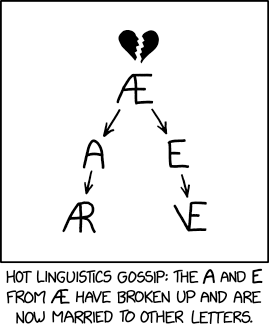
Linguistics Gossip
 ⌘ Read more
I played around with parsers. This time I experimented with parser combinators for twt message text tokenization. Basically, extract mentions, subjects, URLs, media and regular text. It’s kinda nice, although my solution is not completely elegant, I have to say. Especially my communication protocol between different steps for intermediate results is really ugly. Not sure about performance, I reckon a hand-written state machine parser would be quite a bit faster. I need to write a second parser and then benchmark them.
lexer.go and newparser.go resemble the parser combinators: https://git.isobeef.org/lyse/tt2/-/commit/4d481acad0213771fe5804917576388f51c340c0 It’s far from finished yet.
The first attempt in parser.go doesn’t work as my backtracking is not accounted for, I noticed only later, that I have to do that. With twt message texts there is no real error in parsing. Just regular text as a “fallback”. So it works a bit differently than parsing a real language. No error reporting required, except maybe for debugging. My goal was to port my Python code as closely as possible. But then the runes in the string gave me a bit of a headache, so I thought I just build myself a nice reader abstraction. When I noticed the missing backtracking, I then decided to give parser combinators a try instead of improving on my look ahead reader. It only later occurred to me, that I could have just used a rune slice instead of a string. With that, porting the Python code should have been straightforward.
Yeah, all this doesn’t probably make sense, unless you look at the code. And even then, you have to learn the ropes a bit. Sorry for the noise. :-)
↳
In-reply-to
»
slides/go-generics.md at main - slides - Mills -- I'm presenting this tomorrow at work, something I do every Wednesday to teach colleagues about Go concepts, aptly called
⤋ Read More
go mills() 😅
So. Some bits.
i := fIndex(xs, 5.6)
Can also be
i := Index(xs, 5.6)
The compiler can infer the type automatically. Looks like you mention that later.
Also the infer is super smart.. You can define functions that take functions with generic types in the arguments. This can be useful for a generic value mapper for a repository
func Map[U,V any](rows []U, fn func(U) V) []V {
  out := make([]V, len(rows))
  for i := range rows { out = fn(rows[i]) }
  return out
}


rows := []int{1,2,3}
out := Map(rows, func(v int) uint64 { return uint64(v) })
I am pretty sure the type parameters goes the other way with the type name first and constraint second.
func Foo[comparable T](xs T, s T) int
Should be
func Foo[T comparable](xs T, s T) int❤️ 🎶: Us two by Lee Eun Mi
Salt Dome
 ⌘ Read more
https://themarkup.org/blacklight?url=welcome.us un minador de datos por excelencia.
https://themarkup.org/blacklight?url=welcome.us un minador de datos por excelencia.
WELCOME.US sitio habilitado para encontrar patrocinadores cae a causa del tráfico.
WELCOME.US sitio habilitado para encontrar patrocinadores cae a causa del tráfico.
welcome, glad you all found us.
❤️ 🎶: Glimpse of Us (gf’s perspective in Korean) by Rita Kim
I accidentally wiped out my bookmarks file this afternoon. Syncthing propagated the change, and I was forced to restore from an old partial backup. Lesson learned: versioning is useful.
bd1c8: This is what I used for my torified lynx, I’ve setup an alias like so alias gopher=‘lynx -socks5_proxy=localhost:9050 “
So I looked up how to do it. It did not work. I Git cloned https://github.com/dgoulet/torsocks and followed the build instructions. I tried using it and got Looking up check.torproject.org1676676356 PERROR torsocks[16470]: socks5 libc connect: Connection refused (in socks5_connect() at socks5.c:202)
bd1c8: you would use torsocks.
Omniknot
 ⌘ Read more
↳
In-reply-to
»
On the topic of Programming Languages and Telemetry. I'm kind of curious... Do any of these programming language and their toolchains collect telemetry on their usage and effectively "spy" on your development?
⤋ Read More
@prologic@twtxt.net I get the worry of privacy. But I think there is some value in the data being collected. Do I think that Russ is up there scheming new ways to discover what packages you use in internal projects for targeting ads?? Probably not.
Go has always been driven by usage data. Look at modules. There was need for having repeatable builds so various package tool chains were made and evolved into what we have today. Generics took time and seeing pain points where they would provide value. They weren’t done just so it could be checked off on a box of features. Some languages seem to do that to the extreme.
Whenever changes are made to the language there are extensive searches across public modules for where the change might cause issues or could be improved with the change. The fs embed and strings.Cut come to mind.
I think its good that the language maintainers are using what metrics they have to guide where to focus time and energy. Some of the other languages could use it. So time and effort isn’t wasted in maintaining something that has little impact.
The economics of the “spying” are to improve the product and ecosystem. Is it “spying” when a municipality uses water usage metrics in neighborhoods to forecast need of new water projects? Or is it to discover your shower habits for nefarious reasons?
↳
In-reply-to
»
Any good ideas on how to maintain ~/go/pkg/mod and to remove old garbage?
⤋ Read More
@prologic@twtxt.net the rm -rf is basically what go clean -modcache does.
I think you can use another form that will remove just the deps for a specific module. go clean -r
↳
In-reply-to
»
I've never liked the idea of having everything displayed all of the time for all of history.
⤋ Read More
@eldersnake@we.loveprivacy.club Several reasons:
- It’s another language to learn (SQL)
- It adds another dependency to your system
- It’s another failure mode (database blows up, scheme changes, indexs, etc)
- It increases security problems (now you have to worry about being SQL-safe)
And most of all, in my experience, it doesn’t actually solve any problems that a good key/value store can solve with good indexes and good data structures. I’m just no longer a fan, I used to use MySQL, SQLite, etc back in the day, these days, nope I wouldn’t even go anywhere near a database (for my own projects) if I can help it – It’s just another thing that can fail, another operational overhead.
Thanks for the suggestion. One can also simply use netcat.
Code Lifespan
 ⌘ Read more
I’m in Minnesota, US, where this gopher hole is located.
Is it allowed to use your server magical.fish by telnet? I can reach port 71 by telnet and get the chat seite with input chat. wha
↳
In-reply-to
»
#randomQuestionOfTheDay
⤋ Read More
@mckinley@twtxt.net i use pass along with the android and browser-pass clients. it is very good and keeping in sync is pretty simple.
What password manager do you use? Or, why none?
Port 71 belongs to Magical.gopher. You need to be using OpenNic dns for it to work.
Hey @kdx@kdx.re What clinet are you using?
well. simple. Is there more security, if I use Port 71?
↳
In-reply-to
»
Trying to wrap my head around webfinger..
⤋ Read More
@xuu@txt.sour.is that doesn’t seem to fit the spirit of the spec, at least by my read (I could be wrong obv). The example on Wikipedia’s webfinger page,
{
	"subject": "acct:bob@example.com",
	"aliases": [
		"https://www.example.com/~bob/"
	],
	"properties": {
		"http://example.com/ns/role": "employee"
	},
	"links": [{
			"rel": "http://webfinger.example/rel/profile-page",
			"href": "https://www.example.com/~bob/"
		},
		{
			"rel": "http://webfinger.example/rel/businesscard",
			"href": "https://www.example.com/~bob/bob.vcf"
		}
	]
}
and then the comparison with how mastodon uses webfinger,
{
    "subject": "acct:Mastodon@mastodon.social",
    "aliases": [
        "https://mastodon.social/@Mastodon",
        "https://mastodon.social/users/Mastodon"
    ],
    "links": [
        {
            "rel": "http://webfinger.net/rel/profile-page",
            "type": "text/html",
            "href": "https://mastodon.social/@Mastodon"
        },
        {
            "rel": "self",
            "type": "application/activity+json",
            "href": "https://mastodon.social/users/Mastodon"
        },
        {
            "rel": "http://ostatus.org/schema/1.0/subscribe",
            "template": "https://mastodon.social/authorize_interaction?uri={uri}"
        }
    ]
}
suggests to me you want to leave the subject/acct bit as is (don’t add prefixes) and put extra information you care to include in the links section, where you’re free to define the rel URIs however you see fit. The notion here is that webfinger is offering a mapping from an account name to additional information about that account, so if anything you’d use a "subject": "acct:SALTY ACCOUNT_REPRESENTATION" line in the JSON to achieve what you’re saying if you don’t want to do that via links.
↳
In-reply-to
»
Trying to wrap my head around webfinger..
⤋ Read More
@prologic@twtxt.net Unfortunately the RFC’s are a bit light in this regard. While it makes mention of different kinds of accounts like mailto: or status services.. it never combines them. It does make mention of using redirects to forward a request to other webfingers to provide additional detail.
I am kinda partial to using salty:acct:me@sour.is, yarn:acct:xuu@txt.sour.is, mailto:me@sour.is that could redirect to a specific service. and a parent account acct:me@sour.is that would reference them in some way. either in properties or aliases.
↳
In-reply-to
»
restic · Backups done right! -- In case no-one has used this wonderful tool
⤋ Read More
restic yet, I can beyond a doubt assure you it is really quite fantastic 👌 #backups
Interesting. Ive been using backupninja with Borg for snapshots.
restic · Backups done right! – In case no-one has used this wonderful tool restic yet, I can beyond a doubt assure you it is really quite fantastic 👌 #backups
Did something chchange with how the discover feed is generated? My pods logout mode now only shows my twts. It used to be all twts from watcher observation like my logged on discover tab. @prologic@twtxt.net
One of the frustrating parts of using twtxt for conversations is the URLs are, well… ugly. Anyone (like y’all yarn folks) looked at using webfinger for translating user@domain accounts to URLs?
@prologic@twtxt.net and @justamoment, this Gitxt project sounds really interesting. Can you tell us about some of your goals?
I bought my Galaxy Note 8 five years go today. This is by far the most use I’ve gotten out of one smartphone!
Pleroma’s gopher server barfs if you arrive to it using domain.tld/1/ so it means I can’t link to it from here, but if you just enter domain.tld it works
An interesting read about testing code using nullable states instead of mocks.
https://www.jamesshore.com/v2/projects/testing-without-mocks/testing-without-mocks