My mate and I were fortunate enough to witness one of the very best, top-quality sunsets of the year on our evening hike. Very hard to get any better than this. The really good stuff easily lasted for 20 minutes, even one hour after the sun disappeared behind the horizon, there were red clouds slightly glowing in the dark. Absolutely insane. Enjoy!
↳
In-reply-to
»
iPhone Duo - Apple Sorry Apple™, I'm really finding it quite hard to justify spending thousands of dollar on your products!
⤋ Read More
@prologic@twtxt.net Must say I do kinda like the rounded design, passport screen ratio, the inner screen textured finish and the promised pencil support, making this a pocketable drawing tablet.
Obviously wouldn’t buy it, or any other foldable device, with these fragile plastic displays, lack of a headphone jack and thanks to iOS also too many software compromises.
Since earlier this year, I main a TCL phone, I got during a sale event, for under $150 and it really has pretty alright specs: 8GB RAM, recently updated to Android 16, 90Hz refresh rate, even the headphone jack, …
Yesterday, my mate and I left the house at 10 in the morning around 15 or 16°C. There was a steady wind blowing, the sun came and went every two minutes. The clouds looked really nice. Temperatures peaked at 21°C I reckon. Certainly great t-shirt weather. It was supposed to slightly rain at some point in the morning, but all we got was less than two hand full of drops and later the tiniest amount of drizzle for not even half a minute. So, nothing.
The weathermen also called for a cloudy arvo and partially sunny evening. The forecast must have scared off people right away, because there was noone around. We saw very dark clouds in the distance and there was certainly rain in the town. But out in nature, just a constant alternation between the sun and clouds.
Just before noon, we arrived at the bakery two villages over and got four fire brezels (with pepper, extremely tasty, but the fingers are an oily mess after that) and two nut sticky buns for provisions. This is where the small bird (19-23) was giving us a show.
It’s so dry, the landscape looks already like autumn for several weeks. Sooo many orange and brown leaves on the ground, it’s crazy. I hope we still get a real autumn and head not straight from summer into winter. Last weekend was still an awful 37°C.
This time, we paid the small entrence fee to walk around inside the ruin of Hohenrechberg Castle. The red sandstone looks super sick. I really dig it. It’s actually purplish at parts, no kidding. Absolutely unreal! At least for me, I normally only see the beige sandstone around here.
Right when we went down the castle ditch, both camera batteries were completely drained after just 880 photos in total. What a bummer. I saw a guy with a leather glove coming out of a door and immediately followed him to the aviary in the hopes of a show or something. That flight cage wasn’t there last time I visited the ruin. And we were lucky, the falconer fed his harris’ hawk and explained us along the way. Other families came and went, but we talked to him for at least 20 minutes. Super interesting. I think that was easily the best part.
At exactly 19 o’clock I unlocked the front door. Our feet were done. It was an amazing nine hours hike. :-)
The gallery is a tiny bit larger than usual, enjoy: https://lyse.isobeef.org/wanderung-auf-die-burgruine-hohenrechberg-2026-08-22/
@movq@www.uninformativ.de Regarding https://movq.de/blog/postings/2026-08-16/0/POSTING-en.html, how often do you edit the first commit? A good mate does the same for at least a whole decade, probably more. I never found myself in this situation. Even though I mess with commits on a daily basis. Just never the first one so far. 8-)
I am sooooooooooooooooooooooooooooooooooooooooooooooooOOOOOOOOOOOOOOoooooooooooooooo tired of “fast-moving” software. ruff changed a ton of stuff and now all my code bases “need fixing”. Blah.
And SemVer is worth nothing if your 4 year old program with over 16’000 commits is still at “version 0.x”. Blah!
Everything is horrible.
↳
In-reply-to
»
I don't think I'm going to add edit and delete support in this app because I think it was a horrible mistake to add those features to a client 🤣
⤋ Read More
So just because I enjoy this kind of thing (looking into laws and trying to understand them…):
GDPR is about roles, not ownership
There’s no property right in personal data under GDPR. The whole regime hangs on three roles:
- Data subject — the person the data is about.
- Controller (Art. 4(7)) — “the natural or legal person … which, alone or jointly with others, determines the purposes and means of the processing of personal data.”
- The rights in Arts. 16 and 17 are exercised by a data subject against a controller. They compel a third party to rectify or erase. They are not self-executing duties that a piece of software must expose.
That’s the key. In your architecture, for a user’s own posts about themselves sitting in their own feed on their own device:
- the user is the data subject, and
- the user is also the only person “determining the purposes and means” of that data.
There is no third party controller to compel. The “right to erasure” is a right to make someone else delete — and there is no someone else. It is satisfied the instant the user can change the file. A UI button is a convenience, not a legal requirement. Omitting it removes zero rights, because the data is a plain-text file the user can edit or delete by any means — editor, sed, git, their file manager. Full practical control is retained; nobody is being denied anything by anyone.
↳
In-reply-to
»
The original twt is unavailable. It may have been edited or deleted, or is from an unknown or muted feed.
⤋ Read More
@balloon-fu-sen@tw.fus.f5.si Thank you for reaching out 👌 I had alraedy done so via Email too a few days back and she upgraded her Pod to yarnd/0.16.x 🎉
↳
In-reply-to
»
@prologic @bender is it normal that twtxtapp's
⤋ Read More
<tab> (white space) between the timestamps and posts look a bit shorter than the ones from jenny? just noticed that and thought maybe it's someting you'd want to know.
@aelaraji@aelaraji.com @david@daiwei.me @prologic@twtxt.net It depends on the tab size, but often, a tab aligns the following character to next column that is a multiple of eight.
1      8       |16     |24     |32
2026-07-12T08:11:34+02:00      Here goes the text
2026-07-12T06:11:34Z   Here goes the text
🥳 Finally! After nearly 4 years, yarnd v0.16.0 “Silver Sojourner” is out! 🚀 Twt Hash v2, SQLite FTS5 search, HTMX-powered UI, first-time setup wizard and literally hundreds of bug fixes 🐛
Release notes: https://git.mills.io/yarnsocial/yarn/releases/tag/0.16.0
Upgrading is fully automatic — the Twt Hash v2 migration re-fetches all feeds on first start, so expect the first cycle to be a bit heavier. Images on Docker Hub as prologic/yarnd:0.16.0 👌
cc @kat@yarn.girlonthemoon.xyz @abucci@anthony.buc.ci @shinyoukai@yume.laidback.moe @eldersnake@we.loveprivacy.club 🙏
↳
In-reply-to
»
We slept in the forest. It was really great except of my mate's fucking terror dog who was barking and snarling the entire night to each and every sound. I had maybe half an hour of sleep in total. Despite that, it was pleasantly warm. Well, the night, that is. The heat was brutal during the days. Literally streams of sweat were running down on us on the way there in the evening and back in the morning.
⤋ Read More
@prologic@twtxt.net Well, 15 shows the site. On the left, I had a roll mat on a tarp. I borrowed some “NVA tarps” from the scouts for this trip. The scouts got them from the National People’s Army, the German Democratic Republic’s armed forces after Germany was reunited. They’re 1.75m x 1.75m in size and weigh 1.3kg, quite heavy, but super awesome. One tarp on the bottom, another one to cover up the clothes, shoes and sleeping bag in order to protect against the thaw. Finally, a mosquito net over all that, hung from a rope between two trees.
My mate just used a hammock with a mozzie net on the right hand side. The third tarp served as the luxurious bedside carpet. :-)
We sat on my second tarp to chill and enjoy the sunset and surroundings. It was nice to notice birds etc. die down. It took a really long time for the last light to fade away. Since we have a very high risk of forest fires, we of course couldn’t have a camp fire. But after all the exhaustion, I didn’t even miss it for one second.
Since we had dinner at home before leaving, all we brought were two lye rolls, two grain rolls, two brezels, some sausage and chocolate biscuits for breakfast. From the 2.5l of water, I ended up using 2l. It’s always good to have a little extra, despite the unnecessary weight. We had brekkie a few kilometers further on a bench in the shade. The first bench was already in direct sun.
Our camp site was maybe 30m to the side and a few meters down of a summit path hidden behind some trees and bushes. We were quite lucky, the other side of the hill got quite a bit of a breeze at night. We could hear the leaved treetops making much more noise behind us.
@movq@www.uninformativ.de Yes, these kind of dogs should really be strictly forbidden!
It’s not illegal if you own the forest or ask the owner. :-)
@david@daiwei.me Yeah, no clue. But my mate said the dog is disqualified from such adventures in the future. :-)
The temps were supposed to hit 14°C just before sunrise. Since we didn’t bring a thermometer, I can’t tell for sure. I was rather hot in my sleeping bag, so I had to pull out my arms every now and then. My mate’s sleeping bag was a little lighter and, unfortunately, the zipper jammed up. Since it didn’t close all the way, it felt quite a bit cold I was told in the morning. When we got up at 6ish (we said, we don’t care about time at all), it was probably already 16°C if not more. I brought a jumper, but a t-shirt was already nice enough to wear. The jumper just served as my pillow. The mercury raised by the minute then.
Yeah, I circled the spot with a biro to keep an eye on it. Until now, there’s absolutely nothing to see. Looks like I got lucky.
↳
In-reply-to
»
Hey folks 👋 Today I announce the re-release of the Twtxt Search Engine now live and running and actively re-crawling and re-indexing. 🎉 Please report bugs or any useability issues to me! 🙏 #Twtxt #Search
⤋ Read More
@prologic@twtxt.net That’s cool to hear!
Looking at my access logs, something seems to be off, though:
2026-07-04T04:11:26+02:00 200
2026-07-04T05:16:09+02:00 304
2026-07-04T06:33:34+02:00 304
2026-07-04T06:37:46+02:00 304 # just four minutes since last crawl
2026-07-04T06:41:55+02:00 304 # another four minutes
2026-07-04T07:11:33+02:00 304
2026-07-04T07:11:40+02:00 200 # no conditional request just seven seconds later
2026-07-04T07:43:25+02:00 304
2026-07-04T07:43:33+02:00 200 # just eight seconds since last crawl
2026-07-04T09:18:06+02:00 304
2026-07-04T09:22:53+02:00 304 # just four minutes since last crawl
2026-07-04T09:27:03+02:00 304 # another four minutes
@movq@www.uninformativ.de Regarding https://movq.de/blog/postings/2026-06-16/0/POSTING-en.html:
In my opinion, the KDE 3.5 menu was organized way better than the Windows Start menu. Granted, a typical KDE installation had much more applications to offer, too. So, there was more need to get it right. And it probably was also later in time.
Isn’t Notepad++ and Python cheating!? :-D
Crazy story on the clock’s seconds. I never heard of that before. Neat.
Yeah, UI these days is horrible. (That’s why my own TUIs suck, too!)
In Magic today, the Phyrexian Invasion failed in the first game, but the second game was EPIC!
I played my (unlisted) Dragons 2: Draconic Boogaloo deck, and…
Turn 1: Nothing special
Turn 2: Miirym (when a dragon enters, copy it)
Turn 3: Tiamat (choose 5 dragons from deck, put in hand)
Turn 4: Klauth (when dragons attack, create mana equal to their total power)
I attacked with all 5 dragons, which made 28 mana x2 = 56(!) mana.
Then (still turn 4) I played Scourge of Valkas (when a dragon enters, deal damage to target equal to number of dragons) + 5 other dragons, dealing 6 + 2 x (7+8+9+10+11+12+13+14+15+16+17) = 270(!) direct damage (more than double enough to kill the other 3 players).
Damn fine win, if I do say so myself.
And a trip to my backyard mountain again. It was very windy, so the 16°C felt even cooler than that. But it will be back in the twenties tomorrow when I visit a mate for a hike, oof.
My mate and I hiked some 16-18 kilometers to the Wasserberg. The 22°C sun was beating down hard on us. There were quite a bunch of clouds all around, but none of them casted the tiniest shade on us. Only in the second half we got a little bit luckier in that regard. Still, we were soaked before we even left town. Hardly any breeze.
Unfortunately, I left my camera at home and found it hidden behind the cettle in the kitchen after searching the entire house for some 15 odd minutes. However, a greenfinch paid me a visit this morning and I got it on camera. The sunset was crazy colored, too:
↳
In-reply-to
»
Yesterday's evening stroll: https://lyse.isobeef.org/asperg-2026-04-15/
⤋ Read More
To complete, the clouds after sunset: https://lyse.isobeef.org/abendhimmel-2026-04-16/
↳
In-reply-to
»
Yesterday's evening stroll: https://lyse.isobeef.org/asperg-2026-04-15/
⤋ Read More
And the morning sun: https://lyse.isobeef.org/morgensonne-2026-04-16/
↳
In-reply-to
»
Btw @movq you've inspired me to try and have a good 'ol crack at writing a bootloader, stage1 and customer microkernel (µKernel) that will eventually load up a Mu (µ) program and run it! 🤣 I will teach Mu (µ) to have a
⤋ Read More
./bin/mu -B -o ... -p muos/amd64 ... target.
@prologic@twtxt.net I’d love to take a look at the code. 😅
I’m kind of curious to know how much Assembly I need vs. How much of a microkernel can I build purely in Mu (µ)? 🤔
Can’t really answer that, because I only made a working kernel for 16-bit real mode yet. That is 99% C, though, only syscall entry points are Assembly. (The OpenWatcom compiler provides C wrappers for triggering software interrupts, which makes things easier.)
But in long mode? No idea yet. 😅 At least changing the page tables will require a tiny little bit of Assembly.
↳
In-reply-to
»
My little toy operating system from last year runs in 16-bit Real Mode (like DOS). Since I’ve recently figured out how to switch to 64-bit Long Mode right after BIOS boot, I now have a little program that performs this switch on my toy OS. It will load and run any x86-64 program, assuming it’s freestanding, a flat binary, and small enough (< 128 KiB code, only uses the first 2 MiB of memory).
⤋ Read More
@prologic@twtxt.net That might be a challenge, at least in 16-bit Real Mode: The OS follows the model of COM files on DOS, i.e. the size of the binary cannot exceed 64 KiB and heap+stack of the running program will have to fit into that same 64 KiB. 😅 (The memory layout is very rigid, each process gets such a 64 KiB slice.)
And in 64-bit Long Mode, there is no “kernel” yet. The thing in the video is literally just a small bare-metal program.
But some day, maybe. 😃
My little toy operating system from last year runs in 16-bit Real Mode (like DOS). Since I’ve recently figured out how to switch to 64-bit Long Mode right after BIOS boot, I now have a little program that performs this switch on my toy OS. It will load and run any x86-64 program, assuming it’s freestanding, a flat binary, and small enough (< 128 KiB code, only uses the first 2 MiB of memory).
Here I’m running a little C program (compiled using normal GCC, no Watcom trickery):
https://movq.de/v/b27ced6dcb/los86%2D64.mp4
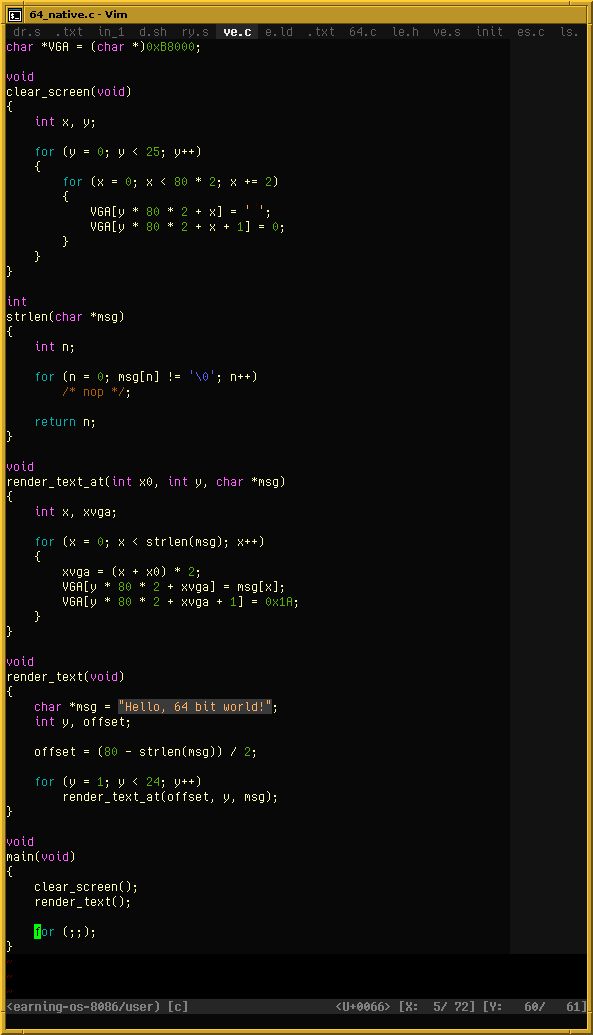
Next steps could include:
- Use Rust instead of C for that 64-bit program?
- Provide interrupt service routines. (At the moment, it just keeps interrupts disabled.)
Samsung A71 with evolution x 16
Waiting for @prologic@twtxt.net to make it back from his luxurious vacation, to engage on Australia’s teen-under-16 social media banning technical, parental, and philosophical discourse.
↳
In-reply-to
»
Advent of Code 2025 starts tomorrow. 🥳🎄
⤋ Read More
Day 2 was pretty tough on my old hardware. Part 1 originally took 16 minutes, then I got it down to 9 seconds – only to realize later that my solution abused some properties of my particular input. A correct solution will probably take about 30 seconds. 🫤
Part 2 took 29 minutes this morning. I wrote an optimized version but haven’t tested it yet. I hope it’ll be under a minute.
Python 1 feels really slow, even compared to Java 1. And these first puzzles weren’t even computationally intensive. We’ll see how far I’ll make it …

Sooooo looking forward to my holiday, after this week of work 🤯 16 day holiday in Vietnam! Whoohoo 🤟
↳
In-reply-to
»
17, 21, and 22 are my favourites. Thank you for sharing! On 17, the pulley might be dangerously hanging, but if you manage to make it work, you will have a couple of nails to use! :-D
⤋ Read More
@bender@twtxt.net Thanks. That pulley is just to hang back up the telephone wire (on the ground in 16) for that farm and restaurant in 04 once they finish logging. Hahahahahaaahaaaa, I didn’t see the nails on top of the pole. :-D
Yup, these ice crystals are just lovely. :-)
We had a nice family day in Schwäbisch Gmünd: https://lyse.isobeef.org/schwaebisch-gmuend-2025-11-16/
I’m currently using a theme named deep. I like that it has all 16 colors and decent contrast.
that’s an hour to only travel 16 miles
@aelaraji@aelaraji.com, I mean to follow up here on the brief exchange we had on irc.mills.io, but I forgot. Never too late, so here it goes:
18:16 <aelaraji> quark 🙏 much appreciated but it won't be necessary, since there isn't much to miss out on in most of  where I hang out, so I could just disconnect and spare everyone else the noise
18:17 *** aelaraji (aelaraji@776014f5a3edd32f1ed19658b7b85c8c655945b0feacaedd92fe60e61a3c0ae2) has quit (/ME goes "yeeeeet..!")
18:18 <quark> No noise for me.
18:18 <quark> It’s all good.
18:18 <quark> What would IRC be without on/offs?
18:19 <quark> Preeeety boring!
18:19 <quark> Ah, he was gone.
18:19 <quark> Well, I will twtxt this to him.  LOL.
↳
In-reply-to
»
Good morning. Driving the dot matrix printer from my little real-mode toy OS. 🖨️
⤋ Read More
@lyse@lyse.isobeef.org @dce@hashnix.club It’s pretty cool, I won’t argue that, but also really simple, to be completely honest. 😅 The BIOS already provides all you need to send data to the printer:
https://helppc.netcore2k.net/interrupt/bios-printer-services
The BIOS actually does provide a great deal of things, which, to me, was one of the most surprising learnings of this project (the project of writing a little 16-bit real-mode OS, that is). It often doesn’t feel like I was writing an operating system – it felt more like writing a normal program that just uses BIOS calls like we would use syscalls these days.
(I’ve also read a lot of warnings, like “don’t use the BIOS for this or that”. Mostly because it tends to be very slow.)
What stupid weather in August. I’m sitting here on our terrace in my jacket. It’s raining and the temperature has dropped to 16° C.
↳
In-reply-to
»
linode's having a major outage (ongoing as of writing, over 24 hours in) and my friend runs a site i help out with on one of their servers. we didn't have recent backups so i got really anxious about possible severe data loss considering the situation with linode doesn't look great (it seems like a really bad incident).
⤋ Read More
@kat@yarn.girlonthemoon.xyz after 5 years or so with Linode, I started having little—but annoying—issues with them. Moved to Vultr and have been very happy with them since Ubuntu 16.04, so 9 years, and a little bit more.
Global update: Trump in Scotland says EU trade deal has 50-50 chance as tariff row grows. Gaza sees 9 more starvation deaths (122 total); UN says famine is deliberate. Thai-Cambodia clashes kill 16, displace 135k. US raid in Syria kills top ISIS leader & sons.
↳
In-reply-to
»
I was drafting support for showing “application icons” in my window manager, i.e. the Firefox icon in the titlebar:
⤋ Read More
@movq@www.uninformativ.de According to this screenshot, KDE still shows good old application icons: 
And GNOME used to have them, too: 
I like the looks of your window manager. That’s using Wayland, right? The only thing on this screenshot to critique is all that wasted space of the windows not making use of the full screen!!!1 At least the file browser. 8-)
This drives me nuts when my workmates share their screens. I really don’t get it how people can work like that. You can’t even read the whole line in the IDE or log viewer with all the expanded side bars. And then there’s 200 pixels on the left and another 300 pixels on the right where the desktop wallpaper shows. Gnaa! There’s the other extreme end when somebody shares their ultra wide screen and I just have a “regularish” 16:10 monitor and don’t see shit, because it’s resized way too tiny to fit my width. Good times. :-D
Sorry for going off on a tangent here. :-) Back to your WM: It has the right mix of being subtle and still similar to motif. Probably close to the older Windowses. My memory doesn’t serve me well, but I think they actually got it fairly good in my opinion. Your purple active window title looks killer. It just fits so well. This brown one ( ) gives me also classic vibes. Awww. We ran some similar brownish color scheme (don’t recall its name) on Win95 or Win98 for some time on the family computer. I remember other people visting us not liking these colors. :-D
Here’s an example of X11/Xlib being old and archaic.
X11 knows the data type “cardinal”. For example, the window property _NET_WM_ICON (which holds image data for icons) is an array of “cardinal”. I am already not really familiar with that word and I’m assuming that it comes from mathematics:
https://en.wikipedia.org/wiki/Cardinal_number
(It could also be a bird, but probably not: https://en.wikipedia.org/wiki/Cardinalidae)
We would probably call this an “integer” today.
EWMH says that icons are arrays of cardinals and that they’re 32-bit numbers:
https://specifications.freedesktop.org/wm-spec/latest-single/#id-1.6.13
So it’s something like 0x11223344 with 0x11 being the alpha channel, 0x22 is red, and so on.
You would assume that, when you retrieve such an array from the X11 server, you’d get an array of uint32_t, right?
Nope.
Xlib is so old, they use char for 8-bit stuff, short int for 16-bit, and long int for 32-bit:
That is congruent with the general C data types, so it does make sense:
https://en.wikipedia.org/wiki/C_data_types
Now the funny thing is, on modern x86_64, the type long int is actually 64 bits wide.
The result is that every pixel in a Pixmap, for example, is twice as large in memory as it would need to be. Just because Xlib uses long int, because uint32_t didn’t exist, yet.
And this is something that I wouldn’t know how to fix without breaking clients.
↳
In-reply-to
»
After many weeks and probably at least a hundred hours of research, discussions and in-person viewing, I think I've finally come up with my Final Choices (shortlist) of a Hybrid Camper / Caravan that I think will suit my family and that I'll enjoy (far less work for me to setup and teardown). The one at the top of the list I'm leaning towards os the SWAG SCT16 Family 4B Media #Camping #Campers
⤋ Read More
@bender@twtxt.net That was one of the inputs into my research 🧐 So that’s already factored in. We bought our new truck (2025 GWM Canon) recently to replace the ‘ol 2nd hand Nissan Navara we bought that just had too many things go wrong with it, and I don’t have time or energy to learn to be a diesel mechanic haha 🤣 – So yes, the SCT-16 has a Tare (unladen weight) of 2150Kg and a maximum legal (ATM) weight of 2,800Kg.
The WM_CLASS Property is used on X11 to assign rules to certain windows, e.g. “this is a GIMP window, it should appear on workspace number 16.” It consists of two fields, name and class.
Wayland (or rather, the XDG shell protocol – core Wayland knows nothing about this) only has a single field called app_id.
When you run X11 programs under Wayland, you use XWayland, which is baked into most compositors. Then you have to deal with all three fields.
Some compositors map name to app_id, others map class to app_id, and even others directly expose the original name and class.
Apparently, there is no consensus.
↳
In-reply-to
»
The lack of suckless-like simple, hackable software these days is appalling.
⤋ Read More
@prologic@twtxt.net Yeah, this really could use a proper definition or a “manifest”. 😅 Many of these ideas are not very wide spread. And I haven’t come across similar projects in all these years.
Let’s take the farbfeld image format as an example again. I think this captures the “spirit” quite well, because this isn’t even about code.
This is the entire farbfeld spec:
farbfeld is a lossless image format which is easy to parse, pipe and compress. It has the following format:

╔════════╤═════════════════════════════════════════════════════════╗
║ Bytes  │ Description                                             ║
╠════════╪═════════════════════════════════════════════════════════╣
║ 8      │ "farbfeld" magic value                                  ║
╟────────┼─────────────────────────────────────────────────────────╢
║ 4      │ 32-Bit BE unsigned integer (width)                      ║
╟────────┼─────────────────────────────────────────────────────────╢
║ 4      │ 32-Bit BE unsigned integer (height)                     ║
╟────────┼─────────────────────────────────────────────────────────╢
║ [2222] │ 4x16-Bit BE unsigned integers [RGBA] / pixel, row-major ║
╚════════╧═════════════════════════════════════════════════════════╝

The RGB-data should be sRGB for best interoperability and not alpha-premultiplied.
(Now, I don’t know if your screen reader can work with this. Let me know if it doesn’t.)
I think these are some of the properties worth mentioning:
- The spec is extremely short. You can read this in under a minute and fully understand it. That alone is gold.
- There are no “knobs”: It’s just a single version, it’s not like there’s also an 8-bit color depth version and one for 16-bit and one for extra large images and one that supports layers and so on. This makes it much easier to implement a fully compliant program.
- Despite being so simple, it’s useful. I’ve used it in various programs, like my window manager, my status bars, some toy programs like “tuxeyes” (an Xeyes variant), or Advent of Code.
- The format does not include compression because it doesn’t need to. Just use something like bzip2 to get file sizes similar to PNG.
- It doesn’t cover every use case under the sun, but it does cover the most important ones (imho). They have discussed using something other than RGBA and decided it’s not worth the trouble.
- They refrained from adding extra baggage like metadata. It would have needlessly complicated things.
↳
In-reply-to
»
I bought the “remastered” versions of Grim Fandango and Forsaken on GOG, because they’re super cheap at the moment. Both have native Linux versions.
⤋ Read More
In all fairness, GOG says that Forsaken is only supported on Ubuntu 16.04 – not current Arch Linux. If you ask me, this just goes to show that Linux is not a good platform for proprietary binary software.
Is it free software, do you have the source code? Then you’re good to go, things can be patched/updated (that can still be a lot of work). But proprietary binary blobs? Very bad idea.
I did a “lecture”/“workshop” about this at work today. 16-bit DOS, real mode. 💾 Pretty cool and the audience (devs and sysadmins) seemed quite interested. 🥳
- People used the Intel docs to figure out the instruction encodings.
- Then they wrote a little DOS program that exits with a return code and they used uhex in DOSBox to do that. Yes, we wrote a COM file manually, no Assembler involved. (Many of them had never used DOS before.)
- DEBUG from FreeDOS was used to single-step through the program, showing what it does.
- This gets tedious rather quickly, so we switched to SVED from SvarDOS for writing the rest of the program in Assembly language. nasm worked great for us.
- At the end, we switched to BIOS calls instead of DOS syscalls to demonstrate that the same binary COM file works on another OS. Also a good opportunity to talk about bootloaders a little bit.
- (I think they even understood the basics of segmentation in the end.)
The 8086 / 16-bit real-mode DOS is a great platform to explain a lot of the fundamentals without having to deal with OS semantics or executable file formats.
Now that was a lot of fun. 🥳 It’s very rare that we do something like this, sadly. I love doing this kind of low-level stuff.
Saw this on Mastodon:
https://racingbunny.com/@mookie/114718466149264471
18 rules of Software Engineering
- You will regret complexity when on-call
- Stop falling in love with your own code
- Everything is a trade-off. There’s no “best” 3. Every line of code you write is a liability 4. Document your decisions and designs
- Everyone hates code they didn’t write
- Don’t use unnecessary dependencies
- Coding standards prevent arguments
- Write meaningful commit messages
- Don’t ever stop learning new things
- Code reviews spread knowledge
- Always build for maintainability
- Ask for help when you’re stuck
- Fix root causes, not symptoms
- Software is never completed
- Estimates are not promises
- Ship early, iterate often
- Keep. It. Simple.
Solid list, even though 14 is up for debate in my opinion: Software can be completed. You have a use case / problem, you solve that problem, done. Your software is completed now. There might still be bugs and they should be fixed – but this doesn’t “add” to the program. Don’t use “software is never done” as an excuse to keep adding and adding stuff to your code.
Speaking of Wine, Arch Linux completely fucked up Wine for me with the latest update.
- 16-bit support is gone.
- Performance of 3D games is horrible and unplayable.
Arch is shipping a WoW64 build now, which is not yet ready for prime time.
And then I realized that there’s actually only one stable Wine release per year but Arch has been shipping development releases all the time. That’s quite unusual. I’m used to Arch only shipping stable packages … huh.
Hopefully things will improve again. I’m not eager to build Wine from source. I’d rather ditch it and resort to my real Windows XP box for the little (retro)gaming that I do … 🫤
↳
In-reply-to
»
@lyse That bird pic goes right in the wallpaper collection. 😍
⤋ Read More
@movq@www.uninformativ.de I’m glad you like that raven. :-) This is the original for when you get a screen as big as an entire wall one day: 
Once again, we had some very beautiful colors this evening: https://lyse.isobeef.org/abendhimmel-2025-05-16/

↳
In-reply-to
»
@kat my terrible script https://bytes.4-walls.net/kat/dotfiles/src/branch/main/scripts/Scripts/tinypin-log.sh
⤋ Read More
@kat@yarn.girlonthemoon.xyz You don’t need to change the directory first in line 11, you can just create the directory, that’s sufficient since you’re having an absolute path.
The echo in line 13 is useless, you can simplify this to: newdir="$WD/$now" If you reversed this line with the previous one, you could make use of the variable in the directory creation: mkdir "$newdir".
In line 16, pull the directory change out of the loop upfront. The loop body doesn’t modify the working directory, so no need to reset it with each cycle. In fact, you could even spare the cd altogether when you simply tell find where to look: find "$basedir" -type f….
I didn’t try it, but if I read the manpage correctly, you should be able to simplify line 19 as well:
-C Change to DIR before performing any operations. This option is order-sensitive, i.e. it affects all options that follow.
Hence, remove the cd and put the -C "$WD" as the first argument to tar. Again, I didn’t try it. Proceed with caution.
Finally, you don’t need to specify the full path to rm in line 21. I bet, /bin is in your PATH. When you removed the previous cd from my last suggestion, the relative path that follows won’t work anymore. So, just use the absolute path that you already have in a variable: rm -rf "$newdir"
I hope you find this tiny review a wee bit useful. :-)
↳
In-reply-to
»
Confession:
⤋ Read More
@movq@www.uninformativ.de @kat@yarn.girlonthemoon.xyz @quark@ferengi.one In 2014 one person created protocol ii. Later it forked in IDEC. Why i said this? Because it’s simple “federated” forum-like protocol where from your station fetch another every 5-10 minutes. Stations has topic-based channels like idec.talks, linux.16, haiku.os, zx.spectrum. In short it’s FIDO but.. more modern? Documentation: https://github.com/idec-net/new-docs (mostly Russian, but you can use translator, also protocol already translated to english)
After yarnd v0.16 is released and the next round of specification updates are done and dusted, who wants me to have another crack at building Twtxt and activity pub integration support?
↳
In-reply-to
»
I went on a small hike, just 12-13km this time. The weather was great, blue sky, sunny 18°C, but with the wind it felt colder. Leaves and other green stuff is exploding like crazy. It looks super beautiful right now.
⤋ Read More
@lyse@lyse.isobeef.org Very nice! 👌 So lovely and green 😅 – What’s with the sign in  ? 🧐
? 🧐
First draft of yarnd 0.16 release notes. 📝 – Probably needs some tweaking and fixing, but it’s sounding alright so far 👌 #yarnd