(4) The First Brain Was Just Uploaded To A Computer - YouTube
– Wow 😮 This is pretty amazing! Scientists and this new company called Eon, have managed to replicate the entire structure of a fruit fly’s brain, exactly. It behaves exactly like a fruit fly does, in it’s virtual simulated world. The only thing they’re missing is the strengths of the connections and weights of each neuron and the state of the chemical “soup”? of the original fly, so it carries no memories and has no “mind”, but structurally it works! Holy shit! Wowza 😱
Agog to be the 4,960th 🐲 on BackerKit for Deathbringer TTRPG by Professor DM. 🤘
I recently installed Quake on my laptop (via vkQuake), and have really been enjoying playing it again.
When I was at University, we had a lab full of shiny new Windows NT 4.0 workstations that we immediately installed it on, and spent many a late evening fragging each other.
But tonight, when I defeated Chthon for the first time, it occurred to me that I had never actually played the single player mode all the way though (not even the first episode). So now I’m 2 missions into Episode 2 with plans to finish it over the next week or so. #LifeGoals

In #Magic last night, I debuted my new #Dune deck with an underwhelming performance - perhaps unsurprisingly for a desert-focused deck, I faced a real drought, starting the game with only 1 land in hand (even after a mulligan) and not pulling another land until turn 4(!). Because of our house starting mana, I wasn’t totally sunk, but everything I got out was just luck. I did die last thanks to my big wurms (so I guess I was 2nd place?), but still… underwhelming.
For game 2, I wanted to bring the thunder (especially after my pitiful performance last week), so I dusted off my Night of 1000 Squirrels deck (headed by the infamous Chatterfang, Squirrel General). By turn 3, the #squirrel army was forming, and thanks to well-timed casts of Fog and Make a Stand, the squirrels managed to overrun everyone just a few turns later.
Another fun night overall. I won’t be able to play for the next few weeks, so I’m glad this one ended with a win. 😁 #mtg
↳
In-reply-to
»
The original twt is unavailable. It may have been edited or deleted, or is from an unknown or muted feed.
⤋ Read More
@GabesArcade@gabesarcade.com Not sure if @mariam@twtpub.com will ever see or respond to our welcomes tbh 😢 I caught the new user trying out the Twtxt App 4 days too left 🤦♂️ – I think I need to make some improvements to the app, some nudges, something to encourage users to stick around? Maybe some periodic push notifications? 🤔
I finally managed to get back out disc golfing today at Vietnam Veterans Park and had a good time despite losing a brand new disc on hole 3 (on its 3rd throw ever, my glow-in-the-dark Lynx disappeared into an overgrown creek-bed and was swallowed by the underbrush). After my buddy lost a disc on hole 4, we were kinda demoralized and both threw for crap the rest of the course, but it was still a nice day to be slingin’ in the sun…

I am sooooooooooooooooooooooooooooooooooooooooooooooooOOOOOOOOOOOOOOoooooooooooooooo tired of “fast-moving” software. ruff changed a ton of stuff and now all my code bases “need fixing”. Blah.
And SemVer is worth nothing if your 4 year old program with over 16’000 commits is still at “version 0.x”. Blah!
Everything is horrible.
↳
In-reply-to
»
Does this seem right to you so far @david ? 🤔
⤋ Read More
i think there should be at least 4 we know of right?
↳
In-reply-to
»
I don't think I'm going to add edit and delete support in this app because I think it was a horrible mistake to add those features to a client 🤣
⤋ Read More
So just because I enjoy this kind of thing (looking into laws and trying to understand them…):
GDPR is about roles, not ownership
There’s no property right in personal data under GDPR. The whole regime hangs on three roles:
- Data subject — the person the data is about.
- Controller (Art. 4(7)) — “the natural or legal person … which, alone or jointly with others, determines the purposes and means of the processing of personal data.”
- The rights in Arts. 16 and 17 are exercised by a data subject against a controller. They compel a third party to rectify or erase. They are not self-executing duties that a piece of software must expose.
That’s the key. In your architecture, for a user’s own posts about themselves sitting in their own feed on their own device:
- the user is the data subject, and
- the user is also the only person “determining the purposes and means” of that data.
There is no third party controller to compel. The “right to erasure” is a right to make someone else delete — and there is no someone else. It is satisfied the instant the user can change the file. A UI button is a convenience, not a legal requirement. Omitting it removes zero rights, because the data is a plain-text file the user can edit or delete by any means — editor, sed, git, their file manager. Full practical control is retained; nobody is being denied anything by anyone.
Yeah, lol, fuck off. Tried to reproduce that hashing issue, thus playing around with Go a little bit. And what did I find?
$ tree ~/.config/go
/home/user/.config/go
└── telemetry
    ├── local
    │   ├── asm@devel-devel-linux-amd64-2026-07-14.v1.count
    │   ├── compile@devel-devel-linux-amd64-2026-07-14.v1.count
    │   ├── go@devel-devel-linux-amd64-2026-07-14.v1.count
    │   ├── link@devel-devel-linux-amd64-2026-07-14.v1.count
    │   ├── upload.token
    │   └── weekends
    └── upload

4 directories, 6 files
It collects and uploads “telemetry” now.
No.
(Don’t tell me how I can turn that off. Not interested. This is a compiler and it wants to track me, without asking for consent. That’s a no-go.)
🥳 Finally! After nearly 4 years, yarnd v0.16.0 “Silver Sojourner” is out! 🚀 Twt Hash v2, SQLite FTS5 search, HTMX-powered UI, first-time setup wizard and literally hundreds of bug fixes 🐛
Release notes: https://git.mills.io/yarnsocial/yarn/releases/tag/0.16.0
Upgrading is fully automatic — the Twt Hash v2 migration re-fetches all feeds on first start, so expect the first cycle to be a bit heavier. Images on Docker Hub as prologic/yarnd:0.16.0 👌
cc @kat@yarn.girlonthemoon.xyz @abucci@anthony.buc.ci @shinyoukai@yume.laidback.moe @eldersnake@we.loveprivacy.club 🙏
Windows NT 4 didn’t have a Device Manager. You know, this thing right here that got introduced with Windows 95:

And that’s super awkward in NT4.
You know what doesn’t have a Device Manager, either? Linux. Why? 🤔 Isn’t this one of the most useful system tools? It gives you an overview of the devices in your system and tells you which driver is used for them. Linux could really use such a tool, I think? 🤔
(There are programs like “hardinfo” and I remember ancient KDE providing such a tool, but they’re all an afterthought. Hardly integrated into the overall system.)
↳
In-reply-to
»
The original twt is unavailable. It may have been edited or deleted, or is from an unknown or muted feed.
⤋ Read More
@GabesArcade@gabesarcade.com The no-JS part is one thing, but you also have to disable the (nowadays common) forced-HTTP-to-HTTPS-redirect, because those old browsers can’t do modern crypto. And make sure that your webserver serves the correct page even if no Host header is sent by the client. And don’t even think about serving UTF-8 or even just putting utf-8 in the content type. 😅 And for the JPEG thumbnails I pass a special flag to ImageMagick so that IBM Web Explorer from OS/2 won’t trip. 🤣 And always use link rel="stylesheet" for CSS, because some browsers render inlined CSS as literal text. And … probably more that I forgot by now. 😂
@david@daiwei.me Not sure, actually. Let’s see. Those are the ones where I still have the original disks (or have bought them on eBay again):
- SuSE Linux 6.4 (it’s a massive 7 CD distro with a huge manual, best thing ever)
- OS/2 2.1
- OS/2 Warp 3 (red and blue spine because
$reasons)
- OS/2 Warp 4
- PC DOS 7
- MS-DOS 6.22
- Windows 3.1
- Windows for Workgroups 3.11
- Windows 95 C
- Windows 98
- Windows NT 4 Workstation (still in the mail, though 😅)
- Windows 2000
- Windows XP Professional (last Windows I ever used on my private PCs)
(Plus a few “classic” office products as can be seen here: https://movq.de/blog/postings/2024-05-23/0/POSTING-en.html )
Okay, wow. Windows NT 4 wasn’t part of my timeline back then, so this is the first time I’m seeing it in action. And this thing came with IE 2, which I’ve also never seen before. (That’s interesting, because I remember using IE even on Win 3.x, but apparently that was already IE 3?)
It also makes me really happy to see my website work in these old browsers. Fullscreen images are “broken” because those are PNG or WebP, but the rest works just fine. 🥳
Interesting, HTTPS is almost twice as slow as plain HTTP on my server (~72 ms vs. ~135 ms):
$ hyperfine -r 50 "curl -so /dev/null 'http://movq.de/blog/postings/2024-05-23/0/t/word11a.jpg.jpg'"
Benchmark 1: curl -so /dev/null 'http://movq.de/blog/postings/2024-05-23/0/t/word11a.jpg.jpg'
  Time (mean ± σ):      72.7 ms ±  17.2 ms    [User: 6.2 ms, System: 4.8 ms]
  Range (min … max):    49.5 ms …  99.7 ms    50 runs

$ hyperfine -r 50 "curl -so /dev/null 'https://movq.de/blog/postings/2024-05-23/0/t/word11a.jpg.jpg'"
Benchmark 1: curl -so /dev/null 'https://movq.de/blog/postings/2024-05-23/0/t/word11a.jpg.jpg'
  Time (mean ± σ):     135.5 ms ±  28.9 ms    [User: 17.8 ms, System: 5.6 ms]
  Range (min … max):    93.2 ms … 198.5 ms    50 runs
Ran 4.5 km (2.8 miles) at the lake, middle of the day, 31 degrees! I’m a glutton for punishment.
The newsletter feature coming with Mastodon 4.6 also looks very interesting. Could be a good starting point for users who don‘t want to create an account but follow users. Maybe then the next step is to eventually create an account.#mastodon
Version 4.6 of Mastodon Collections introduces lists of users to make it easier to find accounts on specific topics.https://maurice-renck.de/en/blog/2026/mastodon-collections
In Magic today, the Phyrexian Invasion failed in the first game, but the second game was EPIC!
I played my (unlisted) Dragons 2: Draconic Boogaloo deck, and…
Turn 1: Nothing special
Turn 2: Miirym (when a dragon enters, copy it)
Turn 3: Tiamat (choose 5 dragons from deck, put in hand)
Turn 4: Klauth (when dragons attack, create mana equal to their total power)
I attacked with all 5 dragons, which made 28 mana x2 = 56(!) mana.
Then (still turn 4) I played Scourge of Valkas (when a dragon enters, deal damage to target equal to number of dragons) + 5 other dragons, dealing 6 + 2 x (7+8+9+10+11+12+13+14+15+16+17) = 270(!) direct damage (more than double enough to kill the other 3 players).
Damn fine win, if I do say so myself.
Every now and then, I think that I have carefully proof-read my message enough times and hit the “Add message” button in tt. But then, in the message tree, I spot another missed typo. My process is then to go to my twtxt.txt and fix it by hand. However, I still have to clean up tt’s cache. This is rather tidious:
- Recall the
sqlitebrowser ~/.local/share/twtxt/tt2.sqlitefrom my shell history.
- Switch to the “Browse data” tab.
- Go to the
messagestable and wait a second or two until it’s loaded.
- Sort by the
created_atcolumn twice, so that I get descending order.
- Select the first message, which is typically the one in question.
- Find the “Remove currently selected row” button in the tool bar.
- Commit the changes.
- Close sqlitebrowser.
So, I finally implemented the removal of messages from the cache in tt. I can now hit d and confirm the removal. Bam! Should have done that ages ago!

Next up is the search, I think.
↳
In-reply-to
»
It was an easy patch, so menus have drop shadows now:
⤋ Read More
@movq@www.uninformativ.de Exactly! :-D
I just came across these two covers which stood out to me:
- https://www.youtube.com/watch?v=tVvhHydubR0
played a bit faster, and faster is almost always better
- https://www.youtube.com/watch?v=rpwGUx0Sz_4
a choire’s polyphony usually makes things automatically better
Installing OS/2Warp 4 in 86Box as we speak… Why? Because I can!
↳
In-reply-to
»
what is the user-agent name of the crawler that pulls the tweets here on twtxt.net? i am seeing getwtxt-ng/dev and twtstrm/0.4.0 in the logs
⤋ Read More
@klaxzy@klaxzy.net twtstrm/0.4.0 is from Eric. The getwtxt-ng/dev seems to be this.
what is the user-agent name of the crawler that pulls the tweets here on twtxt.net? i am seeing getwtxt-ng/dev and twtstrm/0.4.0 in the logs
↳
In-reply-to
»
Really nothing spectacular at all today, but yet we still got some red for less than five minutes: https://lyse.isobeef.org/abendhimmel-2026-04-27/ Azabache was hiding somewhere in the trees, I could hear him very well, but not lay my eye on him. The leaves are already covering him up perfectly now.
⤋ Read More
@lyse@lyse.isobeef.org 4 is a keeper! Wish it was landscape, perfect for a wall then. :-P
I won our only game of Magic for this week with my (yet-to-be published) “Bolas Triumphant” deck: 5 players over 3 hours, including 4 board wipes (one of which came from my Nicol Bolas, God-Pharaoh), and I even got to cast Omniscience via a Fae of Wishes. I can’t speak for everyone, but I know I had a good time. 😁
What do the Gopher Troopers think of the following? The Gopher protocol is a nearly-forgotten network protocol from the early 1990s, designed to serve and navigate text-based menus and documents over the Internet. While its far less common than HTTP/HTTPS today, there are still some security risks associated with Gopher and Gopher space. Lets break them down carefully: 1. Lack of Encryption Problem: Gopher was designed long before widespread use of SSL/TLS. All dataincluding credentials, file transfers, and menu selectionsis transmitted in plaintext. Impact: Anyone intercepting traffic (e.g., via a network sniffer, public Wi-Fi, or a compromised router) can read sensitive information, including usernames and passwords. 2. No Authentication or Access Control Problem: Gopher servers rarely implement robust authentication; access control is usually limited or non-existent. Impact: Unauthorized users might browse sensitive directories or download private files, particularly if servers are misconfigured. 3. Server Software Vulnerabilities Problem: Modern OSes can still run legacy Gopher servers, but the software is often unmaintained. Impact: Old software may contain buffer overflows, directory traversal bugs, or command injection vulnerabilities that attackers could exploit. 4. Malicious Gopher Links Problem: Gopher menus can contain links that point to scripts or other servers, similar to hyperlinks in HTTP. A client following a malicious link could inadvertently: Download malware Access sensitive internal network resources (server-side request forgery) Impact: Could serve as a vector for attacks if a user opens content from untrusted sources. 5. Legacy Protocol Weaknesses Problem: Gopher lacks modern web security mechanisms like: Content security policies Same-origin policies Cross-site request forgery protection Impact: If Gopher is bridged to other services (like modern browsers via gateways), old vulnerabilities may be exposed. 6. Information Leakage Problem: Gopher servers often provide directory listings without restriction. Impact: Sensitive files, backup directories, and internal documents may be exposed unintentionally. 7. Bridging Risks Problem: Some modern browsers access Gopher via gateways (HTTP-to-Gopher proxies). These bridges may: Expose sensitive internal resources to the gateway Introduce logging or tracking that wouldnt exist on pure Gopher Impact: Attacks could occur indirectly through insecure intermediaries. Key Takeaways Gopher is inherently insecure due to its design in a pre-HTTPS era. Main threats: eavesdropping, unauthorized access, malware delivery, and exploitation of unpatched server software. Safe practice: Use Gopher only in isolated, trusted environments, or through secure HTTP(S) gateways with proper sanitization.
Ezekiel 4:12 …words to live by
↳
In-reply-to
»
Just showelled 20cm of snow for half an hour, fuck me! I'm totally shattered. But it's worth it. Looks so beautiful. And all the disbelief and terror in the eyes of the people. Well, that's what our winters were like three decades ago. I'm just glad that I can work from home.
⤋ Read More
I’ve got sore muscles. The sticky snow couldn’t be pushed, it had to be laborously cleared shovel by shovel. :-D
In my lunch break, I went on a short stroll. Oh boy, walking through deep damp snow is exhausting! There were sections with easily 30 centimeters and more. Some big wind drifts had piled up. Despite melting off quickly in the 4°C, especially turning the trees brown again, the white landscape still looks so nice. I’m glad these road marking sticks finally came in handy for the snow plow guys. :-) The black and orange stripes are 30 cm high.
https://lyse.isobeef.org/waldspaziergang-2026-01-26/
That’s probably it. There’s no significant snowfall announced for the rest of the week and temperatures are supposed to stay in the 2-4°C range by day.
My mate and I went on a hike earlier. Yesterday, we had lovely 12°C. But today, it was down to at most 4°C. Oh well. At least the sun was out and and there was just a tiny bit of wind. We knew upfont that scarf, beanie and gloves were mandatory. Especially at the more windy sections like up top the hills. The view was absolutely terrible, but we made the best of it.
With the sun shining on us during our lunch break at a forest edge bench, we still enjoyed the lookout in 01. I brought some old carpet scraps to sit on and was happily surprised that they isolated even better than I had hoped for. Some hot tea helped us staying warm.
After five hours we returned just after sunset. I’m quite tired now, completely out of shape.
↳
In-reply-to
»
https://github.com/unix-v4-commentary/unix-v4-source-commentary
⤋ Read More
Wow, as I anticipated, this is waaay out of my capabilities to really understand it. But I’m quite happy to just have spotted a mistake in an explanatory comment in section 4.5.2 “The icode Array”. Of course, it should be /e + tc + /i + ni + t\0. Let’s hope that my e-mail with the patch actually makes it into Briam’s inbox. I fear GMail just hides it in the spam folder.
↳
In-reply-to
»
With RAM crazy prices being what they are, I guess my PC is gonna be stuck on 16GB RAM for some time. I originally bought the DDR4 16GB kit for like $49 AUD, and I thought I'd just buy another 16GB or more later down the track (this was like a year and a half ago), thinking it would be similarly priced or even cheaper...
⤋ Read More
@eldersnake@we.loveprivacy.club
Steps to world domination:
- “Invent” “AI” (by using other people’s data).
- Get people hyped about it and ideally hooked on it.
- Only provide it as a cloud service. But hey, if you want to, you can run it locally!
- Buy all hardware available on the market, so that nobody but you can build more systems.
- All PCs of consumers and competitors are too weak now and can’t be upgraded anymore.
- Everybody depends on your cloud service! Win!
All of that is possible because corporations don’t have a “conscience” in capitalism. Nobody forces the RAM manufacturers to sell all their stuff to just one or two buyers, but since the only goal of that manufacturer is to make money, they do it.
The tt URLs View now automatically selects the first URL that I probably are going to open. In decreasing order, the URL types are:
- markdown media URLs (images, videos, etc.)
- markdown or plaintext URLs
- subjects
- mentions
I might differentiate between mentions of subscribed and unsubscribed feeds in the future. The odds of opening a new feed over an already existing one are higher.
Wishing everybody a good morning of the last sunday before Xmas. As we say here in Germany: einen schönen 4. Advent!
I just completed “Printing Department” - Day 4 - Advent of Code 2025 #AdventOfCode https://adventofcode.com/2025/day/4 – Again, I’m doing this in mu, a Go(ish) / Python(ish) dynamic langugage that I had to design and build first which has very few builtins and only a handful of types (ints, no flots). 🤣
↳
In-reply-to
»
Advent of Code 2025 starts tomorrow. 🥳🎄
⤋ Read More
Alright, Advent of Code is over:
https://www.uninformativ.de/blog/postings/2025-12-12/0/POSTING-en.html
It’s been quite the time sink, especially with the DOS games on top, but it was fun. 🥳
In case you’re wondering: All puzzles (except for part 2 of day 10) were doable in Python 1 on SuSE Linux 6.4 and ran in a finite time on the Pentium 133. Puzzle 10/2 might have been doable as well if I had better education. 🤣
↳
In-reply-to
»
Advent of Code 2025 starts tomorrow. 🥳🎄
⤋ Read More
FWIW, day 03 and day 04 where solved on SuSE Linux 6.4:
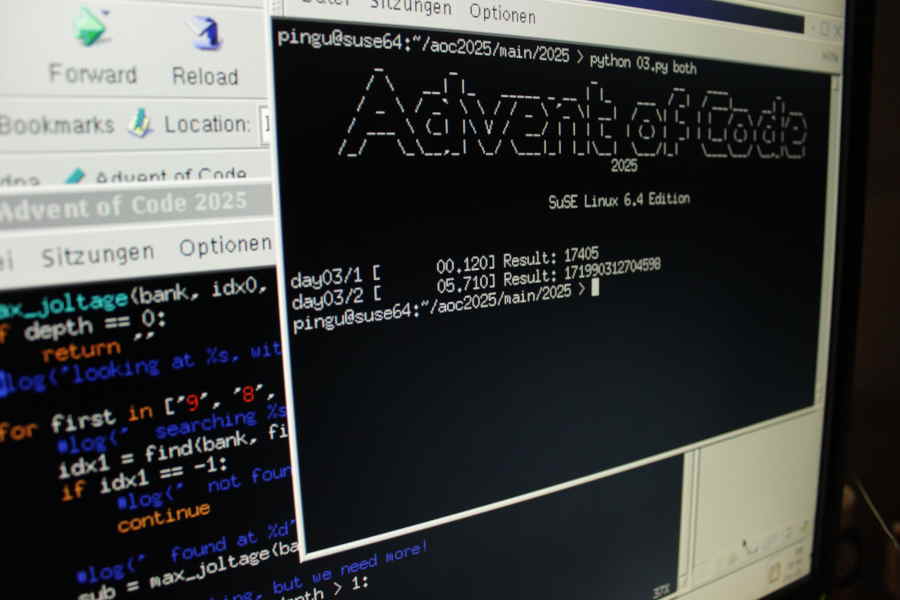
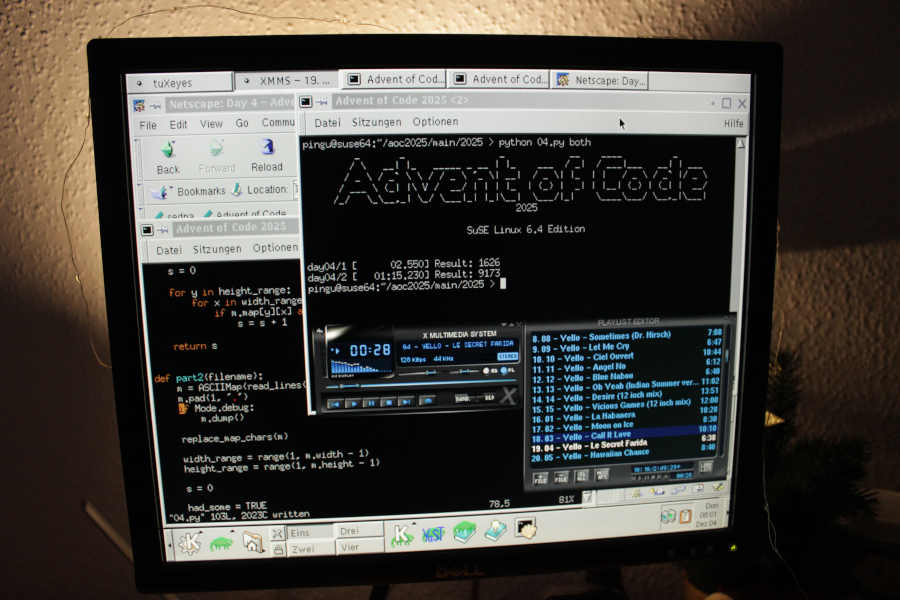
Performance really is an issue. Anything is fast on a modern machine with modern Python. But that old stuff, oof, it takes a while … 😅
Should have used C or Java. 🤪 Well, maybe I do have to fall back on that for later puzzles. We’ll see.
Advent of Code 2025 starts tomorrow. 🥳🎄
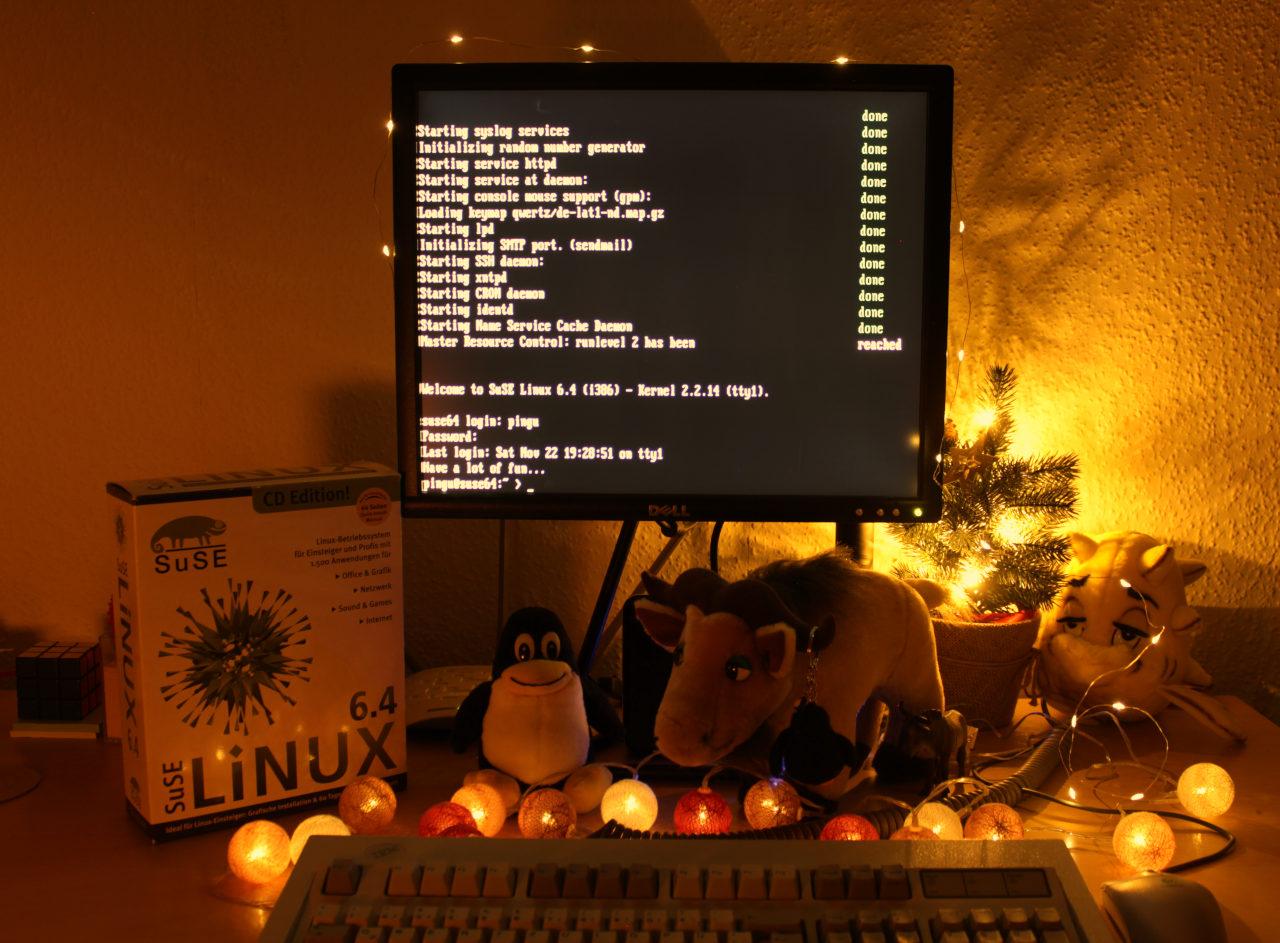
This year, I’m going to use Python 1 on SuSE Linux 6.4, writing the code on my trusty old Pentium 133 with its 64 MB of RAM. No idea if that old version of Python will be fast enough for later puzzles. We’ll see.
Arsenal 4-1 Tottenham
Better Technology, Worse Motivation: GenAI’s Mediocrity Trap
While generative AI (GenAI) promises productive efficiency, it can paradoxically lead to lower-quality work. We conducted an experiment with professional illustrators and found that AI assistance flattens the quality curve—it accelerates initial gains but sharply diminishes the returns on sustained effort. Faced with this, a significant number of professionals made a strategic choice: they sacrificed the final quality to save time.
From http://www.jin-li.org/uploads/1/1/4/5/114595093/ai_and_motivation.pdf
I haven’t read this and can’t vouch for it; seems vaguely AI-boostery. Still, the conclusions are interesting. This seems to be the picture that is emerging about generative AI generally: most people don’t like it and find that degrades the quality of work. Coders seem to like it and think that it helps them, but in fact it makes the slower, less productive, and more bug prone.
By all measures it’s a bad technology. We should just be honest about it. There is no need to make excuses for multi-trillion-dollar corporations.
↳
In-reply-to
»
@bender It's good enough ti iron out any bugs 🐛 Can I haz an account? 🙏
⤋ Read More
@prologic@twtxt.net I will share later my GoToSocial 10 lines (or less) config.yaml, and 4 lines Caddyfile, and you will see how easy it is.
↳
In-reply-to
»
And regarding those broken URLs: I once speculated that these bots operate on an old dataset, because I thought that my redirect rules actually were broken once and produced loops. But a) I cannot reproduce this today, and b) I cannot find anything related to that in my Git history, either. But it’s hard to tell, because I switched operating systems and webservers since then …
⤋ Read More
@lyse@lyse.isobeef.org Probably wouldn’t help, since almost every request comes from a different IP address. These are the hits on those weird /projects URLs since Sunday:
    1 IP  has  5 hits
    1 IP  has  4 hits
   13 IPs have 3 hits
  280 IPs have 2 hits
25543 IPs have 1 hit
The total number of hits has decreased now. Maybe the botnet has moved on …
↳
In-reply-to
»
There are no really good GUI toolkits for Linux, are there?
⤋ Read More
@movq@www.uninformativ.de Don’t you worry, this was meant as a joke. :-D
There was a time when I thought that Swing was actually really good. But having done some Qt/KDE later, I realized how much better that was. That were the late KDE 3 and early KDE 4 days, though. Not sure how it is today. But back then it felt Trolltech and the KDE folks put a hell lot more thought into their stuff. I was pleasantly surprised how natural it appeared and all the bits played together. Sure, there were the odd ends, but the overall design was a lot better in my opinion.
To be fair, I never used it from C++, always the Python bindings, which were considerably more comfortable (just alone the possibility to specify most attributes right away as kwargs in the constructor instead of calling tons of setters). And QtJambi, the Java binding, was also relatively nice. I never did a real project though, just played around with the latter.
↳
In-reply-to
»
@lyse it hasn't happened yet. It is this coming Saturday.
⤋ Read More
@bender@twtxt.net Hm, are we talking about different dates or are there different timezone offsets for this timezone abbreviation? With EDT being UTC-4, 2025-11-02T12:00:00Z is Sunday at 8:00 in the morning local time for you. Or were did I mess up here? :-?
@prologic@twtxt.net You want me to submit a reply with “I probably won’t show up”?
- Negativity bias increases clicks. 2) Extreme opinions increase sharing. 3) Out-group animosity increases engagement. 4) Moral-emotional language goes viral. All the sad young terminally online men | Hacker News
↳
In-reply-to
»
@lyse That looks like an older bug report. Which groff version is that (
⤋ Read More
groff --version)?
@movq@www.uninformativ.de It’s an ancient 1.22.4. :-)
Hey @itsericwoodward@itsericwoodward.com, I just wanna let you know that twtstrm/0.4.0 sends a broken User-Agent header. Instead of the URL, the nick is repeated.
↳
In-reply-to
»
@itsericwoodward any news about this? I am, at the very least, curious!
⤋ Read More
@bender@twtxt.net Thanks for asking!
So, I’ve been working on 2 main twtxt-related projects.
The first is small Node / express application that serves up a twtxt file while allowing its owner to add twts to it (or edit it outright), and I’ve been testing it on my site since the night I made that post. It’s still very much an MVP, and I’ve been intermittently adding features, improving security, and streamlining the code, with an eye to release it after I get an MVP done of project #2 (the reader).
But that’s where I’ve been struggling. The idea seems simple enough - another Node / express app (this one with a Vite-powered front-end) that reads a public twtxt file, parses the “follow” list, grabs (and parses) those twtxt files, and then creates a river of twts out of the result. The pieces work fine in seclusion (and with dummy data), but I keep running into weird issues when reading real-live twtxt files, so some twts come through, while others get lost in the ether. I’ll figure it out eventually, but for now, I’ve been spending far more time than I anticipated just trying to get it to work end-to-end.
On top of it, the 2 projects wound up turning into 4 (so far), as I’ve been spinning out little libraries to use across both apps (like https://jsr.io/@itsericwoodward/fluent-dom-esm, and a forthcoming twtxt helper library).
In the end, I’m hoping to have project 1 (the editor) into beta by the end of October, and project 2 (the reader) into beta sometime after that, but we’ll see.
I hope this has satisfied your curiosity, but if you’d like to know more, please reach out!
↳
In-reply-to
»
@itsericwoodward any news about this? I am, at the very least, curious!
⤋ Read More
@bender@twtxt.net Thanks for asking!
So, I’ve been working on 2 main twtxt-related projects.
The first is small Node / express application that serves up a twtxt file while allowing its owner to add twts to it (or edit it outright), and I’ve been testing it on my site since the night I made that post. It’s still very much an MVP, and I’ve been intermittently adding features, improving security, and streamlining the code, with an eye to release it after I get an MVP done of project #2 (the reader).
But that’s where I’ve been struggling. The idea seems simple enough - another Node / express app (this one with a Vite-powered front-end) that reads a public twtxt file, parses the “follow” list, grabs (and parses) those twtxt files, and then creates a river of twts out of the result. The pieces work fine in seclusion (and with dummy data), but I keep running into weird issues when reading real-live twtxt files, so some twts come through, while others get lost in the ether. I’ll figure it out eventually, but for now, I’ve been spending far more time than I anticipated just trying to get it to work end-to-end.
On top of it, the 2 projects wound up turning into 4 (so far), as I’ve been spinning out little libraries to use across both apps (like https://jsr.io/@itsericwoodward/fluent-dom-esm, and a forthcoming twtxt helper library).
In the end, I’m hoping to have project 1 (the editor) into beta by the end of October, and project 2 (the reader) into beta sometime after that, but we’ll see.
I hope this has satisfied your curiosity, but if you’d like to know more, please reach out!
↳
In-reply-to
»
Here is just a small list of things™ that I'm aware will break, some quite badly, others in minor ways:
⤋ Read More
@prologic@twtxt.net I know we won’t ever convince each other of the other’s favorite addressing scheme. :-D But I wanna address (haha) your concerns:
I don’t see any difference between the two schemes regarding link rot and migration. If the URL changes, both approaches are equally terrible as the feed URL is part of the hashed value and reference of some sort in the location-based scheme. It doesn’t matter.
The same is true for duplication and forks. Even today, the “cannonical URL” has to be chosen to build the hash. That’s exactly the same with location-based addressing. Why would a mirror only duplicate stuff with location- but not content-based addressing? I really fail to see that. Also, who is using mirrors or relays anyway? I don’t know of any such software to be honest.
If there is a spam feed, I just unfollow it. Done. Not a concern for me at all. Not the slightest bit. And the byte verification is THE source of all broken threads when the conversation start is edited. Yes, this can be viewed as a feature, but how many times was it actually a feature and not more behaving as an anti-feature in terms of user experience?
I don’t get your argument. If the feed in question is offline, one can simply look in local caches and see if there is a message at that particular time, just like looking up a hash. Where’s the difference? Except that the lookup key is longer or compound or whatever depending on the cache format.
Even a new hashing algorithm requires work on clients etc. It’s not that you get some backwards-compatibility for free. It just cannot be backwards-compatible in my opinion, no matter which approach we take. That’s why I believe some magic time for the switch causes the least amount of trouble. You leave the old world untouched and working.
If these are general concerns, I’m completely with you. But I don’t think that they only apply to location-based addressing. That’s how I interpreted your message. I could be wrong. Happy to read your explanations. :-)