I don’t get people strolling in nature with headphones on and constantly staring at their phones all the time. Why even go outside if you cover ears and eyes? Okay, you’re on the move and smell the country air, but still. Yesterday, one girl was wearing earphones and reading a real book while walking on a field path. Better than a phone, sure, but what the hell!?
↳
In-reply-to
»
@lyse the siting lady reads this?
⤋ Read More
@bender@twtxt.net Thanks, mate!
On the back of the bench, the badge says: “Gestiftet Verein berg hohenstaufen Göppingen 2013”. I read that as the Mt. Hohenstaufen club donated the bench itself: 
On the front of the bench, the badge says: “Gestiftet von Hildegard Schuster, Gesellschafterin der Schwarz-Gruppe, Firma Wackler”. The bronze lady was donated by a shareholder of the Schwarz group, specifically the local Wackler trucking and logistics company. Clip of 27 in original resolution: 
The book itself reads: “Zur Erinnerung an Ralph Kobza” It’s in memory of the sales manager of the art foundry next town that created also this statue. My mate took this photo: 
Things my mind will always find hard to comprehend.

[copy-pasted from elsewhere]
Exciting news! D: HEAVY WATER, the second installment in #NealStephenson’s Bomb Light series, publishes October 13th.
Europe, 1934. A British journalist arrives in Moscow on a routine cultural assignment. What follows pulls him across a continent on the brink: through Barcelona in the grip of civil war, across Soviet aerodromes, into the frozen landscapes of occupied Norway. At the center of it all is a substance so rare and so consequential that nations are quietly willing to go to war over it.
Heavy water. Two atoms of hydrogen. One oxygen. The difference between a world that holds and one that doesn’t.
For more information and to pre-order your copy, visit this link: https://www.harpercollins.com/products/d-neal-stephenson
Tour info will be shared later this week. So, stay tuned!

↳
In-reply-to
»
Okay. I have lost the “battle” against “AI” at work and I will no longer try to “fight” any of it.
⤋ Read More
@movq@www.uninformativ.de Related reading (if you’re interested): Let’s Talk about LLMs by James Bennett
First, it quotes the DORA report on the “State of AI-assisted Software Development”:
The research reveals a critical truth: AI’s primary role in software development is that of an amplifier. It magnifies the strengths of high-performing organizations and the dysfunctions of struggling ones.
At the end, it quotes the late Fred Books:
The first step toward the management of disease was replacement of demon theories and humours theories by the germ theory. That very step, the beginning of hope, in itself dashed all hopes of magical solutions. It told workers that progress would be made stepwise, at great effort, and that a persistent, unremitting care would have to be paid to a discipline of cleanliness. So it is with software engineering today.
I just realized that this book, which I’m still using as a reference every now and then, is from 2005.
In other words, it’s over 20 years old now. 😬

Finished reading The Island of Desire, by Robert Dean Frisbie. A book of two halves; the first slow, and the second nail-biting. ★★★★ 📗
Started working my way through The Book of PF, a nerdy tome about OpenBSD’s firewall. 📚
Watched The Martian. Subscribed to a month of Disney+, as there’s no iTunes rental. Lots missing from the book, but still great ★★★★ 📽️
Saw Project Hail Mary at the cinema as planned. Not nearly as detailed as the book, naturally, but still very entertaining ★★★★ 🍿
Started experimenting with cover images on my books page (h/t: robertbirming.com)
nutts.org now has /whoami, /books, and /uses pages
download some books, and turn off your router and data, eventually your boredom will have fun reading a book, just pull the cable out.
↳
In-reply-to
»
The original twt is unavailable. It may have been edited or deleted, or is from an unknown or muted feed.
⤋ Read More
@movq@www.uninformativ.de if they haven’t, I would recommend a “subtle” nudge. You know, like leaving an advert flier at their door for a “Basic English (including swearing words!) for Dummies” book, or something like that. :-D :-P
Behold! 🥳 My first (hopefully it doesn’t fail 🤞) µSaaS (microSaaS)
Turn PDFs into audiobooks.
(only supports PDF(s) at the moment, books, papers, etc)
Happy reading/listening 🤓 👂 #Audiofern #Audiobooks #microSaaS
↳
In-reply-to
»
This weekend, I'm building a service that turns PDFs into chaptered, audiobook‑quality narration in minutes—upload, listen in a built‑in player, and download MP3/M4B files with clean metadata.
⤋ Read More
Has a bit of a long history story behind this, where last year at work we were reading this book called Engineering a Safer World and initially came across a service called Speech Reply that allowed me to upload a PDF copy of the book and start to read it, but unfortunately, the free trial right now before I can finish reading it turns out that Speech Reply service cost a whopping US$30 a month and expected me to pay a full year upfront, which was well over US$300 just for one fucking book! So I sent their sales and support staff a message kindly asking if it were possible to just pay for the audio transcription of just a single book or to change to a monthly subscription fee, to which they refused, so basically in the end I got very angry and told them to go fuck themselves and built my own service. A year later here we are :-)
↳
In-reply-to
»
I came across this on "Why Is SQLite Coded In C", which I found interesting:
⤋ Read More
@bender@twtxt.net They’re not completely impossible, but C makes it much easier to run into them. I think the key point is that in those “safe” languages, buffer overflows are caught and immediately crash the program (if not handled otherwise) instead of silently corrupting memory, not being noticed right away and maybe only later crashing at a different location, where it can be very hard to find the actual root cause. This is a big improvement in my book.
Some programmers are indeed horrible. I’m guilty myself. :-)
I like the article.
↳
In-reply-to
»
The original twt is unavailable. It may have been edited or deleted, or is from an unknown or muted feed.
⤋ Read More
@shinyoukai@neko.laidback.moe I think I never watched it. In any case, enjoy reading your books.
Got a nice conspiracy theory for you:
https://mastodon.social/@mcc/115670290552252848
Actually wait I just thought about this and realized that the precise timing of the ACTUAL GitHub seed bank, by which I mean the Arctic Code Vault, on 2020-02-02, makes it more or less a perfect snapshot of pre-Copilot GitHub. Also precisely timed before we all got brain damage from COVID. This is the only remaining archive of source code by people with a fully working sense of smell
(Bonus points because the Arctic World Archive is located in Svaldbard and that’s the name of the AI in Stacey Kade’s “Cold Eternity”.)
I like to read through old RPG books and zines for inspiration for my games, and lately I’ve been enjoying the Arduin Grimoire (https://en.wikipedia.org/wiki/Arduin), one of the earliest 3rd-party zines (coming out during the initial run of OD&D). It’s filled with a bunch of unique ideas (some better than others), entirely too many charts, and is very much a product of its time, but there’s something about its “raw”-ness (and its variety) that I still find appealing.
The Art of Solder Jumper Programming ; a book I’d love to write one day . #halfbaked #electronics #programming
ENSHITTIFICATION the book I guess lays out a framework, but the references are all his own covered territory
Going to see Cory Doctorow’s book talk, but loathe having to drive an hour to get there
↳
In-reply-to
»
Finally, new books arrived. Let’s see if Dead Silence is as good as it sounds. 😃
⤋ Read More
This was a great read, btw. 😃 If you liked Event Horizon, this is for you. I’m gonna get her other two scifi books as well, that’s for sure.
Physics Insight
 ⌘ Read more
Finally, new books arrived. Let’s see if Dead Silence is as good as it sounds. 😃
↳
In-reply-to
»
i went to a rilo kiley concert the other day and it was so special to me... i teared up at some of the songs but when "a better son/daughter" came on, i full on cried. what an amazing experience.
⤋ Read More
@kat@yarn.girlonthemoon.xyz Ten stories or more are already very tall in my books. Not sure at which height I would start calling high rise buildings sky scrapers, but Wikipedia suggests around 150 meters, depending on region.
Oh, I just found  and this really does not look all that high. I thought that this would be at least 50 or 100 meters up. I was completely wrong. :-D
Its like TV. Very few good channels and many bad channels. Or like books. Very few good books and many bad books. Look for spezialized channels and educate your children. Read the bible.com . But only Jesus is reliable. Forget Moses and the punishing God.
↳
In-reply-to
»
Speaking of manpages:
⤋ Read More
@kat@yarn.girlonthemoon.xyz On the one hand, all these programs have a very long history and the technology behind manpages is actually very powerful – you can use it to write books:
https://www.troff.org/pubs.html
I have two books from that list, for example “The UNIX programming environment”:
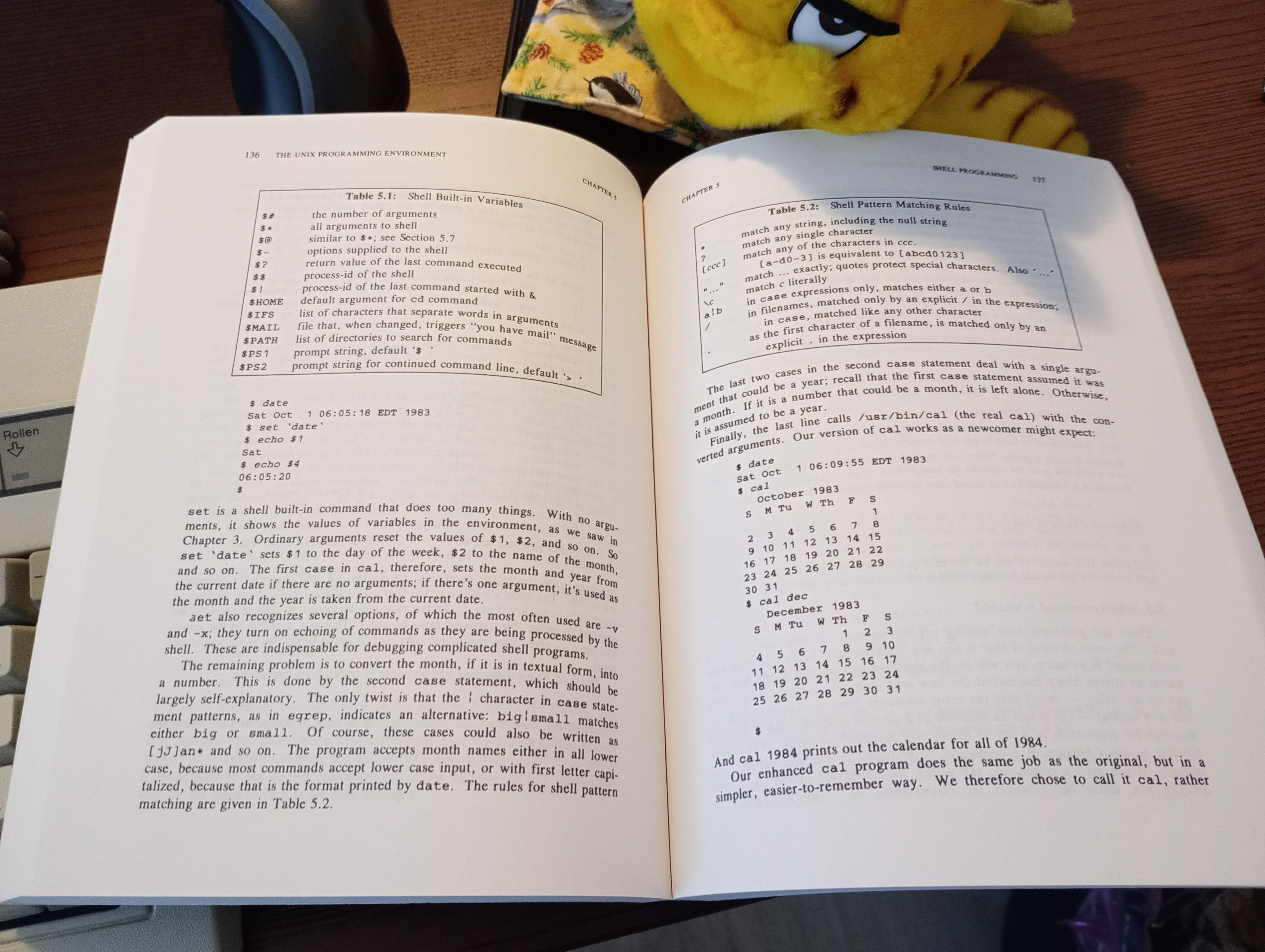
It’s a bit older, of course, but it looks and feels like a normal book, and it uses the same tech as manpages – which I think is really cool. 😎
It’s comparable to LaTeX (just harder/different to use) but much faster than LaTeX. You can also do stuff like render manpages as a PDF (man -Tpdf cp >cp.pdf) or as an HTML file (man -Thtml cp >cp.html). I think I once made slides for a talk this way.
On the other hand, traditional manpages (i.e., ones that are not written in mandoc) do not use semantic markup. They literally say, “this text is bold, that text over here is italics”, and so on.
So when you run man foo, it has no other choice but to show it in black, white, bold, underline – showing it in color would be wrong, because that’s not what the source code of that manpage says.
Colorizing them is a hack, to be honest. You’re not meant to do this. (The devs actually broke this by accident recently. They themselves aren’t really aware that people use colors.)
If mandoc and semantic markup was more commonly used, I think it would be easier to convince the devs to add proper customizable colors.
HTTP referrers are quite broken, aren’t they?
Because of that recent storm on my blog, I had a peek at them. There’s a lot of garbage in there. For example, https://docs.freebsd.org/en/books/handbook/disks-virtual.html is supposed to refer to one of my blog posts …
What’s going on here?
↳
In-reply-to
»
https://threadreaderapp.com/thread/1935344122103308748.html Interesting article on how ChatGPT is rotting your brain 🤣
⤋ Read More
About ChatGPT rotting people’s brains, similarly could be said about search engines, and reference books. Oh, also doom scrolling, and mobile devices, and the Internet… :-P
↳
In-reply-to
»
Sometimes things go wrong when buying CDs second-hand. I bought an album quite cheap – but as it turned out, they only checked the cover, not the content, so I got something else instead which is actually much more expensive. 🤣
⤋ Read More
@movq@www.uninformativ.de a first edition signed Superman comic book, carefully folded just to fit, but not damaged enough to have lost its value?
Nobody want to be a shitty programmer. The question is: Do you do anything not to not be one?
Reading blogs or social media and watching YouTube videos is fun. After them, your code may be a little better, of course. But you need a lot. You need to study! Read good books and study the code of other programmers, for example. Maybe work with a new language, architectures and paradigms. You need break the routine.
If you know Object-oriented programming, you learn functional programming.
If you know Model-View-Controller, you learn Model-View-ViewModel.
If you don’t know anything about architectures, you learn Clean Architecture, Hexagonal Architecture, etc.
If you know Python, you learn Ruby or Go.
If you know Clojure or Lisp… you don’t need to learn anything else. You are already a good programmer. Just kidding. You can learn Elixir or Scala.
Be a good programmer my friend.
happy free comic book day! my store was out of freebies but i got some of my pulls and also a trade of one of my favorite reads last year!

↳
In-reply-to
»
To the parents or teachers: How do you teach kids to program these days? 🤔
⤋ Read More
@movq@www.uninformativ.de I started with Delphi in school, the book (that we never ever used even once and I also never looked at) taught Pascal. The UI part felt easy at first but prevented me from understanding fundamental stuff like procedures or functions or even begin and end blocks for ifs or loops. For example I always thought that I needed to have a button somewhere, even if hidden. That gave me a handler procedure where I could put code and somehow call it. Two or three years later, a new mate from the parallel class finally told me that this wasn’t necessary and how to do thing better.
You know all too well that back in the day there was not a whole lot of information out there. And the bits that did exist were well hidden. At least from me. Eventually discovering planet-quellcodes.de (I don’t remember if that was the original forum or if that got split off from some other board) via my best schoolmate was like finding the Amber Room. Yeah, reading the ITG book would have been a very good idea for sure. :-)
In hindsight, a console program without the UI overhead might have been better. At least for the very start. Much less things to worry about or get lost.
Hence, I’d recommend to start programming with a console program. As for the language, not sure. But Python is probably a good choice, it doesn’t require a lot of surrounding boilerplate like, say Java or Go. It also does exceptionally well in the principle of least surprise.
↳
In-reply-to
»
A visual flow chart diagram that illustrates how two different but very related concepts can lead to system accidents 👌 Media
⤋ Read More
These ideas are dr the two books:
- Drift into Failure: From Hunting Broken Components to Understanding Complex Systems by Sidney Dekker (2011)
- Engineering a Safer World by Nancy Leveson (2011)
The former I haven’t read. The later I haven’t finished reading 😅
📖 The Future of Normativity: https://academic.oup.com/book/59520
A threat model for opposing authoritarianism
A decade ago, I published a book on privacy “Dragnet Nation: A Quest for Privacy, Security, and Freedom in a World of Relentless Surveillance.” In the book, and since then, in articles and speeches, I have been dispensing advice to people on how to protect their privacy. But my advice did not envision the moment we are in – where the government would collaborate with a tech CEO to strip-mine all of our data from government databases and use i … ⌘ Read more
css naked day, I missed that this year. css is messy anyway and i got a css book in german to learn the basics