Russia attacks 200m from Nato border, you think Nato would react if the attack went 1 meter over the border?.. Or would they just come with excuses on why not to intervene?
↳
In-reply-to
»
@xuu "yet"? It's supported ipv6 for like 6 years now.
⤋ Read More
@xuu@txt.sour.is ah, well, I think it’s on 1.0.x now but it picked up ipv6 support in 0.10.x
↳
In-reply-to
»
The original twt is unavailable. It may have been edited or deleted, or is from an unknown or muted feed.
⤋ Read More
What I see here is that when I was reading your .txt, the timestamp was like 40 minutes later than current time. Say it’s 1pm and that twt is timed on 1.40pm
No idea why, perhaps your server has a wrong Timezone, or your twtxt tool is doing some timezome conversion?
user/bmallred/data/2023-07-04-05-12-13.fit: 1.10 miles, 00:10:28 average pace, 00:11:33 duration
user/bmallred/data/2023-07-02-06-15-08.fit: 1.24 miles, 00:09:30 average pace, 00:11:47 duration





1:Thinking that everything is dangerous. 2:Thinking you are in charge of everything. 3:High self esteem. 4:Looking for things to make a song and dance out of. These 4 things are a dangerous combination.
Meduza is on gopher. magical.fish/1/feeds/news/meduza/2023/06/menu
↳
In-reply-to
»
A GTK 4 application showing an empty window uses about 160 MB of RAM:
⤋ Read More
@movq@www.uninformativ.de
Doesn’t even compile on my system, which is apparently broken:
> cc -Wall -Wextra -o win win.c $(pkg-config --cflags --libs gtk4)
cc: error: unrecognized argument in option ‘-mfpmath=sse -msse -msse2 -pthread -I/usr/include/gtk-4.0 -I/usr/include/gio-unix-2.0 -I/usr/include/cairo -I/usr/include/pango-1.0 -I/usr/include/harfbuzz -I/usr/include/pango-1.0 -I/usr/include/fribidi -I/usr/include/harfbuzz -I/usr/include/gdk-pixbuf-2.0 -I/usr/include/x86_64-linux-gnu -I/usr/include/cairo -I/usr/include/pixman-1 -I/usr/include/uuid -I/usr/include/freetype2 -I/usr/include/libpng16 -I/usr/include/graphene-1.0 -I/usr/lib/x86_64-linux-gnu/graphene-1.0/include -I/usr/include/libmount -I/usr/include/blkid -I/usr/include/glib-2.0 -I/usr/lib/x86_64-linux-gnu/glib-2.0/include -lgtk-4 -lpangocairo-1.0 -lpango-1.0 -lharfbuzz -lgdk_pixbuf-2.0 -lcairo-gobject -lcairo -lgraphene-1.0 -lgio-2.0 -lgobject-2.0 -lglib-2.0’
cc: note: valid arguments to ‘-mfpmath=’ are: 387 387+sse 387,sse both sse sse+387 sse,387
I played with nlpodyssey/verbaflow: Neural Language Model for Go today a little bit today…. First I had to download a ~2GB file (the model), then convert that to a format the program verbaflow understands which came out to roughly ~5GB. Then I tried some of the samples in the README. My god, this this is so goddamn awfully slow its like watching paint dry 😱 All just to predict the next few tokens?! 😳 I had a look at the resource utilisation as well as it was trying to do this “work”, using 100% of 1.5 Cores and ~10GB of Memory 😳 Who da fuq actually thinks any of this large language model (LLM) and neural network crap is actually any good or useful? 🤔 Its just garbage 🤣
Physical Quantities
 ⌘ Read more
Bell Witch released a new album/song recently. I nominate this as “soundtrack of the apocalypse”. 🤘 // Bell Witch - Future’s Shadow Part 1: The Clandestine Gate // https://www.youtube.com/watch?v=Mg8TLge8gUU
📣 Outage Notification: On Tuesday 23rd May 2023 between 7.30am to 5pm, there will be an outage of undefined length with no known start time due to planned power meter upgrades on the premises by the energy company.
You know, it’s one of those things where they give you a ~12hr window 🤦♂️ I will post here again once the technician is on-site and power down. I will power back up as soon as the work is complete.
According to the information I’ve received, the outage should be no more than ~1-2hrs.
Apologies for any inconvenience 🤗
Still undecided between TiddlyWiki, DokuWiki, Bear, Benotes, Memos, my blog software, standardnotes, apple notes and more. I like them all quite a bit, but standardnotes, the only one that has reall multiplatform is so fucking complicated to host on your own and then they have this stupid offline subscription thing that allows rich text or the block editor that works like notion. I also found codex docs which is really really nice. Unfortunately they lack proper authentication. 1 / 2
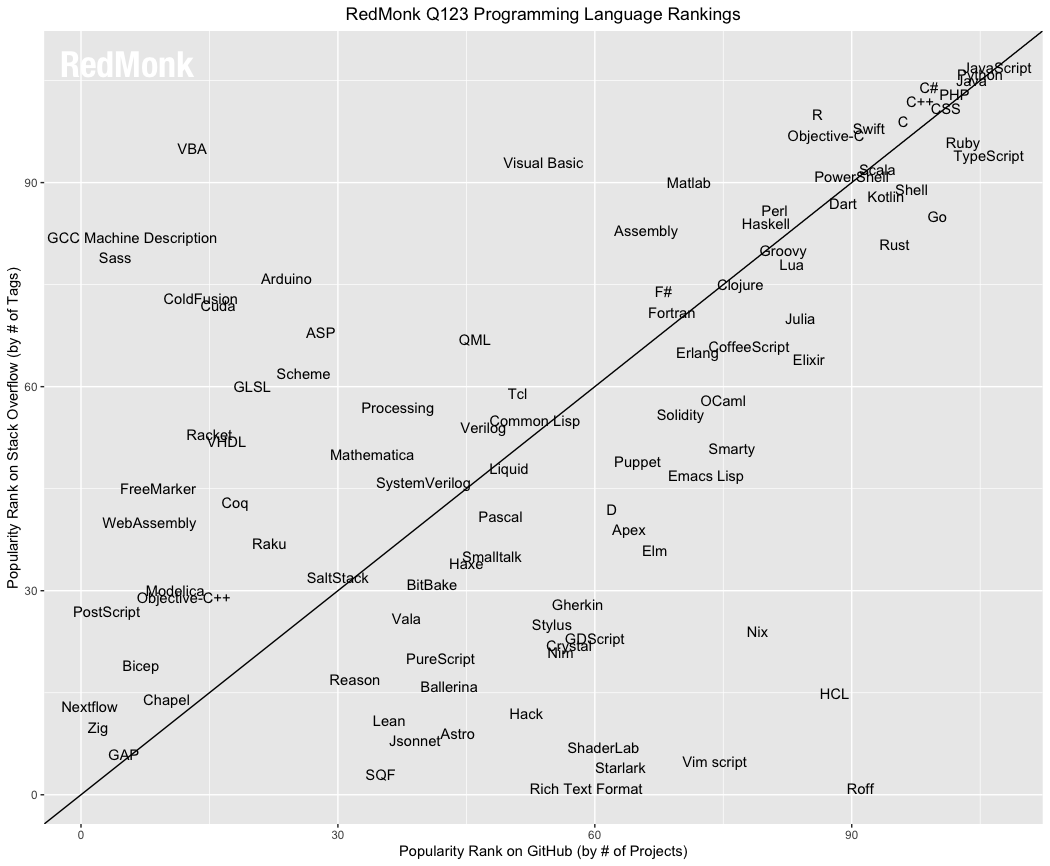
According to the RedMonk programming language rankings from Jan 2023, Go and Scala are tied at 14th place 😏
1 JavaScript
2 Python
3 Java
4 PHP
5 C#
6 CSS
7 TypeScript
7 C++
9 Ruby
10 C
11 Swift
12 Shell
12 R
14 Go
14 Scala
16 Objective-C
17 Kotlin
18 PowerShell
19 Rust
19 Dart
user/bmallred/data/2023-05-17-09-14-01.fit: 1.03 miles, 00:10:13 average pace, 00:10:34 duration
TornadoVM Continues Adapting Java OpenJDK/GraalVM For Heterogeneous Hardware
A new release of TornadoVM is now available, the open-source plug-in to OpenJDK and GraalVM to allow for Java code to run on heterogeneous hardware with ease – including various GPU models as well as FPGAs… ⌘ Read more
↳
In-reply-to
»
Metaverse Could Contribute Up To 2.4% of US GDP By 2035, Study Shows
A study commissioned by Meta has found that the metaverse could contribute around 2.4% to U.S. annual GDP by 2035, equating to as much as $760 billion. Reuters reports: The concept of the metaverse includes augmented and virtual reality technologies that allow users to immerse themselves in a virtual world or overlay information digitally on ... ⌘ Read more
⤋ Read More
@stigatle@yarn.stigatle.no @prologic@twtxt.net @eldersnake@we.loveprivacy.club I love VR too, and I wonder a lot whether it can help people with accessibility challenges, like low vision.
But Meta’s approach from the beginning almost seemed like a joke? My first thought was “are they trolling us?” There’s open source metaverse software like Vircadia that looks better than Meta’s demos (avatars have legs in Vircadia, ffs) and can already do virtual co-working. Vircadia developers hold their meetings within Vircadia, and there are virtual whiteboards and walls where you can run video feeds, calendars and web browsers. What is Meta spending all that money doing, if their visuals look so weak, and their co-working affordances aren’t there?
On top of that, Meta didn’t seem to put any kind of effort into moderating the content. There are already stories of bad things happening in Horizon Worlds, like gangs forming and harassing people off of it. Imagine what that’d look like if 1 billion people were using it the way Meta says they want.
Then, there are plenty of technical challenges left, like people feeling motion sickness or disoriented after using a headset for a long period of time. I haven’t heard announcements from Meta that they’re working on these or have made any advances in these.
All around, it never sounded serious to me, despite how much money Meta seems to be throwing at it. For something with so much promise, and so many obvious challenges to attack first that Meta seems to be ignoring, what are they even doing?
↳
In-reply-to
»
@xuu What's your budget?
⤋ Read More
@shreyan@twtxt.net probably ~1k up to 1.5k. One I found had 64G ram and 12C / 16T for 1.1k
↳
In-reply-to
»
I may have misspoken in my haste/anguish. I don't know of any examples of Ben Shapiro advocating rape. I do know them of Jordan Peterson. He's known for that, but I've seen it myself. So, to be clear, I don't know if Ben Shapiro is a rape apologist and have no evidence of that. Wouldn't surprise me frankly because the set of ideas he does talk about tends to include being A-OK with crimes against women, but anyway.
⤋ Read More
@xuu@txt.sour.is LOL omfg.
This is the absurd logical endpoint of free market fundamentalism. “The market will fix everything!” Including, apparently, encroaching floodwater.
I do have to say though, after spending awhile looking at houses, that there are a crapton of homes for sale for very high prices (>$1 million) in coastal areas NASA is more or less telling us will be underwater in the next few decades. I don’t get how a house that’s going to be underwater soon is worth $1 million, but then I’m never been a free market fundamentalist either so 🤷 Maybe they’re all watertight.
user/bmallred/data/2023-05-09-06-13-11.fit: 1.01 miles, 00:08:41 average pace, 00:08:48 duration
Recipe Relativity
 ⌘ Read more
↳
In-reply-to
»
Started with
Media
a concept sketch of a full body end-time factory worker on a distant planet, cyberpunk light brown suite, (badass), looking up at the viewer, 2d, line drawing, (pencil sketch:0.3), (caricature:0.2), watercolor city sketch,
Negative prompt: EasyNegativ, bad-hands-5, 3d, photo, naked, sexy, disproportionate, ugly
Steps: 20, Sampler: Euler a, CFG scale: 7, Seed: 2479087078, Face restoration: GFPGAN, Size: 512x768, Model hash: 2ee2a2bf90, Model: mimic_v10, Denoising strength: 0.7, Hires upscale: 1.5, Hires upscaler: Latent
⤋ Read More
@prologic@twtxt.net @carsten@yarn.zn80.net
(1) You go to the store and buy a microwave pizza. You go home, put it in the microwave, heat it up. Maybe it’s not quite the way you like it, so you put some red pepper on it, maybe some oregano.
Are you a pizza chef? No. Do we know what your cooking is like? Also no.
(2) You create a prompt for StableDiffusion to make a picture of an elephant. What pops out isn’t quite to your liking. You adjust the prompt, tweak it a bunch, till the elephant looks pretty cool.
Are you an artist? No. Do we know what your art is like? Also no.
The elephant is “fake art” in a similar sense to how a microwave pizza is “fake pizza”. That’s what I meant by that word. The microwave pizza is a sort of “simulation of pizza”, in this sense. The generated elephant picture is a simulation of art, in a similar sense, though it’s even worse than that and is probably more of a simulacrum of art since you can’t “consume” an AI-generated image the way you “consume” art.
Started with

a concept sketch of a full body end-time factory worker on a distant planet, cyberpunk light brown suite, (badass), looking up at the viewer, 2d, line drawing, (pencil sketch:0.3), (caricature:0.2), watercolor city sketch,
Negative prompt: EasyNegativ, bad-hands-5, 3d, photo, naked, sexy, disproportionate, ugly
Steps: 20, Sampler: Euler a, CFG scale: 7, Seed: 2479087078, Face restoration: GFPGAN, Size: 512x768, Model hash: 2ee2a2bf90, Model: mimic_v10, Denoising strength: 0.7, Hires upscale: 1.5, Hires upscaler: Latent
On LinkedIn I see a lot of posts aimed at software developers along the lines of “If you’re not using these AI tools (X,Y,Z) you’re going to be left behind.”
Two things about that:
- No you’re not. If you have good soft skills (good communication, show up on time, general time management) then you’re already in excellent shape. No AI can do that stuff, and for that alone no AI can replace people
- This rhetoric is coming directly from the billionaires who are laying off tech people by the 100s of thousands as part of the class war they’ve been conducting against all working people since the 1940s. They want you to believe that you have to scramble and claw over one another to learn the “AI” that they’re forcing onto the world, so that you stop honing the skills that matter (see #1) and are easier to obsolete later. Don’t fall for it. It’s far from clear how this will shake out once governments get off their asses and start regulating this stuff, by the way–most of these “AI” tools are blatantly breaking copyright and other IP laws, and some day that’ll catch up with them.
That said, it is helpful to know thy enemy.
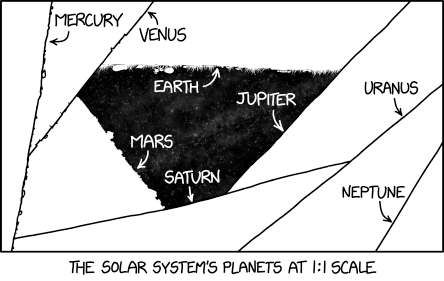
1-to-1 Scale
 ⌘ Read more
user/bmallred/data/2023-04-07-13-19-28.fit: 1.52 miles, 00:08:59 average pace, 00:13:37 duration
user/bmallred/data/2023-04-05-06-24-03.fit: 1.55 miles, 00:07:43 average pace, 00:11:57 duration
↳
In-reply-to
»
slides/go-generics.md at main - slides - Mills -- I'm presenting this tomorrow at work, something I do every Wednesday to teach colleagues about Go concepts, aptly called
⤋ Read More
go mills() 😅
So. Some bits.
i := fIndex(xs, 5.6)
Can also be
i := Index(xs, 5.6)
The compiler can infer the type automatically. Looks like you mention that later.
Also the infer is super smart.. You can define functions that take functions with generic types in the arguments. This can be useful for a generic value mapper for a repository
func Map[U,V any](rows []U, fn func(U) V) []V {
  out := make([]V, len(rows))
  for i := range rows { out = fn(rows[i]) }
  return out
}


rows := []int{1,2,3}
out := Map(rows, func(v int) uint64 { return uint64(v) })
I am pretty sure the type parameters goes the other way with the type name first and constraint second.
func Foo[comparable T](xs T, s T) int
Should be
func Foo[T comparable](xs T, s T) intSquare Packing
 ⌘ Read more
bd1c8: Is tor daemon installed, configured and running? See man 1 torsocks also.
user/bmallred/data/2023-02-06-10-02-12.fit: 1.34 miles, 00:09:39 average pace, 00:12:56 duration
user/bmallred/data/2023-02-06-08-58-34.fit: 1.43 miles, 00:09:57 average pace, 00:14:15 duration
Fixing passwd(1) broken by PAM — https://dbohdan.com/passwd-pam-fix
magicalxot2nosefso27zfzuujuaphtznzn3ng7q44u426s6bkiuvzqd.onion:70/1/
[ATENCIÓN] Nueva actualización de Newsboat v2.30.1-1 bugfixes en Termux 🤩.
[ATENCIÓN] Nueva actualización de Newsboat v2.30.1-1 bugfixes en Termux 🤩.
Or if you are a rightist at gopher://gopherspace.de/1/journalist
If you like to learn good german, read the Bible at gopher://sdf.org/1/users/scn/Bibel
If you have time and the Courage to change, read the Bible at gopher://rbfh.de/1/Bible
They are stuck with Cousins at least 1 more season. One of the reasons Vikes got a new GM this year.
↳
In-reply-to
»
Trying to wrap my head around webfinger..
⤋ Read More
@xuu@txt.sour.is that doesn’t seem to fit the spirit of the spec, at least by my read (I could be wrong obv). The example on Wikipedia’s webfinger page,
{
	"subject": "acct:bob@example.com",
	"aliases": [
		"https://www.example.com/~bob/"
	],
	"properties": {
		"http://example.com/ns/role": "employee"
	},
	"links": [{
			"rel": "http://webfinger.example/rel/profile-page",
			"href": "https://www.example.com/~bob/"
		},
		{
			"rel": "http://webfinger.example/rel/businesscard",
			"href": "https://www.example.com/~bob/bob.vcf"
		}
	]
}
and then the comparison with how mastodon uses webfinger,
{
    "subject": "acct:Mastodon@mastodon.social",
    "aliases": [
        "https://mastodon.social/@Mastodon",
        "https://mastodon.social/users/Mastodon"
    ],
    "links": [
        {
            "rel": "http://webfinger.net/rel/profile-page",
            "type": "text/html",
            "href": "https://mastodon.social/@Mastodon"
        },
        {
            "rel": "self",
            "type": "application/activity+json",
            "href": "https://mastodon.social/users/Mastodon"
        },
        {
            "rel": "http://ostatus.org/schema/1.0/subscribe",
            "template": "https://mastodon.social/authorize_interaction?uri={uri}"
        }
    ]
}
suggests to me you want to leave the subject/acct bit as is (don’t add prefixes) and put extra information you care to include in the links section, where you’re free to define the rel URIs however you see fit. The notion here is that webfinger is offering a mapping from an account name to additional information about that account, so if anything you’d use a "subject": "acct:SALTY ACCOUNT_REPRESENTATION" line in the JSON to achieve what you’re saying if you don’t want to do that via links.
↳
In-reply-to
»
Trying to wrap my head around webfinger..
⤋ Read More
@prologic@twtxt.net That was exactly my thought at first too. but what do we put as the rel for salty account? since it is decentralized we dont have a set URL for machines to key off. so for example take the standard response from okta:
# http GET https://example.okta.com/.well-known/webfinger  resource==acct:bob
{
    "links": [
        {
            "href": "https://example.okta.com/sso/idps/OKTA?login_hint=bob#",
            "properties": {
                "okta:idp:type": "OKTA"
            },
            "rel": "http://openid.net/specs/connect/1.0/issuer",
            "titles": {
                "und": "example"
            }
        }
    ],
    "subject": "acct:bob"
}
It gives one link that follows the OpenID login. So the details are specific to the subject acct:bob.
Mastodons response:
{
  "subject": "acct:xuu@chaos.social",
  "aliases": [
    "https://chaos.social/@xuu",
    "https://chaos.social/users/xuu"
  ],
  "links": [
    {
      "rel": "http://webfinger.net/rel/profile-page",
      "type": "text/html",
      "href": "https://chaos.social/@xuu"
    },
    {
      "rel": "self",
      "type": "application/activity+json",
      "href": "https://chaos.social/users/xuu"
    },
    {
      "rel": "http://ostatus.org/schema/1.0/subscribe"
    }
  ]
}
it supplies a profile page and a self which are both specific to that account.
user/bmallred/data/2023-01-10-10-04-43.fit: 1.42 miles, 00:06:31 average pace, 00:09:15 duration
user/bmallred/data/2023-01-10-08-57-57.fit: 1.43 miles, 00:08:30 average pace, 00:12:12 duration
Pleroma’s gopher server barfs if you arrive to it using domain.tld/1/ so it means I can’t link to it from here, but if you just enter domain.tld it works
1lb de carne de cerdo 360,1 botella de RON malo 400, 1 jabón 150-170 pesos.
1lb de carne de cerdo 360,1 botella de RON malo 400, 1 jabón 150-170 pesos.
The translators don’t seem to be working. Also I found a sports news feed: gopher://gophernews.net/1/topic/sports
↳
In-reply-to
»
I made a thing. Its a multi password type checker. Using the PHC string format we can identify a password hashing format from the prefix
⤋ Read More
$name$ and then dispatch the hashing or checking to its specific format.
Here is an example of usage:
func Example() {
	pass := "my_pass"
	hash := "my_pass"

	pwd := passwd.New(
		&unix.MD5{}, // first is preferred type.
		&plainPasswd{},
	)

	_, err := pwd.Passwd(pass, hash)
	if err != nil {
		fmt.Println("fail: ", err)
	}

	// Check if we want to update.
	if !pwd.IsPreferred(hash) {
		newHash, err := pwd.Passwd(pass, "")
		if err != nil {
			fmt.Println("fail: ", err)
		}

		fmt.Println("new hash:", newHash)
	}

	// Output:
	//  new hash: $1$81ed91e1131a3a5a50d8a68e8ef85fa0
}
This shows how one would set a preferred hashing type and if the current version of ones password is not the preferred type updates it to enhance the security of the hashed password when someone logs in.
https://github.com/sour-is/go-passwd/blob/main/passwd_test.go#L33-L59