Just missed the 15th anniversary of the Linux installation on my laptop:
$ head -n 1 /var/log/pacman.log
[2011-04-27 11:38] installed filesystem (2011.04-1)
↳
In-reply-to
»
Fuck me dead, our sky burned down once again! https://lyse.isobeef.org/abendhimmel-2026-04-28/
⤋ Read More
@prologic@twtxt.net @movq@www.uninformativ.de @bender@twtxt.net Thank you very much! <3
I only filtered out the noise floor of the camera itself. I selected one second of “silence” in Audacity and used the “Effect” → “Noise reduction” (Rausch-Verminderung in German) dialog with its default settings. I repeated that two or three times in total with different sections of “silence”. It’s very hard to find something where there is really no other bird singing in the background. But in contrast to the original audio, the edited version is noticeably more squeaky I find.
Oh, and I increased the volume. Especially after the noise reduction, everything is a bit quieter.
I got rather lucky, only a few cars went by and my microphone is too shitty, to really pick it up. :-D It’s kinda drowned out by the background noise. 45 seconds into the video, a car passes. Also at 1:10 without a doubt. I’m sure there were actually many were. Most of them passed behind me, the mic is facing away from that sound source. Of course, the densely built-up area still reflects a lot.
It also helped that Azabache is a loud singer himself. Fortunately, no idiots screaming either.
If you want to compare yourself or play around to see what other improvements you are able to achieve, I uploaded the original from the camera in the same directory under the lovely name DSCN5687.MOV. It’s 236.1 MiB in size.
↳
In-reply-to
»
495 turns and about ~4hrs alter I won! 🙌 Small map, 2-players, myself and an AI player. 😅 Media -- It took forever to beach the island the AI player was on and get enough Galley's and Swordsmen just to push back and eventually slowly destroy all enemy units and capture all cities! 🤣
⤋ Read More
@bender@twtxt.net Well I’m open to ideas of course 😅 My goal here was to build something like a Civ-1 inspired game that’s playable online and multiplayer. Do you remember this old bad boy that was played on PC(s) on MS-DOS ?! 😅
Actual Software for Win3x: gopher://shibboleths.org/1/win31
As an enjoyer of delightfully bad graphic design, found on most Czech village center cork boards, I’m sad to see the stolen clipart and badly cropped watermarked stock images, gradually replaced with AI slop.
This is far from a serious rant, but generating images of my kind being telepathically hit with sharp rocks, surely gives me a right to complain.

So far these seem the most prominent slop categories, seem to be…
Architecture slop:
- find a sketch of what an old building looked like

- generate an AI version, without correcting any of the perspective errors - this one is diagonally levitating

- generate a recreation of the buildings demise - after going through the AI, for the second time, it is now a completely different building

Moralizing slop:


History slop:

↳
In-reply-to
»
Another AI rant:
⤋ Read More
@movq@www.uninformativ.de LOL. I think I get the idea. I am concerned about AI too. Managers starting with “I don’t know anything about this, but here is what says”. Infuriating.
I came across this one today, here is a gift link: https://www.nytimes.com/2026/04/15/opinion/art-artificial-intelligence.html?unlocked_article_code=1.bFA.XNiu.ZukFfdNl3Al1&smid=nytcore-ios-share
↳
In-reply-to
»
Eehhh, what the hell is going on here!?
⤋ Read More
@movq@www.uninformativ.de Yup, I’ve also seen the floating point conversion happening with (1 << 63) - 1 yesterday night. But instead of pausing to think about it for a second, somehow all I had in mind was “give me a better representation, ain’t gonna have time for this shit”, so I turned it to hex. Beyond my comprehension what I was thinking there. O_o That’s embarrassing, unbelievable. Well, I blame late o’clock where my brain had already quit on me and went to bed.
Very interesting data point you raise there. The fun part didn’t cross my mind yet or at least I couldn’t pinpoint it. In hindsight it’s totally obvious, though. Past experience also tells me the exact same. Dealing with a problem and researching something myself is a so much more better teacher. The longer I faced up with a topic, the higher the chance to really manifest in long- or at least mid-term memory. If I just get told something, the odds are that it’s completely erased from memory in a matter of days if not hours.
↳
In-reply-to
»
Eehhh, what the hell is going on here!?
⤋ Read More
@lyse@lyse.isobeef.org AI result ahead, feel free to ignore.
I “asked” the AI at work the same question out of morbid curiousity. It “said” that SQLite converts that integer to floating point internally on overflows and then, when converting back, the x86 instruction cvttsd2si will turn it into 0x8000000000000000, even if the actual floating point value is outside of that range. So, yes, it allegedly actually saturates, as a side effect of the type conversion.
I couldn’t find anything about that automatic conversion in SQLite’s manual, yet, but an experiment looks like it might be true:
sqlite> select typeof(1 << 63);
╭─────────────────╮
│ typeof(1 << 63) │
╞═════════════════╡
│ integer         │
╰─────────────────╯

sqlite> select typeof((1 << 63) - 1);
╭──────────────────────╮
│ typeof((1 << 63) ... │
╞══════════════════════╡
│ real                 │
╰──────────────────────╯
As for cvttsd2si, this source confirms the handling of 0x8000000000000000 on range errors: https://www.felixcloutier.com/x86/cvttsd2si
The following C program also confirms it (run through gdb to see cvttsd2si in action):
<a href="https://yarn.girlonthemoon.xyz/search?q=%23include">#include</a> <stdint.h>
<a href="https://yarn.girlonthemoon.xyz/search?q=%23include">#include</a> <stdio.h>

int
main()
{
    int64_t i;
    double d;

    /* -3000 instead of -1, because `double` can’t represent a
     * difference of -1 at this scale. */
    d = -9223372036854775808.0 - 3000;

    i = d;
    printf("%lf, 0x%lx, %ld\n", d, i, i);

    return 0;
}
(Remark about AI usage: Fine, I got an answer and maybe it’s even correct. But doing this completely ruined it for me. It would have been much more satisfying to figure this out myself. I actually suspected some floating point stuff going on here, but instead of verifying this myself I reached for the unethical tool and denied myself a little bit of fun at the weekend. Won’t do that again.)
↳
In-reply-to
»
Eehhh, what the hell is going on here!?
⤋ Read More
Disclaimer: Can’t guarantee that I’m fully awake and I’m being trained at work not to use my brain anymore, so maybe this is complete bullshit. 😪🧟♀️
It says here that SQLite uses signed integers:
https://sqlite.org/datatype3.html
In pure bits, 1 << 63 would be 0x8000000000000000, but as a signed value, it gets interpreted as -9223372036854775808. Subtracting 1 yields -9223372036854775809 – but that doesn’t fit in 64 bits anymore. It’s possible that SQLite doesn’t want to wrap around but instead saturates? Haven’t checked. 🤔
With 62 bits, there is enough room.
With 1 << 64, I have no idea how SQLite wants to handle this, because this should immediately trigger a warning, because it doesn’t fit right away. Maybe it gets truncated to 0?
sqlite> select printf('0x%x', 2 * (1 << 64));
╭──────────────────────╮
│ printf('0x%x', 2 ... │
╞══════════════════════╡
│ 0x0                  │
╰──────────────────────╯
sqlite> select printf('0x%x', 0 - 1);
╭──────────────────────╮
│ printf('0x%x', 0 ... │
╞══════════════════════╡
│ 0xffffffffffffffff   │
╰──────────────────────╯
sqlite> select printf('0x%x', 0 - 2);
╭──────────────────────╮
│ printf('0x%x', 0 ... │
╞══════════════════════╡
│ 0xfffffffffffffffe   │
╰──────────────────────╯
Eehhh, what the hell is going on here!?
SELECT
    printf("0x%x", (1 << 63) - 2),
    printf("0x%x", (1 << 63) - 1),
    printf("0x%x",  1 << 63     ),
    printf("0x%x", (1 << 63) + 1),
    printf("0x%x", (1 << 63) + 2)
SQLite yields:
0x8000000000000000 (instead of 0x7ffffffffffffffe)
0x8000000000000000 (instead of 0x7fffffffffffffff)
0x8000000000000000 (correct)
0x8000000000000001 (correct)
0x8000000000000002 (correct)
Huh!? O_o Am I stupid? What am I missing here? Or is this actually a bug? :-?
With 62 bits, everything is spot on:
0x3ffffffffffffffe
0x3fffffffffffffff
0x4000000000000000
0x4000000000000001
0x4000000000000002
And 64 bits rather unsurprisingly also yield:
0xfffffffffffffffe
0xffffffffffffffff
0x0
0x1
0x2
↳
In-reply-to
»
It's blackbird time again! https://lyse.isobeef.org/amsel-2026-03-29/
⤋ Read More
@lyse@lyse.isobeef.org 1, 3, and 22 are my picks on this very reduced set. Our bird is King/Queen, and that stop on the roof is their spot! 🥰
Send snail mail to Cupertino: 1 Apple Park Way, Cupertino CA 95014
I went 1 for 2 at Magic this week… Temmet made a good showing the first game before being overwhelmed by an infinite number of Wylls (aka Fred Durst, on account of all his “rollin’, rollin’, rollin’!”). As a result, I unleashed Chatterfang on the group for the second game, and he lead his squirrel army to victory once again. Good times!
What do the Gopher Troopers think of the following? The Gopher protocol is a nearly-forgotten network protocol from the early 1990s, designed to serve and navigate text-based menus and documents over the Internet. While its far less common than HTTP/HTTPS today, there are still some security risks associated with Gopher and Gopher space. Lets break them down carefully: 1. Lack of Encryption Problem: Gopher was designed long before widespread use of SSL/TLS. All dataincluding credentials, file transfers, and menu selectionsis transmitted in plaintext. Impact: Anyone intercepting traffic (e.g., via a network sniffer, public Wi-Fi, or a compromised router) can read sensitive information, including usernames and passwords. 2. No Authentication or Access Control Problem: Gopher servers rarely implement robust authentication; access control is usually limited or non-existent. Impact: Unauthorized users might browse sensitive directories or download private files, particularly if servers are misconfigured. 3. Server Software Vulnerabilities Problem: Modern OSes can still run legacy Gopher servers, but the software is often unmaintained. Impact: Old software may contain buffer overflows, directory traversal bugs, or command injection vulnerabilities that attackers could exploit. 4. Malicious Gopher Links Problem: Gopher menus can contain links that point to scripts or other servers, similar to hyperlinks in HTTP. A client following a malicious link could inadvertently: Download malware Access sensitive internal network resources (server-side request forgery) Impact: Could serve as a vector for attacks if a user opens content from untrusted sources. 5. Legacy Protocol Weaknesses Problem: Gopher lacks modern web security mechanisms like: Content security policies Same-origin policies Cross-site request forgery protection Impact: If Gopher is bridged to other services (like modern browsers via gateways), old vulnerabilities may be exposed. 6. Information Leakage Problem: Gopher servers often provide directory listings without restriction. Impact: Sensitive files, backup directories, and internal documents may be exposed unintentionally. 7. Bridging Risks Problem: Some modern browsers access Gopher via gateways (HTTP-to-Gopher proxies). These bridges may: Expose sensitive internal resources to the gateway Introduce logging or tracking that wouldnt exist on pure Gopher Impact: Attacks could occur indirectly through insecure intermediaries. Key Takeaways Gopher is inherently insecure due to its design in a pre-HTTPS era. Main threats: eavesdropping, unauthorized access, malware delivery, and exploitation of unpatched server software. Safe practice: Use Gopher only in isolated, trusted environments, or through secure HTTP(S) gateways with proper sanitization.
↳
In-reply-to
»
@lyse Thanks for the heads-up.
⤋ Read More
@lyse@lyse.isobeef.org Thanks (again) for the heads-up!. I’m not sure why you were seeing black text, but I just pushed a new version of the library (v0.10.1) with some updated colors in the demo’s themes (which should hopefully address the contrast issues).
The dark mode was an aesthetic choice by a designer with a strong preference for dark mode (and who thought the maroon looked better as a background color), but in the interest of being supportive of my audience, I added a localstorage-backed memory to the theme toggle (so when you turn it to light mode, it should remember for future visits).
Went 2/3 at Magic today: Prosper dominated game 1, Ash and his Knights came within a single planar die roll of winning game 2, and then Atraxa came up with the win in a fairly tight game 3. All in all, not a bad afternoon of Magic.
↳
In-reply-to
»
Can anyone recommend a command-line SQL query formatter? Unfortunately,
⤋ Read More
sqlparse is also unsuitable for me: https://github.com/andialbrecht/sqlparse/issues/688
I’m supporting incremental SQLite schema changes to just upgrade from an older database version to whatever the current software version supports. In the past, I already noticed that this is quite expensive in unit tests when each test case runs through the entire schema patches and applies them one by one.
To speed up test execution I now decided that I finally go through the troubles of maintaining both a set of incremental patches and a full schema setup in one go. A unit test verifies that both ways end up with the same structure. This gives me a set of SQLs to check the structures:
SELECT type, name, tbl_name, sql
FROM sqlite_schema
ORDER BY type, name, tbl_name
Unfortunately, the resulting CREATE TABLE SQL queries are formatted differently, depending on whether the full schema was set up in one big step or the structure had been modified with ALTER TABLE. Mainly, added columns are not on their own lines but appended in one physical line. That’s why I wanted an SQL formatting tool. Since I didn’t find one that works decently, I’m now doing some simple string manipulation. Joining consecutive whitespace into a single space character, removing spaces before commas and closing parentheses and spaces after opening parentheses. This works surpringly good enough. Of course, if it fails, the “diff” is absolutely horrendous.
Now for the cool part, my test execution dropped from around 5:05 minutes to just 1:32 minutes! I call that a win.
I just stumbled across PRAGMA table_info('tablename') https://sqlite.org/pragma.html#pragma_table_info, PRAGMA foreign_key_list('tablename') and friends. I guess, I have to play with that, now. It’s probably much better to use than the SQL text approach.
To whoever is operating this “xt” client, there might be a misconfiguration. My feed is often, but not always, pulled twice within a few seconds:
2026-03-14T15:31:02+01:00 "GET /twtxt.txt HTTP/1.1" 304 "xt/0.0.1"
2026-03-14T15:31:31+01:00 "GET /twtxt.txt HTTP/1.1" 304 "xt/0.0.1"

2026-03-14T15:41:19+01:00 "GET /twtxt.txt HTTP/1.1" 304 "xt/0.0.1"
2026-03-14T15:41:31+01:00 "GET /twtxt.txt HTTP/1.1" 304 "xt/0.0.1"

2026-03-14T15:51:04+01:00 "GET /twtxt.txt HTTP/1.1" 304 "xt/0.0.1"

2026-03-14T16:01:25+01:00 "GET /twtxt.txt HTTP/1.1" 304 "xt/0.0.1"
2026-03-14T16:01:27+01:00 "GET /twtxt.txt HTTP/1.1" 304 "xt/0.0.1"

2026-03-14T16:11:51+01:00 "GET /twtxt.txt HTTP/1.1" 304 "xt/0.0.1"
2026-03-14T16:11:54+01:00 "GET /twtxt.txt HTTP/1.1" 304 "xt/0.0.1"

2026-03-14T16:21:53+01:00 "GET /twtxt.txt HTTP/1.1" 304 "xt/0.0.1"

2026-03-14T16:32:19+01:00 "GET /twtxt.txt HTTP/1.1" 304 "xt/0.0.1"
2026-03-14T16:32:22+01:00 "GET /twtxt.txt HTTP/1.1" 304 "xt/0.0.1"

2026-03-14T16:52:28+01:00 "GET /twtxt.txt HTTP/1.1" 304 "xt/0.0.1"
2026-03-14T16:52:31+01:00 "GET /twtxt.txt HTTP/1.1" 304 "xt/0.0.1"
Maybe this is caused by a development and a production setup, no idea. Since this client is sending the If-Modified-Since or If-None-Match request header, I’m good with that, though. Looking forward to discover a new feed hopefully soon. :-)
Hi @c2803! You are right. But whot is the reason, that the onion site of magical.fish is not working? Why 1436.ninja/1/Port70News is not working? Why gopher://sdf-eu.org is not working? I thing, big companies or states are making troubles to gopher sites. If you like to search the web anonymously, take the onion site of me0w.net .
Actual Software For Win3x Users: gopher://shibboleths.org/1/win31
Do not die from hunger. Man does not live from bread only, but from every word out of God’s mouth. Read the Good News of Matthew in the Bible. bible.com or 5fi.sh in every language or gopher://rbfh.de or gopher://sdf.org/1/users/scn/Bibel .
↳
In-reply-to
»
👋 Looking for other interested folks to continue to evolve the development of Salty.im 🙏 I've been hard™ at work on the
⤋ Read More
v2 branch and @doesnm.p.psf.lt has been incredibly helpful so far. Be great ot have a few more folks to join us, some of the v2 highlights include:
@bender@twtxt.net Here is a properly formatted version of your message:
Not yet — but that’s probably a good idea.
Instructions:
- Clone the repository
git clone https://git.mills.io/saltyim/saltyim.git
cd saltyim
- Check out the
v2branch
git checkout v2
- Build and install the CLI/TUI
make DESTDIR=$HOME/bin install
After installation, run:
salty-chat
A Phlog about the mysteries of history and the most incredible events, new conspiracy theories and the wildest world news gopher://shibboleths.org/1/phlog
I’m trying to implement configurable key bindings in tt. Boy, is parsing the key names into tcell.EventKeys a horrible thing. This type consists of three information:
- maybe a predefined compound key sequence, like Ctrl+A
- maybe some modifiers, such as Shift, Ctrl, etc.
- maybe a rune if neither modifiers are present nor a predefined compound key exists
It’s hardcoded usage results in code like this:
func (t *TreeView[T]) InputHandler() func(event *tcell.EventKey, setFocus func(p tview.Primitive)) {
    return t.WrapInputHandler(func(event *tcell.EventKey, setFocus func(p tview.Primitive)) {
        switch event.Key() {
        case tcell.KeyUp:
            t.moveUp()
        case tcell.KeyDown:
            t.moveDown()
        case tcell.KeyHome:
            t.moveTop()
        case tcell.KeyEnd:
            t.moveBottom()
        case tcell.KeyCtrlE:
            t.moveScrollOffsetDown()
        case tcell.KeyCtrlY:
            t.moveScrollOffsetUp()
        case tcell.KeyTab, tcell.KeyBacktab:
            if t.finished != nil {
                t.finished(event.Key())
            }
        case tcell.KeyRune:
            if event.Modifiers() == tcell.ModNone {
                switch event.Rune() {
                case 'k':
                    t.moveUp()
                case 'j':
                    t.moveDown()
                case 'g':
                    t.moveTop()
                case 'G':
                    t.moveBottom()
                }
            }
        }
    })
}
This data structure is just awful to handle and especially initialize in my opinion. Some compound tcell.Keys are mapped to human-readable names in tcell.KeyNames. However, these names always use - to join modifiers, e.g. resulting in Ctrl-A, whereas tcell.EventKey.Name() produces +-delimited strings, e.g. Ctrl+A. Gnaarf, why this asymmetry!? O_o
I just checked k9s and they’re extending tcell.KeyNames with their own tcell.Key definitions like crazy: https://github.com/derailed/k9s/blob/master/internal/ui/key.go Then, they convert an original tcell.EventKey to tcell.Key: https://github.com/derailed/k9s/blob/b53f3091ca2d9ab963913b0d5e59376aea3f3e51/internal/ui/app.go#L287 This must be used when actually handling keyboard input: https://github.com/derailed/k9s/blob/e55083ba271eed6fc4014674890f70c5ed6c70e0/internal/ui/tree.go#L101
This seems to be much nicer to use. However, I fear this will break eventually. And it’s more fragile in general, because it’s rather easy to forget the conversion or one can get confused whether a certain key at hand is now an original tcell.Key coming from the library or an “extended” one.
I will see if I can find some other programs that provide configurable tcell key bindings.
↳
In-reply-to
»
With RAM crazy prices being what they are, I guess my PC is gonna be stuck on 16GB RAM for some time. I originally bought the DDR4 16GB kit for like $49 AUD, and I thought I'd just buy another 16GB or more later down the track (this was like a year and a half ago), thinking it would be similarly priced or even cheaper...
⤋ Read More
@eldersnake@we.loveprivacy.club
Steps to world domination:
- “Invent” “AI” (by using other people’s data).
- Get people hyped about it and ideally hooked on it.
- Only provide it as a cloud service. But hey, if you want to, you can run it locally!
- Buy all hardware available on the market, so that nobody but you can build more systems.
- All PCs of consumers and competitors are too weak now and can’t be upgraded anymore.
- Everybody depends on your cloud service! Win!
All of that is possible because corporations don’t have a “conscience” in capitalism. Nobody forces the RAM manufacturers to sell all their stuff to just one or two buyers, but since the only goal of that manufacturer is to make money, they do it.
Nice! 😊 Here are the startup latencies for the simplest Mu (µ) program. println("Hello World"):
- Interpreter: ~5ms
- Native Code: ~1.5ms
Hmmm 🤔
Excluding merges, 1 author has pushed 171 commits to main and 175 commits to all branches. On main, 294 files have changed and there have been 52880 additions and 18269 deletions.
From the Mu (µ) Gitea Activity Tab
↳
In-reply-to
»
@lyse You actually have a Markdown parser/renderer in there? Oh dear. I would have been (well, I am) way too lazy for that. 😅
⤋ Read More
@movq@www.uninformativ.de Well, just a very limited subset thereof:
- inline and multiline code blocks using single/double/triple backticks (but no code blocks with just indentation)
- markdown links using using
[text](url)
- markdown media links using

And that’s it. No bold, italics, lists, quotes, headlines, etc.
Just like mentions, plain URLs, markdown links and markdown media URLs are highlighted and available in the URLs View. They’re also colored differently, similarly to code segments.
I definitely should write some documentation and provide screenshots.
↳
In-reply-to
»
@movq That's cool! I also like the name of your library. :-) I assume you made the thing load quickly, didn't you?
⤋ Read More
I assume you made the thing load quickly, didn’t you?
That’s the problem with Python. If you have a couple of files to import, it will take time.
I want this to be reasonably fast on my old Intel NUC from 2016 (Celeron N3050 @ 1.60GHz) and I already notice that the program startup takes about 95 ms (or 125 ms when there are no .pyc files yet). That’s still fine, but it shows that I’ll have to be careful and keep this thing very small …
Python 3.14 will bring lazy imports, maybe that can help in some cases.
The tt URLs View now automatically selects the first URL that I probably are going to open. In decreasing order, the URL types are:
- markdown media URLs (images, videos, etc.)
- markdown or plaintext URLs
- subjects
- mentions
I might differentiate between mentions of subscribed and unsubscribed feeds in the future. The odds of opening a new feed over an already existing one are higher.
Whoo! I fixed one of the hardest bugs in mu (µ) I think I’ve had to figure out. Took me several days in fact to figure it out. The basic problem was, println(1, 2) was bring printed as 1 2 in the bytecode VM and 1 nil when natively compiled to machine code on macOS. In the end it turned out the machine code being generated / emitted meant that the list pointers for the rest... of the variadic arguments was being slot into a register that was being clobbered by the mu_retain and mu_release calls and effectively getting freed up on first use by the RC (reference counting) garbage collector 🤦♂️
very good blog post that reminded me why it’s taking so long to ship bbycll — previously i had computed the hashes of every post before storing them in the database, after realizing it’s a much better idea to compute the hashes during runtime and only store the post content & timestamp i’m now having to rewrite every function that reads & writes data. i hope the reason as to why i lost motivation is obvious — thankfully i caught it early enough so that once i’m done rewriting just those functions i should™ be able to finalize 1.0-rc with little hassle
↳
In-reply-to
»
Advent of Code 2025 starts tomorrow. 🥳🎄
⤋ Read More
I rewrote all my solutions in Rust (except for day 10 part 2) and these are the runtimes on my i7-3770 from 2013 (this measures CLOCK_PROCESS_CPUTIME_ID, not wallclock):
day01/1 [      00.000501311] Result: 1066
day01/2 [      00.000400298] Result: 6223
day02/1 [      00.000358848] Result: 12586854255
day02/2 [      00.000750711] Result: 17298174201
day03/1 [      00.000106537] Result: 17405
day03/2 [      00.000404632] Result: 171990312704598
day04/1 [      00.000257517] Result: 1626
day04/2 [      00.007495342] Result: 9173
day05/1 [      00.000237212] Result: 505
day05/2 [      00.000142731] Result: 344423158480189
day06/1 [      00.000229629] Result: 4076006202939
day06/2 [      00.000279552] Result: 7903168391557
day07/1 [      00.000204422] Result: 1622
day07/2 [      00.000283816] Result: 10357305916520
day08/1 [      00.029427421] Result: 84968
day08/2 [      00.028089859] Result: 8663467782
day09/1 [      00.000310304] Result: 4764078684
day09/2 [      00.015512554] Result: 1652344888
day10/1 [      00.000796663] Result: 375
day10/2 [      --.---------] Result: 15377 (Z3)
day11/1 [      00.000416804] Result: 753
day11/2 [      00.000660528] Result: 450854305019580
day12/1 [      00.000336081] Result: 577
day12/2 [      00.000000695] Result: no part 2
A little under 90 ms total.
On my Samsung NC10 netbook from 2011 with its Intel Atom N455 at 1.6 GHz:
day01/1 [      00.003771326] Result: 1066
day01/2 [      00.003267317] Result: 6223
day02/1 [      00.003902698] Result: 12586854255
day02/2 [      00.006659479] Result: 17298174201
day03/1 [      00.000747544] Result: 17405
day03/2 [      00.002737587] Result: 171990312704598
day04/1 [      00.001263892] Result: 1626
day04/2 [      00.044985301] Result: 9173
day05/1 [      00.001696761] Result: 505
day05/2 [      00.000978962] Result: 344423158480189
day06/1 [      00.001387660] Result: 4076006202939
day06/2 [      00.001734248] Result: 7903168391557
day07/1 [      00.001295528] Result: 1622
day07/2 [      00.001809659] Result: 10357305916520
day08/1 [      00.277251443] Result: 84968
day08/2 [      00.284359332] Result: 8663467782
day09/1 [      00.003152407] Result: 4764078684
day09/2 [      00.071123459] Result: 1652344888
day10/1 [      00.005279527] Result: 375
day10/2 [      --.---------] Result: 15377 (Z3)
day11/1 [      00.003273342] Result: 753
day11/2 [      00.005139719] Result: 450854305019580
day12/1 [      00.002857552] Result: 577
day12/2 [      00.000004421] Result: no part 2
A little over 700 ms total.
I like this. You get performance that’s more or less in the ballpark of C, but without the footguns.
If your very popular project with lots of stars on GitHub is over 10 years old, and you’re still at a pre-1.0 version because you’re using SemVer and a 1.0 would mean making some kind of commitment and that’s somehow not desirable for you, then I think you’re doing something wrong. 🤔
I cleaned up all my of AoC (Advent of Code) 2025 solutions, refactored many of the utilities I had to write as reusable libraries, re-tested Day 1 (but nothing else). here it is if you’re curious! This is written in mu, my own language I built as a self-hosted minimal compiler/vm with very few types and builtins.
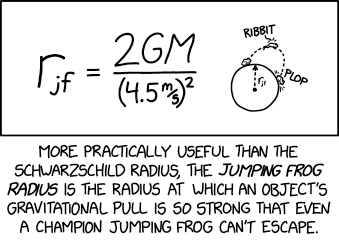
Jumping Frog Radius
 ⌘ Read more
I’m having to write my own functions like this in mu just to solve AoC puzzles :D
fn pow10(k) {
    p := 1
    i := 0
    while i < k {
        p = p * 10
        i = i + 1
    }
    return p
}
I just completed “Secret Entrance” - Day 1 - Advent of Code 2025 #AdventOfCode https://adventofcode.com/2025/day/1 — However I did it in my own toy programming language called mu, which I had to build first 🤣
Come back from my trip, run my AoC 2025 Day 1 solution in my own language (mu) and find it didn’t run correctly 🤣 Ooops!
$ ./bin/mu examples/aoc2025/day1.mu
closure[0x140001544e0]
↳
In-reply-to
»
Advent of Code 2025 starts tomorrow. 🥳🎄
⤋ Read More
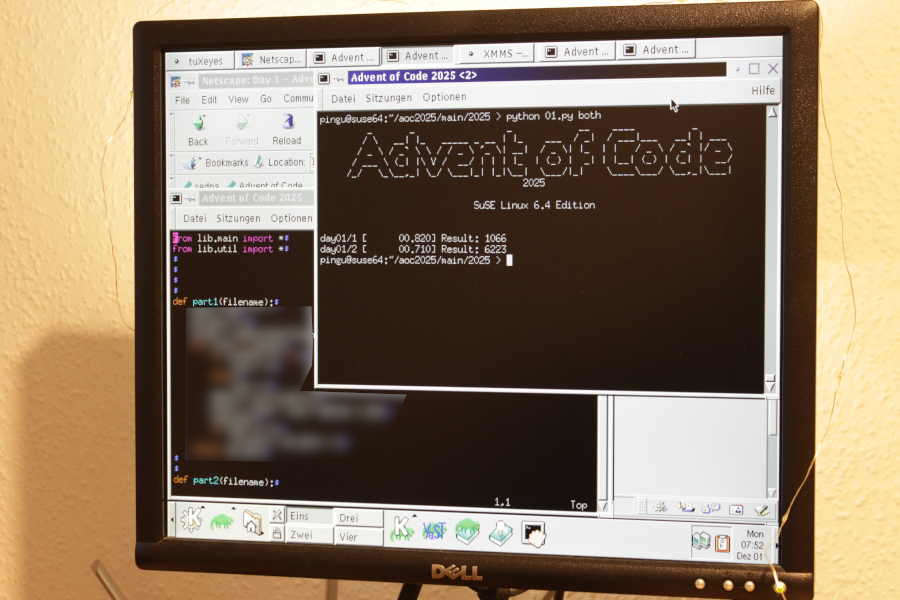
Alright, Advent of Code is over:
https://www.uninformativ.de/blog/postings/2025-12-12/0/POSTING-en.html
It’s been quite the time sink, especially with the DOS games on top, but it was fun. 🥳
In case you’re wondering: All puzzles (except for part 2 of day 10) were doable in Python 1 on SuSE Linux 6.4 and ran in a finite time on the Pentium 133. Puzzle 10/2 might have been doable as well if I had better education. 🤣
Awk to take lines from Plan 9’s /lib/unicode and prepend the actual glyph and a tab: awk ‘{cmd=sprintf(“unicode %s”, $1); cmd | getline c; printf(“%s %s\n”, c, $0)}’
Good fixed software for Win3x users: gopher://shibboleths.org/1/win31
↳
In-reply-to
»
That would be my dream job: Weighing penguins. 😍
⤋ Read More
@prologic@twtxt.net No beak, no feathers, … looks suspicious! That’s probably a weird mammal!!1! 😅🤣
↳
In-reply-to
»
I'm contemplating the idea of switching my activity pub instance from
⤋ Read More
Gootosocial to a Pleroma one. While GTS is kinda cute (lightweight and easy to manage) of a software, the inability to fetch/scroll through people's past toots when visiting a profile or having access to a federated timeline and a proper search functionality ...etc felt like handicap for the past N months.
@bender@twtxt.net yeah, I’ve been reading through the documentation last night and it felt overwhelming for a minute… +1 point goes to GTS’s docs. but hey, I’ll be taking the easy route: podman-compose up -d they provide both a container image and an example compose file in a separate git repo but I’m wondering why that is not mentioned anywhere in the docs, (unless it is and I haven’t seen it yet)
↳
In-reply-to
»
Advent of Code 2025 starts tomorrow. 🥳🎄
⤋ Read More
Day 2 was pretty tough on my old hardware. Part 1 originally took 16 minutes, then I got it down to 9 seconds – only to realize later that my solution abused some properties of my particular input. A correct solution will probably take about 30 seconds. 🫤
Part 2 took 29 minutes this morning. I wrote an optimized version but haven’t tested it yet. I hope it’ll be under a minute.
Python 1 feels really slow, even compared to Java 1. And these first puzzles weren’t even computationally intensive. We’ll see how far I’ll make it …

AoC Day #1 solution (mu): https://gist.mills.io/prologic/d3c22bcbc22949939b715a850fe63131
Thinking about doing Advent of Code in my own tiny language mu this year.
mu is:
- Dynamically typed
- Lexically scoped with closures
- Has a Go-like curly-brace syntax
- Built around lists, maps, and first-class functions
Key syntax:
- Functions use
fnand braces:
fn add(a, b) {
    return a + b
}
- Variables use
:=for declaration and=for assignment:
x := 10
x = x + 1
- Control flow includes
if/elseandwhile:
if x > 5 {
    println("big")
} else {
    println("small")
}
while x < 10 {
    x = x + 1
}
- Lists and maps:
nums := [1, 2, 3]
nums[1] = 42
ages := {"alice": 30, "bob": 25}
ages["bob"] = ages["bob"] + 1
Supported types:
int
bool
string
list
map
fn
nil
mu feels like a tiny little Go-ish, Python-ish language — curious to see how far I can get with it for Advent of Code this year. 🎄
↳
In-reply-to
»
Advent of Code 2025 starts tomorrow. 🥳🎄
⤋ Read More
Day 1 was surprisingly finnicky. A lot of people got it wrong, apparently. Me too. 🤣
Apparently MTD of uknowingly toggling mouse on in tmux for the first time is 1.5 agonizing days
Chelsea 1-1 Arsenal