A love letter to Void Linux
I installed Void on my current laptop on the 10th of December 2021, and there has never been any reinstall. The distro is absurdly stable. It’s a rolling release, and yet, the worst update I had in those years was one time, GTK 4 apps took a little longer to open on GNOME. Which was reverted after a few hours. Not only that, I sometimes spent months without any update, and yet, whenever I did update, absolutely nothing went wrong. Granted, I pretty much only did full upgrades … ⌘ Read more
zlib-rs is faster than C
I’m sure we can all have a calm, rational discussion about this, so here it goes: zlib-rs, the Rust re-implementation of the zlib library, is now faster than its C counterparts in both decompression and compression. We’ve released version 0.4.2 of zlib-rs, featuring a number of substantial performance improvements. We are now (to our knowledge) the fastest api-compatible zlib implementation for decompression, and beat the competition in the most important compression cases too. ↫ F … ⌘ Read more
Pinellas County - 4 mile run: 4.06 miles, 00:08:50 average pace, 00:35:50 duration
late in the evening (fucking work). definitely had the urge to drop a deuce for the majority of it. the pace was comfortable.
#running
↳
In-reply-to
»
I heard that congratulations to Germany are in order, is that right? If so, congratulations!
⤋ Read More
@bender@twtxt.net @prologic@twtxt.net The outcome was to be expected but it’s still pretty catastrophic. Here’s an overview:
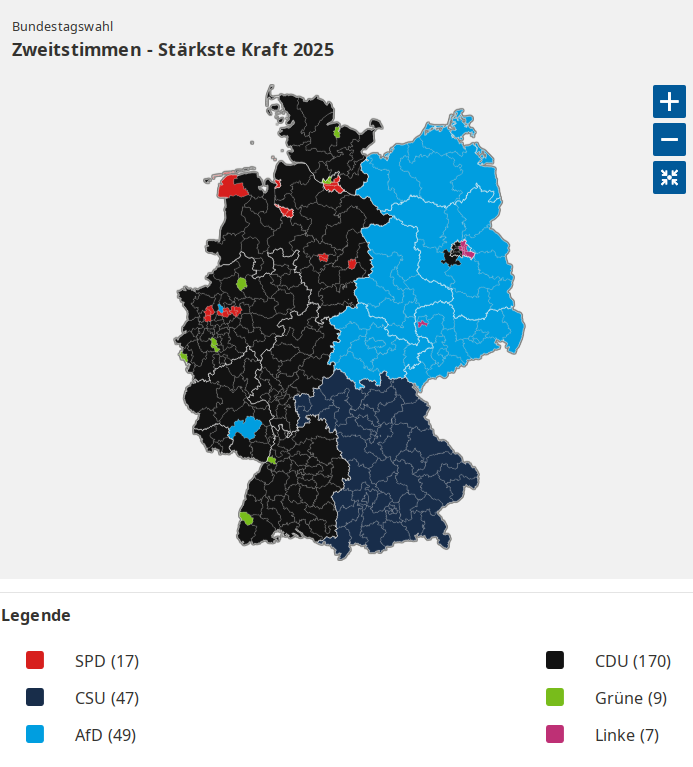
East Germany is dominated by AfD. Bavaria is dominated by CSU (it’s always been that way, but this is still a conservative/right party). Black is CDU, the other conservative/right party.
The guy who’s probably going to be chancellor recently insulted the millions of people who did demonstrations for peace/anti-right. “Idiots”, “they’re nuts”, stuff like that. This was before the election. He already earned the nickname “Mini Trump”.
Both the right and the left got more votes this time, but the left only gained 3.87 percentage points while the right (CDU/CSU + AfD) gained 14.72:
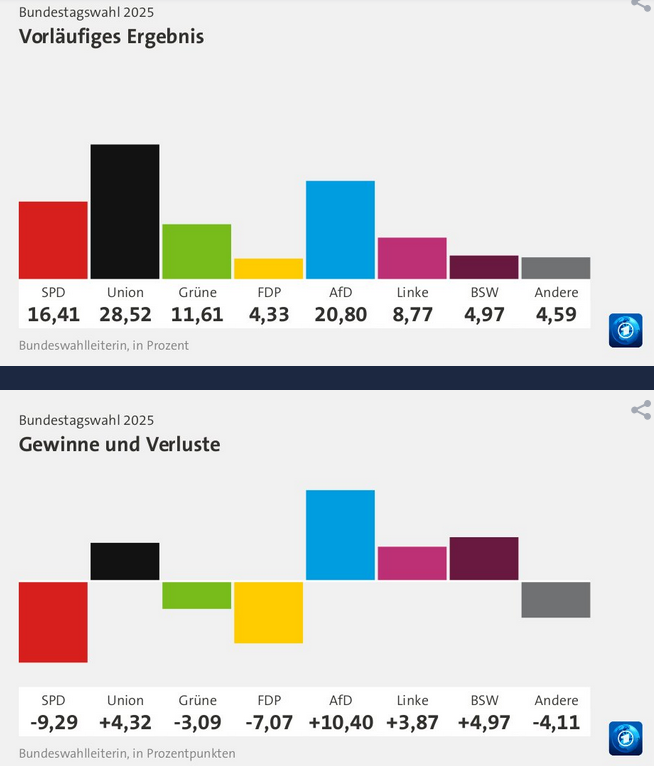
The Green party lost, SPD (“mid-left”) lost massively (worst result in their history). FDP also lost. These three were the previous government.
This isn’t looking good at all, especially when you think about what’s going to happen in the next 4 years. What will CDU (the winner) do? Will they be able to “turn the ship around”? Highly unlikely. They are responsible for the current situation (in large parts). They will continue to do business as usual. They will do anything but help poor/ordinary people. This means that AfD will only get stronger over the next 4 years.
Our only hope would be to ban AfD altogether. So far, nobody but non-profit organizations is willing to do that (for unknown reasons).
I don’t even know if banning the AfD would help (but it’s probably our best/only option). AfD politicians are nothing but spiteful, hateful, angry, similar to Trump/MAGA. If you’ve seen these people talk and still vote for them, then you must be absolutely filled with rage and hatred. Very concerning.
Correct me if I’m wrong, @lyse@lyse.isobeef.org, @arne@uplegger.eu, @johanbove@johanbove.info.
Running - 4 miles: 4.00 miles, 00:09:31 average pace, 00:38:05 duration
so boring
#running #treadmill
Running - 4 miles: 4.00 miles, 00:09:32 average pace, 00:38:06 duration
this week is going to be hell. with the travel and all the fires at work i can already tell.
#running #treadmill
↳
In-reply-to
»
What would you like the new twtxt logo to be?
Comments: https://git.mills.io/yarnsocial/twtxt.dev/issues/9#issuecomment-18960
Media
⤋ Read More
@eapl.me@eapl.me I can do that as soon as I get back home. Also, just in case you’ve missed it, Choice 1 is actually 4 different variations.
↳
In-reply-to
»
What would you like the new twtxt logo to be?
Comments: https://git.mills.io/yarnsocial/twtxt.dev/issues/9#issuecomment-18960
Media
⤋ Read More
4, but I like the idea of @eapl_en@eapl.me
reviewing logs this morning and found i have been spammed hard by bots not respecting the robots.txt file. only noticed it because the OpenAI bot was hitting me with a lot of nonsensical requests. here is the list from last month:
- (810) bingbot
- (641) Googlebot
- (624) http://www.google.com/bot.html
- (545) DotBot
- (290) GPTBot
- (106) SemrushBot
- (84) AhrefsBot
- (62) MJ12bot
- (60) BLEXBot
- (55) wpbot
- (37) Amazonbot
- (28) YandexBot
- (22) ClaudeBot
- (19) AwarioBot
- (14) https://domainsbot.com/pandalytics
- (9) https://serpstatbot.com
- (6) t3versionsBot
- (6) archive.org_bot
- (6) Applebot
- (5) http://search.msn.com/msnbot.htm
- (4) http://www.googlebot.com/bot.html
- (4) Googlebot-Mobile
- (4) DuckDuckGo-Favicons-Bot
- (3) https://turnitin.com/robot/crawlerinfo.html
- (3) YandexNews
- (3) ImagesiftBot
- (2) Qwantify-prod
- (1) http://www.google.com/adsbot.html
- (1) http://gais.cs.ccu.edu.tw/robot.php
- (1) YaK
- (1) WBSearchBot
- (1) DataForSeoBot
i have placed some middleware to reject these for now but it is not a full proof solution.
the leftists are telling me 2+2=4. the right wingers are saying its 10. so as a reasonable centrist its clear to me that the real answer is 7
Let’s Encrypt ends support for expiration notification emails
Since its inception, Let’s Encrypt has been sending expiration notification emails to subscribers that have provided an email address to us. We will be ending this service on June 4, 2025. ↫ Josh Aas on the Let’s Encrypt website They’re ending the expiration notification service because it’s costly, adds a ton of complexity to their systems, and constitutes a privacy risk because of all the email addresses the … ⌘ Read more
Doomsday Clock hits 89 seconds + 4 more stories
The Doomsday Clock moves to 89 seconds; Germany’s Bundestag passes new immigration plan; Scientists succeed in DNA storage using 5D crystal; AI report highlights emerging dangers; NASA discovers life’s building blocks in asteroid samples. ⌘ Read more
PebbleOS becomes open source, new Pebble device announced
Eric Migicovsky, founder of Pebble, the original smartwatch maker, made a major announcement today together with Google. Pebble was originally bought by Fitbit and in turn Fitbit was then bought by Google, but Migicovsky always wanted to to go back to his original idea and create a brand new smartwatch. PebbleOS took dozens of engineers working over 4 years to build, alongside our fantastic product and QA teams. Repro … ⌘ Read more
Pinellas County - Cycling: 4.79 miles, 00:05:43 average pace, 00:27:20 duration
Pinellas County - 5 miles: 4.99 miles, 00:08:49 average pace, 00:44:02 duration
it was chill to start out with. then saw our friends walking their dogs and said hey. and then, saw some friends driving by. and then saying hello to a bunch of people in the park. and then realized there was a 5km race in the park today. yeah, i didn’t keep it chill.
#running
↳
In-reply-to
»
this is epic https://lmnt.me/blog/how-to-make-a-damn-website.html
⤋ Read More
@kat@yarn.girlonthemoon.xyz I approve! That’s how I learned HTML (version 4 at the time and XHTML shortly after) and making websites, too. Some of them are still made like this to this day. Hand-written HTML. Hardly any <div> and class nonsense. I can’t remember with which editor I started out with, but I upgraded to Webweaver (later renamed to Webcraft) quickly. Yeah, this were the times when there was just a single computer for the whole family.
Free hosting on Arcor, Freenet and I don’t know anymore how they were all called. Like this author, I uploaded everything via FTP. Oh dear, when was the last time I used that? And I had registered plenty of free .de.vu domains.
Being on Windows at the time, everything was ISO-8859-1 for me. No UTF-8, I don’t think I’ve heard about it back then.
Later, I wrote my own CMSes in PHP. Man, were they bad in retrospect. :-D Of course, MySQL databases were used as backends. I still exactly know the moment I read the first time about SQL injections. I tried it on my own CMS login and was shocked when I could just break in. The very next thing I did was to lock down everything with an .htaccess until I actually fixed my broken PHP code. Hahaha, good memories.
I swear by Atom or RSS feeds. Many of my sites offer them. I daily consume feeds, they’re just great.
#genuary #genuary2025 #genuary17 Maybe related to today prompt: What happens if pi=4? https://youtu.be/tGfUaZ8hTzg
So Go lang is at a funny version huh’ v1.23.4 will there ever be a v1.23.45678? 🫠🤡
Hmm, I just noticed that the feed template seems to be broken on your yarnd instance, @kat@yarn.girlonthemoon.xyz. Looking at your raw feed file (and your mates as well), line 6 reads:
# This is hosted by a Yarn.social pod yarn running yarnd ERSION@OMMIT  go1.23.4
                                                         ^^^^^^^^^^^^
Looks like the first letters of the version and commit got somehow chopped off. I’ve no idea what happened here, maybe @prologic@twtxt.net knows something. :-? I’m not familiar with the templating, I just recall @xuu@txt.sour.is reporting in IRC the other day that he’s also having great fun with his custom preamble from time to time.
That “broken” comment doesn’t hurt anything, it’s still a proper comment and hence ignored by clients. It’s just odd, that’s all.
It turns out my ISP supports ipv6. After 4-5 months with only ipv4, I thought to ask customer support, and they told me how to turn it on. (I’m pretty happy with ebox so far. Low-priced fibre with no issues so far. Though all my traffic goes through Montreal, 500km away from me in Toronto, which adds a few ms to network latency.)
How in da fuq do you actually make these fucking useless AI bots go way?
proxy-1:~# jq '. | select(.request.remote_ip=="4.227.36.76")' /var/log/caddy/access/mills.io.log | jq -s '. | last' | caddy-log-formatter -
4.227.36.76 - [2025-01-05 04:05:43.971 +0000] "GET /external?aff-QNAXWV=&f=mediaonly&f=noreplies&nick=g1n&uri=https%3A%2F%2Fmy-hero-ultra-impact-codes.linegames.org HTTP/2.0" 0 0
proxy-1:~# date
Sun Jan  5 04:05:49 UTC 2025
😱
For some reason, I was using calc all this time. I mean, it’s good, but I need to do base conversions (dec, hex, bin) very often and you have to type base(2) or base(16) in calc to do that. That’s exhausting after a while.
So I now replaced calc with a little Python script which always prints the results in dec/hex/bin, grouped in bytes (if the result is an integer). That’s what I need. It’s basically just a loop around Python’s exec().
$ mcalc
> 123
         123        0x[7b]    0b[01111011]

> 1234
        1234        0x[04 d2]    0b[00000100 11010010]

> 0x7C00 + 0x3F + 512
       32319        0x[7e 3f]    0b[01111110 00111111]

> a = 10; b = 0x2b; c = 0b1100101
          10        0x[0a]    0b[00001010]

> a + b + 3 * c
         356        0x[01 64]    0b[00000001 01100100]

> 2**32 - 1
  4294967295        0x[ff ff ff ff]    0b[11111111 11111111 11111111 11111111]

> 4 * atan(1)
3.141592653589793

> cos(pi)
-1.0
Easy: 4.06 miles, 00:08:51 average pace, 00:35:59 duration
51F this morning with a bit of a breeze which was great. felt easy but i think the enjoyment of being outside brought my pace and heart rate up a bit. actually slept well last night and woke up refreshed… been about a month or more i think.
#running
↳
In-reply-to
»
@bender I built my own, a much smaller one with a multi stage build... shouldn't that do the trick? 🤔
⤋ Read More
@bender@twtxt.net Dud! you should see the updated version! 😂 I have just discovered the scratch #container image and decided I wanted to play with it… I’m probably going to end up rebuilding a LOT of images.
~/htwtxt » podman image list htwtxt
REPOSITORY                TAG            IMAGE ID      CREATED             SIZE
localhost/htwtxt          1.0.7-scratch  2d5c6fb7862f  About a minute ago  12 MB
localhost/htwtxt          1.0.5-alpine   13610a37e347  4 weeks ago         20.1 MB
localhost/htwtxt          1.0.7-alpine   2a5c560ee6b7  4 weeks ago         20.1 MB
docker.io/buckket/htwtxt  latest         c0e33b2913c6  8 years ago         778 MB
Easy run: 4.07 miles, 00:09:19 average pace, 00:37:56 duration
kept it easy. no watching pace or anything and played it by feel.
#running
Das Spiel der 20 Felder: Die möglichen Regeln des 4.600 Jahre alten Spiels mit einem Entwurf für einen modernen Spielplan.
↳
In-reply-to
»
For Example:
⤋ Read More
after thinking and researching about it, yep, I agree that WebFinger is a good idea.
For example reading here: https://bsky.social/about/blog/4-28-2023-domain-handle-tutorial
I wasn’t considering some scenarios, like multiple accounts for a single domain (See ‘How can I set and manage multiple subdomain handles?’ in the link above)
↳
In-reply-to
»
@aelaraji will all those run on his hardware? I don't think @movq's problem is the software, it is that his hardware has gotten too old. :-D
⤋ Read More
@bender@twtxt.net Hmmm… it makes sense. Now I curious, how old is his hardware though? is it SolveSpace kind of old? or reaaaally Blender 2.4 series kid of old!? 🤔
Goodbye Blender, I guess? 🤔

A bit annoying, but not much of a problem. The only thing I did with Blender was make some very simple 3D-printable objects.
I’ll have a look at the alternatives out there. Worst case is I go back to Art of Illusion, which I used heavily ~15 years ago.
Mention from https://darch.dk/twtxt.txt in 2024-12-08T20:01:08Z
@sorenpeter@darch.dk test 4.9
Mention from https://darch.dk/twtxt.txt in 2024-12-08T19:52:16Z
@sorenpeter@darch.dk test 4.8
You were mentioned by https://darch.dk/twtxt.txt 2024-12-08T19:47:37Z
@sorenpeter@darch.dk test 4.7
You were mentioned by darch.dk/twtxt.txt 2024-12-08T19:46:53Z
@sorenpeter@darch.dk test 4.6
You were mentioned by Array 2024-12-08T19:46:26Z
@sorenpeter@darch.dk test 4.5
You were mentioned 2024-12-08T19:36:07Z in https://darch.dk/twtxt.txt
@sorenpeter@darch.dk test 4.4
You were mentioned in: 2024-12-08T19:25:12Z (https://darch.dk/twtxt.txt)
@sorenpeter@darch.dk test 4.3
You were mentioned in: 2024-12-08T19:24:15Z (https://darch.dk/twtxt.txt#)
@sorenpeter@darch.dk test 4.2
You were mentioned in: 2024-12-08T19:21:41Z (2024-12-08T19:21:41Z)
@sorenpeter@darch.dk test 4.1
You were mentioned in: https://darch.dk/twtxt.txt# by darch.dk
@sorenpeter@darch.dk test 4.1
You were mentioned in: Array by darch.dk
@sorenpeter@darch.dk test 4
↳
In-reply-to
»
@bender Gave it a try on
⤋ Read More
Termux same thing @doesnm uses and it worked 👍 Media
@doesnm@doesnm.p.psf.lt No it’s all good… I’ve just rebuilt it from master and it doesn’t look like anything is broken:
~/GitRepos> git clone https://github.com/plomlompom/htwtxt.git
Cloning into 'htwtxt'...
remote: Enumerating objects: 411, done.
remote: Total 411 (delta 0), reused 0 (delta 0), pack-reused 411 (from 1)
Receiving objects: 100% (411/411), 87.89 KiB | 430.00 KiB/s, done.
Resolving deltas: 100% (238/238), done.
~/GitRepos> cd htwtxt
master ~/GitRepos/htwtxt> go mod init htwtxt
go: creating new go.mod: module htwtxt
go: to add module requirements and sums:
go mod tidy
master ~/GitRepos/htwtxt> go mod tidy
go: finding module for package github.com/gorilla/mux
go: finding module for package golang.org/x/crypto/bcrypt
go: finding module for package gopkg.in/gomail.v2
go: finding module for package golang.org/x/crypto/ssh/terminal
go: found github.com/gorilla/mux in github.com/gorilla/mux v1.8.1
go: found golang.org/x/crypto/bcrypt in golang.org/x/crypto v0.29.0
go: found golang.org/x/crypto/ssh/terminal in golang.org/x/crypto v0.29.0
go: found gopkg.in/gomail.v2 in gopkg.in/gomail.v2 v2.0.0-20160411212932-81ebce5c23df
go: finding module for package gopkg.in/alexcesaro/quotedprintable.v3
go: found gopkg.in/alexcesaro/quotedprintable.v3 in gopkg.in/alexcesaro/quotedprintable.v3 v3.0.0-20150716171945-2caba252f4dc
master ~/GitRepos/htwtxt> go build
master ~/GitRepos/htwtxt> ll
.rw-r--r-- aelaraji aelaraji 330 B Fri Nov 22 20:25:52 2024 go.mod
.rw-r--r-- aelaraji aelaraji 1.1 KB Fri Nov 22 20:25:52 2024 go.sum
.rw-r--r-- aelaraji aelaraji 8.9 KB Fri Nov 22 20:25:06 2024 handlers.go
.rwxr-xr-x aelaraji aelaraji 12 MB Fri Nov 22 20:26:18 2024 htwtxt <-------- There's the binary ;)
.rw-r--r-- aelaraji aelaraji 4.2 KB Fri Nov 22 20:25:06 2024 io.go
.rw-r--r-- aelaraji aelaraji 34 KB Fri Nov 22 20:25:06 2024 LICENSE
.rw-r--r-- aelaraji aelaraji 8.5 KB Fri Nov 22 20:25:06 2024 main.go
.rw-r--r-- aelaraji aelaraji 5.5 KB Fri Nov 22 20:25:06 2024 README.md
drwxr-xr-x aelaraji aelaraji 4.0 KB Fri Nov 22 20:25:06 2024 templates
Pinellas County Running: 4.02 miles, 00:08:45 average pace, 00:35:10 duration
turned into mile intervals
#running
↳
In-reply-to
»
Hey @sorenpeter what version of PHP do you run Timeline on?
⤋ Read More
My bad! My editor was set to use 4 spaces instead of a tab… Making twts by hand is hard =P
Pinellas County Running: 4.02 miles, 00:09:56 average pace, 00:39:52 duration
first run since the run fest. legs were a bit heavy so just left it as an easy run.
#running
China boosts support for Global South + 2 more stories
Chinese President Xi Jinping announces eight development measures for the Global South; President Biden visits the Amazon rainforest to boost climate efforts; Biden pledges record $4 billion to World Bank fund for poorest nations. ⌘ Read more
SPRF 10km: 6.28 miles, 00:07:55 average pace, 00:49:44 duration
played this by feel. such a cool day with a breeze making everything feel comfortable. at around 3 or 4 miles in i realized my pace was probably pretty quick and told myself i would just attempt to maintain. near mile five it started to hurt but just pushed through and got a pb!
#running #race
↳
In-reply-to
»
Thank you, @eapl.me! No need to apologize in the introduction, all good. :-)
⤋ Read More
Regarding section 4 about feed discovery: Yeah, non-HTTP transport protocols are an issue as they do not have
User-Agentheaders. How exactly do you envision thediscovery_urlto work, though?
This is from a twt of mine from January 2022:
https://www.uninformativ.de/files/twtxt/2022%2D01%2D22%2D%2Dfollow%2Dendpoint.md
(This idea gets lost all the time, so I put it into a file now. 😅)
Not sure if this is what @eapl.me@eapl.me had in mind, obviously.
↳
In-reply-to
»
Thanks @lyse! I'm replying here https://text.eapl.mx/reply-to-lyse-about-twtxt
⤋ Read More
Thank you, @eapl.me@eapl.me! No need to apologize in the introduction, all good. :-)
Section 3: I’m a bit on the fence regarding documenting the HTTP caching headers. It’s a very general HTTP thing, so there is nothing special about them for twtxt. No need for the Twtxt Specification to actually redo it. But on the other hand, a short hint could certainly help client developers and feed authors. Maybe it’s thanks to my distro’s Ngninx maintainer, but I did not configure anything for the Last-Modified and ETag headers to be included in the response, the web server just already did it automatically.
The more that I think about it while typing this reply, the more I think your recommendation suggestion is actually really great. It will definitely beneficial for client developers. In almost all client implementation cases I’d say one has to actually do something specifically in the code to send the If-Modified-Since and/or If-None-Match request headers. There is no magic that will do it automatically, as one has to combine data from the last response with the new request.
But I also came across feeds that serve zero response headers that make caching possible at all. So, an explicit recommendation enables feed authors to check their server setups. Yeah, let’s absolutely do this! :-)
Regarding section 4 about feed discovery: Yeah, non-HTTP transport protocols are an issue as they do not have User-Agent headers. How exactly do you envision the discovery_url to work, though? I wouldn’t limit the transports to HTTP(S) in the Twtxt Specification, though. It’s up to the client to decide which protocols it wants to support.
Since I currently rely on buckket’s twtxt client to fetch the feeds, I can only follow http(s):// (and file://) feeds. But in tt2 I will certainly add some gopher:// and gemini:// at some point in time.
Some time ago, @movq@www.uninformativ.de found out that some Gopher/Gemini users prefer to just get an e-mail from people following them: https://twtxt.net/twt/dikni6q So, it might not even be something to be solved as there is no problem in the first place.
Section 5 on protocol support: You’re right, announcing the different transports in the url metadata would certainly help. :-)
Section 7 on emojis: Your idea of TUI/CLI avatars is really intriguing I have to say. Maybe I will pick this up in tt2 some day. :-)
↳
In-reply-to
»
Righto, @eapl.me, ta for the writeup. Here we go. :-)
⤋ Read More
@sorenpeter@darch.dk on 4 for gemini if your TLS client certificate contains your nick@host could that work for discovery?