↳
In-reply-to
»
I may have misspoken in my haste/anguish. I don't know of any examples of Ben Shapiro advocating rape. I do know them of Jordan Peterson. He's known for that, but I've seen it myself. So, to be clear, I don't know if Ben Shapiro is a rape apologist and have no evidence of that. Wouldn't surprise me frankly because the set of ideas he does talk about tends to include being A-OK with crimes against women, but anyway.
⤋ Read More
@xuu@txt.sour.is LOL omfg.
This is the absurd logical endpoint of free market fundamentalism. “The market will fix everything!” Including, apparently, encroaching floodwater.
I do have to say though, after spending awhile looking at houses, that there are a crapton of homes for sale for very high prices (>$1 million) in coastal areas NASA is more or less telling us will be underwater in the next few decades. I don’t get how a house that’s going to be underwater soon is worth $1 million, but then I’m never been a free market fundamentalist either so 🤷 Maybe they’re all watertight.
↳
In-reply-to
»
@prologic omg yes! They are both ultra-right-wing assholes! The worst of the worst! Please tell me you don't listen to these guys' brain poison?
⤋ Read More
I may have misspoken in my haste/anguish. I don’t know of any examples of Ben Shapiro advocating rape. I do know them of Jordan Peterson. He’s known for that, but I’ve seen it myself. So, to be clear, I don’t know if Ben Shapiro is a rape apologist and have no evidence of that. Wouldn’t surprise me frankly because the set of ideas he does talk about tends to include being A-OK with crimes against women, but anyway.
↳
In-reply-to
»
Looks like Google's using this blog post of mine without my permission. I hate this kind of tech company crap so much.
⤋ Read More
There’s a link to the blog post, but they extracted a summary in hopes of keeping people in Google properties (something they’ve been called out on many times).
I was never contacted to ask if I was OK with Google extracting a summary of my blog post and sticking it on the web site. There is a very clear copyright designation at the bottom of each page, including that one. So, by putting their own brand over my text, they violated my copyright. Straightforward theft right there.
There is a “right” way to make something like GitHub CoPilot, but Microsoft did not choose that way. They chose one of the most exploitative options available to them. For that reason, I hope they face significant consequences, though I doubt they will in the current climate. I also hope that CoPilot is shut down, though I’m pretty certain it will not be.
Other than access to the data behind it, Microsoft has nothing special that allows it to create something like CoPilot. The technology behind it has been around for at least a decade. There could be a “public” version of this same tool made by a cooperating group of people volunteering, “leasing”, or selling their source code into it. There could likewise be an ethically-created corporate version. Such a thing would give individual developers or organizations the choice to include their code in the tool, possibly for a fee if that’s something they want or require. The creators of the tool would have to acknowledge that they have suppliers–the people who create the code that makes their tool possible–instead of simply stealing what they need and pretending that’s fine.
This era we’re living through, with large companies stomping over all laws and regulations, blatantly stealing other people’s work for their own profit, cannot come to an end soon enough. It is destroying innovation, and we all suffer for that. Having one nifty tool like CoPilot that gives a bit of convenience is nowhere near worth the tremendous loss that Microsoft’s actions in this instace are creating for everyone.
↳
In-reply-to
»
@prologic @movq this is the default behavior of
⤋ Read More
pass on my machine:
@abucci@anthony.buc.ci So.. The issue is that its showing the password by default? Would making an alias to always include the -c help? We can probably engage Jason with a PR to enable a more hardened approach when desired. I’ve spoken to him before and is generally a pretty open to ideas.
I found this app that was created by the gopass author that does copy by default and has a tui or GUI mode https://github.com/cortex/ripasso
@prologic@twtxt.net @movq@www.uninformativ.de this is the default behavior of pass on my machine:

I add a new password entry named example and then type pass example. The password I chose, “test”, is displayed in cleartext. This is very bad default behavior. I don’t know about the other clis you both mentioned but I’ll check them out.
The browser plugin browserpass does the same kind of thing, though I have already removed it and I’m not going to reinstall it to make a movie. Next to each credential there’s an icon to copy the username to the clipboard, an icon to copy the password to the clipboard, and then an icon to view details, which shows you everything, including the password, in cleartext. The screencap in the Chrome store is out of date; it doesn’t show the offending link to show all details, which I know is there because I literally installed it today and played with it.
↳
In-reply-to
»
Trying to wrap my head around webfinger..
⤋ Read More
@xuu@txt.sour.is that doesn’t seem to fit the spirit of the spec, at least by my read (I could be wrong obv). The example on Wikipedia’s webfinger page,
{
	"subject": "acct:bob@example.com",
	"aliases": [
		"https://www.example.com/~bob/"
	],
	"properties": {
		"http://example.com/ns/role": "employee"
	},
	"links": [{
			"rel": "http://webfinger.example/rel/profile-page",
			"href": "https://www.example.com/~bob/"
		},
		{
			"rel": "http://webfinger.example/rel/businesscard",
			"href": "https://www.example.com/~bob/bob.vcf"
		}
	]
}
and then the comparison with how mastodon uses webfinger,
{
    "subject": "acct:Mastodon@mastodon.social",
    "aliases": [
        "https://mastodon.social/@Mastodon",
        "https://mastodon.social/users/Mastodon"
    ],
    "links": [
        {
            "rel": "http://webfinger.net/rel/profile-page",
            "type": "text/html",
            "href": "https://mastodon.social/@Mastodon"
        },
        {
            "rel": "self",
            "type": "application/activity+json",
            "href": "https://mastodon.social/users/Mastodon"
        },
        {
            "rel": "http://ostatus.org/schema/1.0/subscribe",
            "template": "https://mastodon.social/authorize_interaction?uri={uri}"
        }
    ]
}
suggests to me you want to leave the subject/acct bit as is (don’t add prefixes) and put extra information you care to include in the links section, where you’re free to define the rel URIs however you see fit. The notion here is that webfinger is offering a mapping from an account name to additional information about that account, so if anything you’d use a "subject": "acct:SALTY ACCOUNT_REPRESENTATION" line in the JSON to achieve what you’re saying if you don’t want to do that via links.
Why, oh why, does YouTube include upcoming videos in RSS feeds? “This video premiers in 21 hours.” Oohhhhhhkay. I will long have forgotten about it by then, thank you very much.
Data Point
 ⌘ Read more
↳
In-reply-to
»
I did a take home software engineering test for a company recently, unfortunately I was really sick (have finally recovered) at the time 😢 I was also at the same time interviewing for an SRE position (as well as Software Engineering).
⤋ Read More
@prologic@twtxt.net Error handling especially in Go is very tricky I think. Even though the idea is simple, it’s fairly hard to actually implement and use in a meaningful way in my opinion. All this error wrapping or the lack of it and checking whether some specific error occurred is a mess. errors.As(…) just doesn’t feel natural. errors.Is(…) only just. I mainly avoided it. Yesterday evening I actually researched a bit about that and found this article on errors with Go 1.13. It shed a little bit of light, but I still have a long way to go, I reckon.
We tried several things but haven’t found the holy grail. Currently, we have a mix of different styles, but nothing feels really right. And having plenty of different approaches also doesn’t help, that’s right. I agree, error messages often end up getting wrapped way too much with useless information. We haven’t found a solution yet. We just noticed that it kind of depends on the exact circumstances, sometimes the caller should add more information, sometimes it’s better if the callee already includes what it was supposed to do.
To experiment and get a feel for yesterday’s research results I tried myself on the combined log parser and how to signal three different errors. I’m not happy with it. Any feedback is highly appreciated. The idea is to let the caller check (not implemented yet) whether a specific error occurred. That means I have to define some dedicated errors upfront (ErrInvalidFormat, ErrInvalidStatusCode, ErrInvalidSentBytes) that can be used in the err == ErrInvalidFormat or probably more correct errors.Is(err, ErrInvalidFormat) check at the caller.
All three errors define separate error categories and are created using errors.New(…). But for the invalid status code and invalid sent bytes cases I want to include more detail, the actual invalid number that is. Since these errors are already predefined, I cannot add this dynamic information to them. So I would need to wrap them à la fmt.Errorf("invalid sent bytes '%s': %w", sentBytes, ErrInvalidSentBytes"). Yet, the ErrInvalidSentBytes is wrapped and can be asserted later on using errors.Is(err, ErrInvalidSentBytes), but the big problem is that the message is repeated. I don’t want that!
Having a Python and Java background, exception hierarchies are a well understood concept I’m trying to use here. While typing this long message it occurs to me that this is probably the issue here. Anyways, I thought, I just create a ParseError type, that can hold a custom message and some causing error (one of the three ErrInvalid* above). The custom message is then returned at Error() and the wrapped cause will be matched in Is(…). I then just return a ParseError{fmt.Sprintf("invalid sent bytes '%s'", sentBytes), ErrInvalidSentBytes}, but that looks super weird.
I probably need to scrap the “parent error” ParseError and make all three “suberrors” three dedicated error types implementing Error() string methods where I create a useful error messages. Then the caller probably could just errors.Is(err, InvalidSentBytesError{}). But creating an instance of the InvalidSentBytesError type only to check for such an error category just does feel wrong to me. However, it might be the way to do this. I don’t know. To be tried. Opinions, anyone? Implementing a whole new type is some effort, that I want to avoid.
Alternatively just one ParseError containing an error kind enumeration for InvalidFormat and friends could be used. Also seen that pattern before. But that would then require the much more verbose var parseError ParseError; if errors.As(err, &parseError) && parseError.Kind == InvalidSentBytes { … } or something like that. Far from elegant in my eyes.
Types of Scopes
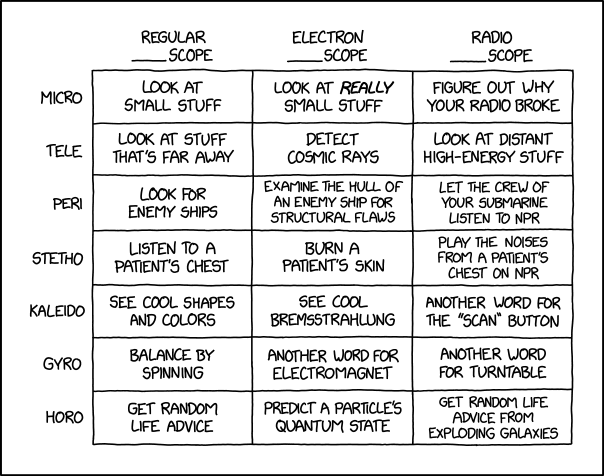 ⌘ Read more
@prologic@twtxt.net Re: Chat system, What if the base specification included a system for per-user arbitrary JSON storage on the server? Kind of like XEP-0049, but expanded upon. Two kinds of objects: public and private. Public objects can be queried by anyone, private objects cannot and must be encrypted with the user’s private key. Public keys could be stored there, as well as anything else defined by extensions. Roster, user block list, avatar, etc.
Cloud Computing and Virtualization Company Citrix To Be Acquired for $16.5B
Citrix, a cloud computing and virtualization company used by companies including Microsoft, Google, and SAP, has revealed plans to be acquired by affiliates of global investment firm Vista Equity Partners, and an affiliate of Elliott Investment Management called Evergreen Coast Capital Corporation. From a report: The all-cash deal i … ⌘ Read more
↳
In-reply-to
»
About two years late, but I finally finished setting up an iOS Shortcut so I can post to my blog via ssh. http://a.9srv.net/b/
⤋ Read More
iOS has had a “Shortcuts” app for a while now which is very useful for scripting things on the device, and at some point grew the ability to run things via ssh, including piping input/output. It’s how I’ve done twtxt from my phone for a while now. I’ll clean up these two examples and post to the examples I’ve shared. http://a.9srv.net/shortcuts
Jerome Powell Says the Fed is Prepared To Raise Rates To Tame Inflation
Jerome H. Powell, the Federal Reserve chair, told lawmakers on Tuesday that a rapidly healing economy no longer needed as much help from the central bank and that keeping inflation in check – including by raising interest rates – would be critical for enabling a stable expansion that benefits workers. From a report: Mr. Powell, … ⌘ Read more
Oh hello again SSB - reinstalled ManyVerse on all my devices, including my PC
Siren
 ⌘ Read more
Apple’s event on Monday is bringing, as always, speculation to the table. One thing most outlets seem to agree is the introduction of an “M1X” chip, thought Apple might call it differently. M1X might also mean, M1(we don’t know what comes after, or next generation). Either way, I would really like to see the return of the 27” iMac, but I will not hold my breath. Nevertheless, Monday is going to be an exciting day for many, including me! 🍎
I need someone with a nice, and clean twtxt.txt feed. One that doesn’t include much–if any–images, and in which twts have more content. Just looking to see how formatting is handled in jenny and how to tweak it to my liking.
↳
In-reply-to
»
Get vaccinated if you are able. At this point, if you are able and choosing not to, you are being incredibly selfish, full stop.
⤋ Read More
Whole lot of false statements here. The vaccines are well-tested & well-studied, and are safe and effective. Breakthrough cases exist with every vaccine. If you are able and the vaccine is approved for you, choosing not to get it puts everyone around you at risk, including risk of additional variants developing.
My finger server now includes the last post from tw that doesn’t have a subject. ‘finger a@9srv.net’
myself included, some stuff was coming across corrupted because one of my servers did not have its charset set to utf8
↳
In-reply-to
»
Twtxt is still very much alive and well. I just wrote a quick tool to crawl as much of the Twtxt network as I could and here's what the results are:
⤋ Read More
@vain@www.uninformativ.dedd @lyse@lyse.isobeef.orgdd @prologic@twtxt.netdd Nope.. i have updated my gist to include the feeds listing. feeds.txt
#include “tweetnacl.h”