↳
In-reply-to
»
The original twt is unavailable. It may have been edited or deleted, or is from an unknown or muted feed.
⤋ Read More
@GabesArcade@gabesarcade.com I think it would have to be specific to the App itself. So say you somehow didn’t save a recovery key or some shit™ You could still get back up and running with ease if you had exported a config? 🤔
↳
In-reply-to
»
The original twt is unavailable. It may have been edited or deleted, or is from an unknown or muted feed.
⤋ Read More
@david@daiwei.me Ha, I just noticed that I changed Newsboat’s defaults. Right from the factory, new items are just bold, while read ones aren’t. No different colors, white on black. Focused items are bold yellow on blue. No matter the read status. I think that’s why I started to play with the config to differentiate them. It’s been so long ago that I didn’t know anymore I even messed with that.
And yes, you’re right, the red on black is borderline readable. Also, my white on green focus is rather silly. But I’m sooo used to it, I don’t realize how bad the contrast is. To be fair, I don’t spend a lot of time in the lists. Aha, there are new articles, Enter to hit the artice view, read it, press n to immediately jump to the next unread article, rince and repeat, finally I’m back in the article list view.
Default theme, read focused:

Default theme, unread focused:

Lyse’s schlimmbesserung, read focused:

Lyse’s schlimmbesserung, unread focused:

Yeah, lol, fuck off. Tried to reproduce that hashing issue, thus playing around with Go a little bit. And what did I find?
$ tree ~/.config/go
/home/user/.config/go
└── telemetry
    ├── local
    │   ├── asm@devel-devel-linux-amd64-2026-07-14.v1.count
    │   ├── compile@devel-devel-linux-amd64-2026-07-14.v1.count
    │   ├── go@devel-devel-linux-amd64-2026-07-14.v1.count
    │   ├── link@devel-devel-linux-amd64-2026-07-14.v1.count
    │   ├── upload.token
    │   └── weekends
    └── upload

4 directories, 6 files
It collects and uploads “telemetry” now.
No.
(Don’t tell me how I can turn that off. Not interested. This is a compiler and it wants to track me, without asking for consent. That’s a no-go.)
Oh come on! Why such a stupid anti-feature!?
WARNING: Your yt-dlp version (2026.03.17) is older than 90 days!
     It is strongly recommended to always use the latest version.
     You cannot update when running from source code; Use git to pull the latest changes.
     To suppress this warning, add --no-update to your command/config.
↳
In-reply-to
»
@lyse Bummer, but thanks for the heads-up. 🙂
⤋ Read More
@itsericwoodward@itsericwoodward.com Turns out, this is a bug in my config to cache synchronization. Nickname changes in the configuration file are just not synced to the cache at startup if the feed URL already exists in the cache. I must have fixed this typo in my config ages ago, because I don’t even recall having that spelling mistake to begin with. Yet, the cache was happily showing the erroneous nickname. Composing a reply automatically adds the mentions from the conversation participants. Everything originates from the cache, so, I successfully poissoned my replies.
↳
In-reply-to
»
@lyse … this reminds me that I should finally write that tutorial on how to make your own X11/Wayland keymaps. That helps a lot in mitigating stupid design issues like these.
⤋ Read More
@movq@www.uninformativ.de I just changed the bindsym directly in my i3 config. But I’m looking forward to learn a few new tricks. :-)
↳
In-reply-to
»
The original twt is unavailable. It may have been edited or deleted, or is from an unknown or muted feed.
⤋ Read More
@tftp@tilde.town mentioning in here requires he whole shebang. With jenny, if using vim, there is a key combination:
Nick name completions: Allows you to use ^X ^U to turn verbatim nick names into full twtxt mentions. For example, typing “cath” and then pressing ^X ^U will turn “cath” into a full mention, like “@”. (This function will read the contents of your “~/.config/jenny/follow” file.)
Heyy 04866, regarding grub, you should have checked your grub config file before installing it, never rely on distro’s tools. See if your grub config matches your intention and install it, if not, tweak it until it’s fine.
↳
In-reply-to
»
The original twt is unavailable. It may have been edited or deleted, or is from an unknown or muted feed.
⤋ Read More
For the record, the third thing is to activate agent forwarding. In ~/.ssh/config:
Host git.mills.io
ForwardAgent yes
Oh great, I received an e-mail that my SMTP credentials have been exposed. Once again, just another shitty scanner that generates garbage reports from tests it doesn’t understand. Thank you for nothing!
conf := &Config{
    SMTPHost: "smtp.example.com",
    SMTPPort: 587,
    SMTPUser: "user",
    SMTPPass: "hunter2",
    SMTPFrom: "from@example.com",
}
↳
In-reply-to
»
@aelaraji Ahhh! That would be even funnier and even more brilliant! 🤣 If you can find this, I would happily employ this tactic next time and make 'em pay 💰 Bahahahaha 🤣
⤋ Read More
@prologic@twtxt.net I couldn’t find the exact blog post from before, one that used redirection directives in its nginx config. but I found [this one ](https://melkat.blog/p/unsafe-pricing#:~:text=Something%20else%20I’ve%20been%20doing%20this%20year,%20fine.) mentioning a similar process but done differently.
↳
In-reply-to
»
@bender It's good enough ti iron out any bugs 🐛 Can I haz an account? 🙏
⤋ Read More
@prologic@twtxt.net I will share later my GoToSocial 10 lines (or less) config.yaml, and 4 lines Caddyfile, and you will see how easy it is.
↳
In-reply-to
»
There are no really good GUI toolkits for Linux, are there?
⤋ Read More
@prologic@twtxt.net Hm, same startup delay. (Go is not an option for me anyway.)
It’s hard to tell why all this is so slow. Maybe in this particular case it has something to do with fonts: strace shows the program loading the fontconfig configs several times, and that takes up a bulk of the startup time. 🤔 (Qt6 or Java don’t do that, but they’re still slow to start up – for other reasons, apparently.)
To be fair, it’s “just” the initial program startup (with warm I/O caches). Once it’s running, it’s fine. All toolkits I’ve tried are. But I don’t want to accept such delays, not in the year 2025. 😅 Imagine every terminal window needing half a second to appear on the screen … nah, man.
↳
In-reply-to
»
@prologic FWIW, I love the idea and I do the same with my email domains. It’s the most effective way to fight spam, IMO. 🥳
⤋ Read More
@bender@twtxt.net No plus-aliases, just aliases. The mailserver runs on my OpenBSB box and is managed using BundleWrap (we use that at work), so to create a new alias, I push a new BundleWrap config to the server.
I should work on my client again and add some new features. Like adding a new feed directly in the client and not having to go to the config first. And showing a preview of a feed before actually adding it. Also, a search would be something to add. And finally combining my User-Agent analyzer with my subscription list to spot new feeds automatically.
stoked to have cobbled together a mutt config that feels mostly-right
I just created a zs blogging template which I’m going to use for https://prologic.blog and I might starting writing long-form again soon™ 🔜 So far the “blogging” template/engine (if you weill) is quite simple. It comprises essentially of an index.md a prehook and a few utilities:
$ git ls-files
.gitignore
.zs/config.yml
.zs/editthispage
.zs/include
.zs/layout.html
.zs/list
.zs/months
.zs/now
.zs/onthispage
.zs/posthook
.zs/postsbymonth
.zs/prehook
.zs/scripts
.zs/styles
.zs/tagcloud
.zs/taglist
.zs/years
archives/.empty
assets/css/site.css
assets/js/main.js
index.md
posts/hello-zs-blog.md
posts/on-tagging.md
posts/second-post.md
tags/.empty
↳
In-reply-to
»
@lyse Hm, I couldn’t trick yt-dlp into downloading the correct format. Works in the browser, though. 😅
⤋ Read More
@movq@www.uninformativ.de I’ve got this magic spell in my config: -f bestvideo[height<=?1080]+bestaudio/best
↳
In-reply-to
»
Adding too this. The configuration example at the repository reads:
⤋ Read More
@quark@ferengi.one ooh, thanks for catching that! i forgot abt the caddy example when adding the config example
nick is nick bc it is parsed as a nickname just for the instance, though calling it instance_nick would probably be less confusing
↳
In-reply-to
»
@zvava I am getting
⤋ Read More
[2025/09/11 12:56:01.816] ⇒ please set config.host when trying to run "bbycll". How to bypass that tiny hurdle?
Woot, thank you! Using a config.json like this:
{
  "host": "localhost:31212",
  "protocols": ["http"]
}
Indeed did the trick! I know it isn’t production ready, but I wanted to see with my own eyes, locally, how did it look. :-) I like where you are going! It is looking very nice, and polished. Can’t wait for an alpha, beta, and release!
↳
In-reply-to
»
@zvava I am getting
⤋ Read More
[2025/09/11 12:56:01.816] ⇒ please set config.host when trying to run "bbycll". How to bypass that tiny hurdle?
@bender@twtxt.net i also recently discovered there was a bug causing new users to initialize wrong leading to their posts not being saved :p ..and made breaking changes to how the config and database files are stored so um, make sure to clear your local tree before updating!
@zvava@twtxt.net I am getting [2025/09/11 12:56:01.816] ⇒ please set config.host when trying to run “bbycll”. How to bypass that tiny hurdle?
↳
In-reply-to
»
@movq Yeah, we've seen how this plays out in practice 🤣 @dce My advice, do what @movq has hinted at and don't change the 1st
⤋ Read More
# url = field in your feed. I'm not sure if you had already, but the first url field is kind of important in your feed as it is used as the "Hashing URI" for threading.
@prologic@twtxt.net @movq@www.uninformativ.de My metadata only has my HTTPS URL. I didn’t consider having multiple. I was talking about my config.yaml. Jenny sounds like a good client, so I might give that a try.
↳
In-reply-to
»
YAYYY TY @prologic NOW I HAVE IMAGE & YOUTUBE EMBEDS ON MY YARN POD 🎉🎉🎉
⤋ Read More
@kat@yarn.girlonthemoon.xyz Here’s the full config I use.
i am having fun with dmenu
https://bytes.4-walls.net/kat/dotfiles/src/branch/main/config/.local/bin/dict
https://bytes.4-walls.net/kat/dotfiles/commit/b5ca2e0eaba3cbc0cf0898926ffcb0bb064d17c7
↳
In-reply-to
»
i wanna figure out more things to do with dmenu but i don't really know man the emoji picker is hard to beat
⤋ Read More
@kat@yarn.girlonthemoon.xyz NVM i stole other peoples code to make a dictionary lookup script https://bytes.4-walls.net/kat/dotfiles/src/branch/main/config/.local/bin/dict
Only figured this out yesterday:
pinentry, which is used to safely enter a password on Linux, has several frontends. There’s a GTK one, a Qt one, even an ncurses one, and so on.
GnuPG also uses pinentry. And you can configure your frontend of choice here in gpg-agent.conf.
But what happens when you don’t configure it? What’s the default?
Turns out, pinentry is a shellscript wrapper and it’s not even that long. Here it is in full:
#!/bin/bash

# Run user-defined and site-defined pre-exec hooks.
[[ -r "${XDG_CONFIG_HOME:-$HOME/.config}"/pinentry/preexec ]] && \
        . "${XDG_CONFIG_HOME:-$HOME/.config}"/pinentry/preexec
[[ -r /etc/pinentry/preexec ]] && . /etc/pinentry/preexec

# Guess preferred backend based on environment.
backends=(curses tty)
if [[ -n "$DISPLAY" || -n "$WAYLAND_DISPLAY" ]]; then
        case "$XDG_CURRENT_DESKTOP" in
        KDE|LXQT|LXQt)
                backends=(qt qt5 gnome3 gtk curses tty)
                ;;
        *)
                backends=(gnome3 gtk qt qt5 curses tty)
                ;;
        esac
fi

for backend in "${backends[@]}"
do
        lddout=$(ldd "/usr/bin/pinentry-$backend" 2>/dev/null) || continue
        [[ "$lddout" == *'not found'* ]] && continue
        exec "/usr/bin/pinentry-$backend" "$@"
done

exit 1
Preexec, okay, then some auto-detection to use a toolkit matching your desktop environment …
… and then it invokes ldd? To find out if all the required libraries are installed for the auto-detected frontend?
Oof. I was sitting here wondering why it would use pinentry-gtk on one machine and pinentry-gnome3 on another, when both machines had the exact same configs. Yeah, but different libraries were installed. One machine was missing gcr, which is needed for pinentry-gnome3, so that machine (and that one alone) spawned pinentry-gtk …
lo prometido es deuda.. aqui les dejo mi configuracion.. https://github.com/dev1lsconf/nixos-config #Hyprland + #NixOS
↳
In-reply-to
»
The lack of suckless-like simple, hackable software these days is appalling.
⤋ Read More
@prologic@twtxt.net Ah, I’m referring to software that’s similar to that of suckless.org: Small, minimal codebases, small tools, but still useful. dmenu is probably the best example and also farbfeld.
Here’s the author of Anubis talking about some of their experiences:
https://xeiaso.net/blog/why-i-use-suckless-tools-2020-06-05/
(You can skip the long config and keybinds part.)
ejemplo de mi .config/twtxt/config https://termbin.com/vfp6 #twtxt #config #example
good morning everyone. before going to bed last night i accidentally password protected the entirety of my biggest site superlove because i botched a refactor of my caddyfile config. lmao
I now subscribed to most feeds in my Go tt reimplementation that I already followed with the old Python tt. Previously, I just had a few feeds for testing purposes in my new config. While transfering, I “dropped” heaps of feeds that appeared to be inactive.
This might motivate me to actually “finish” the new client, so that it could become my daily driver. No need to use the old software stack any longer. Let’s see how bad this goes.
↳
In-reply-to
»
@kat it was like.... meta.json was corrupt or well it was empty actually whatever idk. ended up moving that elsewhere temporarily, rebuilding the binary, restarting server... and it worked?!?!? shit was confusing
⤋ Read More
@prologic@twtxt.net huh interesting! yeah i was stumped for a bit i was like WHAT config.json file are these logs talking about…. but then it worked after i moved the old meta.json file lol!
it’s been while since I’d stopped #window-manager hopping and just settled with #Herbstluftwm but I’m NGL, the River #Wayland compositor is starting to grow on me… I’m still not sure if it’s just me but something about it feels clean and snappy. The shortcuts in the vanilla/example configuration feel a bit clunky, but then again, it’s just me being used to the same old ones I keep adopting and replicating across WMs. I’ve got 0 energy for ricing so I’ll just roll with the vanilla config as is (maybe add in a short-cut for a launcher but that will be it).
↳
In-reply-to
»
reviewing logs this morning and found i have been spammed hard by bots not respecting the
⤋ Read More
robots.txt file. only noticed it because the OpenAI bot was hitting me with a lot of nonsensical requests. here is the list from last month:
@bmallred@staystrong.run Surprisingly, my
User-agent: *
Disallow: /
seems to work. Or maybe those bastards change their user agent and claim to be someone nice. In any case, I just added a bunch of
location = /robots.txt {
    add_header Content-Type text/plain;
    return 200 "User-agent: *\nDisallow: /\n";
}
in my nginx config. No need for any bot to visit, crawl and index most of my sites.
↳
In-reply-to
»
tz test
⤋ Read More
@kat@yarn.girlonthemoon.xyz ok yeah idk what’s going on whatever i’ll mess with config later
hey yarn pod hosting friends, how do i enable an SMTP relay in the env settings? i’m trying to get a friend on here and i’m pretty sure my env config is good but it won’t send emails even after restarts which is strange. i have the right hostname for mailjet, user and pass are in there, same with from address, i’m wondering if the port is messing it up bc it has to send from 587?
↳
In-reply-to
»
And now I've applied rate limits on every site to reasonable values 👌
⤋ Read More
@prologic@twtxt.net Looks like I’m hitting this now when reloading my subscriptions:
$ grep twtxt.net .config/twtxt/config | wc -l
26
a new emmanation of my trusty old vim config, now available as a home-manager nix module. now i can track my dependencies with nix instead of using git subtree and it makes installing backend programs like language servers and such way easier. https://src.ix.cyb.red/pe-vim/
↳
In-reply-to
»
I think it's time I set up jenny for this feed... been echo-ing my twits manually and there came times when it made me feel like a dork xD Plus I don't have my vim's
⤋ Read More
:set spell to catch up with the typos
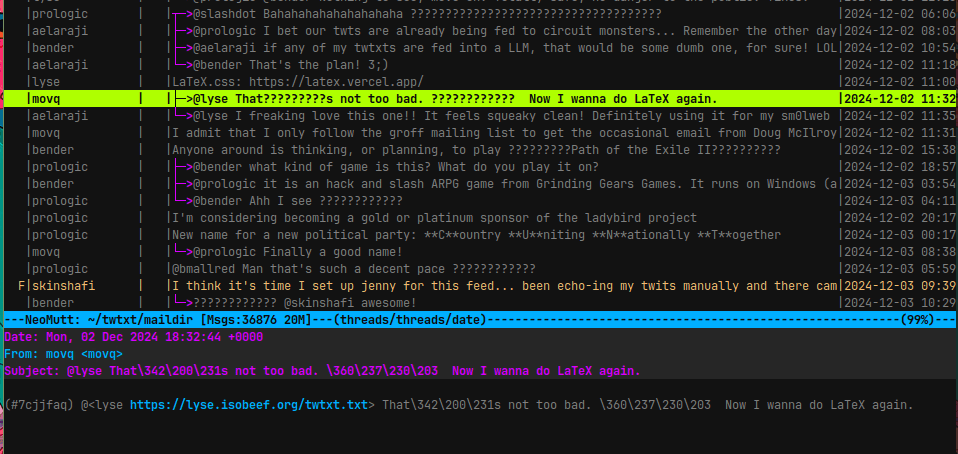
Done! but then again, there’s something weired going on with my muttrc-jenny config file xD … I’m seeing a bunch of ????s in the TUI’s subjects section… checking a couple of twt’s headers I see somethings like \360\237\230\261 (escapesd unicode?), sometime that shows in the mail body and sometimes not.
Could it have something to do with the remote/pubnix machin’s Locale or something? one more thing to digg through 🫠
↳
In-reply-to
»
Hi @prologic Hi @bender 😁 now, Why is my @ mention is all over the place? xD this feed has a
⤋ Read More
# nick = skinshafi so... should I scream buuug ? 🤔
@prologic@twtxt.net I’ve seen plenty but I doubt you could use any (other than PHP) to actually serve your pages, anything you want to serve, you put in a ~/public_xyz folder (your php files go there too for Apache to serve), no config files/server setting.
But don’t take my word for it, I just got there and still yet to meet people and learn a bit of IT wizardry from them ;)
↳
In-reply-to
»
i am working on very smol deployments, where a server may use two or so replicated sqlite databases instead of a db server like postgres to seamlessly move from single to multi-node arrangements as needed. there is a clear performance limit here, but the goal is not to serve a huge number of clients. just to do as much as possible with a small number of useful components that can be upgraded to handle up to medium size workloads, without difficult data conversions or migrations. scaling beyond that point should be done via federation.
⤋ Read More
for example, ejabberd, redka, and litefs. all using sqlite+litefs for their database needs allows agents to communicate over xmpp, matrix, mqtt, and sip. other applications can use sqlite for storage or speak the redis protocol to redka. ejabberd can also handle file uploads, static file publishing, identity, and various other web application services. when scaling, litefs integrates with consul to manage replication which grants the network access to service disco, encrypted mesh networking, and various other features that can be used to build secure service grids. ejabberd and redka can be scaled to multiple nodes that coordinate over the litefs replication protocol without any changes to the db storage config. other components can be configured to plug into this framework fairly easily as well. we keep the network config fairly simple by linking nodes together with yggdrasil to flatten the address space and then linking app nodes together using consul to provide secure routing for the local grid service. yggdrasil also offers utility for buliding federated networks in a similarly flat address space, for more secure communications i2p is also available in yggdrasil mode. minibase is wonderful, and we have not even started to talk about secure IoT.
Tried migrating to jenny… So seems it not suitable for my phone. Fetch command fetched archived feeds so i have 37k+ entries and mutt hangs for several seconds for loading this. Also i don’t like hardcoded paths for config and follow file
Note to self: “If your dashboard says you sh..t is down, it means your sh..t is down. It’s not a dashboard miss-config you dumb azz” 😆
minibase has a network security architecture with a number of overlapping layers of protection. first, routers and discovery endpoints either require a password or an authorized public key to accept traffic. this setup restricts who can reach the endpoints to an extent, but peering with enough third parties with less restrictive policies will practically allow global routing. since this is a possible policy choice, minibase also requires internal traffic to be authenticated. overlay traffic is automatically encrypted by yggdrasil, but applications should still treat the traffic like its clearnet and use tls. currently i’m requiring a dns acme challenge to generate wildcard certs, but eventually it might make sense to scope the certificates to the specific service its associated with. we don’t have much config generation in the nix modules yet, but something like this should be possible eventually. i’m working on configurations for ory oathkeeper, hydra, and kratos to provide a federated auth framework that your network services and minibase configs can integrate with.
↳
In-reply-to
»
Been curious about how people on Pubnix instances do manage their feed, if they have access to log? Sent in a req to join one still no res.
⤋ Read More
Idk about other pubnixes but i can freely edit caddy config (or change webserver and use other config format)
↳
In-reply-to
»
@doesnm
⤋ Read More
twt probably isn't the best client I'm afraid. It doesn't really cache twts by their key (hash) to display threads properly. Jenny however does 👌
It has twts cache which used if timeline is set to jew. Maybe i.should fork twet to make wishes like newlines (i see two squares), showing conversations, showing twts if not found in cache and parsing medata to configure url, nick and followers (currenly it duplicated in config and twtxt file)
↳
In-reply-to
»
I wrote some code to try out non-hash reply subjects formatted as (replyto ), while keeping the ability to use the existing hash style.
⤋ Read More
@david@collantes.us Well, I wouldn’t recommend using my code for your main jenny use anyway. If you want to try it out, set XDG_CONFIG_HOME and XDG_CACHE_HOME to some sandbox directories and only run my code there. If @movq@www.uninformativ.de is interested in any of this getting upstreamed, I’d be happy to try rebasing the changes, but otherwise it’s a proof of concept and fun exercise.
↳
In-reply-to
»
I wrote some code to try out non-hash reply subjects formatted as (replyto ), while keeping the ability to use the existing hash style.
⤋ Read More
BTW this code doesn’t incorporate existing twts into jenny’s database. It’s best used starting from scratch. I’ve been testing it using a custom XDG_CACHE_HOME and XDG_CONFIG_HOME to avoid messing with my “real” jenny data.
↳
In-reply-to
»
@bender It's just a simple twtxt2html and scp ... it goes like:
⤋ Read More
@quark@ferengi.one Mine is a little overkill 😂 but I need to do something for practice:
#!/bin/bash
set -e
trap 'echo "!! Something went wrong...!!"' ERR

#============= Variables ==========#

# Source files
LOCAL_DIR=$HOME/twtxt

TWTXT=$LOCAL_DIR/twtxt.txt
HTML=$LOCAL_DIR/log.html
TEMPLATE=$LOCAL_DIR/template.tmpl

# Destination
REMOTE_HOST=remotHostName     # Host already setup in ~/.ssh/config

WEB_DIR="path/to/html/content"
GOPHER_DIR="path/to/phlog/content"
GEMINI_DIR="path/to/gemini-capsule/content"

DIST_DIRS=("$WEB_DIR" "$GOPHER_DIR" "$GEMINI_DIR")


#============ Functions ===========#

# Building log.html:

build_page() {
	twtxt2html -T $TEMPLATE $TWTXT > $HTML
}

# Bulk Copy files to their destinations:

copy_files() {
	for DIR in "${DIST_DIRS[@]}"; do
    # Copy both `txt` and `html` files to the Web server and only `txt`
    # to gemini and gopher server content folders
		if [ "$DIR" == "$WEB_DIR" ]; then
			scp -C "$TWTXT" "$HTML" "$REMOTE_HOST:$DIR/"
		else
			scp -C "$TWTXT" "$REMOTE_HOST:$DIR/"
		fi
	done
}

#========== Call to functions ===========$

build_page && copy_files