↳
In-reply-to
»
The original twt is unavailable. It may have been edited or deleted, or is from an unknown or muted feed.
⤋ Read More
@jecxjo@sh0.xyz Haven’t followed Python projects for quite a while. This is the first one that I come across that uses match. Cool.
Why.
Python’s numeric types complex, float and int are not subtypes of each other, but to support common use cases, the type system contains a straightforward shortcut: when an argument is annotated as having type float, an argument of type int is acceptable; similar, for an argument annotated as having type complex, arguments of type float or int are acceptable.
https://typing.python.org/en/latest/spec/special-types.html#special-cases-for-float-and-complex
↳
In-reply-to
»
I trip over this in our code at work all the time.
⤋ Read More
@movq@www.uninformativ.de The nice thing about properties is that you can compute and cache things on the fly at first attempt and also ensure validation for writing. But like you said, since it’s not obvious that reading or writing might do some more things, it’s strongly advised to avoid doing expensive stuff disguised as properties.
I reckon the vast majority of property use cases is to provide read-only access. At least that was my impression when I was doing a lot more in Python.
Personally, I think that this just reads a lot nicer:
oink.my_property
oink.my_property = 42
Than:
oink.get_my_property()
oink.set_my_property(42)
Btw, any field access is implemented using method calls. I might be wrong, but I believe there’s always __getattr__ and __setattr__ involved. 8-)
I trip over this in our code at work all the time.
Python has this concept of “properties”:
class Oink:
    def __init__(self):
        self._foo = 3

    @property
    def my_property(self):
        return self._foo


a = Oink()
print(a.my_property)
my_property() is a method but it can be used as if it were a field.
This can also be used to define a setter:
class Oink:
    def __init__(self):
        self._foo = 3

    @property
    def my_property(self):
        return self._foo

    @my_property.setter
    def my_property(self, value):
        self._foo = 123 * value
Because, for some reason, Python people don’t like getters and setters. Instead, they hide it behind a property.
The result is, when you read this:
a.my_property = 5
print(a.my_property)
You have no idea that this actually calls a method.
↳
In-reply-to
»
(Just a brain dump, nobody needs to read this.)
⤋ Read More
@movq@www.uninformativ.de My grief with Java is that it’s sooo verbose. Sure, all the enterprise garbage makes it a hell lot more terrible, but even regular Java feels always so lengthy. And back in the days when I was using it daily, I missed so many convenient things in the stdlib after having experienced Python’s “batteries included”. Not sure if or how recent Java versions caught up.
I really think I should go back to Java.
Writing programs in Python is so exhausting. I want a compiler and I want static typing. No, linters and type checkers and IDEs are not good enough. Compilers catch way more errors in advance.
Rust is also exhausting. They’re constantly adding language features and, at the same time, the runtime library remains tiny and you need 3rd party libraries for everything. Many of those are still at version 0.x (SemVer!) and you can’t rely on anything. Often times, you need the latest Rust nightly compiler.
Go is … I don’t like it. And huge binaries.
I like C as a language, but it’s too fragile. I want to have a proper HashMap every now and then.
None of the above have good GUI libraries, at least not on Linux.
And then there’s Java. This is my fractal renderer that I wrote over 17 years ago:
https://movq.de/v/fcd3c4e557/vid-1784121825.mp4
It’s fast. It has a GUI with custom widgets and those weren’t even hard to make. It still works without changing a single line of code. The source code files have timestamps from 2009 and I just noticed that the JAR file I’m using in the video was compiled in 2010.
Java as a language is relatively easy to learn and to master. There are few surprises. The source code organization with packages is good. Java API docs are clear and well written.
The JVM ramp-up times have improved considerably:
https://movq.de/v/e7314e521e/vid-1784121998.mp4
This isn’t like the Dark Ages anymore. Might even be usable for some CLI tools.
The only thing where Java really sucks is anything close-ish to the kernel. Try issuing an ioctl() … I couldn’t have made my TUI framework in Java, but then again, I wouldn’t have needed to because Swing already exists and it just works.
↳
In-reply-to
»
Numbered headings in blog posts, yay or nay?
⤋ Read More
@lyse@lyse.isobeef.org Besides, have a look at  again: When it goes from item 9 to item 10, the indentation of the text (after the number) changes. Pretty ugly. In other words, a table of contents should be a table, not a list like it is at the moment. And that would require me to write my own extension for python-markdown … Probably not worth it.
↳
In-reply-to
»
@lyse Mhm, yeah, I also think I like
⤋ Read More
date := time.Date(2026, time.June, 19, /**/ 17, 0, 0, 0, time.UTC) the most. 🤔 (My only gripe with this is that it isn’t obvious whether the third 0 is milli-, micro- or nanoseconds. These days it’s probably nanoseconds, but you never know.)
@movq@www.uninformativ.de Right. A Go programmer eventually knows that its nanoseconds precision. Keyword arguments like in Python are just sooo superior to unnamed positional arguments. I wish that Go had them, too.
↳
In-reply-to
»
@movq Regarding https://movq.de/blog/postings/2026-06-16/0/POSTING-en.html:
⤋ Read More
@lyse@lyse.isobeef.org In what way was KDE 3’s menu organized? KDE 1 is the only KDE version I ever used. 😅 We’re talking about this one, right?

Isn’t Notepad++ and Python cheating!? :-D
Well, Python was certainly already a thing back then, but Notepad++ is from 2003, right. I think I used https://www.wintotal.de/download/proton/ at the time? Maybe? I don’t know. 😅
@movq@www.uninformativ.de Regarding https://movq.de/blog/postings/2026-06-16/0/POSTING-en.html:
In my opinion, the KDE 3.5 menu was organized way better than the Windows Start menu. Granted, a typical KDE installation had much more applications to offer, too. So, there was more need to get it right. And it probably was also later in time.
Isn’t Notepad++ and Python cheating!? :-D
Crazy story on the clock’s seconds. I never heard of that before. Neat.
Yeah, UI these days is horrible. (That’s why my own TUIs suck, too!)
↳
In-reply-to
»
@lyse By the way, which site generator are you using? I kind of miss having code blocks with syntax highlighting and that generic yellow highlighting thing is pretty cool, too.
⤋ Read More
@lyse@lyse.isobeef.org Ah, I almost thought so (that you wrote it by hand), but then I looked at the source code and saw the TOC and I was like: “Naah, probably not. I would be way too lazy to do that manually.” 😅 And indeed … ha.
Oh god, yeah, that’s a lot of <span>. 🤔 Can’t really avoid that, I guess, especially if you want to do syntax highlighting of code blocks.
You wrote your own site generator, didn’t you?
In parts. I write everything in Markdown (it’s online, even: https://movq.de/blog/postings/2026-05-29/0/POSTING-en.md), plus a few Vim shortcuts (to generate thumbnails, for example), and then python-markdown renders it: https://pypi.org/project/Markdown/ This process is wrapped in a shell script, like “re-render every page if the .md file is newer than the .html file” and that’s mostly it. And the Atom feed generator is completely custom. 🤔
Porting Starlark to pure Python with Claude — https://dbohdan.com/starlark-python
hey folks, is there any good twtxt client for linux out there that you recommend? every time i update pip or some other python stuff twtxt gets screwed and ask for some dependency or breaks, it is annoying to fix that everytime, thanks
Via https://github.com/newsboat/newsboat/issues/3220#issuecomment-4198066671 I came across this nice selection on why not to use AI: https://github.com/Vxrpenter/AIMania/blob/main/WHY.md#why
This then lead me to the slopware list: https://codeberg.org/small-hack/open-slopware
Holy shit, there’s even more than I thought. :-O In addition to Vim, the following affects me more or less daily (but hopefully not my ancient versions): curl, VLC, ImageMagick, rsync, Python, systemd and even the Linux Kernel itself. Oh fuck me dead. :‘-(
↳
In-reply-to
»
@movq @prologic That's what I like about Go, too. However, every now and then I really dislike the result, e.g. when removing spaces from a column layout. Doesn't happen often, but when it does, I hate it.
⤋ Read More
Pep8 is deprecated, I think
Hmm, I don’t think it is, this still says “Status: Active”: https://peps.python.org/pep-0008/ 🤔
↳
In-reply-to
»
Since I used so much Rust during the holidays, I got totally used to
⤋ Read More
rustfmt. I now use similar tools for Python (black and isort).
@movq@www.uninformativ.de @prologic@twtxt.net That’s what I like about Go, too. However, every now and then I really dislike the result, e.g. when removing spaces from a column layout. Doesn’t happen often, but when it does, I hate it.
I think I should have a look at Python formatters, too. Pep8 is deprecated, I think, it’s been some time that I looked at it.
Since I used so much Rust during the holidays, I got totally used to rustfmt. I now use similar tools for Python (black and isort).
What have I been doing all these years?! I never want to format code manually again. 🤣😅
↳
In-reply-to
»
More widget system progress:
⤋ Read More
And now the event loop is not a simple loop around curses’ getch() anymore but it can wait for events on any file descriptor. Here’s a simple test program that waits for connections on a TCP socket, accepts it, reads a line, sends back a line:
https://movq.de/v/93fa46a030/vid-1767547942.mp4
And the scrollbar indicators are working now.
I’ll probably implement timer callbacks using timerfd (even though that’s Linux-only). 🤔
↳
In-reply-to
»
@movq That's cool! I also like the name of your library. :-) I assume you made the thing load quickly, didn't you?
⤋ Read More
@movq@www.uninformativ.de Yeah, I see. Just crudely checked on my computer, with around 0.013 seconds, Python 2.7 seems a tad faster than Python 3.14’s 0.023 seconds in this little program.
The lazy imports sound not too bad, but I just skimmed over them. There are surprisingly many exceptions, but yeah, no way around them. :-)
↳
In-reply-to
»
@movq That's cool! I also like the name of your library. :-) I assume you made the thing load quickly, didn't you?
⤋ Read More
The baseline here is about 55 ms for nothing, btw. Python ain’t fast to start up.
$ time python -c 'exit(0)'

real    0m0.055s
user    0m0.046s
sys     0m0.007s
↳
In-reply-to
»
@movq That's cool! I also like the name of your library. :-) I assume you made the thing load quickly, didn't you?
⤋ Read More
I assume you made the thing load quickly, didn’t you?
That’s the problem with Python. If you have a couple of files to import, it will take time.
I want this to be reasonably fast on my old Intel NUC from 2016 (Celeron N3050 @ 1.60GHz) and I already notice that the program startup takes about 95 ms (or 125 ms when there are no .pyc files yet). That’s still fine, but it shows that I’ll have to be careful and keep this thing very small …
Python 3.14 will bring lazy imports, maybe that can help in some cases.
↳
In-reply-to
»
Well, you girls and guys are making cool things, and I have some progress to show as well. 😅
⤋ Read More
@prologic@twtxt.net No, that’s Python/curses on Linux. 😅
Well, you girls and guys are making cool things, and I have some progress to show as well. 😅
https://movq.de/v/c0408a80b1/movwin.mp4
Scrolling widgets appears to work now. This is (mostly) Unicode-aware: Note how emojis like “😅” are double-width “characters” and the widget system knows this. It doesn’t try to place a “😅” in a location where there’s only one cell available.
Same goes for that weird “ä” thingie, which is actually “a” followed by U+0308 (a combining diacritic). Python itself thinks of this as two “characters”, but they only occupy one cell on the screen. (Assuming your terminal supports this …)
This library does the heavy Unicode lifting: https://github.com/jquast/wcwidth (Take a look at its implementation to learn how horrible Unicode and human languages are.)
The program itself looks like this, it’s a proper widget hierarchy:
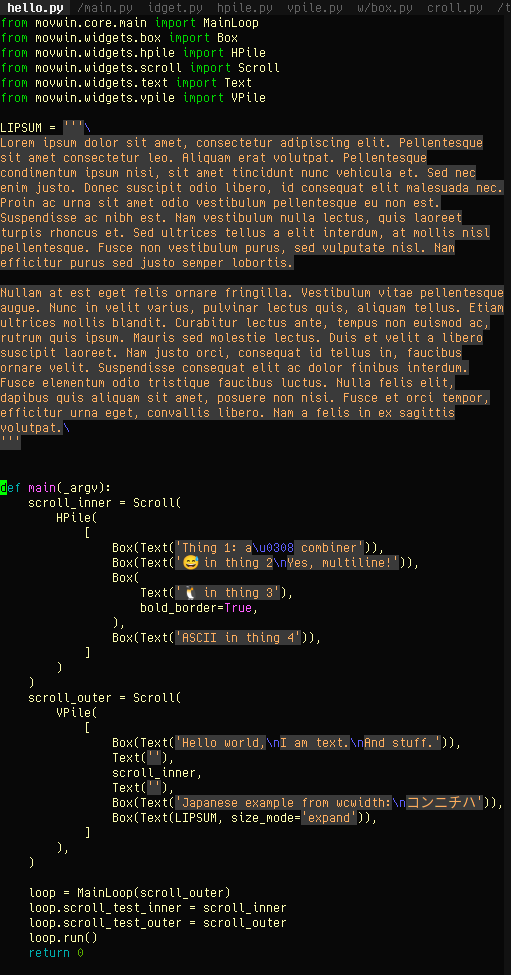
(There is no input handling yet, hence some things are hardwired for the moment.)
↳
In-reply-to
»
@lyse That sounds useful. 🤔
⤋ Read More
@movq@www.uninformativ.de Yeah. I had that in my Python implementation and was really missing that.
↳
In-reply-to
»
Trying to come up with a name for a new project and every name is already taken. 🤣 The internet is full!
⤋ Read More
@lyse@lyse.isobeef.org I’m toying with the idea of making a widget/window system on top of Python’s ncurses. I’ve never really been happy with the existing ones (like urwid, textual, pytermgui, …). I mean, they’re not horrible, it’s mostly the performance that’s bugging me – I don’t want to wait an entire second for a terminal program to start up.
Not sure if I’ll actually see it through, though. Unicode makes this kind of thing extremely hard. 🫤
↳
In-reply-to
»
@movq wow! what is assembler?
⤋ Read More
@kiwu@twtxt.net Assembly is usually the most low-level programming language that you can get. Typical programming languages like Python or Go are a thick layer of abstraction over what the CPU actually does, but with Assembler you get to see it all and you get full control. (With lots of caveats and footnotes. 😅)
I’m interested in the boot process, i.e. what exactly happens when you turn on your computer. In that area, using Assembler is a must, because you really need that fine-grained control here.
I finished all 12 days of Advent of Code 2025! #AdventOfCode https://adventofcode.com — did it in my own language, mu (Go/Python-ish, dynamic, int/bool/string, no floats/bitwise). Found a VM bug, fixed it, and the self-hosted mu compiler/VM (written in mu, host in Go) carried me through. 🥳
I just completed “Printing Department” - Day 4 - Advent of Code 2025 #AdventOfCode https://adventofcode.com/2025/day/4 – Again, I’m doing this in mu, a Go(ish) / Python(ish) dynamic langugage that I had to design and build first which has very few builtins and only a handful of types (ints, no flots). 🤣
I just completed “Lobby” - Day 3 - Advent of Code 2025 #AdventOfCode https://adventofcode.com/2025/day/3 – Again, I’m doing this in mu, a Go(ish) / Python(ish) dynamic langugage that I had to design and build first which has very few builtins and only a handful of types (ints, no flots). 🤣
↳
In-reply-to
»
Come back from my trip, run my AoC 2025 Day 1 solution in my own language (mu) and find it didn't run correctly 🤣 Ooops!
⤋ Read More
Ahh that’s because I forgot to call main() at the end of the source file. mu is a bit of a dynamic programming language, mix of Go(ish) and Python(ish).
$ ./bin/mu examples/aoc2025/day1.mu
Execution failed: undefined variable readline
↳
In-reply-to
»
Advent of Code 2025 starts tomorrow. 🥳🎄
⤋ Read More
Alright, Advent of Code is over:
https://www.uninformativ.de/blog/postings/2025-12-12/0/POSTING-en.html
It’s been quite the time sink, especially with the DOS games on top, but it was fun. 🥳
In case you’re wondering: All puzzles (except for part 2 of day 10) were doable in Python 1 on SuSE Linux 6.4 and ran in a finite time on the Pentium 133. Puzzle 10/2 might have been doable as well if I had better education. 🤣
↳
In-reply-to
»
Advent of Code 2025 starts tomorrow. 🥳🎄
⤋ Read More
FWIW, day 03 and day 04 where solved on SuSE Linux 6.4:
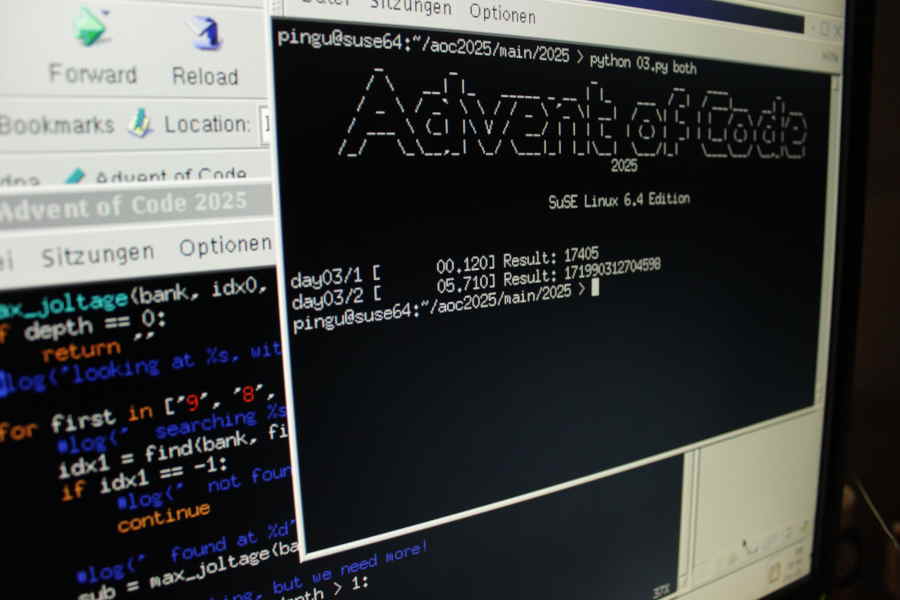
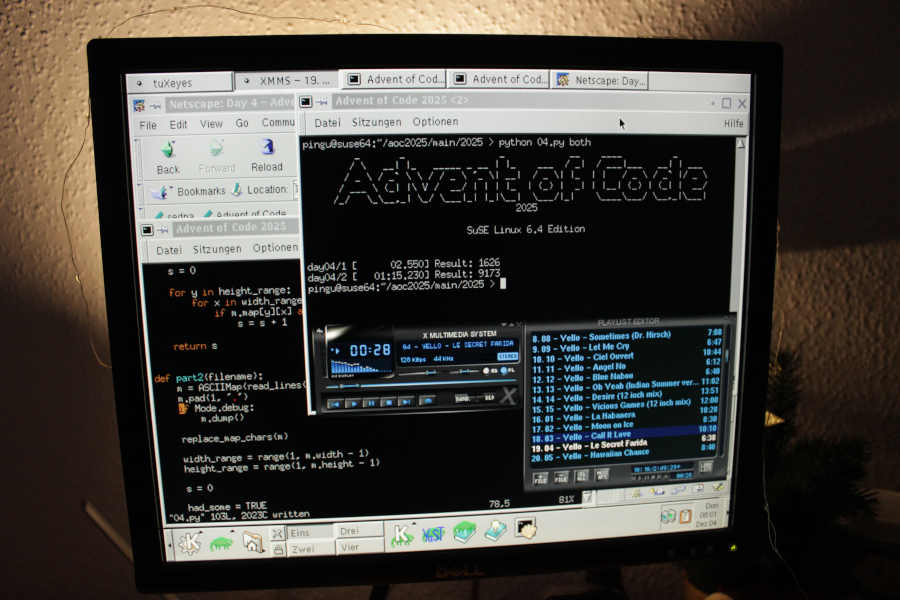
Performance really is an issue. Anything is fast on a modern machine with modern Python. But that old stuff, oof, it takes a while … 😅
Should have used C or Java. 🤪 Well, maybe I do have to fall back on that for later puzzles. We’ll see.
↳
In-reply-to
»
Advent of Code 2025 starts tomorrow. 🥳🎄
⤋ Read More
Day 2 was pretty tough on my old hardware. Part 1 originally took 16 minutes, then I got it down to 9 seconds – only to realize later that my solution abused some properties of my particular input. A correct solution will probably take about 30 seconds. 🫤
Part 2 took 29 minutes this morning. I wrote an optimized version but haven’t tested it yet. I hope it’ll be under a minute.
Python 1 feels really slow, even compared to Java 1. And these first puzzles weren’t even computationally intensive. We’ll see how far I’ll make it …

Thinking about doing Advent of Code in my own tiny language mu this year.
mu is:
- Dynamically typed
- Lexically scoped with closures
- Has a Go-like curly-brace syntax
- Built around lists, maps, and first-class functions
Key syntax:
- Functions use
fnand braces:
fn add(a, b) {
    return a + b
}
- Variables use
:=for declaration and=for assignment:
x := 10
x = x + 1
- Control flow includes
if/elseandwhile:
if x > 5 {
    println("big")
} else {
    println("small")
}
while x < 10 {
    x = x + 1
}
- Lists and maps:
nums := [1, 2, 3]
nums[1] = 42
ages := {"alice": 30, "bob": 25}
ages["bob"] = ages["bob"] + 1
Supported types:
int
bool
string
list
map
fn
nil
mu feels like a tiny little Go-ish, Python-ish language — curious to see how far I can get with it for Advent of Code this year. 🎄
Advent of Code 2025 starts tomorrow. 🥳🎄
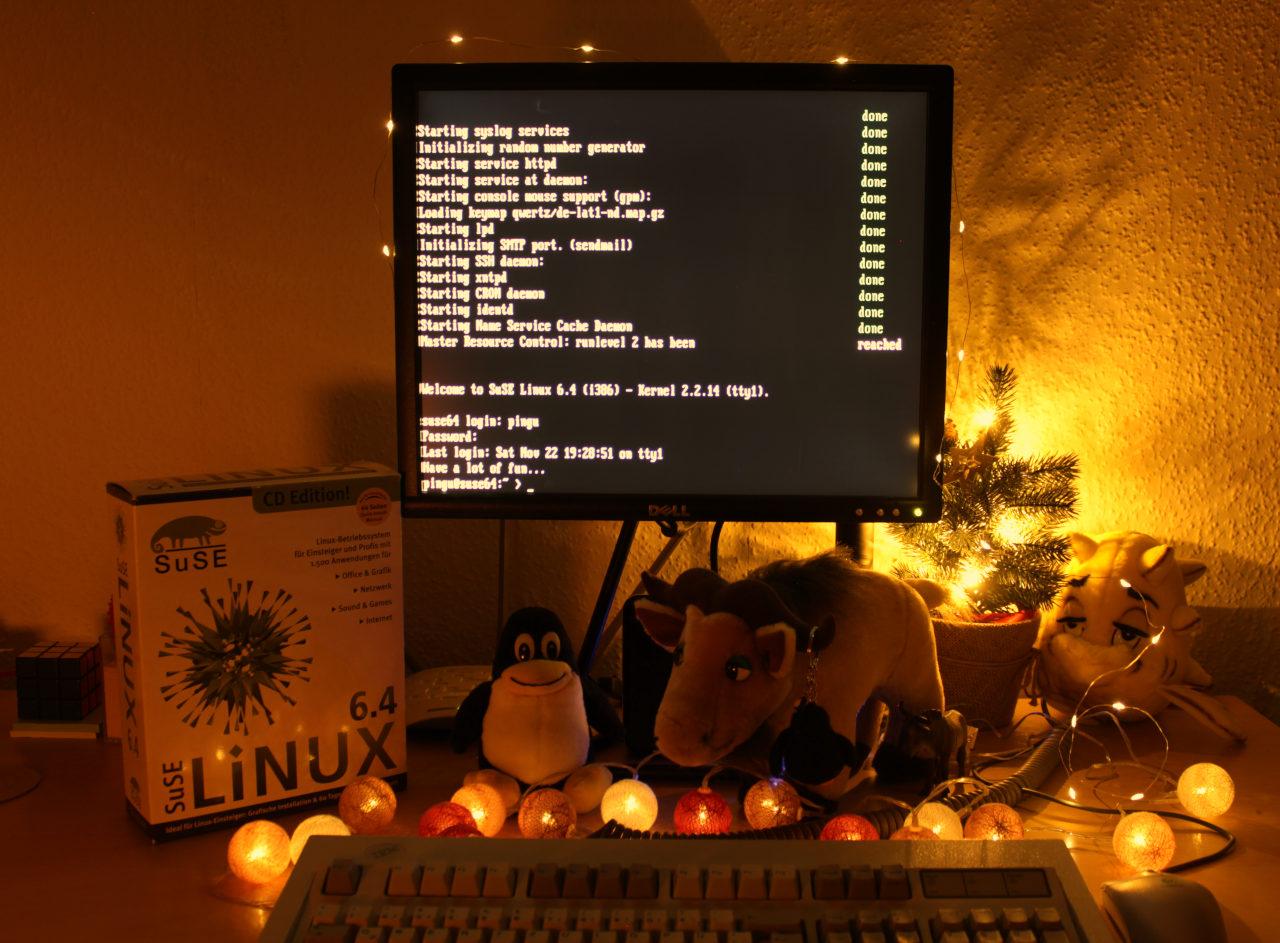
This year, I’m going to use Python 1 on SuSE Linux 6.4, writing the code on my trusty old Pentium 133 with its 64 MB of RAM. No idea if that old version of Python will be fast enough for later puzzles. We’ll see.
All my newly added test cases failed, that movq thankfully provided in https://git.mills.io/yarnsocial/twtxt.dev/pulls/28#issuecomment-20801 for the draft of the twt hash v2 extension. The first error was easy to see in the diff. The hashes were way too long. You’ve already guessed it, I had cut the hash from the twelfth character towards the end instead of taking the first twelve characters: hash[12:] instead of hash[:12].
After fixing this rookie mistake, the tests still all failed. Hmmm. Did I still cut the wrong twelve characters? :-? I even checked the Go reference implementation in the document itself. But it read basically the same as mine. Strange, what the heck is going on here?
Turns out that my vim replacements to transform the Python code into Go code butchered all the URLs. ;-) The order of operations matters. I first replaced the equals with colons for the subtest struct fields and then wanted to transform the RFC 3339 timestamp strings to time.Date(…) calls. So, I replaced the colons in the time with commas and spaces. Hence, my URLs then also all read https, //example.com/twtxt.txt.
But that was it. All test green. \o/
↳
In-reply-to
»
FTR, I see one (two) issues with PyQt6, sadly:
⤋ Read More
@movq@www.uninformativ.de I think I now remember having similar problems back then. I’m pretty sure I typically consulted the Qt C++ documentation and only very rarely looked at the Python one. It was easy enough to translate the C++ code to Python.
Yeah, the GIL can be problematic at times. I’m glad it wasn’t an issue for my application.
↳
In-reply-to
»
There are no really good GUI toolkits for Linux, are there?
⤋ Read More
FTR, I see one (two) issues with PyQt6, sadly:
- The PyQt6 docs appear to be mostly auto-generated from the C++ docs. And they contain many errors or broken examples (due to the auto-conversion). I found this relatively unpleasent to work with.
- (Until Python finally gets rid of the Global Interpreter Lock properly, it’s not really suited for GUI programs anyway – in my opinion. You can’t offload anything to a second thread, because the whole program is still single-threaded. This would have made my fractal rendering program impossible, for example.)
↳
In-reply-to
»
There are no really good GUI toolkits for Linux, are there?
⤋ Read More
@movq@www.uninformativ.de Yeah, give it a shot. At worst you know that you have to continue your quest. :-)
Fun fact, during a semester break I was actually a little bored, so I just started reading the Qt documentation. I didn’t plan on using Qt for anything, though. I only looked at the docs because they were on my bucket list for some reason. Qt was probably recommended to me and coming from KDE myself, that was motivation enough to look at the docs just for fun.
The more I read, the more hooked I got. The documentation was extremely well written, something I’ve never seen before. The structure was very well thought out and I got the impression that I understood what the people thought when they actually designed Qt.
A few days in I decided to actually give it a real try. Having never done anything in C++ before, I quickly realized that this endeavor won’t succeed. I simply couldn’t get it going. But I found the Qt bindings for Python, so that was a new boost. And quickly after, I discovered that there were even KDE bindings for Python in my package manager, so I immediately switched to them as that integrated into my KDE desktop even nicer.
I used the Python KDE bindings for one larger project, a planning software for a summer camp that we used several years. It’s main feature was to see who is available to do an activity. In the past, that was done on a large sheet of paper, but people got assigned two activities at the same time or weren’t assigned at all. So, by showing people in yellow (free), green (one activity assigned) and red (overbooked), this sped up and improved the planning process.
Another core feature was to generate personalized time tables (just like back in school) and a dedicated view for the morning meeting on site.
It was extended over the years with all sorts of stuff. E.g. I then implemented a warning if all the custodians of an activitiy with kids were underage to satisfy new the guidelines that there should be somebody of age.
Just before the pandemic I started to even add support for personalized live views on phones or tablets during the planning process (with web sockets, though). This way, people could see their own schedule or independently check at which day an activity takes place etc. For these side quests, they don’t have to check the large matrix on the projector. But the project died there.
Here’s a screenshot from one of the main views: 
This Python+Qt rewrite replaced and improved the Java+Swing predecessor.
↳
In-reply-to
»
There are no really good GUI toolkits for Linux, are there?
⤋ Read More
@lyse@lyse.isobeef.org Hmmmmmmmmmmmm … guess I should take a look at Qt. 🤔 That’s the one popular toolkit that I’ve never really tried for some reason. I really don’t like C++ (might as well use Rust), so I’ll also use Python.
↳
In-reply-to
»
There are no really good GUI toolkits for Linux, are there?
⤋ Read More
@movq@www.uninformativ.de Don’t you worry, this was meant as a joke. :-D
There was a time when I thought that Swing was actually really good. But having done some Qt/KDE later, I realized how much better that was. That were the late KDE 3 and early KDE 4 days, though. Not sure how it is today. But back then it felt Trolltech and the KDE folks put a hell lot more thought into their stuff. I was pleasantly surprised how natural it appeared and all the bits played together. Sure, there were the odd ends, but the overall design was a lot better in my opinion.
To be fair, I never used it from C++, always the Python bindings, which were considerably more comfortable (just alone the possibility to specify most attributes right away as kwargs in the constructor instead of calling tons of setters). And QtJambi, the Java binding, was also relatively nice. I never did a real project though, just played around with the latter.
↳
In-reply-to
»
@movq It's way more expensive and time-consuming in the end. If only somebody had warned us!!1
⤋ Read More
@lyse@lyse.isobeef.org (… I am making a Zalgo Generator in Python right now, because I need it for something else … 🤣)
↳
In-reply-to
»
@lyse Xfce is nice, but it’s also mostly GTK. I don’t really know the answer yet. For now, I’ll just avoid anything that uses GTK4.
⤋ Read More
I was always under the wrong impression that Tkinter is bundled with Python.
It should be. Maybe your distro splits it off. 🤔
↳
In-reply-to
»
@lyse Xfce is nice, but it’s also mostly GTK. I don’t really know the answer yet. For now, I’ll just avoid anything that uses GTK4.
⤋ Read More
@movq@www.uninformativ.de I never programmed with Tkinter myself and it’s been ages that I ran a program which used it. I always thought that it looks awful. But maybe there are nicer themes these days. I just wanted to give the demo python3 -m tkinter a try, but this module doesn’t exist. I was always under the wrong impression that Tkinter is bundled with Python.
↳
In-reply-to
»
It’s time to say goodbye to the GTK world.
⤋ Read More
@lyse@lyse.isobeef.org Xfce is nice, but it’s also mostly GTK. I don’t really know the answer yet. For now, I’ll just avoid anything that uses GTK4.
For my own programs, I might have a closer look at Tkinter. I was complaining recently that I couldn’t find a good file manager, so it might be an interesting excercise to write one in Python+Tkinter. 🤔 (Or maybe that’s too much work, I don’t know yet.)
I have a Python script that transforms the original YouTube channel Atom feed into a more useful Atom feed by removing the spam description and replacing it with the video duration, filtering out videos by title, duration, etc. I just updated it to exclude the damn Shorts garbage more efficiently. Finally, YouTube updated their Atom feed generation, so that the video URL contains /short/ if it’s of this useless kind. Never thought that they ever actually will improve their Atom feeds. Thank you, much appreciated!
↳
In-reply-to
»
This aggressive auto-logout on my bank’s website …
⤋ Read More
@movq@www.uninformativ.de I’d love to have a Python script pushing my local CSV, too. But that’s never gonna fly, not in a thousand years. I can’t imagine that ever becoming reasonably stable without having to fix everything after the reverse-engineered API changes again.
↳
In-reply-to
»
This aggressive auto-logout on my bank’s website …
⤋ Read More
@lyse@lyse.isobeef.org I do my timetracking in a little Python script, locally. Every now and then, I push the data to our actual service. Problem solved – but it’s a completely unpopular approach, they all want to use the web site. I don’t get it. Then, of course, when it’s down, shit hits the fan. (Luckily, our timetracking software is neither developed nor run by us anymore. It’s a silly cloud service, but the upside is that I’m not responsible anymore. 🤷)
Some of our oldschool devs tried to roll out local timetracking once, about 15 years ago. I don’t remember anymore why they failed …
This is developed inhouse, I’m just so glad that we’re not a software engineering company. Oh wait. How embarrassing.
Oh to be anonymous on the internet. That must be nice. 😅
↳
In-reply-to
»
@kat I don’t like Golang much either, but I am not a programmer. This little site, Go by example might explain a thing or two.
⤋ Read More
@prologic@twtxt.net interesting that ruby is so low on the list, i find it the easiest to learn! hell i struggle with python more than ruby and i’ve been told that python is like ruby but better lol. maybe it’s just my weird brain!
↳
In-reply-to
»
@kat I don’t like Golang much either, but I am not a programmer. This little site, Go by example might explain a thing or two.
⤋ Read More
One of the nicest things about Go is the language itself, comparing Go to other popular languages in terms of the complexity to learn to be proficient in:
- Go:
25keywords (Stack Overflow); CSP-style concurrency (goroutines & channels)
- Python 2:
30keywords (TutorialsPoint); GIL-bound threads & multiprocessing (Wikipedia)
- Python 3:
35keywords (Initial Commit); GIL-bound threads,asyncio& multiprocessing (Wikipedia, DEV Community)
- Java:
50keywords (Stack Overflow); threads +java.util.concurrent(Wikipedia)
- C++:
82keywords (Stack Overflow);std::thread, atomics & futures (en.cppreference.com)
- JavaScript:
38keywords (Stack Overflow); single-threaded event loop &async/await, Web Workers (Wikipedia)
- Ruby:
42keywords (Stack Overflow); GIL-bound threads (MRI), fibers & processes (Wikipedia)