TornadoVM Continues Adapting Java OpenJDK/GraalVM For Heterogeneous Hardware
A new release of TornadoVM is now available, the open-source plug-in to OpenJDK and GraalVM to allow for Java code to run on heterogeneous hardware with ease – including various GPU models as well as FPGAs… ⌘ Read more
↳
In-reply-to
»
So the news is telling me, Bluesky is the hottest new decentralized thing, with parole waiting month to join, or buying invite codes of ebay, for thousands of dollars.
⤋ Read More
They haven’t written the federation code yet. Its literally run on the staging instance. People are paying to access the alpha. Though if you want a code to see what all the fuss is about there are a few with invites around here.
So the news is telling me, Bluesky is the hottest new decentralized thing, with parole waiting month to join, or buying invite codes of ebay, for thousands of dollars.
Yet there’s not one other instance out there, for people to join this decentralized paradise. Idk, just sounds a little sussy to me.
I know there was stems.social, but when people tried joining it, they cried “abuse” and shut it down - so no, it doesn’t count.
being immersed in gorgeous #nature makes me want to write elegant programs, I’m amazed by the underlying systems #coding #phylosophy
being immersed in gorgeous #nature makes me want to write elegant programs, I’m amazed by the underlying systems #coding #phylosophy
Went to the barber shop today. Got a nice talk and, surprisingly, my first “contract” to 3D print something. So, I spent the last hour reading about QR codes, versions and patterns and rescue data to embed an image in the centre of the code. Then it took me some time to convert it from a PNG to an SVG to an STL, so I can put it into Tinkercad to design the new plate. I now have a baseplate, a backplate with the QRCode & two smaller plates which I have to glue into placeholders on the backplate.
There is a “right” way to make something like GitHub CoPilot, but Microsoft did not choose that way. They chose one of the most exploitative options available to them. For that reason, I hope they face significant consequences, though I doubt they will in the current climate. I also hope that CoPilot is shut down, though I’m pretty certain it will not be.
Other than access to the data behind it, Microsoft has nothing special that allows it to create something like CoPilot. The technology behind it has been around for at least a decade. There could be a “public” version of this same tool made by a cooperating group of people volunteering, “leasing”, or selling their source code into it. There could likewise be an ethically-created corporate version. Such a thing would give individual developers or organizations the choice to include their code in the tool, possibly for a fee if that’s something they want or require. The creators of the tool would have to acknowledge that they have suppliers–the people who create the code that makes their tool possible–instead of simply stealing what they need and pretending that’s fine.
This era we’re living through, with large companies stomping over all laws and regulations, blatantly stealing other people’s work for their own profit, cannot come to an end soon enough. It is destroying innovation, and we all suffer for that. Having one nifty tool like CoPilot that gives a bit of convenience is nowhere near worth the tremendous loss that Microsoft’s actions in this instace are creating for everyone.
↳
In-reply-to
»
I was listening to an O’Reilly hosted event where they had the CEO of GitHub, Thomas Dohmke, talking about CoPilot. I asked about biased systems and copyright problems. He, Thomas Dohmke, said, that in the next iteration they will show name, repo and licence information next to the code snippets you see in CoPilot. This should give a bit more transparency. The developer still has to decide to adhere to the licence. On the other hand, I have to say he is right about the fact, that probably every one of us has used a code snippet from stack overflow (where 99% no licence or copyright is mentioned) or GitHub repos or some tutorial website without mentioning where the code came from. Of course, CoPilot has trained with a lot of code from public repos. It is a more or less a much faster and better search engine that the existing tools have been because how much code has been used from public GitHub repos without adding the source to code you pasted it into?
⤋ Read More
@carsten@yarn.zn80.net That’s a dissembling answer from him. Github is owned by Microsoft, and CoPilot is a for-pay product. It would have no value, and no one would pay for it, were it not filled with code snippets that no one consented to giving to Microsoft for this purpose. Microsoft will pay $0 to the people who wrote the code that makes CoPilot valuable to them.
In short, it’s a gigantic resource-grab. They’re greedy assholes taking advantage of the hard work of millions of people without giving a single cent back to any of them. I hope they’re sued so often that this product is destroyed.
I was listening to an O’Reilly hosted event where they had the CEO of GitHub, Thomas Dohmke, talking about CoPilot. I asked about biased systems and copyright problems. He, Thomas Dohmke, said, that in the next iteration they will show name, repo and licence information next to the code snippets you see in CoPilot. This should give a bit more transparency. The developer still has to decide to adhere to the licence. On the other hand, I have to say he is right about the fact, that probably every one of us has used a code snippet from stack overflow (where 99% no licence or copyright is mentioned) or GitHub repos or some tutorial website without mentioning where the code came from. Of course, CoPilot has trained with a lot of code from public repos. It is a more or less a much faster and better search engine that the existing tools have been because how much code has been used from public GitHub repos without adding the source to code you pasted it into?
I played around with parsers. This time I experimented with parser combinators for twt message text tokenization. Basically, extract mentions, subjects, URLs, media and regular text. It’s kinda nice, although my solution is not completely elegant, I have to say. Especially my communication protocol between different steps for intermediate results is really ugly. Not sure about performance, I reckon a hand-written state machine parser would be quite a bit faster. I need to write a second parser and then benchmark them.
lexer.go and newparser.go resemble the parser combinators: https://git.isobeef.org/lyse/tt2/-/commit/4d481acad0213771fe5804917576388f51c340c0 It’s far from finished yet.
The first attempt in parser.go doesn’t work as my backtracking is not accounted for, I noticed only later, that I have to do that. With twt message texts there is no real error in parsing. Just regular text as a “fallback”. So it works a bit differently than parsing a real language. No error reporting required, except maybe for debugging. My goal was to port my Python code as closely as possible. But then the runes in the string gave me a bit of a headache, so I thought I just build myself a nice reader abstraction. When I noticed the missing backtracking, I then decided to give parser combinators a try instead of improving on my look ahead reader. It only later occurred to me, that I could have just used a rune slice instead of a string. With that, porting the Python code should have been straightforward.
Yeah, all this doesn’t probably make sense, unless you look at the code. And even then, you have to learn the ropes a bit. Sorry for the noise. :-)
Très intéressant : Scott a utilisé ChatGPT comme un copilote GitHub : il lui a donné l’algo en anglais, et c’est ChatGPT qui lui a codé le script. Comme il le dit : les seules erreurs […] 🔗 https://yom.li/notes/20230318113016 🔖 https://www.youtube.com/watch?v=jPhJbKBuNnA
Code Lifespan
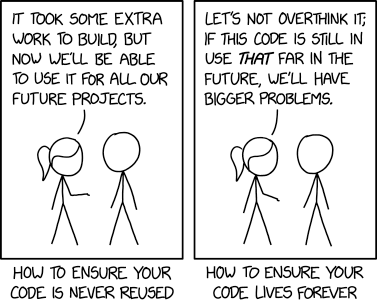 ⌘ Read more
Managing tests (breaking them, fixing them) in my map for code: https://merveilles.town/@akkartik/109742488349122478
It seems like https://proxy.vulpes.one/ runs a code that once was written by @prologic@twtxt.net. Its rendering looks quite nice. Sadly, I am unable to compile it (modified code at https://git.vulpes.one/gopherproxy/).
A map for code: https://merveilles.town/@akkartik/109656512985323270
An interesting read about testing code using nullable states instead of mocks.
https://www.jamesshore.com/v2/projects/testing-without-mocks/testing-without-mocks
The first 90 percent of the code accounts for the first 90 percent of the development time. The remaining 10 percent of the code accounts for the other 90 percent of the development time. Zeno’s Paradox and Why Modern Technology is Rubbish – Terence Eden’s Blog
ChatGPT is good, but it’s not that good 🤣 I asked it to write a program in Go that performs double ratcheting and well the code is total garbage 😅 – Its only as good as the inputs it was trained on 🤣 #OpenAI #GPT3
performed qiudanz tag on the Hybrid Live Coding Interfaces Workshop 2022 | https://compudanzas.net/qiudanz_tag.html
wrote guiding notes for the qiudanz tag exploration that we will be showcasing on the Hybrid Live Coding Interfaces 2022 workshop. | https://compudanzas.net/qiudanz_tag.html
For some people they are just fun. Others can’t handle it. They go nuts. 2022-11-29T19:42:33-06:00 I prefer to spend my time writing code for only a few gopher users. No time for conspiracies.
↳
In-reply-to
»
git-bug
⤋ Read More
Ah git-bug! Ive chatted with the creator when he was working on the graphql parts. Its working with git objects directly sorta like how git-repo does code reviews. Its a pretty neat idea for storing data along side the branches. I believe they don’t add a disconnected branch to avoid data getting corrupted by merging branches or something like that.
↳
In-reply-to
»
Great, last system update broke something, building from current master I get:
⤋ Read More
@prologic@twtxt.net Alright, there’s some erroneous markdown parsing going on, I reckon. In my original twt I have a code block surrounded by three backticks. The code block itself contains a single backtick. However, at least for rendering, yarnd shows three backticks instead (not sure if my markdown is invalid, though):

accepted in the Hybrid Live Coding Interfaces 2022 workshop with our qiudanz technique proposal | https://compudanzas.net/qiudanz_devlog.html
Trying to figure out what sql query maddy does to change user passwords, but first, i’m looking for the subcommand that actually does that… on the source code
Parece que sí funciona 😀
Por ahora está con un valor hard-coded. Me falta implementar alguna función (Quizás con JS o alguna selección manual) para poder cambiar la zona, si viajas.
I was just reminded of this interpreter for an APL/J-like language by Arthur Whitney, the absolute weirdest bit of C code I’ve actually gotten something out of, and thought I’d share: https://code.jsoftware.com/wiki/Essays/Incunabulum
Live-coding using LÖVE: https://spectra.video/w/wkDB5fsjBNBbsqKXGhGzwT (video; 5 minutes)
📣 NEW: Announcing the new and improved Yarns search engine and crawler! search.twtxt.net – Example search for “Hello World” Enjoy! 🤗 – @darch@neotxt.dk When you have this, this is what we need to work on in terms of improving the UI/UX. As a first step you should probably try to apply the same SimpleCSS to this codebase and go from there. – In the end (didn’t happen yet, time/effort) most of the code here in yarns will get reused directly into yarnd, except that I’ll use the bluge indexer instead.
applied to the Hybrid Live Coding Interfaces 2022 workshop | https://compudanzas.net/qiudanz_devlog.html
just wrote a note in my code float* output; /* to write output to physical device, or just the next lower device in the abstraction tower */ feeling pretty proud of that LoL #coding #klebe
just wrote a note in my code float* output; /* to write output to physical device, or just the next lower device in the abstraction tower */ feeling pretty proud of that LoL #coding #klebe
HM [02;04;06]: 13 mile run: 13.21 miles, 00:11:02 average pace, 02:25:47 duration
felt great minus high alert for code brown since miles 7 to 11.
last run of the training block!
#running
sound-only tetris: chords and layered timbres come to mind, might yield pretty interesting tunes :)) #halfbaked #videogame #sound #coding #nyx #klebe
sound-only tetris: chords and layered timbres come to mind, might yield pretty interesting tunes :)) #halfbaked #videogame #sound #coding #nyx #klebe
sound-only pong: pitch, panning and volume should be enough #halfbaked #videogame #sound #coding #nyx #klebe
sound-only pong: pitch, panning and volume should be enough #halfbaked #videogame #sound #coding #nyx #klebe
↳
In-reply-to
»
Today I found that Solarpunk is a thing:
https://www.wikiwand.com/en/Solarpunk
⤋ Read More
@abucci@anthony.buc.ci Its not better than a Cat5e. I have had two versions of the device. The old ones were only 200Mbps i didn’t have the MAC issue but its like using an old 10baseT. The newer model can support 1Gbps on each port for a total bandwidth of 2Gbps.. i typically would see 400-500Mbps from my Wifi6 router. I am not sure if it was some type of internal timeout or being confused by switching between different wifi access points and seeing the mac on different sides.
Right now I have my wifi connected directly with a cat6e this gets me just under my providers 1.3G downlink. the only thing faster is plugging in directly.
MoCA is a good option, they have 2.5G models in the same price range as the 1G Powerline models BUT, only if you have the coax in wall already.. which puts you in the same spot if you don’t. You are for sure going to have an outlet in every room of the house by code.
started writing a small crawler to find keywords and mentions, should now be able to see if you’re mentioning me :)) #twtxt #community #coding
started writing a small crawler to find keywords and mentions, should now be able to see if you’re mentioning me :)) #twtxt #community #coding
My entry for Wheel Reinvention Jam: rethinking debug by print, and therefore source code. https://handmade.network/p/283/bifold-text
↳
In-reply-to
»
Progress! so i have moved into working on aggregates. Which are a grouping of events that replayed on an object set the current state of the object. I came up with this little bit of generic wonder.
⤋ Read More
(cont.)
Just to give some context on some of the components around the code structure.. I wrote this up around an earlier version of aggregate code. This generic bit simplifies things by removing the need of the Crud functions for each aggregate.
Domain ObjectsA domain object can be used as an aggregate by adding the event.AggregateRoot struct and finish implementing event.Aggregate. The AggregateRoot implements logic for adding events after they are either Raised by a command or Appended by the eventstore Load or service ApplyFn methods. It also tracks the uncommitted events that are saved using the eventstore Save method.
type User struct {
  Identity string ```json:"identity"`

  CreatedAt time.Time

  event.AggregateRoot
}

// StreamID for the aggregate when stored or loaded from ES.
func (a *User) StreamID() string {
	return "user-" + a.Identity
}
// ApplyEvent to the aggregate state.
func (a *User) ApplyEvent(lis ...event.Event) {
	for _, e := range lis {
		switch e := e.(type) {
		case *UserCreated:
			a.Identity = e.Identity
			a.CreatedAt = e.EventMeta().CreatedDate
        /* ... */
		}
	}
}
Events are applied to the aggregate. They are defined by adding the event.Meta and implementing the getter/setters for event.Event
type UserCreated struct {
	eventMeta event.Meta

	Identity string
}

func (c *UserCreated) EventMeta() (m event.Meta) {
	if c != nil {
		m = c.eventMeta
	}
	return m
}
func (c *UserCreated) SetEventMeta(m event.Meta) {
	if c != nil {
		c.eventMeta = m
	}
}
With a domain object that implements the event.Aggregate the event store client can load events and apply them using the Load(ctx, agg) method.
// GetUser populates an user from event store.
func (rw *User) GetUser(ctx context.Context, userID string) (*domain.User, error) {
	user := &domain.User{Identity: userID}

	err := rw.es.Load(ctx, user)
	if err != nil {
		if err != nil {
			if errors.Is(err, eventstore.ErrStreamNotFound) {
				return user, ErrNotFound
			}
			return user, err
		}
		return nil, err
	}
	return user, err
}
An OnX command will validate the state of the domain object can have the command performed on it. If it can be applied it raises the event using event.Raise() Otherwise it returns an error.
// OnCreate raises an UserCreated event to create the user.
// Note: The handler will check that the user does not already exsist.
func (a *User) OnCreate(identity string) error {
    event.Raise(a, &UserCreated{Identity: identity})
    return nil
}

// OnScored will attempt to score a task.
// If the task is not in a Created state it will fail.
func (a *Task) OnScored(taskID string, score int64, attributes Attributes) error {
	if a.State != TaskStateCreated {
		return fmt.Errorf("task expected created, got %s", a.State)
	}
	event.Raise(a, &TaskScored{TaskID: taskID, Attributes: attributes, Score: score})
	return nil
}
The following functions in the aggregate service can be used to perform creation and updating of aggregates. The Update function will ensure the aggregate exists, where the Create is intended for non-existent aggregates. These can probably be combined into one function.
// Create is used when the stream does not yet exist.
func (rw *User) Create(
  ctx context.Context,
  identity string,
  fn func(*domain.User) error,
) (*domain.User, error) {
	session, err := rw.GetUser(ctx, identity)
	if err != nil && !errors.Is(err, ErrNotFound) {
		return nil, err
	}

	if err = fn(session); err != nil {
		return nil, err
	}

	_, err = rw.es.Save(ctx, session)

	return session, err
}

// Update is used when the stream already exists.
func (rw *User) Update(
  ctx context.Context,
  identity string,
  fn func(*domain.User) error,
) (*domain.User, error) {
	session, err := rw.GetUser(ctx, identity)
	if err != nil {
		return nil, err
	}

	if err = fn(session); err != nil {
		return nil, err
	}

	_, err = rw.es.Save(ctx, session)
	return session, err
}
↳
In-reply-to
»
I did a take home software engineering test for a company recently, unfortunately I was really sick (have finally recovered) at the time 😢 I was also at the same time interviewing for an SRE position (as well as Software Engineering).
⤋ Read More
@prologic@twtxt.net Error handling especially in Go is very tricky I think. Even though the idea is simple, it’s fairly hard to actually implement and use in a meaningful way in my opinion. All this error wrapping or the lack of it and checking whether some specific error occurred is a mess. errors.As(…) just doesn’t feel natural. errors.Is(…) only just. I mainly avoided it. Yesterday evening I actually researched a bit about that and found this article on errors with Go 1.13. It shed a little bit of light, but I still have a long way to go, I reckon.
We tried several things but haven’t found the holy grail. Currently, we have a mix of different styles, but nothing feels really right. And having plenty of different approaches also doesn’t help, that’s right. I agree, error messages often end up getting wrapped way too much with useless information. We haven’t found a solution yet. We just noticed that it kind of depends on the exact circumstances, sometimes the caller should add more information, sometimes it’s better if the callee already includes what it was supposed to do.
To experiment and get a feel for yesterday’s research results I tried myself on the combined log parser and how to signal three different errors. I’m not happy with it. Any feedback is highly appreciated. The idea is to let the caller check (not implemented yet) whether a specific error occurred. That means I have to define some dedicated errors upfront (ErrInvalidFormat, ErrInvalidStatusCode, ErrInvalidSentBytes) that can be used in the err == ErrInvalidFormat or probably more correct errors.Is(err, ErrInvalidFormat) check at the caller.
All three errors define separate error categories and are created using errors.New(…). But for the invalid status code and invalid sent bytes cases I want to include more detail, the actual invalid number that is. Since these errors are already predefined, I cannot add this dynamic information to them. So I would need to wrap them à la fmt.Errorf("invalid sent bytes '%s': %w", sentBytes, ErrInvalidSentBytes"). Yet, the ErrInvalidSentBytes is wrapped and can be asserted later on using errors.Is(err, ErrInvalidSentBytes), but the big problem is that the message is repeated. I don’t want that!
Having a Python and Java background, exception hierarchies are a well understood concept I’m trying to use here. While typing this long message it occurs to me that this is probably the issue here. Anyways, I thought, I just create a ParseError type, that can hold a custom message and some causing error (one of the three ErrInvalid* above). The custom message is then returned at Error() and the wrapped cause will be matched in Is(…). I then just return a ParseError{fmt.Sprintf("invalid sent bytes '%s'", sentBytes), ErrInvalidSentBytes}, but that looks super weird.
I probably need to scrap the “parent error” ParseError and make all three “suberrors” three dedicated error types implementing Error() string methods where I create a useful error messages. Then the caller probably could just errors.Is(err, InvalidSentBytesError{}). But creating an instance of the InvalidSentBytesError type only to check for such an error category just does feel wrong to me. However, it might be the way to do this. I don’t know. To be tried. Opinions, anyone? Implementing a whole new type is some effort, that I want to avoid.
Alternatively just one ParseError containing an error kind enumeration for InvalidFormat and friends could be used. Also seen that pattern before. But that would then require the much more verbose var parseError ParseError; if errors.As(err, &parseError) && parseError.Kind == InvalidSentBytes { … } or something like that. Far from elegant in my eyes.
I did a take home software engineering test for a company recently, unfortunately I was really sick (have finally recovered) at the time 😢 I was also at the same time interviewing for an SRE position (as well as Software Engineering).
Got the results of my take-home today and whilst there was some good feedback, man the criticisms of my work were harsh. I’m strictly not allowed to share the work I did for this take-home test, and I really can only agree with the “no unit tests” piece of the feedback, I could have done better there, but I was time pressured, sick and ran out of steam. I was using a lot of libraires to do the work so in the end found it difficult to actually think about a proper set of “Unit Tests”. I did write one (in shell) but I guess it wasn’t seen?
The other points were on my report and future work. Not detailed enough I guess? Hmmm 🤔
Am I really this bad? Does my code suck? 🤔 Have I completely lost touch with software engineering? 🤦♂️
in the [[gameoflife]] there are 8 cells around each cell, that can be 0 or 1. Make #sound with that. #8bit or even #1bit with bitscan. Maybe on #uxn . #halfbaked #coding #cellularautomata
in the [[gameoflife]] there are 8 cells around each cell, that can be 0 or 1. Make #sound with that. #8bit or even #1bit with bitscan. Maybe on #uxn . #halfbaked #coding #cellularautomata