↳
In-reply-to
»
Have finally put together the beginnings of a site for Mu (µ) https://mu-lang.odev 🤞 #mu #mu-lang
⤋ Read More
@prologic@twtxt.net broken link. Correct one is: https://mu-lang.dev/
Have finally put together the beginnings of a site for Mu (µ) https://mu-lang.dev 🤞 #mu #mu-lang
Fark me OS Dev is hard 🤣
Solo tú y yo, por siempre
/https://baldo.cat/media/photos/IMG_7130.jpeg) #catsoftwtxt
#catsoftwtxt
/https://baldo.cat/media/photos/IMG_6983.jpeg)
Bitcoin had a lot of potential, but It won’t fulfill it’s purpose because the Devs are little girls who are afraid of The state. in fact, The coin is going to become The state’s coin, The more effecient The state is The more valuable is it’s coin, Therefor The freedom you’ve hoped for was murdered becuase you’ve abandoned The project in it’s first steps, satoshi.
CatGPT
/https://baldo.cat/media/photos/IMG_6793.jpeg) #catsoftwtxt
#catsoftwtxt
/https://baldo.cat/media/photos/IMG_6779.jpeg)
↳
In-reply-to
»
Hmmm 🧐 I'm annectodaly not convinced so-called "AI"(s) really save time™. -- I have no proof though, I would need to do some concrete studies / numbers... -- But, there is one benefit... It can save you from typing and from worsening RSI / Carpal Tunnel.
⤋ Read More
@prologic@twtxt.net AI is slot machines for coders:
- “Before starting tasks, developers forecast that allowing AI will reduce completion time by 24%. After completing the study, developers estimate that allowing AI reduced completion time by 20%. Surprisingly, we find that allowing AI actually increases completion time by 19%–AI tooling slowed developers down.” https://metr.org/blog/2025-07-10-early-2025-ai-experienced-os-dev-study/
- “Stack Overflow data reveals the hidden productivity tax of ‘almost right’ AI code”: https://venturebeat.com/ai/stack-overflow-data-reveals-the-hidden-productivity-tax-of-almost-right-ai-code
The same intermittent reward operant conditioning that gets people addicted to gambling and thinking that if they follow certain rituals they’ll win “next time” drives people’s beliefs that AI tools are making them more productive when they’re making them less productive. I’m going to guess that a side effect of this is that people think they’re typing less when in the longer term they’re typing the same amount or more when you factor in the productivity loss (as far as I’ve read the studies don’t measure this so I’m only guessing).
People are also being rapidly de-skilled by this technology: the more they use it, the more their actual skills atrophy. “Continuous exposure to AI might reduce the ADR (adesoma detection rate) of standard non-AI assisted colonoscopy, suggesting a negative effect on endoscopist behaviour.” (science speak for saying that radiologists get worse at seeing tumors in scans once they’ve used AI): https://www.thelancet.com/journals/langas/article/PIIS2468-1253(25)00133-5/abstract
Nobody who cares about the future should be using this stuff for anything.
↳
In-reply-to
»
Bye bye PayPal 👋 Hello LibrePay 👋
⤋ Read More
@bender@twtxt.net Just a donations thiny I knew about from years ago that I never setup properly. Now an acceptable form of donation on my prologic.dev site 👌 (if anyone ever does that is!)
yakumo.dev is finally done for, November 26, 2025 in UTC time.
So long… I won’t be missing it though
↳
In-reply-to
»
Which actively maintained Yarn/twtxt clients are there at the moment? Client authors raise your hands! 🙋
⤋ Read More
Hm, so regarding the hash change:
https://git.mills.io/yarnsocial/twtxt.dev/pulls/28
How about 2026-03-01 00:00:00 UTC as the cut-off date? 🤔
First Dates: Baldo. 2 años. «Ronronea conmigo durante toda la noche.»
/https://baldo.cat/media/photos/1124A147-0140-4BCB-B764-12FCDE93E535.jpeg) #catsoftwtxt
#catsoftwtxt
All my newly added test cases failed, that movq thankfully provided in https://git.mills.io/yarnsocial/twtxt.dev/pulls/28#issuecomment-20801 for the draft of the twt hash v2 extension. The first error was easy to see in the diff. The hashes were way too long. You’ve already guessed it, I had cut the hash from the twelfth character towards the end instead of taking the first twelve characters: hash[12:] instead of hash[:12].
After fixing this rookie mistake, the tests still all failed. Hmmm. Did I still cut the wrong twelve characters? :-? I even checked the Go reference implementation in the document itself. But it read basically the same as mine. Strange, what the heck is going on here?
Turns out that my vim replacements to transform the Python code into Go code butchered all the URLs. ;-) The order of operations matters. I first replaced the equals with colons for the subtest struct fields and then wanted to transform the RFC 3339 timestamp strings to time.Date(…) calls. So, I replaced the colons in the time with commas and spaces. Hence, my URLs then also all read https, //example.com/twtxt.txt.
But that was it. All test green. \o/
Diferencia entre gato poralizado y no polarizado
/https://baldo.cat/media/photos/IMG_6629.jpeg) #catsoftwtxt
#catsoftwtxt
↳
In-reply-to
»
New beginnings, new horizons. New pod logo 🤟 Media
⤋ Read More
@prologic@twtxt.net this one? https://twtxt.dev/assets/img/twtxt-logo.svg Other than being “circlish” I don’t see any relationship. 😅
↳
In-reply-to
»
New beginnings, new horizons. New pod logo 🤟 Media
⤋ Read More
@prologic@twtxt.net I prefer something like the logo on https://twtxt.dev, for example, instead. But hey, it is your pod, have fun!
-Yo no estoy en peligro, Skyler. Yo soy el peligro. Un sanguinario depredador se abalanza sobre un lindo minino, ¿y tú crees que ese soy yo? No. ¡Yo soy el que salta!-
/https://baldo.cat/media/photos/IMG_6519.jpeg) #catsoftwtxt
#catsoftwtxt
Soñando que vence a Scar
/https://baldo.cat/media/photos/IMG_6469.jpeg) #catsoftwtxt
#catsoftwtxt
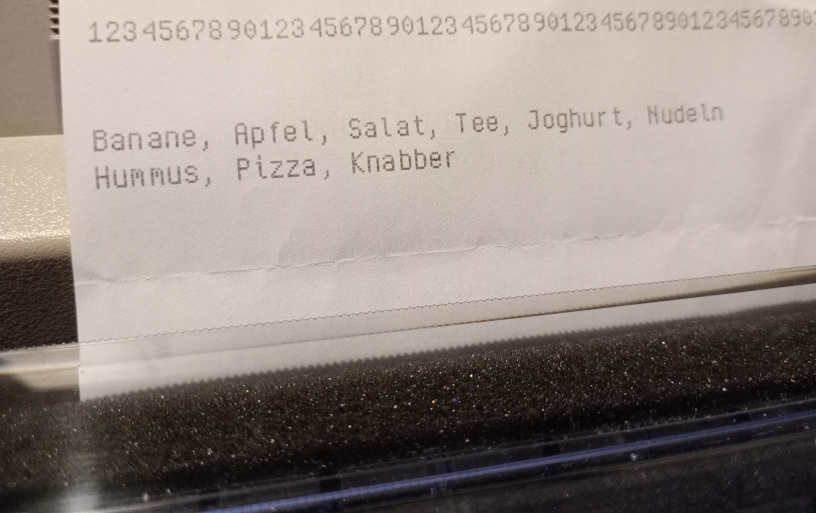
Android shopping list apps disappointed me too many times, so I went back to writing these lists by hand a while ago.
Here’s what’s more fun: Write them in Vim and then print them on the dotmatrix printer. 🥳
And, because I can, I use my own font for that, i.e. ImageMagick renders an image file and then a little tool converts that to ESC/P so I can dump it to /dev/usb/lp0.
(I have so much scrap paper from mail spam lying around that I don’t feel too bad about this. All these sheets would go straight to the bin otherwise.)
↳
In-reply-to
»
is there an etiquette to twtxt'ing? am i flooding?
⤋ Read More
Oh, and I forgot (because I thought it was obvious, my bad), set a nick, and a url at the very minimum on your feed. See “Metadata Extension”.
↳
In-reply-to
»
is there an etiquette to twtxt'ing? am i flooding?
⤋ Read More
@threatcat@tilde.club unwritten etiquette (by me, and for me, but one can hope, right?).
- Proper grammar (in any language).
- Correct capitalisation, and punctuation.
- Subject extension support.
Anything else doesn’t matter. ☺️
PR to clean up some unwanted specs and cleanup some invalid/bad references. 🙏
/https://baldo.cat/media/photos/IMG_6356.jpeg)

-¿Y… sueles acurrucarte mucho por aquí?-
/https://baldo.cat/media/photos/IMG_6259.jpeg) #catsoftwtxt
#catsoftwtxt
Disfraz de Halloween 🎃 : ojos flotantes
/https://baldo.cat/media/photos/IMG_6287.jpeg) #catsoftwtxt
#catsoftwtxt
¡Feliz Halloween 🎃 🧛!
/https://baldo.cat/media/photos/IMG_5964.jpeg) #catsoftwtxt
#catsoftwtxt
Nuevo Post: https://dev1ls.deno.dev/yggdrasil-la-red-mesh-ipv6-descentralizada #NixOS #ipv6 #yggdrasil #Dev
GTK2 about to be removed from the official Arch repos: https://lists.archlinux.org/archives/list/arch-dev-public@lists.archlinux.org/thread/2BDHYLEFSYQBDTMUOZT5J6AFTA5M3FO6/
It’ll probably all be dropped to the AUR, so I can build this myself, because I still have some stuff that depends on it (and will never receive further updates).
↳
In-reply-to
»
Der ganze Vorgang ist archetypisch für die seit Jahrzehnten völlig ohne Not stattfindende politische Selbstverzwergung Europas.
⤋ Read More
@movq@www.uninformativ.de My impression also is that good sysadmins are missing. No wonder if they all get laid off because they’re “not doing anything” and developers can just operate their shit themselves. Or so the bosses and plenty devs think. Sadly, that’s the general view.
Hell no, devops is bullshit in my opinion. Most developers (including myself) are rather bad at administrating. A good sysadmin offers other skills. Great admins appear to just sit around, but they’re much more proactively working than programmers who also operate the same stuff. The latter have a waaay more reactive work model in comparison. When things have already gone south. The sysadmin, on the other hand, would have noticed and thus prevented the vast majority very early on when it was far from becoming a problem in the future.
At least that’s my personal experience in all those years in different projects and what my mates tell me from their companies. Sure, skills can be learned, but it’s just not happening (enough). And obviously, there are people out there who excel in both disciplines, but they are rare. Most fall in one of the categories. Not to forget, plenty are just bad at everything. :-)
mask : gemi.dev get attack,errors or maintenance!?? huuft.. now can’t open waffle news and chilli weather ð mybe must build backup data on other host or do other option to get solutions…
↳
In-reply-to
»
The original twt is unavailable. It may have been edited or deleted, or is from an unknown or muted feed.
⤋ Read More
@important_dev_news@n8n.andros.dev Fuxk me decision makers are fuxking stupid sometimes 🤣
Color negro brillante e irresistible.
/https://baldo.cat/media/photos/IMG_5888.jpeg) #catsoftwtxt
#catsoftwtxt
↳
In-reply-to
»
The original twt is unavailable. It may have been edited or deleted, or is from an unknown or muted feed.
⤋ Read More
@important_dev_news@n8n.andros.dev Thank fuxk 🤣
- ¿Te gusta el nuevo pienso? Es bajo en calorías. -
/https://baldo.cat/media/photos/IMG_5864.jpeg) #catsoftwtxt
#catsoftwtxt
↳
In-reply-to
»
@zvava the second format (the one you think should be changed to), is it backwards compatible to what's currently in place? I believe the first one would be.
⤋ Read More
@bender@twtxt.net The first format use the subject extension while the other is a new format that is inspired by mentions format, the first one should be compatible but I’m not sure, if it’s used verbatim by the client it would work, but if we consider the new proposal for it to have an optional part it wont work on clients without changes.
↳
In-reply-to
»
@bender Really? 🤔
⤋ Read More
@zvava@twtxt.net Going to have to hard disagree here I’m sorry. a) no-one reads the raw/plain twtxt.txt files, the only time you do is to debug something, or have a stick beak at the comments which most clients will strip out and ignore and b) I’m sorry you’ve completely lost me! I’m old enough to pre-date before Linux became popular, so I’m not sure what UNIX principles you think are being broken or violated by having a Twt Subject (Subject) whose contents is a cryptographic content-addressable hash of the “thing”™ you’re replying to and forming a chain of other replies (a thread).
I’m sorry, but the simplest thing to do is to make the smallest number of changes to the Spec as possible and all agree on a “Magic Date” for which our clients use the modified function(s).
↳
In-reply-to
»
Did something bad happen in the world today? 🧐
⤋ Read More
@prologic@twtxt.net thanks, I already follow @important_dev_news@n8n.andros.dev too.
BTW, the feed on https://feeds.twtxt.net/ seem down? It says it’s in maintenance.
↳
In-reply-to
»
@zvava which Texodus feed? That I know of, there is only one, or am I wrong?
⤋ Read More
@bender@twtxt.net https://andros.dev/texudus.txt, its url doesn’t correspond to the feed either
↳
In-reply-to
»
is there consensus on what characters should(n't) be allowed in
⤋ Read More
nicks? i remember reading somewhere whitespace should not be allowed, but i don't see it in the spec on twtxt.dev — in fact, are there any other resources on twtxt extensions outside of twtxt.dev?
@zvava@twtxt.net @movq@www.uninformativ.de I’m not entirely sure about the spaces, but maybe they were omitted to simplify parsing of mentions in the form of @<nick url>. If the next token after the @<nick does not look like a URL, it’s not a mention but regular text. This is just wild guessing, though.
Looking at the regex and tests in the original twtxt reference implementation seems to confirm that theory in the sense as it relies on whitespace as the delimiter:

Another thing about nicks is that the original twtxt reference implementation converts nicks to all lowercase:

You probably know this already, the original twtxt file format specification can be found here: https://twtxt.readthedocs.io/en/latest/user/twtxtfile.html
As for extensions, I don’t know of anything outside of twtxt.dev that has actually been (partially) implemented. However, there is also the issue tracker of the official reference implementation. You might wanna dig through that. For example, there is an alternative suggestions of multiline messages: https://github.com/buckket/twtxt/issues/157
↳
In-reply-to
»
is there consensus on what characters should(n't) be allowed in
⤋ Read More
nicks? i remember reading somewhere whitespace should not be allowed, but i don't see it in the spec on twtxt.dev — in fact, are there any other resources on twtxt extensions outside of twtxt.dev?
@zvava@twtxt.net Good question. This is the spec, I think:
https://twtxt.dev/exts/metadata.html#nick
It doesn’t say much. 🤔
In the wild, I’ve only seen “traditional” nick names, i.e. ASCII 0x21 thru 0x7E.
My client removes anything but r'[a-zA-Z0-9]' from nick names.
is there consensus on what characters should(n’t) be allowed in nicks? i remember reading somewhere whitespace should not be allowed, but i don’t see it in the spec on twtxt.dev — in fact, are there any other resources on twtxt extensions outside of twtxt.dev?
↳
In-reply-to
»
@zvava love the direction this is heading, hope this soon evolves into a basic Android app, usable with any instance.
⤋ Read More
@thecanine@twtxt.net Id like that too, it just can’t come from me, because native mobile dev just isn’t my thing 😢
↳
In-reply-to
»
ok so i have found a genuine twt hash collision. what do i do.
⤋ Read More
@zvava@twtxt.net Herw you go: https://git.mills.io/yarnsocial/twtxt.dev/pulls/28
Dear dev.alessandrocutolo.it, do you really need to fetch my twtxt feed every 20-30 seconds? 😅 Not that it’s posing a problem, but I feel like this could be optimized. For example, how about using the if-modified-since request header: https://developer.mozilla.org/en-US/docs/Web/HTTP/Reference/Headers/If-Modified-Since
↳
In-reply-to
»
The original twt is unavailable. It may have been edited or deleted, or is from an unknown or muted feed.
⤋ Read More
@important_dev_news@n8n.andros.dev This feels like a decision that punishes Mozilla and Apple, way more than it punishes Google.
↳
In-reply-to
»
@prologic @movq My metadata only has my HTTPS URL. I didn't consider having multiple. I was talking about my config.yaml. Jenny sounds like a good client, so I might give that a try.
⤋ Read More
@dce@hashnix.club No worries 😌 It’s all documented in our soecs, it’s not such a common thing that we’ve felt the great need to really solve, we’re aware folks want to sometimes have their feed on several protocols, and that’s totally fine™ 😅
↳
In-reply-to
»
@prologic slightly off topic, what's the URL for the feed you replied to? I must have muted it. 😅
⤋ Read More
@bender@twtxt.net This one: https://n8n.andros.dev/webhook/f0cfd6a6-60c8-4183-a26d-120bbd25a046
Evitando que mi humano trabaje para darme mimitos.
/https://baldo.cat/media/photos/IMG_4889.jpeg) #catsoftwtxt
#catsoftwtxt