I played with nlpodyssey/verbaflow: Neural Language Model for Go today a little bit today…. First I had to download a ~2GB file (the model), then convert that to a format the program verbaflow understands which came out to roughly ~5GB. Then I tried some of the samples in the README. My god, this this is so goddamn awfully slow its like watching paint dry 😱 All just to predict the next few tokens?! 😳 I had a look at the resource utilisation as well as it was trying to do this “work”, using 100% of 1.5 Cores and ~10GB of Memory 😳 Who da fuq actually thinks any of this large language model (LLM) and neural network crap is actually any good or useful? 🤔 Its just garbage 🤣
New repository: aquilax/calendars - Go packages for working with different calendars
well, public transport got delayed so i guess a late night walk is gonna make up for it. gonna go back this weekend to savor the main dish i ordered
↳
In-reply-to
»
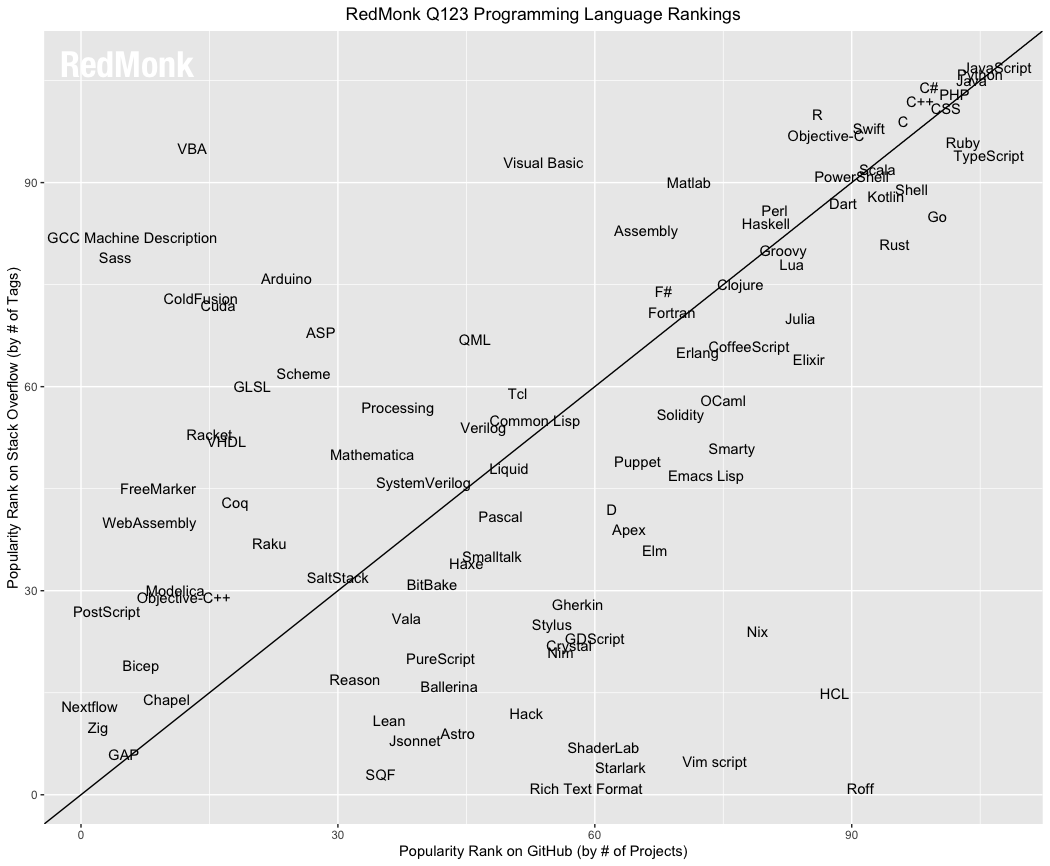
According to the RedMonk programming language rankings from Jan 2023, Go and Scala are tied at 14th place 😏
⤋ Read More
@prologic@twtxt.net I should have posted the more recent one from May, but the rankings are still pretty similar and Go and scala are tied still!
According to the RedMonk programming language rankings from Jan 2023, Go and Scala are tied at 14th place 😏
1 JavaScript
2 Python
3 Java
4 PHP
5 C#
6 CSS
7 TypeScript
7 C++
9 Ruby
10 C
11 Swift
12 Shell
12 R
14 Go
14 Scala
16 Objective-C
17 Kotlin
18 PowerShell
19 Rust
19 Dart
↳
In-reply-to
»
My desktop computer developed a really annoying vibration-induced buzzing sound a few months ago after I added some hard drives to it. It was one of these where it'd be more or less quiet, and then all of a sudden a buzzing would start. If you tapped the case, it often made the buzzing stop.
⤋ Read More
@lyse@lyse.isobeef.org I knew from the get go it was going to be an annoying thing to track down, which is was, but that made it take even longer because I avoided trying.
↳
In-reply-to
»
Metaverse Could Contribute Up To 2.4% of US GDP By 2035, Study Shows
A study commissioned by Meta has found that the metaverse could contribute around 2.4% to U.S. annual GDP by 2035, equating to as much as $760 billion. Reuters reports: The concept of the metaverse includes augmented and virtual reality technologies that allow users to immerse themselves in a virtual world or overlay information digitally on ... ⌘ Read more
⤋ Read More
@shreyan@twtxt.net I agree re: AR. Vircadia is neat. I stumbled on it years ago when I randomly started wondering “wonder what’s going on with Second Life and those VR things” and started googling around.
Unfortunately, like so many metaverse efforts, it’s almost devoid of life. Interesting worlds to explore, cool tools to build your own stuff, but almost no people in it. It feels depressing, like an abandoned shopping mall.
↳
In-reply-to
»
Metaverse Could Contribute Up To 2.4% of US GDP By 2035, Study Shows
A study commissioned by Meta has found that the metaverse could contribute around 2.4% to U.S. annual GDP by 2035, equating to as much as $760 billion. Reuters reports: The concept of the metaverse includes augmented and virtual reality technologies that allow users to immerse themselves in a virtual world or overlay information digitally on ... ⌘ Read more
⤋ Read More
@prologic@twtxt.net I think those headsets were not particularly usable for things like web browsing because the resolution was too low, something like 1080p if I recall correctly. A very small screen at that resolution close to your eye is going to look grainy. You’d need 4k at least, I think, before you could realistically have text and stuff like that be zoomable and readable for low vision people. The hardware isn’t quite there yet, and the headsets that can do that kind of resolution are extremely expensive.
But yeah, even so I can imagine the metaverse wouldn’t be very helpful for low vision people as things stand today, even with higher resolution. I’ve played VR games and that was fine, but I’ve never tried to do work of any kind.
I guess where I’m coming from is that even though I’m low vision, I can work effectively on a modern OS because of the accessibility features. I also do a lot of crap like take pictures of things with my smartphone then zoom into the picture to see detail (like words on street signs) that my eyes can’t see normally. That feels very much like rudimentary augmented reality that an appropriately-designed headset could mostly automate. VR/AR/metaverse isn’t there yet, but it seems at least possible for the hardware and software to develop accessibility features that would make it workable for low vision people.
↳
In-reply-to
»
@prologic omg yes! They are both ultra-right-wing assholes! The worst of the worst! Please tell me you don't listen to these guys' brain poison?
⤋ Read More
@prologic@twtxt.net hmm, dunno about the recency of that line of thought. I suspect though that given his (recent or not) history, if someone directly asked him “do you support rape” he would not say “no”, he’d go on one of these rambling answers about property crime like he did in the video. Maybe I’m mind poisoned by being around academics my whole career, but that way of talking is how an academic gives you an answer they know will be unpopular. PhD = Piled Higher And Deeper, after all right? In other words, if he doesn’t say “no” right away, he’s saying “yes”, except with so many words there’s some uncertainty about whether he actually meant yes. And he damn well knows that, and that’s why I give him no slack.
There are people in academia who believe adult men should be able to have sex with children, legally, too. They use the same manner of talking about it that Peterson uses. We need to stop tolerating this, and draw hard red lines. No, that’s bad, no matter how many words you use to say it. No, don’t express doubts about it, because that provides justification and talking points to the people who actually carry out the acts.
↳
In-reply-to
»
I may have misspoken in my haste/anguish. I don't know of any examples of Ben Shapiro advocating rape. I do know them of Jordan Peterson. He's known for that, but I've seen it myself. So, to be clear, I don't know if Ben Shapiro is a rape apologist and have no evidence of that. Wouldn't surprise me frankly because the set of ideas he does talk about tends to include being A-OK with crimes against women, but anyway.
⤋ Read More
@xuu@txt.sour.is LOL omfg.
This is the absurd logical endpoint of free market fundamentalism. “The market will fix everything!” Including, apparently, encroaching floodwater.
I do have to say though, after spending awhile looking at houses, that there are a crapton of homes for sale for very high prices (>$1 million) in coastal areas NASA is more or less telling us will be underwater in the next few decades. I don’t get how a house that’s going to be underwater soon is worth $1 million, but then I’m never been a free market fundamentalist either so 🤷 Maybe they’re all watertight.
I wish I could turn into a bear so I could go to my cave and sleep for three months
The Lightning lost, but at least the Avalanche and Bruins lost, too. I’m going to have to root for the Florida Panthers now.
↳
In-reply-to
»
@prologic omg yes! They are both ultra-right-wing assholes! The worst of the worst! Please tell me you don't listen to these guys' brain poison?
⤋ Read More
@prologic@twtxt.net Maybe so, but that’s not because of the people who are objecting to Jordan Peterson, that’s for sure. You really need to read the articles I’ve posted before going there. Really.
↳
In-reply-to
»
@prologic omg yes! They are both ultra-right-wing assholes! The worst of the worst! Please tell me you don't listen to these guys' brain poison?
⤋ Read More
@prologic@twtxt.net Because they are rightwing assholes with a huge platform and they are literally HURTING PEOPLE. People get attacked because of things people like Shapiro and Peterson say. This is not just idle chitchat over coffee. They are saying things like it’s OK to rape women (and NO I am not going to dig out the videos where they say that –that’s up to YOU to do, do your own homework before defending these ghouls).
↳
In-reply-to
»
(2) Jordan Peterson: "Meghan Markle GRATES On Me!" - YouTube
⤋ Read More
@prologic@twtxt.net I’ve read half, skimmed the others. Mostly I was going for scale–look at all those headlines. These are horrible people who say horrible things on a regular basis.
↳
In-reply-to
»
I've seen BlueSky referred to as BS (as in Blue Sky, but you know...), which seems apt.
⤋ Read More
Do they legitimately believe that end users will encounter videos of gruesome murders, live streams of school shootings, etc etc etc, and be like “oh, tee hee hee, that’s not what I want to see! I’d better block that!” and go about their business as usual?
No, they can’t possibly be that foolish. They are going to be doing some amount of content moderation. Just not of Nazis, fascists, or far right reactionaries. Which to me means they want that content on there.
I’ve seen BlueSky referred to as BS (as in Blue Sky, but you know…), which seems apt.
CEO is a cryptocurrency fool, as is Jack Dorsey, so I don’t expect much from it. Then again I’m old and refuse to join any new hotness so take my curmudgeonly opinions with a grain of salt.
I read somewhere or another that the “decentralization” is only going to be there so that they can push content moderation onto users. They will happily welcome Nazis and fascists, leaving it up to end users to block those instances.
I wonder how they plan to handle the 4chan-level stuff, since that will surely come.
College Knowledge
 ⌘ Read more
How do I quit getting error 400 when I go to reply to anything? @prologic@twtxt.net ???
↳
In-reply-to
»
DEEPL now has a Writer https://www.deepl.com/write - very nice, fast and available in multiple languages. Write better texts, instantly.
⤋ Read More
@prologic@twtxt.net @carsten@yarn.zn80.net
There is (I assure you there will be, don’t know what it is yet…) a price to be paid for this convenience.
Exactly prologic, and that’s why I’m negative about these sorts of things. I’m almost 50, I’ve been around this tech hype cycle a bunch of times. Look at what happened with Facebook. When it first appeared, people loved it and signed up and shared incredibly detailed information about themselves on it. Facebook made it very easy and convenient for almost anyone, even people who had limited understanding of the internet or computers, to get connected with their friends and family. And now here we are today, where 80% of people in surveys say they don’t trust Facebook with their private data, where they think Facebook commits crimes and should be broken up or at least taken to task in a big way, etc etc etc. Facebook has been fined many billions of dollars and faces endless federal lawsuits in the US alone for its horrible practices. Yet Facebook is still exploitative. It’s a societal cancer.
All signs suggest this generative AI stuff is going to go exactly the same way. That is the inevitable course of these things in the present climate, because the tech sector is largely run by sociopathic billionaires, because the tech sector is not regulated in any meaningful way, and because the tech press / tech media has no scruples. Some new tech thing generates hype, people get excited and sign up to use it, then when the people who own the tech think they have a critical mass of users, they clamp everything down and start doing whatever it is they wanted to do from the start. They’ll break laws, steal your shit, cause mass suffering, who knows what. They won’t stop until they are stopped by mass protest from us, and the government action that follows.
That’s a huge price to pay for a little bit of convenience, a price we pay and continue to pay for decades. We all know better by now. Why do we keep doing this to ourselves? It doesn’t make sense. It’s insane.
↳
In-reply-to
»
Started with
Media
a concept sketch of a full body end-time factory worker on a distant planet, cyberpunk light brown suite, (badass), looking up at the viewer, 2d, line drawing, (pencil sketch:0.3), (caricature:0.2), watercolor city sketch,
Negative prompt: EasyNegativ, bad-hands-5, 3d, photo, naked, sexy, disproportionate, ugly
Steps: 20, Sampler: Euler a, CFG scale: 7, Seed: 2479087078, Face restoration: GFPGAN, Size: 512x768, Model hash: 2ee2a2bf90, Model: mimic_v10, Denoising strength: 0.7, Hires upscale: 1.5, Hires upscaler: Latent
⤋ Read More
@prologic@twtxt.net @carsten@yarn.zn80.net
(1) You go to the store and buy a microwave pizza. You go home, put it in the microwave, heat it up. Maybe it’s not quite the way you like it, so you put some red pepper on it, maybe some oregano.
Are you a pizza chef? No. Do we know what your cooking is like? Also no.
(2) You create a prompt for StableDiffusion to make a picture of an elephant. What pops out isn’t quite to your liking. You adjust the prompt, tweak it a bunch, till the elephant looks pretty cool.
Are you an artist? No. Do we know what your art is like? Also no.
The elephant is “fake art” in a similar sense to how a microwave pizza is “fake pizza”. That’s what I meant by that word. The microwave pizza is a sort of “simulation of pizza”, in this sense. The generated elephant picture is a simulation of art, in a similar sense, though it’s even worse than that and is probably more of a simulacrum of art since you can’t “consume” an AI-generated image the way you “consume” art.
ChatGPT and Elasticsearch: OpenAI meets private data | Elastic Blog
Terrifying. Elasticsearch is celebrating that they’re going to send your private data to OpenAI? No way.
Escape Speed
 ⌘ Read more
↳
In-reply-to
»
On LinkedIn I see a lot of posts aimed at software developers along the lines of "If you're not using these AI tools (X,Y,Z) you're going to be left behind."
⤋ Read More
@prologic@twtxt.net yeah. I’d add “Big Data” to that hype list, and I’m sure there are a bunch more that I’m forgetting.
On the topic of a GPU cluster, the optimal design is going to depend a lot on what workloads you intend to run on it. The weakest link in these things is the data transfer rate, but that won’t matter too much for compute-heavy workloads. If your workloads are going to involve a lot of data, though, you’d be better off with a smaller number of high-VRAM cards than with a larger number of interconnected cards. I guess that’s hardware engineering 101 stuff, but still…
On LinkedIn I see a lot of posts aimed at software developers along the lines of “If you’re not using these AI tools (X,Y,Z) you’re going to be left behind.”
Two things about that:
- No you’re not. If you have good soft skills (good communication, show up on time, general time management) then you’re already in excellent shape. No AI can do that stuff, and for that alone no AI can replace people
- This rhetoric is coming directly from the billionaires who are laying off tech people by the 100s of thousands as part of the class war they’ve been conducting against all working people since the 1940s. They want you to believe that you have to scramble and claw over one another to learn the “AI” that they’re forcing onto the world, so that you stop honing the skills that matter (see #1) and are easier to obsolete later. Don’t fall for it. It’s far from clear how this will shake out once governments get off their asses and start regulating this stuff, by the way–most of these “AI” tools are blatantly breaking copyright and other IP laws, and some day that’ll catch up with them.
That said, it is helpful to know thy enemy.
I played around with parsers. This time I experimented with parser combinators for twt message text tokenization. Basically, extract mentions, subjects, URLs, media and regular text. It’s kinda nice, although my solution is not completely elegant, I have to say. Especially my communication protocol between different steps for intermediate results is really ugly. Not sure about performance, I reckon a hand-written state machine parser would be quite a bit faster. I need to write a second parser and then benchmark them.
lexer.go and newparser.go resemble the parser combinators: https://git.isobeef.org/lyse/tt2/-/commit/4d481acad0213771fe5804917576388f51c340c0 It’s far from finished yet.
The first attempt in parser.go doesn’t work as my backtracking is not accounted for, I noticed only later, that I have to do that. With twt message texts there is no real error in parsing. Just regular text as a “fallback”. So it works a bit differently than parsing a real language. No error reporting required, except maybe for debugging. My goal was to port my Python code as closely as possible. But then the runes in the string gave me a bit of a headache, so I thought I just build myself a nice reader abstraction. When I noticed the missing backtracking, I then decided to give parser combinators a try instead of improving on my look ahead reader. It only later occurred to me, that I could have just used a rune slice instead of a string. With that, porting the Python code should have been straightforward.
Yeah, all this doesn’t probably make sense, unless you look at the code. And even then, you have to learn the ropes a bit. Sorry for the noise. :-)
↳
In-reply-to
»
slides/go-generics.md at main - slides - Mills -- I'm presenting this tomorrow at work, something I do every Wednesday to teach colleagues about Go concepts, aptly called
⤋ Read More
go mills() 😅
@chunkimo@twtxt.net lol. go walrus!!
slides/go-generics.md at main - slides - Mills – I’m presenting this tomorrow at work, something I do every Wednesday to teach colleagues about Go concepts, aptly called go mills() 😅
Tampa Bay seems to be picking up the pace. They beat the Islanders 5-0. Go Lightning!
e-scooters go like the clappers
I wish I was somewhere I could go surfing right now.
Qualifications
 ⌘ Read more
❤️ 🎶: Time to Go by DooRi
In case you didn’t notice, I deleted my Twitter and Keybase accounts. Going full indieweb.
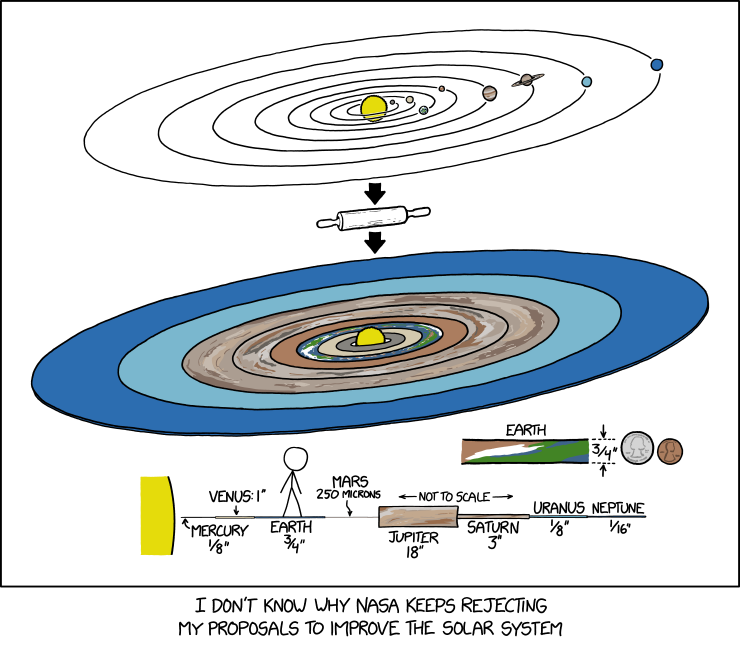
Flatten the Planets
 ⌘ Read more
Lymphocytes
 ⌘ Read more
↳
In-reply-to
»
This is the GraphQL compiler complaining right? 🤔
⤋ Read More
@prologic@twtxt.net it is from the generator. But in the actual go implementation methods are represented with a unsigned short. So 65k is the hard limit in go.
Oof.

↳
In-reply-to
»
On the topic of Programming Languages and Telemetry. I'm kind of curious... Do any of these programming language and their toolchains collect telemetry on their usage and effectively "spy" on your development?
⤋ Read More
@prologic@twtxt.net I get the worry of privacy. But I think there is some value in the data being collected. Do I think that Russ is up there scheming new ways to discover what packages you use in internal projects for targeting ads?? Probably not.
Go has always been driven by usage data. Look at modules. There was need for having repeatable builds so various package tool chains were made and evolved into what we have today. Generics took time and seeing pain points where they would provide value. They weren’t done just so it could be checked off on a box of features. Some languages seem to do that to the extreme.
Whenever changes are made to the language there are extensive searches across public modules for where the change might cause issues or could be improved with the change. The fs embed and strings.Cut come to mind.
I think its good that the language maintainers are using what metrics they have to guide where to focus time and energy. Some of the other languages could use it. So time and effort isn’t wasted in maintaining something that has little impact.
The economics of the “spying” are to improve the product and ecosystem. Is it “spying” when a municipality uses water usage metrics in neighborhoods to forecast need of new water projects? Or is it to discover your shower habits for nefarious reasons?
↳
In-reply-to
»
Any good ideas on how to maintain ~/go/pkg/mod and to remove old garbage?
⤋ Read More
@prologic@twtxt.net the rm -rf is basically what go clean -modcache does.
I think you can use another form that will remove just the deps for a specific module. go clean -r
Any good ideas on how to maintain ~/go/pkg/mod and to remove old garbage?
What’s with all these tech companies going through massive layoffs. The latest one is Intel, but instead they’re cutting salaries to avoid laying off.
❤️ 🎶: Never Let You Go (電視劇《我只喜歡你》片尾曲) by 薩吉
↳
In-reply-to
»
I've never liked the idea of having everything displayed all of the time for all of history.
⤋ Read More
@eldersnake@we.loveprivacy.club Several reasons:
- It’s another language to learn (SQL)
- It adds another dependency to your system
- It’s another failure mode (database blows up, scheme changes, indexs, etc)
- It increases security problems (now you have to worry about being SQL-safe)
And most of all, in my experience, it doesn’t actually solve any problems that a good key/value store can solve with good indexes and good data structures. I’m just no longer a fan, I used to use MySQL, SQLite, etc back in the day, these days, nope I wouldn’t even go anywhere near a database (for my own projects) if I can help it – It’s just another thing that can fail, another operational overhead.
@prologic@twtxt.net @movq@www.uninformativ.de this is the default behavior of pass on my machine:

I add a new password entry named example and then type pass example. The password I chose, “test”, is displayed in cleartext. This is very bad default behavior. I don’t know about the other clis you both mentioned but I’ll check them out.
The browser plugin browserpass does the same kind of thing, though I have already removed it and I’m not going to reinstall it to make a movie. Next to each credential there’s an icon to copy the username to the clipboard, an icon to copy the password to the clipboard, and then an icon to view details, which shows you everything, including the password, in cleartext. The screencap in the Chrome store is out of date; it doesn’t show the offending link to show all details, which I know is there because I literally installed it today and played with it.
The most secure way to access this site is to torify a gopher client and go to the onion address.
↳
In-reply-to
»
i am curious why we only get 5 twts in yarn when they have several more on the feed. so something isnt parsing right.
⤋ Read More
@mckinley@twtxt.net very weird things going on for me.. i can see your twt but its not showing up as a reply or fork? 
New repository: aquilax/with - with* helper functions for go
I bought my Galaxy Note 8 five years go today. This is by far the most use I’ve gotten out of one smartphone!