Soy el detective Baldo. Aún recuerdo cuando esa gatita salvaje entró en mi caja contoneando su cola. Le habían robado el cascabel de oro. Acepté el caso sin dudarlo, quería meter los bigotes en ese caso. Olía a pescado podrido.
/https://baldo.cat/media/photos/IMG_5286.jpeg) #catsoftwtxt
#catsoftwtxt
↳
In-reply-to
»
Speaking of manpages:
⤋ Read More
@kat@yarn.girlonthemoon.xyz On the one hand, all these programs have a very long history and the technology behind manpages is actually very powerful – you can use it to write books:
https://www.troff.org/pubs.html
I have two books from that list, for example “The UNIX programming environment”:
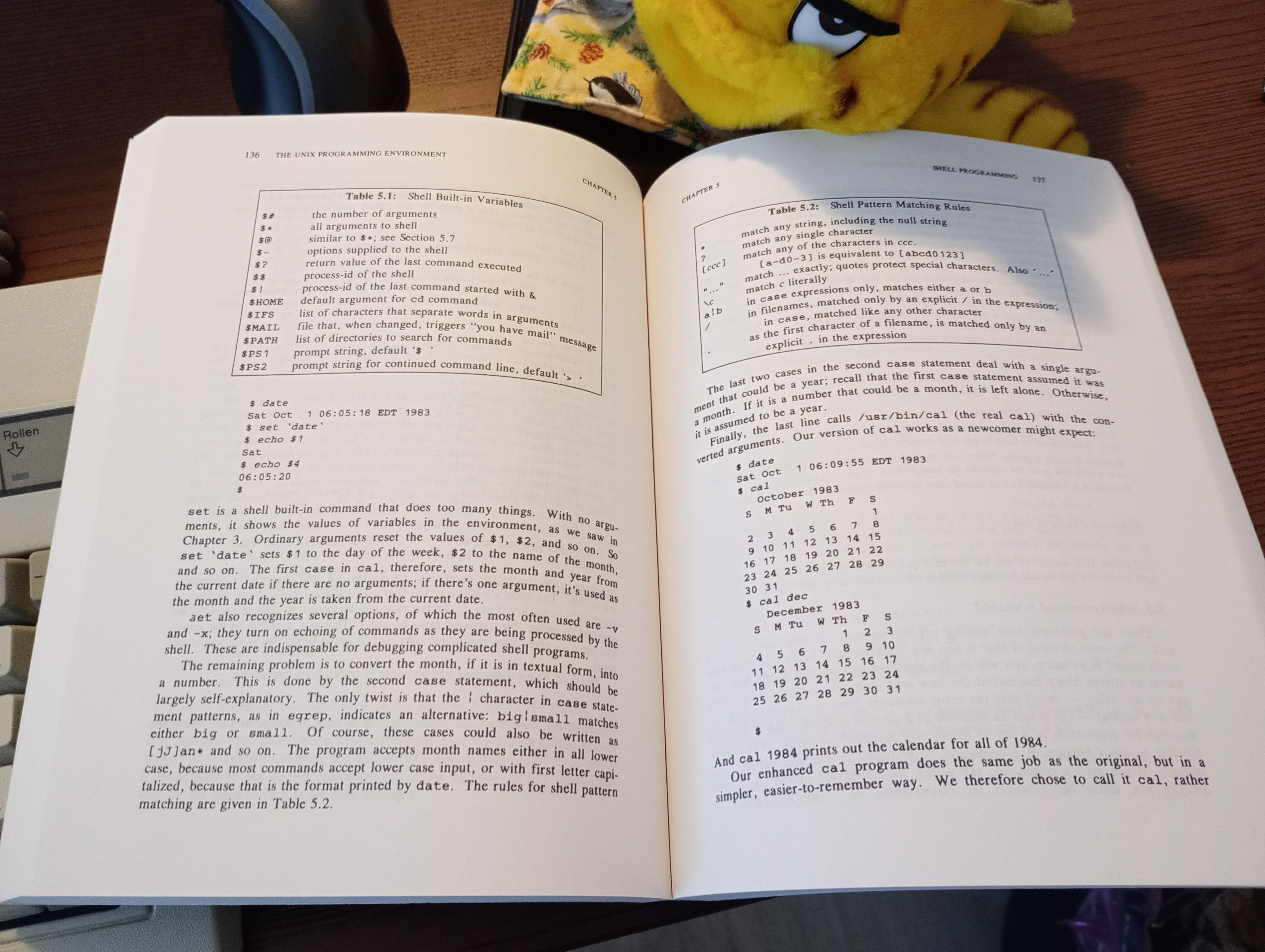
It’s a bit older, of course, but it looks and feels like a normal book, and it uses the same tech as manpages – which I think is really cool. 😎
It’s comparable to LaTeX (just harder/different to use) but much faster than LaTeX. You can also do stuff like render manpages as a PDF (man -Tpdf cp >cp.pdf) or as an HTML file (man -Thtml cp >cp.html). I think I once made slides for a talk this way.
On the other hand, traditional manpages (i.e., ones that are not written in mandoc) do not use semantic markup. They literally say, “this text is bold, that text over here is italics”, and so on.
So when you run man foo, it has no other choice but to show it in black, white, bold, underline – showing it in color would be wrong, because that’s not what the source code of that manpage says.
Colorizing them is a hack, to be honest. You’re not meant to do this. (The devs actually broke this by accident recently. They themselves aren’t really aware that people use colors.)
If mandoc and semantic markup was more commonly used, I think it would be easier to convince the devs to add proper customizable colors.
-¡Deja de estudiar y hazme caso!-
/https://baldo.cat/media/photos/IMG_5283.jpeg) #catsoftwtxt
#catsoftwtxt
i signed up for omg.lol and i’m really liking it. such a cozy and fun little community with a suite of fun web things. i wish the financial barrier to entry was a bit lower though (maybe like $5 for a few months on it or something) just so i could recommend it to my broke friends more, but i totally get why it’s priced the way it is (solo dev!!!)
In 1996, they came up with the X11 “SECURITY” extension:
https://www.reddit.com/r/linux/comments/4w548u/what_is_up_with_the_x11_security_extension/
This is what could have (eventually) solved the security issues that we’re currently seeing with X11. Those issues are cited as one of the reasons for switching to Wayland.
That extension never took off. The person on reddit wonders why – I think it’s simple: Containers and sandboxes weren’t a thing in 1996. It hardly mattered if X11 was “insecure”. If you could run an X11 client, you probably already had access to the machine and could just do all kinds of other nasty things.
Today, sandboxing is a thing. Today, this matters.
I’ve heard so many times that “X11 is beyond fixable, it’s hopeless.” I don’t believe that. I believe that these problems are solveable with X11 and some devs have said “yeah, we could have kept working on it”. It’s that people don’t want to do it:
Why not extend the X server?
Because for the first time we have a realistic chance of not having to do that.
https://wayland.freedesktop.org/faq.html
I’m not in a position to judge the devs. Maybe the X.Org code really is so bad that you want to run away, screaming in horror. I don’t know.
But all this was a choice. I don’t buy the argument that we never would have gotten rid of things like core fonts.
All the toolkits and programs had to be ported to Wayland. A huge, still unfinished effort. If that was an acceptable thing to do, then it would have been acceptable to make an “X12” that keeps all the good things about X11, remains compatible where feasible, eliminates the problems, and requires some clients to be adjusted. (You could have still made “X11X12” like “XWayland” for actual legacy programs.)
↳
In-reply-to
»
The original twt is unavailable. It may have been edited or deleted, or is from an unknown or muted feed.
⤋ Read More
@important_dev_news@n8n.andros.dev Oh gawd, is the EU doing this “age verification” bullshit too!? Not just Australia?! 🇦🇺 Farrrrk!!!!! Help!!!!
/https://baldo.cat/media/photos/IMG_5230.jpeg)
↳
In-reply-to
»
I was drafting support for showing “application icons” in my window manager, i.e. the Firefox icon in the titlebar:
⤋ Read More
@lyse@lyse.isobeef.org Oh, huh, maybe it was just my GNOME 2 themes back then that didn’t show the icon. 🤔
I like the looks of your window manager. That’s using Wayland, right?
Oh, no. It’s still X11. All my recent Wayland comments resulted from me trying to switch, but I think it’s still too early. Being unable to use QEMU (because it can’t capture the mouse pointer) is a pretty big blocker for me. This is completely broken, it just happens to be unnoticeable with modern guest OSes, so it’s probably not a priority for devs.
(Not to mention that I would have to fork and substantially extend dwl in order to “replicate” my X11 WM. And then, after having done that, I’d have to follow upstream Wayland development, for which I don’t have the resources. Things would need to slow down before I can do that.)
all that wasted space of the windows not making use of the full screen!!!1
Heh. I’ve been using tiling WMs for ~15 years now, so it’s actually kind of refreshing to see something different for a change. 😅
Probably close to the older Windowses.
That particular theme is a ripoff of OS/2 Warp 3: 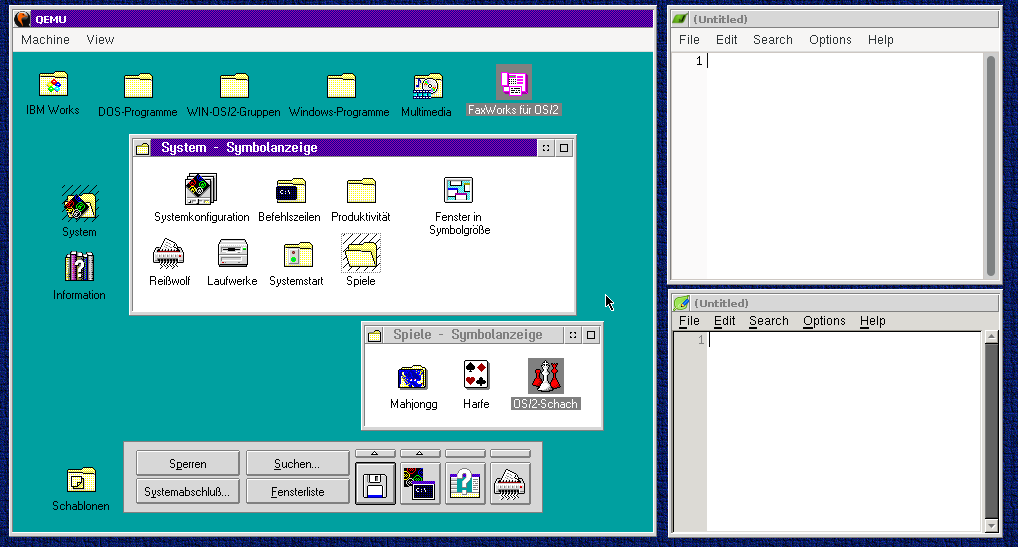 😅
😅
We ran some similar brownish color scheme (don’t recall its name) on Win95 or Win98
Oh god. Yeah, I wasn’t a fan of those, either. 🥴
Only figured this out yesterday:
pinentry, which is used to safely enter a password on Linux, has several frontends. There’s a GTK one, a Qt one, even an ncurses one, and so on.
GnuPG also uses pinentry. And you can configure your frontend of choice here in gpg-agent.conf.
But what happens when you don’t configure it? What’s the default?
Turns out, pinentry is a shellscript wrapper and it’s not even that long. Here it is in full:
#!/bin/bash

# Run user-defined and site-defined pre-exec hooks.
[[ -r "${XDG_CONFIG_HOME:-$HOME/.config}"/pinentry/preexec ]] && \
        . "${XDG_CONFIG_HOME:-$HOME/.config}"/pinentry/preexec
[[ -r /etc/pinentry/preexec ]] && . /etc/pinentry/preexec

# Guess preferred backend based on environment.
backends=(curses tty)
if [[ -n "$DISPLAY" || -n "$WAYLAND_DISPLAY" ]]; then
        case "$XDG_CURRENT_DESKTOP" in
        KDE|LXQT|LXQt)
                backends=(qt qt5 gnome3 gtk curses tty)
                ;;
        *)
                backends=(gnome3 gtk qt qt5 curses tty)
                ;;
        esac
fi

for backend in "${backends[@]}"
do
        lddout=$(ldd "/usr/bin/pinentry-$backend" 2>/dev/null) || continue
        [[ "$lddout" == *'not found'* ]] && continue
        exec "/usr/bin/pinentry-$backend" "$@"
done

exit 1
Preexec, okay, then some auto-detection to use a toolkit matching your desktop environment …
… and then it invokes ldd? To find out if all the required libraries are installed for the auto-detected frontend?
Oof. I was sitting here wondering why it would use pinentry-gtk on one machine and pinentry-gnome3 on another, when both machines had the exact same configs. Yeah, but different libraries were installed. One machine was missing gcr, which is needed for pinentry-gnome3, so that machine (and that one alone) spawned pinentry-gtk …
-Me gusta mi nueva cestita-
/https://baldo.cat/media/photos/IMG_5136.jpeg) #catsoftwtxt
#catsoftwtxt
Se ha ido la colonia que había fuera y el “jefe” que me pegaba. ¡Ya puedo subir otra vez!
/https://baldo.cat/media/photos/IMG_5067.jpeg) #catsoftwtxt
#catsoftwtxt
Yin-cat
/https://baldo.cat/media/photos/IMG_4996.jpeg) #catsoftwtxt
#catsoftwtxt
↳
In-reply-to
»
This aggressive auto-logout on my bank’s website …
⤋ Read More
@lyse@lyse.isobeef.org I do my timetracking in a little Python script, locally. Every now and then, I push the data to our actual service. Problem solved – but it’s a completely unpopular approach, they all want to use the web site. I don’t get it. Then, of course, when it’s down, shit hits the fan. (Luckily, our timetracking software is neither developed nor run by us anymore. It’s a silly cloud service, but the upside is that I’m not responsible anymore. 🤷)
Some of our oldschool devs tried to roll out local timetracking once, about 15 years ago. I don’t remember anymore why they failed …
This is developed inhouse, I’m just so glad that we’re not a software engineering company. Oh wait. How embarrassing.
Oh to be anonymous on the internet. That must be nice. 😅
Mejorando sus técnicas de camuflaje para cazar moscas
/https://baldo.cat/media/photos/IMG_4857.jpeg) #catsoftwtxt
#catsoftwtxt
Fresquito
/https://baldo.cat/media/photos/IMG_4747.jpeg) #catsoftwtxt
#catsoftwtxt
↳
In-reply-to
»
I did a “lecture”/“workshop” about this at work today. 16-bit DOS, real mode. 💾 Pretty cool and the audience (devs and sysadmins) seemed quite interested. 🥳
⤋ Read More
@movq@www.uninformativ.de Interesting internal education sessions are way too infrequent here as well. There are a bunch of “knowledge transfer” meetings actually, but 90% of the topics already sound totally boring to me. The other 9% talks turned out to be underwhelming, sadly. I only attended a single one where it was delivered what has been promised. They’re all talks, not real hands-on trainings like you did.
Once a year the security guys organize a really great hacking event, though. Teams can volunteer to hand in their software dev instances and all workmates are invited to hack them and report security vulnerabilities. That’s a lot of fun, but also gets frustrating towards the end when you don’t make any progress. :-) There’s also some actual hands-on training in advance for preparation of the two days. Unfortunately, I missed the last event due to my own project being very stressful at the time.
When I had a Do What You Want Day I also show my direct teammates what I learned in the hopes of this being interesting to them as well. I’m the only one in my team using this opportunity, sadly.
I did a “lecture”/“workshop” about this at work today. 16-bit DOS, real mode. 💾 Pretty cool and the audience (devs and sysadmins) seemed quite interested. 🥳
- People used the Intel docs to figure out the instruction encodings.
- Then they wrote a little DOS program that exits with a return code and they used uhex in DOSBox to do that. Yes, we wrote a COM file manually, no Assembler involved. (Many of them had never used DOS before.)
- DEBUG from FreeDOS was used to single-step through the program, showing what it does.
- This gets tedious rather quickly, so we switched to SVED from SvarDOS for writing the rest of the program in Assembly language. nasm worked great for us.
- At the end, we switched to BIOS calls instead of DOS syscalls to demonstrate that the same binary COM file works on another OS. Also a good opportunity to talk about bootloaders a little bit.
- (I think they even understood the basics of segmentation in the end.)
The 8086 / 16-bit real-mode DOS is a great platform to explain a lot of the fundamentals without having to deal with OS semantics or executable file formats.
Now that was a lot of fun. 🥳 It’s very rare that we do something like this, sadly. I love doing this kind of low-level stuff.
↳
In-reply-to
»
Just discovered how easy it is to recall my last arg in shell and my brain went 🤯 How come I've never learned about this before!? I wonder how many other QOL shortcuts I'm missing on 🥲
⤋ Read More
@aelaraji@aelaraji.com Oh, that’s great! I haven’t heard about any of them before either. There’s also a caveat though, that I ran right into the very first time I tried this in zsh:
$ ls > /dev/null
$ echo $_
--color=tty
Yeah, exactly what you think:
$ which ls
ls: aliased to ls --color=tty
Alt+. is going to be my favorite one! In the above, it would also give me /dev/null, which might be probably more what I would expect.
Batdo
/https://baldo.cat/media/photos/batdo.jpg) #catsoftwtxt
#catsoftwtxt
- Esta almohada me gusta. ¡Pa mi! -
/https://baldo.cat/media/photos/IMG_4714.jpeg) #catsoftwtxt
#catsoftwtxt
Las 50 sombras de Baldo
/https://baldo.cat/media/photos/IMG_4673.jpeg) #catsoftwtxt
#catsoftwtxt
↳
In-reply-to
»
2024 was okay for me, but 2025 is gonna be real shit. 😂 So much annoying stuff coming up. Gotta enjoy the moment, who knows how long it will last. 😅
⤋ Read More
@bender@twtxt.net Can’t you see this twt ??
↳
In-reply-to
»
2024 was okay for me, but 2025 is gonna be real shit. 😂 So much annoying stuff coming up. Gotta enjoy the moment, who knows how long it will last. 😅
⤋ Read More
Just as a little courtesy call (is that the right term?): 2025 continues to be annoying and exhausting, and I won’t really have the energy to work on twtxt/Yarn or texudus. Other than the occasional retrocomputing thingy (which gives a nice boost of nostalgia), I’m not doing much of anything lately.
wonger’s website https://wonger.dev/
↳
In-reply-to
»
@kat I don’t like Golang much either, but I am not a programmer. This little site, Go by example might explain a thing or two.
⤋ Read More
Ultimately, Go sits in the sweet spot on the complexity vs performance chart:
- Minimal syntax & concepts → low learning curve
- Compiled speed → high throughput
- Built-in CSP concurrency → scalable by default
See Rob Pyke’s presentation on Expressiveness of Go
↳
In-reply-to
»
@kat I don’t like Golang much either, but I am not a programmer. This little site, Go by example might explain a thing or two.
⤋ Read More
One of the nicest things about Go is the language itself, comparing Go to other popular languages in terms of the complexity to learn to be proficient in:
- Go:
25keywords (Stack Overflow); CSP-style concurrency (goroutines & channels)
- Python 2:
30keywords (TutorialsPoint); GIL-bound threads & multiprocessing (Wikipedia)
- Python 3:
35keywords (Initial Commit); GIL-bound threads,asyncio& multiprocessing (Wikipedia, DEV Community)
- Java:
50keywords (Stack Overflow); threads +java.util.concurrent(Wikipedia)
- C++:
82keywords (Stack Overflow);std::thread, atomics & futures (en.cppreference.com)
- JavaScript:
38keywords (Stack Overflow); single-threaded event loop &async/await, Web Workers (Wikipedia)
- Ruby:
42keywords (Stack Overflow); GIL-bound threads (MRI), fibers & processes (Wikipedia)
#<2025-05-10T19:34:00+00:00 https://andros.dev/texudus.txt> Nice:) And is this implemented in your client as well? I’ve started to brainstorm on how to parse texudus in php, but I guess it could snatch some code from you?
↳
In-reply-to
»
i got so emo about my site not being statically generated and instead hand coded but it's like i don't even know if i want that because i feel most SSGs are built for blogging and continuous posting and i don't want that i just want to make my silly pages....
⤋ Read More
@kat@yarn.girlonthemoon.xyz I totally recommend zs 🤣 It powers all my sites! 😅 https://twtxt.dev https://yarn.socia/ https://prologic.dev etc 😎
Fin de semana: ¡A jugar!
/https://baldo.cat/media/photos/IMG_4325.jpeg) #catsoftwtxt
#catsoftwtxt
En estos momentos, no sé si un dios le está pidiendo que libere su pueblo felino o está mirando una paloma
/https://duque-terron.cat/media/photos/IMG_4312.jpeg) #catsoftwtxt
#catsoftwtxt
↳
In-reply-to
»
grafana is confusing af i deployed it again for my job (that is so wild to say...) and i'm like HOW DO THESE ALERTS WORK
⤋ Read More
@kat@yarn.girlonthemoon.xyz Look into using something like pyrra for creating and managing SLO(s) with Prometheus 👌 I use this myself actually, plus I also use HetrixTools for external monitoring with SLO-style measures via status.mills.io 👌
↳
In-reply-to
»
@andros Thanks for consolidating a lot of good ideas. Especially how you have deiced to just extend the mention syntax for location-based treads. This might even be backward compatible with older (pre-yarn) clients.
What about using
⤋ Read More
Z for UTC +00:00- is that allowed in your specs?
Regarding url = I would suggest to only allow one and the maybe add url_old = or url_alt = !?
I'm still not a fan of a DM feature, even thou it helps that i have now been split out into a separate feed file. Instead if would suggest a contact = field for where people can put an email or other id/link for an established chat protocol like signal or matrix.
@bender@twtxt.net I think this would be a good idea as @movq@www.uninformativ.de and @andros@twtxt.andros.dev have done ✅ I may even join the experiments if I have any spare time to hack a custom yrand branch and run it up on say something like a yarnexp.mills.io or something 🤔
↳
In-reply-to
»
The original twt is unavailable. It may have been edited or deleted, or is from an unknown or muted feed.
⤋ Read More
@ You seem to be a bit ahead of your time: https://darch.dk/timeline/conv/jl2mf2a
↳
In-reply-to
»
Nobody want to be a shitty programmer. The question is: Do you do anything not to not be one?
Reading blogs or social media and watching YouTube videos is fun. After them, your code may be a little better, of course. But you need a lot. You need to study! Read good books and study the code of other programmers, for example. Maybe work with a new language, architectures and paradigms. You need break the routine.
⤋ Read More
@andros@twtxt.andros.dev@andros@twtxt.andros.dev i know MVC but i don’t know model view view model what does this mean…. i am learning PHP (and a tiny bit of perl scripting) as a mainly ruby girl so mayhaps i am improving but my focus is SERVERS
↳
In-reply-to
»
I've just released version 1.0 of twtxt.el (the Emacs client), the stable and final version with the current extensions. I'll let the community maintain it, if there are interested in using it. I will also be open to fix small bugs.
I don't know if this twt is a goodbye or a see you later. Maybe I will never come back, or maybe I will post a new twt this afternoon. But it's always important to be grateful. Thanks to @prologic @movq @eapl.me @bender @aelaraji @arne @david @lyse @doesnm @xuu @sorenpeter for everything you have taught me. I've learned a lot about #twtxt, HTTP and working in community. It has been a fantastic adventure!
What will become of me? I have created a twtxt fork called Texudus (https://texudus.readthedocs.io/). I want to continue learning on my own without the legacy limitations or technologies that implement twtxt. It's not a replacement for any technology, it's just my own little lab. I have also made a fork of my own client and will be focusing on it for a while. I don't expect anyone to use it, but feedback is always welcome.
Best regards to everyone.
#twtxt #emacs #twtxt-el #texudus
⤋ Read More
@ About the URL, since it no longer used for hashing there might be no need to change it. I agree that we keep all the parts that already are out there for the most parts. Instead of a contact field you could also just use links like: link = Email mailto:user@example.dk or link = Signal https://signal.me/sthF4raI5Lg_ybpJwB1sOptDla4oU7p[...]
↳
In-reply-to
»
I've just released version 1.0 of twtxt.el (the Emacs client), the stable and final version with the current extensions. I'll let the community maintain it, if there are interested in using it. I will also be open to fix small bugs.
I don't know if this twt is a goodbye or a see you later. Maybe I will never come back, or maybe I will post a new twt this afternoon. But it's always important to be grateful. Thanks to @prologic @movq @eapl.me @bender @aelaraji @arne @david @lyse @doesnm @xuu @sorenpeter for everything you have taught me. I've learned a lot about #twtxt, HTTP and working in community. It has been a fantastic adventure!
What will become of me? I have created a twtxt fork called Texudus (https://texudus.readthedocs.io/). I want to continue learning on my own without the legacy limitations or technologies that implement twtxt. It's not a replacement for any technology, it's just my own little lab. I have also made a fork of my own client and will be focusing on it for a while. I don't expect anyone to use it, but feedback is always welcome.
Best regards to everyone.
#twtxt #emacs #twtxt-el #texudus
⤋ Read More
@andros@twtxt.andros.dev Thanks for consolidating a lot of good ideas. Especially how you have deiced to just extend the mention syntax for location-based treads. This might even be backward compatible with older (pre-yarn) clients.
What about using Z for UTC +00:00- is that allowed in your specs?
Regarding url = I would suggest to only allow one and the maybe add url_old = or url_alt = !?
I’m still not a fan of a DM feature, even thou it helps that i have now been split out into a separate feed file. Instead if would suggest a contact = field for where people can put an email or other id/link for an established chat protocol like signal or matrix.
↳
In-reply-to
»
Nobody want to be a shitty programmer. The question is: Do you do anything not to not be one?
Reading blogs or social media and watching YouTube videos is fun. After them, your code may be a little better, of course. But you need a lot. You need to study! Read good books and study the code of other programmers, for example. Maybe work with a new language, architectures and paradigms. You need break the routine.
⤋ Read More
@andros@twtxt.andros.dev Yup! 👌
↳
In-reply-to
»
@movq ok, I have included a small modification in the documentation to allow you to reply in your own thread: https://texudus.readthedocs.io/en/latest/
You can see my reply: https://andros.dev/texudus.txt
Don't delete anything and give me time to make my modifications to the client.
⤋ Read More
@andros@twtxt.andros.dev Wait, texudus is like compatible fork of twtxt?
↳
In-reply-to
»
Nobody want to be a shitty programmer. The question is: Do you do anything not to not be one?
Reading blogs or social media and watching YouTube videos is fun. After them, your code may be a little better, of course. But you need a lot. You need to study! Read good books and study the code of other programmers, for example. Maybe work with a new language, architectures and paradigms. You need break the routine.
⤋ Read More
@andros@twtxt.andros.dev Programming is art. You become good at art by practising your art. You learn artistic patterns by being inspired by and reading others art works. The most importance however is that you practise your art.
↳
In-reply-to
»
Nobody want to be a shitty programmer. The question is: Do you do anything not to not be one?
Reading blogs or social media and watching YouTube videos is fun. After them, your code may be a little better, of course. But you need a lot. You need to study! Read good books and study the code of other programmers, for example. Maybe work with a new language, architectures and paradigms. You need break the routine.
⤋ Read More
You need break the routine.
I haven’t really done that lately. 🤔 Maybe have another go at Rust (given its increasing importance in the Linux kernel)? Or Elixir, yes, I only had some very, very brief contact with it. 🤔
I just came across an old forum posting of mine about Prolog. That brought up some memories. Prolog is pretty alien, but I do miss stuff like that because it’s so different.
Just thinking out loud here. 😅
↳
In-reply-to
»
I've just released version 1.0 of twtxt.el (the Emacs client), the stable and final version with the current extensions. I'll let the community maintain it, if there are interested in using it. I will also be open to fix small bugs.
I don't know if this twt is a goodbye or a see you later. Maybe I will never come back, or maybe I will post a new twt this afternoon. But it's always important to be grateful. Thanks to @prologic @movq @eapl.me @bender @aelaraji @arne @david @lyse @doesnm @xuu @sorenpeter for everything you have taught me. I've learned a lot about #twtxt, HTTP and working in community. It has been a fantastic adventure!
What will become of me? I have created a twtxt fork called Texudus (https://texudus.readthedocs.io/). I want to continue learning on my own without the legacy limitations or technologies that implement twtxt. It's not a replacement for any technology, it's just my own little lab. I have also made a fork of my own client and will be focusing on it for a while. I don't expect anyone to use it, but feedback is always welcome.
Best regards to everyone.
#twtxt #emacs #twtxt-el #texudus
⤋ Read More
@andros@twtxt.andros.dev @eapl.me@eapl.me Still lots of bugs in my client. 🥴 I’ll try to fix it next week.
And yes, using the same timestamp twice will very likely break threads.
¿Me rascas detrás de la orejita?
/https://baldo.cat/media/photos/IMG_4298.jpeg) #catsoftwtxt
#catsoftwtxt
Sol y caja, ¿qué más se puede pedir?
/https://baldo.cat/media/photos/IMG_4289.jpeg) #catsoftwtxt
#catsoftwtxt
↳
In-reply-to
»
I've just released version 1.0 of twtxt.el (the Emacs client), the stable and final version with the current extensions. I'll let the community maintain it, if there are interested in using it. I will also be open to fix small bugs.
I don't know if this twt is a goodbye or a see you later. Maybe I will never come back, or maybe I will post a new twt this afternoon. But it's always important to be grateful. Thanks to @prologic @movq @eapl.me @bender @aelaraji @arne @david @lyse @doesnm @xuu @sorenpeter for everything you have taught me. I've learned a lot about #twtxt, HTTP and working in community. It has been a fantastic adventure!
What will become of me? I have created a twtxt fork called Texudus (https://texudus.readthedocs.io/). I want to continue learning on my own without the legacy limitations or technologies that implement twtxt. It's not a replacement for any technology, it's just my own little lab. I have also made a fork of my own client and will be focusing on it for a while. I don't expect anyone to use it, but feedback is always welcome.
Best regards to everyone.
#twtxt #emacs #twtxt-el #texudus
⤋ Read More
@andros@twtxt.andros.dev Alright. 👍 Btw, your feed uses spaces instead of tabs. 😅
↳
In-reply-to
»
I've just released version 1.0 of twtxt.el (the Emacs client), the stable and final version with the current extensions. I'll let the community maintain it, if there are interested in using it. I will also be open to fix small bugs.
I don't know if this twt is a goodbye or a see you later. Maybe I will never come back, or maybe I will post a new twt this afternoon. But it's always important to be grateful. Thanks to @prologic @movq @eapl.me @bender @aelaraji @arne @david @lyse @doesnm @xuu @sorenpeter for everything you have taught me. I've learned a lot about #twtxt, HTTP and working in community. It has been a fantastic adventure!
What will become of me? I have created a twtxt fork called Texudus (https://texudus.readthedocs.io/). I want to continue learning on my own without the legacy limitations or technologies that implement twtxt. It's not a replacement for any technology, it's just my own little lab. I have also made a fork of my own client and will be focusing on it for a while. I don't expect anyone to use it, but feedback is always welcome.
Best regards to everyone.
#twtxt #emacs #twtxt-el #texudus
⤋ Read More
@movq@www.uninformativ.de ok, I have included a small modification in the documentation to allow you to reply in your own thread: https://texudus.readthedocs.io/en/latest/
You can see my reply: https://andros.dev/texudus.txt
Don’t delete anything and give me time to make my modifications to the client.
↳
In-reply-to
»
I've just released version 1.0 of twtxt.el (the Emacs client), the stable and final version with the current extensions. I'll let the community maintain it, if there are interested in using it. I will also be open to fix small bugs.
I don't know if this twt is a goodbye or a see you later. Maybe I will never come back, or maybe I will post a new twt this afternoon. But it's always important to be grateful. Thanks to @prologic @movq @eapl.me @bender @aelaraji @arne @david @lyse @doesnm @xuu @sorenpeter for everything you have taught me. I've learned a lot about #twtxt, HTTP and working in community. It has been a fantastic adventure!
What will become of me? I have created a twtxt fork called Texudus (https://texudus.readthedocs.io/). I want to continue learning on my own without the legacy limitations or technologies that implement twtxt. It's not a replacement for any technology, it's just my own little lab. I have also made a fork of my own client and will be focusing on it for a while. I don't expect anyone to use it, but feedback is always welcome.
Best regards to everyone.
#twtxt #emacs #twtxt-el #texudus
⤋ Read More
@andros@twtxt.andros.dev I set up a test feed here:
https://www.uninformativ.de/texudus.txt
I made some preliminary adjustments to my client so that it can work with the different threading model. (And I totally get the concerns, this can be quite a bit of work. Especially in a large code base like Yarn.)
↳
In-reply-to
»
Hehe! it's done! 🤡
⤋ Read More
@doesnm@doesnm.p.psf.lt nah, I’m fine without a web ui. But I like what the dev did with the 2009 facebook/VK look, it kind of feels notsalgic. (the tld is a .me not a .com if anyone else wants to take a look atit)
↳
In-reply-to
»
I've just released version 1.0 of twtxt.el (the Emacs client), the stable and final version with the current extensions. I'll let the community maintain it, if there are interested in using it. I will also be open to fix small bugs.
I don't know if this twt is a goodbye or a see you later. Maybe I will never come back, or maybe I will post a new twt this afternoon. But it's always important to be grateful. Thanks to @prologic @movq @eapl.me @bender @aelaraji @arne @david @lyse @doesnm @xuu @sorenpeter for everything you have taught me. I've learned a lot about #twtxt, HTTP and working in community. It has been a fantastic adventure!
What will become of me? I have created a twtxt fork called Texudus (https://texudus.readthedocs.io/). I want to continue learning on my own without the legacy limitations or technologies that implement twtxt. It's not a replacement for any technology, it's just my own little lab. I have also made a fork of my own client and will be focusing on it for a while. I don't expect anyone to use it, but feedback is always welcome.
Best regards to everyone.
#twtxt #emacs #twtxt-el #texudus
⤋ Read More