I recently installed Quake on my laptop (via vkQuake), and have really been enjoying playing it again.
When I was at University, we had a lab full of shiny new Windows NT 4.0 workstations that we immediately installed it on, and spent many a late evening fragging each other.
But tonight, when I defeated Chthon for the first time, it occurred to me that I had never actually played the single player mode all the way though (not even the first episode). So now I’m 2 missions into Episode 2 with plans to finish it over the next week or so. #LifeGoals

↳
In-reply-to
»
So... my little experimental Mu (µ) OS is now ~8.7k of Mu and ~2k of Assembly, which makes this about an ~80/20 split. I've managed to achieve most of the goals I had set out, by ensuring a tiny Nucleus of only ~2k Assembly and all Policy, Services and Userland written entirely in Mu (a language I also deisnged and created, which still has no support for floats LOL)
⤋ Read More
@prologic@twtxt.net Just out of curiosity, have you ever ran this on real hardware? 😃
Hm, interesting: https://git.mills.io/prologic/muos/src/branch/main/nucleus/nucleus.asm You’re clearing the VGA buffer in each mode (real mode, protected mode, long mode). Why’s that? Wouldn’t it be good enough to only do that after you’ve reached long mode? 🤔
↳
In-reply-to
»
@lyse Ahh yes, but
⤋ Read More
tt has a "draft" mode right? You didn't publish, then edit over and over did you? 😅
@prologic@twtxt.net Not sure if this really counts as a draft mode or this is what you had in mind. I just was in the editor for ages and didn’t close it. tt provides an integrated preview for the rendered message in there. It automatically updates every second.
Here’s a screenshot of the compose view with the conversation context on the top to which to reply to, the editor in the middle and the almost-live preview at the bottom, I hope it’s big enough: 
But it’s not like I hit the “Add message” button in the compose view (the one currently selected on the screenshot), see the message in the conversation tree and then come back into the compose view to continue editing. There’s no edit functionality in tt. Once the message is appended to my twtxt.txt file on disk, all I can do is edit it with vim. The U+2028 line breaks are really annoying to deal with (I’m sure I could do something about that if I spent the time), so I try to avoid that at all costs.
Once new messages have been added to my local file, I then manually upload the file to my server in a separate terminal. There’s no upload command integrated into tt. Right from my very first message in the beginning, I’ve always done it exactly like that. I’m used to this and it really doesn’t bother me. But I can see that others might not be fans of that at all. I might add an upload mechanism to tt at some point in the future.
↳
In-reply-to
»
@prologic @david Thanks! Hahaha, rest assured, it was not right from the beginning at all. I had to fix it over and over again.
⤋ Read More
@lyse@lyse.isobeef.org Ahh yes, but tt has a “draft” mode right? You didn’t publish, then edit over and over did you? 😅
↳
In-reply-to
»
Welcome to the fuck off ai code movement. http://txtpunk.com/foac
⤋ Read More
@anth@a.9srv.net that page is absolutely unreadable on mobile, very close to the same on desktop. Had to use Safari’s reader mode to see it, and then… meh. Closed tab. 😅
↳
In-reply-to
»
Okay. I have lost the “battle” against “AI” at work and I will no longer try to “fight” any of it.
⤋ Read More
@movq@www.uninformativ.de Wow, I’m sorry to hear about that. Permanent emergency mode sucks, I’ve been there, and it always felt like drowning.
Fortunately, at my current job, we’ve been given time to keep our technical debt from overtaking the project. Unfortunately, we’ve been forced to use AI (mostly in the form of GitHub Copilot). Of course, now that the tokens cost more than a developer’s salary, they’ve been rethinking that position somewhat. 😁
In my experience, you are 100% correct - even in the best case, AI is a force multiplier. If the code is clean, it can speed you up. But if the code is a mess, it’ll just multiply the mess.
Okay. I have lost the “battle” against “AI” at work and I will no longer try to “fight” any of it.
It is simply what people want. They want to use it. And that’s the end of it.
And why do they want it? Because it makes their job easier. And why is that? In very large parts, it’s because we have accumulated a metric fuckton of technical debt due to decades long mismanagement. We were (and are) operating in “emergency mode” all the time. There simply was no time to clean things up or to rethink designs. We always have to go with the cheapest and quickest solution. We are never ahead of things: Earlier this year, I started an initiative and wanted to tackle some issue that I could see coming. I was shut down because this wasn’t “urgent”. Very soon after, this exact thing became that exact problem – but now, there was no time anymore to do it properly because NOW it’s urgent, so, once again, we had to go with a quick and dirty solution.
It’s always like that and I had brought it up again and again. And now we have a huge spaghetti mess that hardly anyone understands anymore.
Nobody – except AI. It can still make some sense of this and, obviously, this is useful to people.
So, any argument I make against AI is completely pointless to begin with. I’m such a fool for not having seen this earlier.
The last argument I made today was: “Look, we already have so much technical debt and spaghetti systems, we really, really must clean this up. If we throw AI on top of this now, it’ll only get so much worse.” And once more, I was shut down. My intentions were “admirable”, but “there’s no time for that”.
Okay. Good luck with that. They’ll keep doing it this way. At some point, it’ll either explode entirely and some poor soul has to clean it up, or it’ll explode and they’ll have no other choice but to throw everything away and start from scratch – assuming they can still afford that.
In other words, none of this about AI, really, nor caused by it. Our department’s massive spike in AI usage is just a symptom of the underlying management issues. And since those aren’t being addressed, nothing will change and this whole mess will only get worse.
(I blame all this on management, because, well, that’s who’s to blame. I do not have a solution for it, though – and assigning blame without constructive criticism always sucks big time. I don’t like doing this. If you had put me into that particular management position, I wouldn’t have been able to solve any of this. The thing is, though, I’m not an expert on management and it isn’t my job – I’m just the “princess” who solves your technical issues.)
↳
In-reply-to
»
I really dig #caturday on the Fediverse, so I thought I would start doing it here as well.
⤋ Read More
@prologic@twtxt.net Wow, thanks everyone for the kind words! 😊
In answer to @movq@www.uninformativ.de and @bender@twtxt.net: I’m sorry, it’s just the default camera app on my Samsung Galaxy S23 phone with the “Portrait” mode turned on. It’s a trick I learned from my wife, who used to work for a dog daycare and took pics of doggos for their FB page. It works well for humans, too. 😁
↳
In-reply-to
»
@lyse Thanks for the heads-up.
⤋ Read More
@lyse@lyse.isobeef.org Thanks (again) for the heads-up!. I’m not sure why you were seeing black text, but I just pushed a new version of the library (v0.10.1) with some updated colors in the demo’s themes (which should hopefully address the contrast issues).
The dark mode was an aesthetic choice by a designer with a strong preference for dark mode (and who thought the maroon looked better as a background color), but in the interest of being supportive of my audience, I added a localstorage-backed memory to the theme toggle (so when you turn it to light mode, it should remember for future visits).
↳
In-reply-to
»
hi yarn! what is everyone working on today?
⤋ Read More
@kiwu@twtxt.net I am trying to read our Information Security Office “mind” to grasp what they want. So far they seem to want to get logs from our BIG-IP F5 load balancers into Azure Sentinel, but the Telemetry Streaming plugin normally used for it is on maintenance mode, with deprecations happening on the F5 and Microsoft side soonish. So, yeah… “fun”. Oh, and they want it on production by tomorrow. LOLz!
The Whatsapp application on my Galaxy is now in Deep Sleep mode.
↳
In-reply-to
»
Btw @movq you've inspired me to try and have a good 'ol crack at writing a bootloader, stage1 and customer microkernel (µKernel) that will eventually load up a Mu (µ) program and run it! 🤣 I will teach Mu (µ) to have a
⤋ Read More
./bin/mu -B -o ... -p muos/amd64 ... target.
@prologic@twtxt.net I’d love to take a look at the code. 😅
I’m kind of curious to know how much Assembly I need vs. How much of a microkernel can I build purely in Mu (µ)? 🤔
Can’t really answer that, because I only made a working kernel for 16-bit real mode yet. That is 99% C, though, only syscall entry points are Assembly. (The OpenWatcom compiler provides C wrappers for triggering software interrupts, which makes things easier.)
But in long mode? No idea yet. 😅 At least changing the page tables will require a tiny little bit of Assembly.
↳
In-reply-to
»
Btw @movq you've inspired me to try and have a good 'ol crack at writing a bootloader, stage1 and customer microkernel (µKernel) that will eventually load up a Mu (µ) program and run it! 🤣 I will teach Mu (µ) to have a
⤋ Read More
./bin/mu -B -o ... -p muos/amd64 ... target.
@movq@www.uninformativ.de Yes!
Did you do the whole dance with BIOS boot and everything?
Yup! Fark’n LBA shit and all, loading up the GDT, TSS and switching to x86_64 long mode 🤣
↳
In-reply-to
»
Mu (µ) is coming along really nicely 🤣 Few things left to do (in order):
⤋ Read More
@shinyoukai@neko.laidback.moe Yes; however the interpreter is also platform dependent and relies on making raw syscalls. This is so the runtime semantics remain the same between the two execution modes.
I’ll see if I can add support for linux/amd64 and netbsd/amd64 for the VM at least.
↳
In-reply-to
»
On my way to having windows and mouse support:
⤋ Read More
At around 19 seconds in the video, you can see some minor graphical glitches.
Text mode applications in Unix terminals are such a mess. It’s a miracle that this works at all.
In the old DOS days, you could get text (and colors) on the screen just by writing to memory, because the VGA memory was mapped to a fixed address. We don’t have that model anymore. To write a character to a certain position, you have to send an escape sequence to move the cursor to that position, then more escape sequences to set the color/attributes, then more escape sequences to get the cursor to where you actually want it. And then of course UTF-8 on top, i.e. you have no idea what the terminal will actually do when you send it a “🙂”.
Mouse events work by the terminal sending escape sequences to you (https://www.xfree86.org/current/ctlseqs.html#Mouse%20Tracking).
ncurses does an amazing job here. It’s fast (by having off-screen buffers and tracking changes, so it rarely has to actually send full screen updates to the terminal) and reliable and works across terminals. Without the terminfo database that keeps track of which terminal supports/requires which escape sequences, we’d be lost.
But gosh, what a mess this is under the hood … Makes you really miss memory mapped VGA and mouse drivers.
↳
In-reply-to
»
My little toy operating system from last year runs in 16-bit Real Mode (like DOS). Since I’ve recently figured out how to switch to 64-bit Long Mode right after BIOS boot, I now have a little program that performs this switch on my toy OS. It will load and run any x86-64 program, assuming it’s freestanding, a flat binary, and small enough (< 128 KiB code, only uses the first 2 MiB of memory).
⤋ Read More
@prologic@twtxt.net That might be a challenge, at least in 16-bit Real Mode: The OS follows the model of COM files on DOS, i.e. the size of the binary cannot exceed 64 KiB and heap+stack of the running program will have to fit into that same 64 KiB. 😅 (The memory layout is very rigid, each process gets such a 64 KiB slice.)
And in 64-bit Long Mode, there is no “kernel” yet. The thing in the video is literally just a small bare-metal program.
But some day, maybe. 😃
My little toy operating system from last year runs in 16-bit Real Mode (like DOS). Since I’ve recently figured out how to switch to 64-bit Long Mode right after BIOS boot, I now have a little program that performs this switch on my toy OS. It will load and run any x86-64 program, assuming it’s freestanding, a flat binary, and small enough (< 128 KiB code, only uses the first 2 MiB of memory).
Here I’m running a little C program (compiled using normal GCC, no Watcom trickery):
https://movq.de/v/b27ced6dcb/los86%2D64.mp4
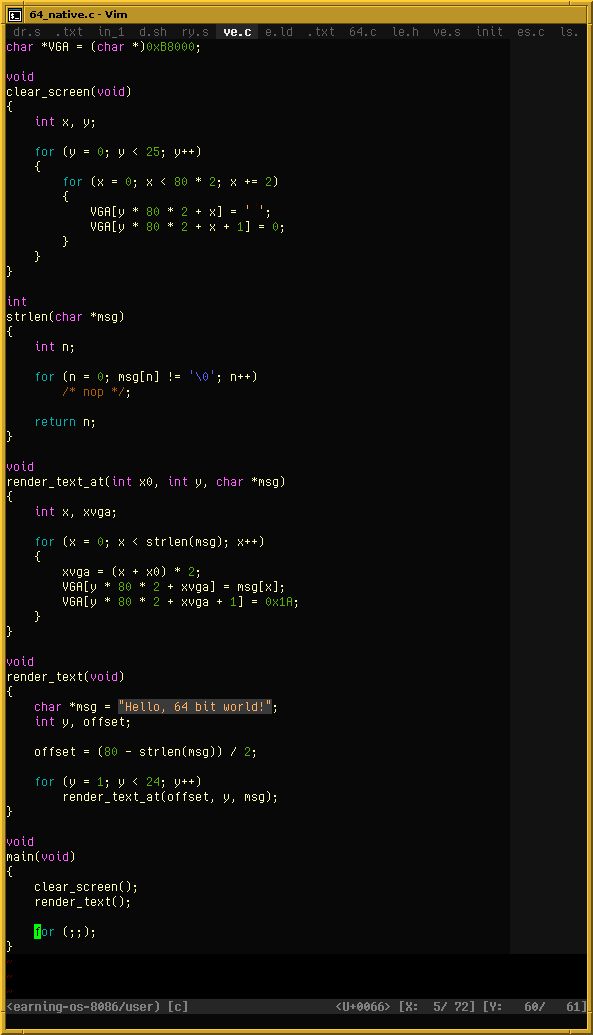
Next steps could include:
- Use Rust instead of C for that 64-bit program?
- Provide interrupt service routines. (At the moment, it just keeps interrupts disabled.)
dark mode forevah!
↳
In-reply-to
»
sorry i haven't been working on bbycll or even hanging around twtxt much at all as of late -- gf was over for a few weeks, i turned twenty years old, and have been doing extremely unnecessary things to my website
⤋ Read More
don’t mind the glaring light mode i just think the pink looks pretty. this “desktop mode” is just a bunch of css repurposing the sidebar into the taskbar, but the file manager and its supporting code is proving a very fun endeavour. my favorite part is u can just turn javascript off and it functions like a regular website with nothing suspicious about it at all
sorry i haven’t been working on bbycll or even hanging around twtxt much at all as of late – gf was over for a few weeks, i turned twenty years old, and have been doing extremely unnecessary things to my website

Java’s Swing is allegedly in “maintenance mode”, so I doubt it’s a good idea to use it for new programs. For example, I very much doubt that it will ever support Wayland.
The replacement is supposed to be JavaFX, but that’s not included in JREs – anymore! It used to be, now it’s not, even though it’s well over 15 years old now.
This whole thing (“Java GUIs”) appears to have stagnated a lot. Probably because everything is web stuff these days …
https://www.oracle.com/java/technologies/javafx/faq-javafx.html#6
↳
In-reply-to
»
There are no really good GUI toolkits for Linux, are there?
⤋ Read More
@prologic@twtxt.net Hmm, I’ll have to take a look. Appears to be Go only, doesn’t it?
I’m not quite sold yet on the idea of “immediate mode” GUIs. 🤔
↳
In-reply-to
»
Good morning. Driving the dot matrix printer from my little real-mode toy OS. 🖨️
⤋ Read More
@lyse@lyse.isobeef.org @dce@hashnix.club It’s pretty cool, I won’t argue that, but also really simple, to be completely honest. 😅 The BIOS already provides all you need to send data to the printer:
https://helppc.netcore2k.net/interrupt/bios-printer-services
The BIOS actually does provide a great deal of things, which, to me, was one of the most surprising learnings of this project (the project of writing a little 16-bit real-mode OS, that is). It often doesn’t feel like I was writing an operating system – it felt more like writing a normal program that just uses BIOS calls like we would use syscalls these days.
(I’ve also read a lot of warnings, like “don’t use the BIOS for this or that”. Mostly because it tends to be very slow.)
Good morning. Driving the dot matrix printer from my little real-mode toy OS. 🖨️
(This is just a wrapper around BIOS INT 17. I love it nonetheless. 😅)
↳
In-reply-to
»
@bender
⤋ Read More
curl -s gopher://… does that for you.
@movq@www.uninformativ.de nice “silent mode”, thank you!
Someone did a thing:
https://social.treehouse.systems/@ariadne/114763322251054485
I’ve been silently wondering all the time if this was possible, but never investigated: Keep doing X11 but use Wayland as a backend.
This uses XWayland’s “rootful” mode, which basically just gives you a normal Wayland window with all the X11 stuff happening inside of it:
https://www.phoronix.com/news/XWayland-Rootful-Useful
In other words, put such a window in fullscreen and you (more or less) have good old X11 running in a Wayland window.
(For me, personally, this won’t be the way forward. But it’s a very interesting project.)
I did a “lecture”/“workshop” about this at work today. 16-bit DOS, real mode. 💾 Pretty cool and the audience (devs and sysadmins) seemed quite interested. 🥳
- People used the Intel docs to figure out the instruction encodings.
- Then they wrote a little DOS program that exits with a return code and they used uhex in DOSBox to do that. Yes, we wrote a COM file manually, no Assembler involved. (Many of them had never used DOS before.)
- DEBUG from FreeDOS was used to single-step through the program, showing what it does.
- This gets tedious rather quickly, so we switched to SVED from SvarDOS for writing the rest of the program in Assembly language. nasm worked great for us.
- At the end, we switched to BIOS calls instead of DOS syscalls to demonstrate that the same binary COM file works on another OS. Also a good opportunity to talk about bootloaders a little bit.
- (I think they even understood the basics of segmentation in the end.)
The 8086 / 16-bit real-mode DOS is a great platform to explain a lot of the fundamentals without having to deal with OS semantics or executable file formats.
Now that was a lot of fun. 🥳 It’s very rare that we do something like this, sadly. I love doing this kind of low-level stuff.
↳
In-reply-to
»
FFS! Can't I just get results, accurate no BS results? No erroneous/misleading AI-Slop of a summary I've never asked for ? I get it, there is plenty of people who LOooove (if not worship) that shit, Good for them! But at least make it opt-in or add in some kind of "Do Not Slop" browser option (as if the "Do Not Track" one made a difference, but I digress). Shit's only going down-hill from here, I might as well as just spin up my own Searx instance and call it a day.
⤋ Read More
@movq@www.uninformativ.de neither do I 😆 and I’m going full Albert Camus mode. Embracing the Absurdism of life just to cope, it’s the only choice I have left.
↳
In-reply-to
»
i started a little thing on my dreamwidth and called it a flash prompt box. basically it's a limited time thing where people can prompt me for stuff i'm offering, like short fanfiction, photoshop-edited user icons, music recs, and a bit more! i'm having sooo much fun with it so far it's been a blast just making stuff for friends :)
⤋ Read More
@prologic@twtxt.net ah that’s alright! the banner is just for fun :] it might be easier to skip to the comments with this link if you want (it’s in the site view mode rather than my page’s theme) https://luckyzukky.dreamwidth.org/98451.html?style=site#comments
↳
In-reply-to
»
I’m keeping this color scheme on my laptop for now:
⤋ Read More
@movq@www.uninformativ.de not bad! The yellowish/ivory tint makes it much easier on the eyes. I have gotten so use to “dark” mode, that find it hard switching to anything else.
Once or twice a year, I make an effort to switch from dark mode / black terminals to light mode again.
It usually doesn’t end well, because the contrast is just not as good. There’s a reason that things like professional DAWs or CAD software use a dark theme.
With a heavy bold font, it’s much better:
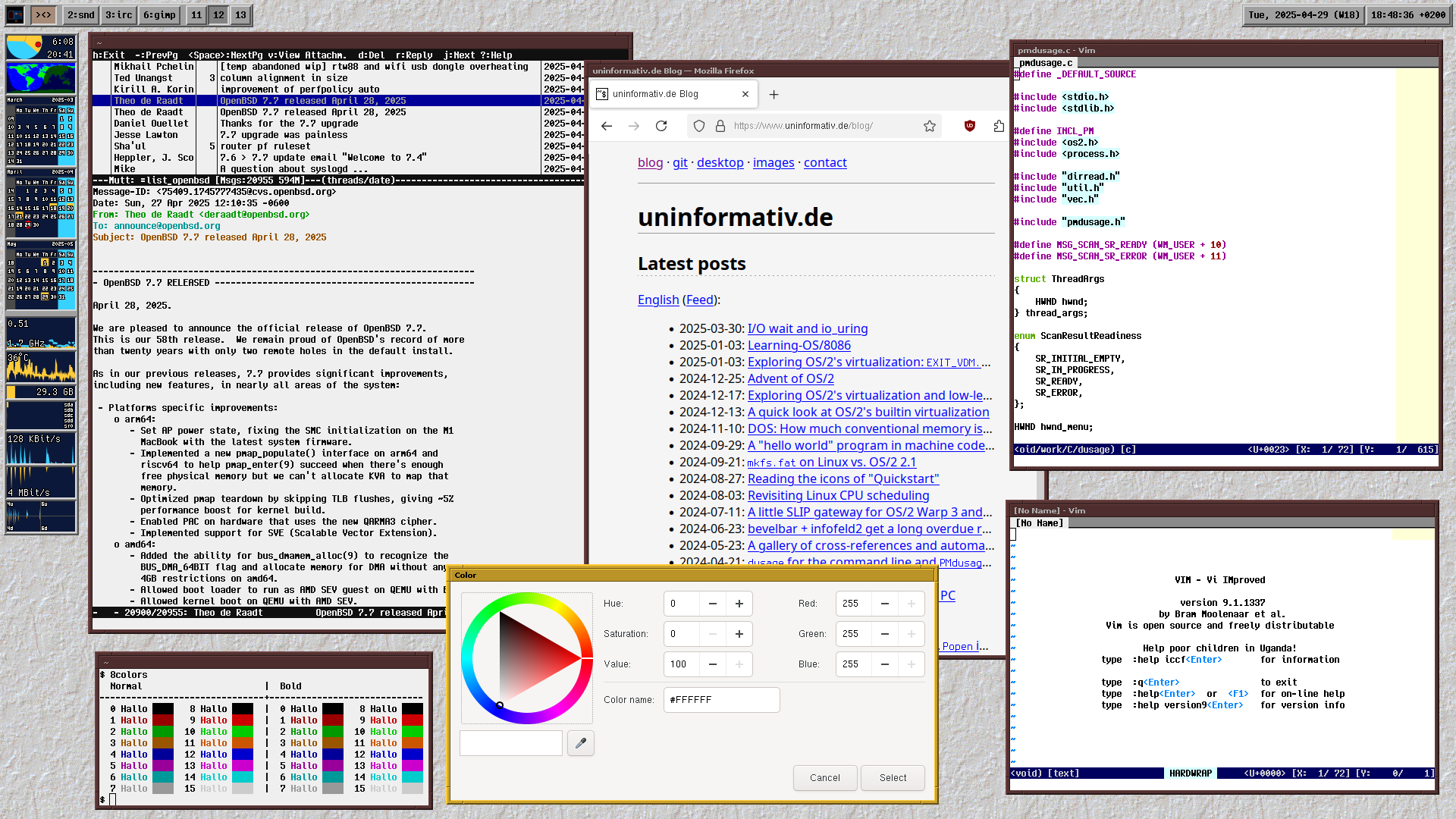
My font doesn’t get any bolder than this, though. I’d have to make a new variant of it. Mhh. 🤔
An AlphaStation’s SROM
The AlphaStation 500 is a workstation from Digital, circa 1996. Mine is a 500 MHz model and has an Alpha 21164A processor (aka EV56). And the way it boots is weird. On your common-or-garden PC, there has always been some kind of ROM chip. It holds a piece of firmware known as the BIOS. This ROM chip is available at a well-known location in the processor’s address space (remembering that any PC processor boots up in 16-bit, 8088 compatible mode, with a 1 MiB address space, just like an I … ⌘ Read more
↳
In-reply-to
»
Markdown and the Slow Fade of the Formatting Fetish - a nice article about Markdown VS proprietary formatting. With quotes like "Microsoft Office works in an office where you pretend to work until you can finally go home." 😄
⤋ Read More
@arne@uplegger.eu I’m very glad I only rarely have to deal with .docx & Co. And when I have to, 99% is in read mode only. Even though, I don’t think that Markdown is the best choice, I use it on a daily basis. Some things, like links, in reStructuredText are better in my opinion.
Jira just resists to switch to Markdown and forces us to use its silly markup language.
For real typesetting, LaTeX is the way to go. But I very, very rarely do that.
↳
In-reply-to
»
@lyse you must be loved by all the web developers in town! But ok, I have added all the missing semicolons, that should technically be there, but them not being there, does not make a difference.
⤋ Read More
@thecanine@twtxt.net And this is exactly why there are quirks modes in browsers…
I’m actually glad I don’t have to deal with all this web shit and work with compilers that hit me in the face when I do something illegal. :-)
Hello, i want to present my new revolution twtxt v3 format - twjson
That’s why you should use it:
- It’s easy to to parse
- It’s easy to read (in formatted mode :D)
- It used actually \n for newlines, you don’t need unprintable symbols
- Forget about hash collisions because using full hash
Here is my twjson feed: https://doesnm.p.psf.lt/twjson.json
And twtxt2json converter: https://doesnm.p.psf.lt/twjson.js
↳
In-reply-to
»
Thinking about adding a little “focus” feature to my window manager: It hides all but one window, no wallpaper, no bars.
⤋ Read More
@lyse@lyse.isobeef.org @bender@twtxt.net It already is a tiling window manager, but some windows can’t be tiled in a meaningful way. I admit that I’m mostly thinking about QEMU or Wine here: They run at a fixed size and can’t be tiled, but I still want to put them in “full screen” mode (i.e., hide anything else).
↳
In-reply-to
»
Thinking about adding a little “focus” feature to my window manager: It hides all but one window, no wallpaper, no bars.
⤋ Read More
@movq@www.uninformativ.de You could also just use a tiling window manager. :-) As a bonus, it doesn’t waste dead space, the window utilizes the entire screen. To also get rid of panels and stuff, put the window in fullscreen mode.
I have released new updates to the twtxt.el client.
- Markdown to Org mode (you need to install Pandoc).
- Centred column.
- Added new logo.
- Added text helper.
The new version I will try to finish the visual thread. You still can’t see the thread yet.
#emacs #twtxt #twtxtel
Philadelpia - Long run: 14.22 miles, 00:10:02 average pace, 02:22:39 duration
great long run. had a few places in mind to try and visit (tun tavern, rocky steps, the river thing) and hit them all with not really any idea where they were. pretty much just went tourist mode taking pictures and reading signs. it was so freaking cold! 22F i think. took the beanie off and the sweat had turned to ice, and my torso was all red from the rubbing of my clothes.
#running
Did the Windows 95 setup team forget that MS-DOS can do graphics?
One of the reactions to my discussion of why Windows 95 setup used three operating systems (and oh there were many) was my explanation that an MS-DOS based setup program would be text-mode. But c’mon, MS-DOS could do graphics! Are you just a bunch of morons? Yes, MS-DOS could do graphics, in the sense that it didn’t actively prevent you from doing graphics. You were still responsible for everything you … ⌘ Read more
Hendersonville - Long run: 7.29 miles, 00:09:56 average pace, 01:12:28 duration
missed the 9 mile target. wrong shoes for the job. had to cut my route short due to flash flooding so turned on tourist mode. did some mud skating and just took everything in
#running
Reviving a dead audio format: the return of ZZM
Long-time readers will know that my first video game love was the text-mode video game slash creation studio ZZT. One feature of this game is the ability to play simple music through the PC speaker, and back in the day, I remember that the format “ZZM” existed, so you could enjoy the square wave tunes outside of the games. But imagine my surprise in 2025 to find that, while the Museum of ZZT does have a ZZM Audio section, it recommends t … ⌘ Read more
The invalid 68030 instruction that accidentally allowed the Mac Classic II to successfully boot up
A bug in the ROM for the Macintosh II was recently discovered that causes a crash when booting in 32-bit mode. Doug Brown discovered and documented the bug while playing with the MAME debugger. Why did it never show up before? It seems a quirk in Motorola’s 68030 CPU inadvertently fixes it when executing an illegal instruction that shou … ⌘ Read more
Snowdrop OS: a homebrew operating system from scratch, in x86 assembly language
Snowdrop OS was born of my childhood curiosity around what happens when a PC is turned on, the mysteries of bootable disks, and the hidden aspects of operating systems. It is a 16-bit real mode operating system for the IBM PC architecture. I designed and developed this homebrew OS from scratch, using only x86 assembly language. ↫ Snowdrop OS’ website I have created and includ … ⌘ Read more
While the US politicians and tech billionaires are going full-on fascist mode, here is a reminder that there are European alternatives for many well known digital and online services: https://european-alternatives.eu
↳
In-reply-to
»
ROFL 🤣 I've found myself a new insult:
⤋ Read More
:diffoff a vim command...
@prologic@twtxt.net it offends someone with a different opinion? 🤣
No, seriously… :diffoff is used to disable vim’s diff mode that’s usually started running vim -d someFile someOtherFile or by having both files on a split window and applying :diffthis on both panes. (just learned this this morning)