(4) The First Brain Was Just Uploaded To A Computer - YouTube
– Wow 😮 This is pretty amazing! Scientists and this new company called Eon, have managed to replicate the entire structure of a fruit fly’s brain, exactly. It behaves exactly like a fruit fly does, in it’s virtual simulated world. The only thing they’re missing is the strengths of the connections and weights of each neuron and the state of the chemical “soup”? of the original fly, so it carries no memories and has no “mind”, but structurally it works! Holy shit! Wowza 😱
Had no clue @prologic@twtxt.net has his own computer mouse brand now, straight up giving them away, for under $3 a piece.
I got one and well pleasantly surprised, especially for the price. It fits perfectly in the hand, decent rubber, weighs nothing, clicks very silently. The scroll wheel is where you can feel some of the cost cutting, it’s pretty wonky, but good enough.
Classic cheap thin long cable, you better like 1600 DPI, cause there’s no button to change that. Sensor is the usual red light, but works on all surfaces, bedsheets included. Gliders are small and not around the sensor, but at this weight, that makes next to no difference.
Decent 8/10 option

Had no clue @prologic@twtxt.net has his own computer mouse brand now, straight up giving them away, for under $3 a piece.
I got one and well pleasantly surprised, especially for the price. It fits perfectly in my hand, decent rubber, weighs nothing, clicks very silently. The scroll wheel is where you can feel some of the cost cutting, it’s pretty wonky, but good enough.
Classic cheap thin long cable, you better like 1600 DPI, cause there’s no button to change that. Sensor is the usual red light, but works on all surfaces, bedsheets included. Gliders are small and not around the sensor, but at this weight, that makes next to no difference.
Decent 8/10 option

At 8 o’clock, we had chilly 10°C. My mate and I dashed up our backyard mountain in just a tad under an hour. And that wasn’t the direct way. Our jumpers came off quick. It was really nice, because the sun was already warming and lighting up the landscape and everbody else still asleep. We had everything to our own.
Shortly after we were atop, the first two yoga women showed up with their mats. When we decended, a bunch more were on the way up. And then came the families with dogs and kids. Very glad to have missed all this hustle and bustle.
Now, I’m really tired. But it’s a great feeling of exhaustion. Two and a half hours later, we’re at 17°C. It’s supposed to hit an acceptable 23°C later on.
Unfortunately, no pics. I learned that charging via the docking station when the computer is turned off doesn’t do shit at all. Oh well.
For the first time in probably 30 years, I played a game of M.U.L.E. tonight (and won!).
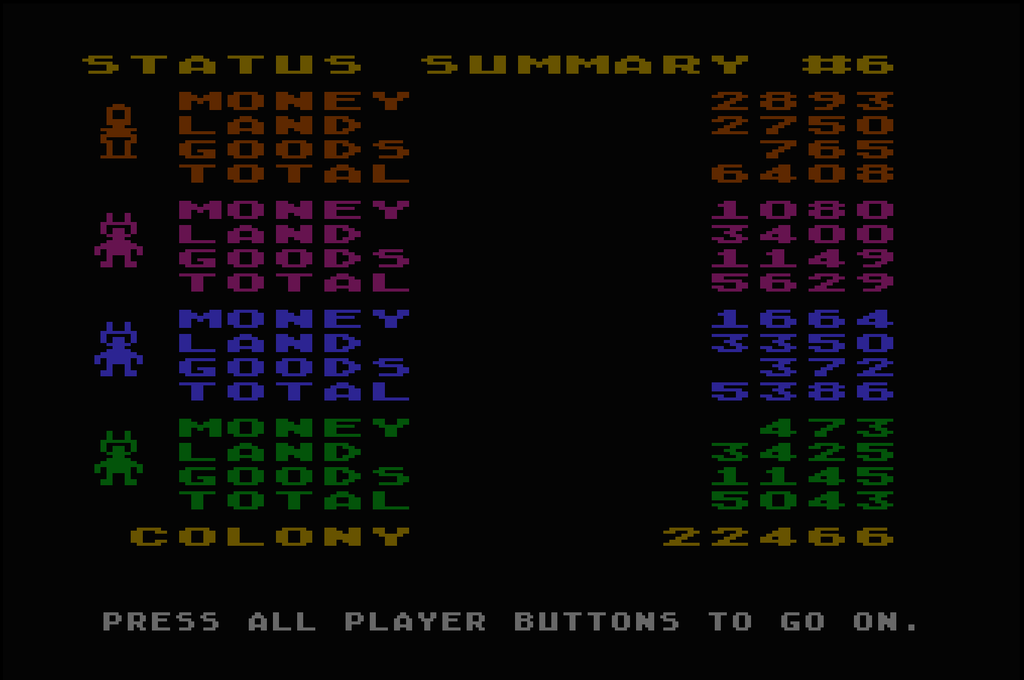
Granted, it was a beginner-level game, with a beginner-level alien against 3 computer players, but… I’m just sayin’.
I even lost one of my tracts of land due to it not being “recorded”, and I still won.
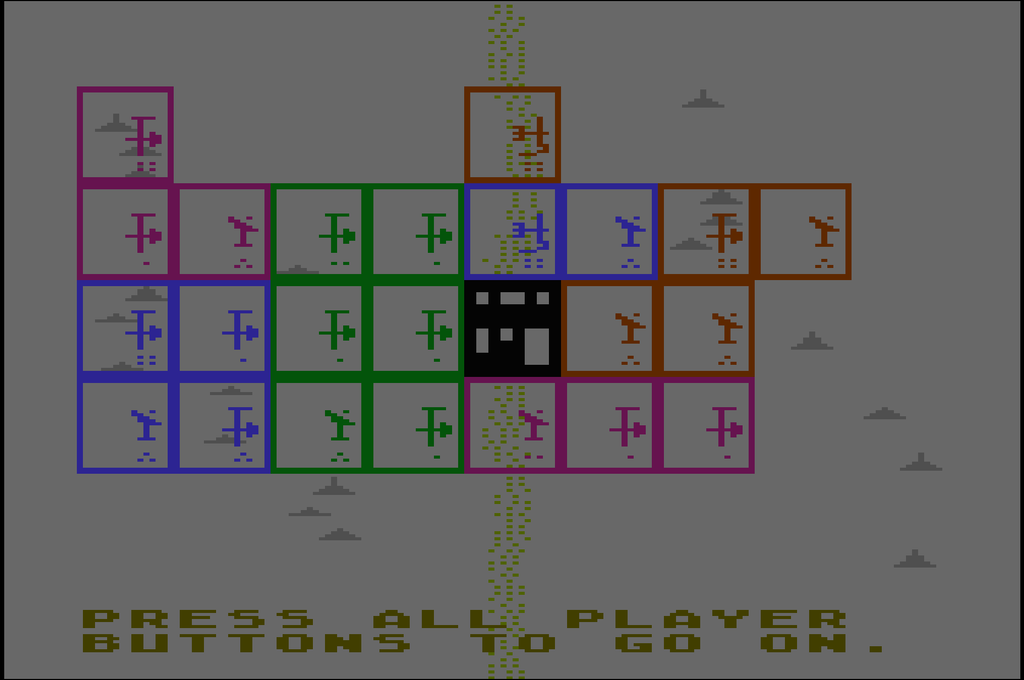
Take that, Mechtrons!
↳
In-reply-to
»
It is such a nice feeling that Mu is such a capable little language 😅 And I decided to write code code in Mu by hand 🤚 haha 🤣 and start solving Project Euler problems, like Problem 8 which works out to be a nice elegant solution in Mu:
⤋ Read More
Oh man wow 😮 Problem 9 was quite hard 😱 I had to build two new functions in the Mu stdlib for computing combinations and permutations, but then the combinations of range(1000) for triples such as a + b == c is enormous! So i had to write iterator versions of these to do lazy evaluation. Anyway solution follows:
#!/usr/bin/env mu

// Special Pythagorean Triplet

import "iter"

fn usage() {
  print("Usage:", args()[0], "<n>")
}

fn sqr(x) { x * x }

fn main() {
  if len(args()) < 2 {
    usage()
    exit(1)
  }

  n := must(int(args()[1]))
  print("n:", n)

  // For a < b < c and a + b + c == n, both a and b are strictly less
  // than n/2. Generate only (a,b) combinations and derive c directly. This
  // keeps the search lazy and reduces n=1000 from C(999,3) = 165,668,499
  // candidate triples to C(499,2) = 124,251 candidate pairs.
  pairs := iter.combinations(iter.range(1, n / 2), 2)

  triples := iter.map(pairs, fn(xs) {
    a := xs[0]
    b := xs[1]
    return [a, b, n - a - b]
  })

  // Enforce b < c; a < b is already guaranteed by combinations over an
  // increasing range, and a + b + c == n holds by construction.
  triples = iter.filter(triples, fn(xs) {
    return xs[1] < xs[2]
  })

  // Euler 9 has one answer for n=1000. find() stops the entire upstream
  // iterator chain as soon as the first Pythagorean triple is found.
  answer := iter.find(triples, fn(xs) {
    return sqr(xs[0]) + sqr(xs[1]) == sqr(xs[2])
  })

  print(answer)

  if answer != nil {
    print(answer[0] * answer[1] * answer[2])
  }
}

main()
↳
In-reply-to
»
The original twt is unavailable. It may have been edited or deleted, or is from an unknown or muted feed.
⤋ Read More
@david@daiwei.me Ta! I only noticed that at the computer but not when I took the photo. :-)
↳
In-reply-to
»
Are you aware of the Residential Proxy pest?
⤋ Read More
@movq@www.uninformativ.de Thanks for that. I’d been hearing about this in the context of browser plugins turning computers into residential proxies for web scrapers, but I hadn’t considered that a TV could be used the same way. ☹️
↳
In-reply-to
»
I trip over this in our code at work all the time.
⤋ Read More
@movq@www.uninformativ.de The nice thing about properties is that you can compute and cache things on the fly at first attempt and also ensure validation for writing. But like you said, since it’s not obvious that reading or writing might do some more things, it’s strongly advised to avoid doing expensive stuff disguised as properties.
I reckon the vast majority of property use cases is to provide read-only access. At least that was my impression when I was doing a lot more in Python.
Personally, I think that this just reads a lot nicer:
oink.my_property
oink.my_property = 42
Than:
oink.get_my_property()
oink.set_my_property(42)
Btw, any field access is implemented using method calls. I might be wrong, but I believe there’s always __getattr__ and __setattr__ involved. 8-)
↳
In-reply-to
»
@lyse Awww, that sounds like a typical experience at school. 😅 They meant well but somehow it was still shitty …
⤋ Read More
@lyse@lyse.isobeef.org Yeah, I have a couple of teachers in my family and they all tell similar stories. 🙄
I have almost no recollection of my time at the “Gymnasium” anymore. I’m either traumatized by it or I wasn’t very interested in what happened there. 😅 But I have some vague memories of doing “computer stuff” at school. There certainly were computers and they certainly ran DOS games like Duke Nukem, that I do know. 😂 Just checked my records, and no, this wasn’t an official class. At best, it was one of those AGs. 🤔
↳
In-reply-to
»
@lyse Awww, that sounds like a typical experience at school. 😅 They meant well but somehow it was still shitty …
⤋ Read More
@movq@www.uninformativ.de Hahaha. It could have been worse, though. I’ve heard stories from others that were many levels crazier than what I experienced. And I’m glad that I was very, very lucky with almost all of my teachers throughout all of school. One of my maths teacher, who was also my computer science teacher then, is the reason I do what I do for a living. It’s all his fault! ;-)
Ja, possibly a BaWü thing. The ministry of education and cultural affairs changes the rules, curriculums and details every one or two years, anyway.
Said teacher had to fight real hard that he was allowed to teach CS in class 12 and 13. As a real subject, that is, not just an extracurricular activity („AG“). At first, the ministry refused, because we’re just am „allgemeinbildendes Gmyi“, not an „informationstechnisches Gymi“. It’s insane, you’ve got super motivated (and technically as well as humanly excellent) teachers and then forbid them to offer a class. What the hell!? (Fun fact on top, he had a doctor in CS and was also teaching at the university of applied sciences.)
Eventually, they granted permission to only have a two hours a week class („zweistündig, wie Nebenfach“). One or two years later – too late for me, unfortunately – they allowed four hours a week („vierstündig, wie Hauptfach“). But each pupil had to sign upfont that they will not take CS class in the Abi. That was still exclusive to ITGs only. Completely ridiculous.
I reckon, you can talk to any random teacher and they will endlessly tell you about very dubious decicions from the ministry. :-/
↳
In-reply-to
»
@lyse Ah, you mean the categorization. Yeah, that would never work in Windows, at least not without having a centralized package manager (so there’s one authoritative source of which program belongs into which category).
⤋ Read More
@movq@www.uninformativ.de That’s right, way harder than centrally managed. They even didn’t reach concensus over the main folder: “Alle Programme, “Alle Programme (x86)”, “All Programs”, “All Programmes”, etc. Anyway.
For class 11 (or maybe already in 10, I don’t remember exactly) we could choose either between traditional maths class with a graphical calculator or “Mathe mit CAS”. There were two teachers in my entire school who were able to teach the latter. It was also fairly new at the time I believe. Certainly unheard of for a „allgemeinbildendes Gymnasium“, maybe the technical ones were already offering it for some time, not sure. It was clear to me that I would take the maths with CAS class.
Each kid had to buy their own Cassiopeia A-Something. I don’t know how much that thing was (definitely more expensive than a graphical calculator) and whether the school subsidized that in any form. But it was slow and underpowered as hell. We rarely used it in class nor for homework (most if not all had already a desktop at home). Typically, when we worked with the CAS, we sat down on the desktop computers. Our class took place in one of the two computer rooms. The desktops were placed on the three sides (left, right, back, facing the walls or windows) and the regular school desks were in the middle. Since there were more pupils than desktops, we always shared. Nowadays, we call it pair programming. ;-)
For the exams we had the “mandatory part” (Pflichtteil) without any tools. Once we finished that and handed the papers to our teacher, we were then allowed to boot up our Cassiopeias and work with them for the second part. Before the exam started, everyone had to show the teacher that they reset their small computer to factory settings. This second part was called „Wahlteil“. But you had to do it in order to pass. So, I never understood the choice of this term. Maybe it’s because the first part is the exact same for everyone (graphical calculator and CAS class), but the second part was definitely different for the two classes. Each suited to their tools.
After one or two exams, it became clear that the Cassiopeia was far from ideal. So, we took the second part at the desktop computers from then on. Our teacher unplugged the network cables himself to avoid cheating. Each computer had an “HDD Sheriff” running that reset the disk at startup. There was also an issue that the personal user accounts were affected by that. Sometimes all your data were lost. If you were lucky, they were still there. So, we saved our Maple project to local disk (if the computer didn’t crash in between, that was no problem) and at least eventually before leaving the classroom, we then also saved it on the server. For that, the teacher quickly plugged in the cable, we saved, and then the cable was unplugged again immediately. Oh, and everybody used their USB sticks, too.
All in all, this Cassiopeia A-* was quite a useless purchase. :-D I’m not sure if I still have it. At least I thought several times about giving it to the flea market. Don’t know if I did or not.
↳
In-reply-to
»
@lyse In what way was KDE 3’s menu organized? KDE 1 is the only KDE version I ever used. 😅 We’re talking about this one, right?
⤋ Read More

@movq@www.uninformativ.de Yes, this screenshot. However, not the Dutch but rather the German version, no wonder it looks so crazy!!1!11
It’s been a hot minute or two since I last used KDE, so I don’t remember exactly. I just vaguely recall that I found myself thinking multiple times that the KDE application categories were better matching or there were more or something like that. Most of my classmates were on Windows and had one giant long list of all sort of stuff in there. You even had to scroll in the menu. Sure, they installed all kind of garbage, which didn’t exactly help. Where in KDE, they were actually grouped by Office, Internet, Graphics, Multimedia, Games, etc. In Windows, applications usually hid themselves in a sub folder named after the software vendor. At least in the later (?) days.
I only used Win 95, 98 and XP at home. For maths class with computer algebra system (Maple), we had a Cassiopeia with Win CE: https://en.wikipedia.org/wiki/Casio_Cassiopeia At school, there was probably also Win 2000, but I don’t know anymore for sure.
↳
In-reply-to
»
@movq I'm very curious...
⤋ Read More
it’s “probabilistic” not “deterministic”
Yep, I know. And when I tell that to people and tell them “if we use AI here, we lose the ability to debug this stuff”, then all I get is: “But it’s good enough. We don’t need to debug this. Non-deterministic computing has its use cases.”
But that is just not how I’d like to model/implement our business processes. 🤔 I want something reliable, not “it mostly works”.
↳
In-reply-to
»
@prologic don’t get mad at me, but the long block of text didn’t address any of my questions. 😜😅
⤋ Read More
@bender@twtxt.net Fine, Let me answer properly and concretely 😅
Would you want your children not to learn anything, because “they have AI”?
No, children still need to learn. That will never change. What they learn however will over time.
Are you OK with your children using the AI for all of their homework?
Yes, frankly I am. Why? Because much of what we teach them in school is utterly pointless.
For example, learning to read Shakespear never taught me anything useful in my life. I regret much of my school years to be honest.
I leanred to read and write, sure. But I learned Math, Science, Computing and how things work on my own by being very curious.
What sense will it make?
That assumes I answered “no”, which I did not. So it all makes perfect sense :D
What kind of future would that bring for them?
This assumes I said “Yes”, which I did :D It will be an itneresting future that’s for sure. I don’t think we can just bury our heads in teh sand and pretend it’s all going to go away, It will not. It will make things very interesting for sure, as we’re already starting to see what’s possible and what’s changeing. For example; ordinary people are using these LLM(s) to write their legal suit and defense in courts with varying levels of success.
Even if AI were to become omniscient, what will it be of the human race then?
I’m not convinced it ever will. In fact, I am not convinced we know how to create true intellience at all.
What would we do?
What would be so different from say an Alien invasion from far superious beings?
What would we do that? Band together and defend humanity?
Serve the AI? Maintain the AI?
That assumes that “AI” will become intelligent and omniscient, which I don’t believe it ever will.
Would we have found the true meaning of life then?
If the meaning of life is to create our own sub-species liken to ourselves, sure, maybe. But is that even a reality? not sure, I doubt it. We barely understand ourselves at the best of times, let alone how our minds works.
To care for AI, Is that it?
How would this be different to caring for a friend, a family member If we could ever truly reate an actual sentient being with real feelings and intelligenace, is there any reason to worry? Could we not be freinds and have mutual goals and form relationships?
↳
In-reply-to
»
@lyse Thanks! There are a few points in there that I’ll add to my list.
⤋ Read More
@bender@twtxt.net Now that’s an interesting philosophical viewpoint right there. But this assumes that the “AI” we seemingly have available to us today is actually telligent, understands and has cognitive reasoning. It does not. All of these LLM models from big-tech companies like Anthropic, OpenAI, Google, Microsoft, Meta and Alibaba are all just very powerful, very large multidimensional neural networks with attention that are very good at statistical probabilities of ‘what comes next”. I think we get really upset over the wrong things sometimes. We need to continue to be upset that these 🤬 companies have basically destroyed any meaningful value of the concept of Copyright and Intellectual Property and Works of art. The so-called “AI” we have today is just a tool. Can you say for certain that the typewriter and the computer ruined our ability to write? Perhaps yes, but we still learn how to do so, likewise, I still think that learning to write code, research, read and write are all valuable skills to learn. Later on once you have the basics, you can defer some of the “tedious” work to these models, because frankly, they’re far better at inferencing and pattern matching than you or i will ever be, not because they’re better at pattern-matching per se, but because they have been trained on a very large corpus and they are much much faster at doing the same basic things we are far superior at.
↳
In-reply-to
»
@lyse Thanks! There are a few points in there that I’ll add to my list.
⤋ Read More
@movq@www.uninformativ.de I’m very curious…
What I like about this whole computer stuff is that you can explore how
things work. You can dig through problems and solve them. Nothing is
more satisfying than finally understanding something after you scratched
your head for some hours.
Surely you could do the same with AI? Tinker with how it works, study it, understand it, build your own and realize what it really is (without all the big tech hype)?
↳
In-reply-to
»
I’ve started collecting reasons against AI usage here, so I don’t have to repeat myself all the time:
⤋ Read More
Of course, @movq@www.uninformativ.de! Most of my points are also included in your list.
First of all, programming is what I really do enjoy the most. So, it doesn’t make any sense at all to not do this anymore. “But you could use your now free time to do something much cooler and more valuable!”, others might reply. Fuck no, I don’t want to waste my time with other shit that doesn’t fulfill me, why on earth would I want to do that?
All this hallucination reduces quality badly. In my experience, it’s also happening much more rapidly than I expected. Even though developers are still supposed to own and understand whatever has been generated under their name and even be responsible for that, the sad reality is that teammates often blindly trust the AI output. “But I asked the AI and it told me that $this was impossible”, “I’ve no idea either, but the AI just generated it” are responses I get more often. What really makes my angry is when I point out a flaw and suggest an alternative and this is the reaction. It happened several times that just trying it out and seeing it clearly work to proof my point only took me half a minute, but people still did something handwavy else instead.
The learning effect is drastically reduced. The more time I spend on a topic, the better the odds that whatever I learned actually makes it over into long-term memory. It’s like if a collegue just says “do it like that” or “this solves your problem”, but neither explains the why or how. Somehow, people are still convinced that it’s a completely different story when you replace the human counterpart with a computer program in this equation.
Skills are unlearned. It’s like with automation in general, just much worse. You end up in a state where you’ve no clue how anything works under the hood or how to actually find out important information that are needed to solve your problem. You’re screwed when a process breaks out of the blue. Even though it can become also rather terrible, with classical automation you’re typically still be able to decipher how exactly the thing was supposed to do something.
The energy consumption is sooo high, I absolutely do not want to be a part in burning down our planet. I’m sure I find (and probably have long found without knowing) other ways to contribute to worsen our climate crisis.
The scraper part is already covered in detail in your list. :-)
I’m convinced that license and copyright violations are only played down or even refused entirely because companies want to make big money quickly. With the work of others of course. Their double standards are obvious, they still try to actively keep their own stuff secret and out of any training sets. At most for internal use only. Virtually noone in charge is interested in good long-term solutions. Short-term for the win, when disaster eventually strikes, the causers are long gone, the responsibilities in other hands.
Vendor lock-in is something that lots of folks are only realizing very slowly. It’s completely crazy to me. This drug dealer routine should be well-known by now. It’s fucking everywhere. Yet, people are always surprised when they found themselves caught in it.
Adding new AI stuff only increases complexity. But complexity is the enemy that everybody should fear and reduce as much as possible. Of course, this is not limited to AI at all. And everywhere I look around, people in charge looooove to make things way more complicated than they ever need to be. Yet, simplicity is the real art and much harder to achieve.
I don’t understand why we have to go back full force to the ambiguity of natural languages. This alone should be more than enough to realize what a stupid idea all that is. Linked to that is that the “instruction set” is interpreted differently with newer model versions. I mean, is has to be. Why else would somebody want to upgrade in the first place than to get more Powerful™ Features™?
Some people argue that with AI the democratization is empowered. However, in my view, the exact opposite is the case. Models are getting so large that you can basically not run them locally or even train them. So, you have to rely on whatever the vendor offers you and runs for you. In the end, this only gives the owners more power, the multi billionaires. Not exactly what I understand by democratization.
Finally, technology assessments are missing completely. Or they are faked such that mostly only the (questionable) benefits are listed. But all the negative impact is just ignored.
Let’s keep some popcorn around for when this all explodes. :-)
I’m not always on the same page as Rob Pike, but this hit close to home:
Although trained in physics, I worked in the computing industry with pride and purpose for over 40 years. And now I can do nothing but sit back and watch it destroy itself for no valid reason beyond hubris (if I’m being charitable).
Ineffable sadness watching something I once loved deliberately lose its soul.
I spent my time trying to make it better. Not just write code, but find better or at least different ways to do so. Simpler, cleaner, more general, more comprehensible.
What’s happening today is a complete repudiation of everything I was trying to achieve.
“Simpler, cleaner, more general, more comprehensible”, that’s what I’ve been trying to establish in our teams as well. Obviously not to the same degree, but you get the idea.
And it all goes out the window now. We’re doing the complete opposite – and with full force.
@d74a3: I guess, he points to a linux kernel for an i486. You can install linux on old computers, f.e. netbsd. I had running netbsd on an old sinix 486 parallel to win98se.
There are lots of old computers and smartphones. Repairshops, libraries, churches, universities.
Also, this really speaks to me (or maybe it speaks for me): https://neilzone.co.uk/2026/04/just-let-me-compute-in-peace/
↳
In-reply-to
»
The original twt is unavailable. It may have been edited or deleted, or is from an unknown or muted feed.
⤋ Read More
@kingdomcome@yarn.girlonthemoon.xyz Oh, that brings back memories! I’ve played minetest one and half centuries ago. Some classmates and I tried to recreate our computer science building at the time. The proportions didn’t work out, but it still kinda worked. Minetest was one of the very few games I played a bit more extensively.
↳
In-reply-to
»
Been missing you, friends! I hope life's been treating you well. What did I miss?
⤋ Read More
@bender@twtxt.net Sweet! So glad that Twtxt still lives, and that everyone’s been keeping busy. My main computer is broken, It’ll take me some time to setup jenny on the R-pi and try to catch-up.
Have a blessed week-end everyone!
↳
In-reply-to
»
Been missing you, friends! I hope life's been treating you well. What did I miss?
⤋ Read More
@aelaraji@aelaraji.com hey, hey! I saw you tinkering with ActivityPub, so I know you were well.
Glad to have you back here! No much has happened on twtxt.net-world. @prologic@twtxt.net is quite busy with large language models, and seeking further independence through capitalistic ways. @lyse@lyse.isobeef.org continues dazzling us with his clicks, @movq@www.uninformativ.de brings us interesting music, videos to see, and a sprinkle of home made computing here and there, and me… well, I continue bending (or trying to) things! 😂
gopher://shibboleths.org actual software for legacy computers and JS+PHP handycrafts FREE anD Fixed
Dialup accounts for old computers like Mac Clasdic?
↳
In-reply-to
»
Trying to build a native heap allocator that grows and isn't statically wired into the binary's image is fuck'n hard™ as 🤣
⤋ Read More
@prologic@twtxt.net Computers are great, eh? Soooo many problems to choose from! What do you want to solve today? 😅
↳
In-reply-to
»
@movq That's cool! I also like the name of your library. :-) I assume you made the thing load quickly, didn't you?
⤋ Read More
@movq@www.uninformativ.de Yeah, I see. Just crudely checked on my computer, with around 0.013 seconds, Python 2.7 seems a tad faster than Python 3.14’s 0.023 seconds in this little program.
The lazy imports sound not too bad, but I just skimmed over them. There are surprisingly many exceptions, but yeah, no way around them. :-)
↳
In-reply-to
»
very good blog post that reminded me why it's taking so long to ship bbycll — previously i had computed the hashes of every post before storing them in the database, after realizing it's a much better idea to compute the hashes during runtime and only store the post content & timestamp i'm now having to rewrite every function that reads & writes data. i hope the reason as to why i lost motivation is obvious — thankfully i caught it early enough so that once i'm done rewriting just those functions i should™ be able to finalize 1.0-rc with little hassle
⤋ Read More
@zvava@twtxt.net The problem you now then is you lose integrity of the message content if you compute the hashes at runtime rather than on the way in. So if your message content or database becomes corrupt in any way, so do your hashes.
very good blog post that reminded me why it’s taking so long to ship bbycll — previously i had computed the hashes of every post before storing them in the database, after realizing it’s a much better idea to compute the hashes during runtime and only store the post content & timestamp i’m now having to rewrite every function that reads & writes data. i hope the reason as to why i lost motivation is obvious — thankfully i caught it early enough so that once i’m done rewriting just those functions i should™ be able to finalize 1.0-rc with little hassle
↳
In-reply-to
»
@movq wow! what is assembler?
⤋ Read More
@kiwu@twtxt.net Assembly is usually the most low-level programming language that you can get. Typical programming languages like Python or Go are a thick layer of abstraction over what the CPU actually does, but with Assembler you get to see it all and you get full control. (With lots of caveats and footnotes. 😅)
I’m interested in the boot process, i.e. what exactly happens when you turn on your computer. In that area, using Assembler is a must, because you really need that fine-grained control here.
there’s something very soothing in spreadsheets to compute filters parts values and frequencies #electronics
↳
In-reply-to
»
My goodness, a new level of stupidity.
⤋ Read More
This looks like a botnet, to be honest. The IPs are all over the place. Ethopia, Brazil, Kenya, Lebanon, Netherlands, … I mean, that’s the logical thing to do, isn’t it? Do your web crawling on infected PCs. Nobody will block those, because those are the same IP ranges as legitimate requests. And obviously you don’t have to pay for computing time.
… and they all send invalid HTTP requests, all answered with HTTP 400 … How silly.
ngl, little relieved that while reading computer things instead of going out for a quick push on my skateboard, it must have rained briefly
↳
In-reply-to
»
Here is just a small list of things™ that I'm aware will break, some quite badly, others in minor ways:
⤋ Read More
@prologic@twtxt.net That is really great to hear!
If there are opposing opinions we either build a bridge or provide a new parallel road.
Also, I wouldn’t call my opinion a “stance”, I just wish for a better twtxt thanks to everyone’s effort.
The last thing we need to do is decide a proper format for the location-based version.
My proposal is to keep the “Subject extension” unchanged and include the reference to the mention like this:
// Current hash format: starts with a '#'
(#hash) here's text
(#hash) @<nick url> here's text

// New location format: valid URL-like + '#' + TIMESTAMP (verbatim format of feed source)
(url#timestamp) here's text
(url#timestamp) @<nick url> here's text
I think the timestamp should be referenced verbatim to prevent broken references with multiple variations (especially with the many timezones out there) which would also make it even easier to implement for everyone.
I’m sure we can get @zvava@twtxt.net, @lyse@lyse.isobeef.org and everyone else to help on this one.
I personally think we should also consider allowing a generic format to build on custom references, this would allow for creating threads using any custom source (manual, computed or external generated), maybe using a new “Topic extension”, here’s some examples.
// New format for custom references: starts with a '!' maybe?
(!custom) here's text
(!custom) @<nick url> here's text

// A possible "Topic" parse as a thread root:
[!custom] start here
[custom] simpler format
This one is just an idea of mine, but I feel it can unleash new ways of using twtxt.
we facilitated a workshop at Alpaca 2025: Introduction to the qiudanz technique: computational transformation of minimalist movement sequences | https://compudanzas.net/alpaca_2025_workshop_notes.html
↳
In-reply-to
»
@lyse that's an amazing way to teach, and one many old school (I remember my father telling me "schools need to teach both theoretical and practical skills!") people will agree with. The fact that graduates need to learn on the job after they graduate exemplifies the importance of hands on.
⤋ Read More
@bender@twtxt.net Absolutely. My computer science teacher was really great and in a lot of aspects very similar. Especially combining the theoretical and practical parts. He’s also the main reason I ended up where I am today. I’m very grateful to him. Mr. Burger, however, takes this on a whole new level.
↳
In-reply-to
»
Well, that was fascinating: https://www.youtube.com/watch?v=LxNq8zOEbM8
⤋ Read More
@movq@www.uninformativ.de Interesting, yes. I didn’t know that.
No AI being used is really great. However, the same clips shown over and over again and some images being mirrored was quite annoying to me. Also, there were some quite terrible computer animations and sometimes the narration and picture didn’t match at all. Talking about the medieval period and then showing an image from the 18th hundred or so. What the heck?
These production issues made me sceptical pretty much early on. So I quickly crosschecked Wikipedia. But it seems spot on from what I’ve read. Very good. Also, the narrator’s voice was really nice to listen to.
Eels are fascinating creatures. :-)
↳
In-reply-to
»
@bender Yeah, the acronym is funny. 😅
⤋ Read More
@movq@www.uninformativ.de Oh, nice read!
If I’m in the woods, I’d like to not waste my time with computers and focus on the beauty of nature. ;-) So, I’m not gonna participate in that event. But I’d read your articles on that subject anytime. :-)
computers? super boring. they do what you tell them. humans? very interesting! they harm their own interests, even when warned!
↳
In-reply-to
»
RIP Android:
⤋ Read More
@prologic@twtxt.net Yes, this is another instance of restricting “personal” computing. You won’t be able to install arbitrary software anymore (“sideloading”, as they call it).
It’s not unique, it’s not new. Boiling the frog alive.
We’re heading towards this: https://www.gnu.org/philosophy/right-to-read.html
RIP Android:
https://9to5google.com/2025/08/25/android-apps-developer-verification/
Since nobody is going to push back on this (I don’t even know if that would be possible), this is going to be a reality on every platform sooner or later.
I’d guess in 20, 30 years, there won’t be “PCs” anymore. No more home computing, no more “I just write my own software”. You won’t own devices anymore, it’ll all be rented and the landlord will tell you what you can do with it.
I hope that I’m wrong, but given where we are today, I don’t think that I will be.
Who knows some dialup accounts for old computers before 1992?
upcoming workshop! we will participate in the Alpaca Conference (Algorithmic Patterns in the Creative Arts) with: Introduction to the qiudanz technique: computational transformation of minimalist movement sequences | https://compudanzas.net/talks_and_workshops.html
↳
In-reply-to
»
What’s Missing from “Retro”: gopher://midnight.pub/0/posts/2679
⤋ Read More
@movq@www.uninformativ.de having to go to a gopher proxy to see a text document better served on readily available web servers… 🤭, but I digress. Verbatim text:
What's Missing from "Retro"
~softwarepagan
------------------------------------------------------------------
You know, often, when I say I miss older ways of computing or
connecting online, people tell me "there's nothing stopping you
from doing that now!" and they are technicay correct in most cases
(though I can't, for example, chat with friends on MSN ever
again...) However, let me explain that while this type of thing can
*sort of* fill that hole in my heart, it isn't *the same.*

Say, for example, I wanted to connect with others over a BBS. This
wouldn't offer the same types of connections it used to. While
there are BBSes around with active users, they're no longer there
to discuss movies, Star Trek, D&D, games, etc. They're there to
discuss *BBSes.* The same can be said for Gopher, old-school forums
and all sorts of revival projects (such as Escargot, Spacehey,
etc.) Retrocomputing enthusiasts, while they have a variety of
interests, are often in these spaces to discuss the medium itself
and not other topics. This exists at a stark contrast from how
things were in the past, where a non-tech-inclined person may learn
the tech to connect with likeminded others (as I did as a
Zelda-obsessed kid.)

The same can be said of old media. People will say "well, nobody is
stopping you from watching old shows/movies now!" Again, they are
technically correct. I can go home right now and watch *Star Trek:
The Next Generation* to my heart's content. It will never again,
however, be current, or new. When something is new, it serves as a
shared cultural experience. Remember how "Game of Thrones* felt in
the mid-to-late 2010s? Yeah, that.

It's sad. I sustain myself on a mixed diet of old things, new
things, and new things intended for old millenials like me who like
old things. It can be bittersweet.
Heck yeah, that’s damn cool: Reading QR codes without a computer! https://qr.blinry.org/
↳
In-reply-to
»
I was drafting support for showing “application icons” in my window manager, i.e. the Firefox icon in the titlebar:
⤋ Read More
@movq@www.uninformativ.de According to this screenshot, KDE still shows good old application icons: 
And GNOME used to have them, too: 
I like the looks of your window manager. That’s using Wayland, right? The only thing on this screenshot to critique is all that wasted space of the windows not making use of the full screen!!!1 At least the file browser. 8-)
This drives me nuts when my workmates share their screens. I really don’t get it how people can work like that. You can’t even read the whole line in the IDE or log viewer with all the expanded side bars. And then there’s 200 pixels on the left and another 300 pixels on the right where the desktop wallpaper shows. Gnaa! There’s the other extreme end when somebody shares their ultra wide screen and I just have a “regularish” 16:10 monitor and don’t see shit, because it’s resized way too tiny to fit my width. Good times. :-D
Sorry for going off on a tangent here. :-) Back to your WM: It has the right mix of being subtle and still similar to motif. Probably close to the older Windowses. My memory doesn’t serve me well, but I think they actually got it fairly good in my opinion. Your purple active window title looks killer. It just fits so well. This brown one ( ) gives me also classic vibes. Awww. We ran some similar brownish color scheme (don’t recall its name) on Win95 or Win98 for some time on the family computer. I remember other people visting us not liking these colors. :-D
↳
In-reply-to
»
ROFL 🤣 I've just read from someone on the Fedi, that Bluesky has started asking people for ID
⤋ Read More
@aelaraji@aelaraji.com And I read the following funny response to that:
Bluesky: Users verify their age by adding a payment method or uploading a photo ID.
Mastodon: Users verify their age by posting pictures of the vintage computer equipment in their homes.
https://beige.party/@maxleibman/114848276288629121
😏
a new proprioception; the persistent feeling there’s something important copied in your clipboard #lol #computer