↳
In-reply-to
»
The original twt is unavailable. It may have been edited or deleted, or is from an unknown or muted feed.
⤋ Read More
@david@daiwei.me
My email is hey (at) itsericwoodward.com, if that works. While I agree it doesn’t help test federation in the short term, right now I don’t really have a frame of reference for how it should work, which makes it doubly hard to setup. 🙂
TBH, my biggest concerns with running my own instance is with DNS, just because of the “unique” way my home network is setup (plus, it’s always DNS…).
↳
In-reply-to
»
I never thought I'd ever get scammed by an Amazon counterfeit product in my life 🤦♂️ I suppose with all the many 10's of thousands of items sold there every day (and all the junk) I suppose it was bound to happen sooner or later. I just tested a couple of USB Flash drives that were being sold as 512G, but were in fact only internally 8G, you write past the 8G and try to read those bytes back and you get a whole pile of zero's back 🤣
⤋ Read More
@david@daiwei.me I just wanted some cheap USB disks to test with, nothing fancy LOL, serves me right 😂
I never thought I’d ever get scammed by an Amazon counterfeit product in my life 🤦♂️ I suppose with all the many 10’s of thousands of items sold there every day (and all the junk) I suppose it was bound to happen sooner or later. I just tested a couple of USB Flash drives that were being sold as 512G, but were in fact only internally 8G, you write past the 8G and try to read those bytes back and you get a whole pile of zero’s back 🤣
↳
In-reply-to
»
Does anyone have time this weekend to manually test and validate and prove out this spec I'm calling Gitxt? A Twtxt-inspired purely decentralised Git federation/forge? 🤔 Hit me up! You need only
⤋ Read More
git, curl and a web server of some kind.
For the curious, this is fully documented with roleplay Alice/Bob. I was going to test this with @david@daiwei.me but we both got busy, but now I’m on holidays from work for a month so 🤷♂️ 🤣
Does anyone have time this weekend to manually test and validate and prove out this spec I’m calling Gitxt? A Twtxt-inspired purely decentralised Git federation/forge? 🤔 Hit me up! You need only git, curl and a web server of some kind.
↳
In-reply-to
»
@prologic Hmm. 🤔
⤋ Read More
@david@daiwei.me I think to @movq@www.uninformativ.de ’s point, we should probably just test teh specification itself no? 🤔
↳
In-reply-to
»
@prologic Hmm. 🤔
⤋ Read More
@movq@www.uninformativ.de I kind of do need a couple of folk to test things with 👌– But i need to do some more testing myself first 😅
↳
In-reply-to
»
@prologic Hmm. 🤔
⤋ Read More
@movq@www.uninformativ.de Ahh, no you can. Much like what we’ve built here with Twtxt / Yarn. I’m building a spec, clients can implement the spec, or you can ya know, just curl and git your way through. I’ll link the spec soon™, just need to keep refining and testing and make sure this actually works properly 😅
@david@daiwei.me Do you mind re-testing too with the updates i just pushed out? 🙏
 Testing image upload fixes 🙏
I’m still on a deckbuilding kick, so I was thrilled that we managed to get 3 games of Magic in last night.
In game 1, my Marvel Villains deck couldn’t stand up to Doctor Who’s Missy and her army of Cybermen (and Daleks). Since someone else was playing a dark lord Sauron deck, I guess that means she’s even more “villainous” that anything Marvel or Tolkien could offer.
For game 2, I ran my Guardians of the Multiverse deck (formerly known as The B-Vengers or Marvel Heroes 2: Electric Bugaloo). It was working well, and I had quite an army going, but I was still one turn from a win when an opponent’s tribal elf deck went off, killing everyone with 19 19/19 forest-walking elves. ¯_(ツ)_/¯
Then in game 3, I ran my Avengers deck, and finally got the win thanks to a Heroes’ Podium, a pair of Hawkeyes, and a flying, shield-wielding Captain America. Assemble, indeed.
Last night will likely be my final Marvel-only game night for a while. I still need to test the decks out some more, but they’re basically complete (I don’t currently plan on adding any more cards to them). Plus, while I’m on this kick, I’d like to finally finish my Sauron deck, and I’ve got some cards on order for both a Dune-themed deck and a couple of decks inspired by the old-school Beatdown Box.
↳
In-reply-to
»
Data protection, @dce! :-D
⤋ Read More
Finally, I added some tests and fixed this. After updating the feed metadata, I now just return early and do not attempt to build an SQL multi-value INSERT statement. Easy-peasy.
↳
In-reply-to
»
@lyse That sounds pretty elaborate. We did something similar last year (when this stuff still mattered, lol), but it was super easy to spot.
⤋ Read More
@movq@www.uninformativ.de “when this stuff still mattered” LOL, true :-D
Right, the good old pen test! Never gets old. :-D
Bwahahaha, these security folks have a great sense of humor! :-D Got a phishing test e-mail disguised as an overdue anti-phishing training e-mail: 
We receive these test phishing e-mails every now and then at work. When you follow the links and log in at the fake login, you probably get assigned another (real) training.
When I got this e-mail, I immediately thought of such a test. Since I actually do have some stupid training deadlines coming up soon, I wasn’t 100% sure, but still doubted that this was one of them. To make the timing even better, in the team meeting last week, our bosses reminded us to complete outstanding trainings before the deadlines. Ideally well in advance. Notifications about deadlines coming closer are sometimes not only sent to the individuals but also to the bosses and their bosses. And then things can get out of hands when somebody doesn’t read the e-mails properly and mistakes them for deadline exceeded reports.
Anyway, the URL also looked kinda legit. It really doesn’t help a single bit that domain names change all the fucking time. So, still with the test program in mind, I thought, I just give it a quick shot out of curiosity. Since I just had logged in before, the empty SSO username field was totally obvious then. Looking at the e-mail headers confirmed that this was indeed one of security’s field checks. :-)
↳
In-reply-to
»
So... my little experimental Mu (µ) OS is now ~8.7k of Mu and ~2k of Assembly, which makes this about an ~80/20 split. I've managed to achieve most of the goals I had set out, by ensuring a tiny Nucleus of only ~2k Assembly and all Policy, Services and Userland written entirely in Mu (a language I also deisnged and created, which still has no support for floats LOL)
⤋ Read More
@movq@www.uninformativ.de No I haven’t :/
Just out of curiosity, have you ever ran this on real hardware? 😃
Only QEMU. Would you like to help test it on real hardware? 😅 I’m not sure I have anything worth testing it on!
↳
In-reply-to
»
The original twt is unavailable. It may have been edited or deleted, or is from an unknown or muted feed.
⤋ Read More
@david@daiwei.me Might not have tested that path very well. Can you make a note of this on Gitea?
Testing offline posting …
Testing the NEW Composer Preview
↳
In-reply-to
»
@dce You may also be interested in the Twtxt App and the little tiny twtd publishing backend? 🤔
⤋ Read More
@dce@hashnix.club Ahh! Let’s fix the 403 error then? I don’t have access to Codeberg, so I can’t reasily test. Can you walk me through what you tried and any other details? I’ll get this fixed.
test
@bender@twtxt.net Test!
↳
In-reply-to
»
The original twt is unavailable. It may have been edited or deleted, or is from an unknown or muted feed.
⤋ Read More
Well, after all these tests, I can’t reproduce. I have used exclusively the desktop to conduct these tests.
↳
In-reply-to
»
The original twt is unavailable. It may have been edited or deleted, or is from an unknown or muted feed.
⤋ Read More
@david@daiwei.me good, let’s get this test going. This is simply a reply to iqqsqst5vokf (first twtxt).
↳
In-reply-to
»
Fixed the broken hashes in the Twtxt App (https://twtxt.app) 🥳 It was hashing your twts with a client-side timestamp the server never used 🤦♂️ Now it keeps the canonical created/hash the pod (or twtd) returns, and the GitHub/Gitea backends write a
⤋ Read More
# url = preamble so every client hashes your feed the same way. Thanks @fastidious for the report 🙏
@prologic@twtxt.net Let’s give it a shot! Test!
↳
In-reply-to
»
The original twt is unavailable. It may have been edited or deleted, or is from an unknown or muted feed.
⤋ Read More
@aelaraji@aelaraji.com wow, look who the cat dragged in! 😂 I was thinking about you just yesterday, when testing the twtxt.app, and seeing your avatar photo broken. And today, here you are! Nice to “see” you mate!
Test 2
multiline
Test 1
↳
In-reply-to
»
🚨 jenny was broken due to the switch to v2 hash tags.
⤋ Read More
Test! It works now.
🚨 jenny was broken due to the switch to v2 hash tags.
I pushed a hotfix to main, but this needs a few more test cases. I’ll do that tomorrow.
↳
In-reply-to
»
Haha, I just noticed that this is the first twt hash v2 that I reply to. \o/ Oh yeah!
⤋ Read More
@lyse@lyse.isobeef.org Test!
This is a neat tool for comparing several public DNS resolvers (some of which were new to me) on various criteria; includes a speed test. https://evilbit.de/dns-resolver-guide.html

This is a test.

test helololol
this is a test
↳
In-reply-to
»
Behold, I bring you (reincarnated) mbox.blue -- A tiny shared linux server based on / around containers (my own implemtnation).
⤋ Read More
What’s your motivation for running this, btw? 🤔
Basically, two things a) feeling generous for folks that either can’t afford or find it hard to have a little place to call home (webpage, feed, whatever) and b) a real opportunity to test some of the components that make it possible sshbox, which I know works well as it fronts my Gitea instance’s Git+SSH service and box, a container runtime I wrote a while ago, recently improved, hardened and polished.
testing 1 2 3
Hello World! testing an offline-first PWA Yarn.social / Twtxt client :)
↳
In-reply-to
»
@lyse Two emails. 😅 One person asking for the source code, and the author of wcwidth (the library I’m using) contacted me to provide some input. 👌
⤋ Read More
@lyse@lyse.isobeef.org Oh, no, he was the one providing the feedback. 😅
mgk appears to be everywhere. His Unicode box drawing demo has been part of my unicode-test script for a long time: https://movq.de/git/bin-pub/file/unicode-test.html#l23
↳
In-reply-to
»
@bender … boom, 5500+ hits on that blog post. 🤣 Should I start monetizing this shit?! 🤪 (Don’t worry, I won’t. German law gets super annoying if you do that kind of thing.)
⤋ Read More
@bender@twtxt.net The good thing is that it’s already pretty battle-tested. 😅 There was this dumpster fire a few years back: https://news.ycombinator.com/item?id=31114554 This was on their front page for quite a while, just look at the number of comments … 😂
↳
In-reply-to
»
@bender … boom, 5500+ hits on that blog post. 🤣 Should I start monetizing this shit?! 🤪 (Don’t worry, I won’t. German law gets super annoying if you do that kind of thing.)
⤋ Read More
@movq@www.uninformativ.de LOL. At least now you know your infrastructure and web server can handle some traffic. Consider it a test, in addition to the fleeting recognition. 🤣
↳
In-reply-to
»
@prologic Ahh, I see. Okay, I’m with you there. On this high level, I can understand how the thing works.
⤋ Read More
On the subject of debugging these so-called AI(s) / Black Boxes… the model is a black box sure, but that’s not really the problem. Everything around it — the inputs, the outputs, the decisions it makes — all of that can and should be fully logged, traced and replayed. The “program” isn’t the model, it’s the full context you feed it. That’s what you debug. It’s not so different from any other system really; if you’re running something in production with no logs, no structured outputs and no tests, you’d have the same problem. The model doesn’t change that discipline, it just makes it more important.
Testing, testing, everything seems to be in order. Alright gordon your suit should keep you safe from all of this..
I’m pleased to announce that express-twtkpr (my ExpressJS library for hosting, editing, and posting to a twtxt.txt file) continues to crawl towards a full release with another (pre-alpha) update published to NPM. This update includes a whole new plugin system, and even a (little) more documentation. Check it out, if you dare (and use it at your own risk): https://www.npmjs.com/package/express-twtkpr
And speaking of plugins, here’s where the fun’s at: announcing express-twtkpr-core-plugins, a set of 3 plugins for your TwtKpr install: emojiButton, uploadButton, and postToMastodon. Like express-twtkpr, this set of plugins is still in pre-alpha, and lacks documentation, examples, tests, installation flexibility, or polish (so also use them at your own risk). Other than that, they work great: https://www.npmjs.com/package/express-twtkpr-core-plugins

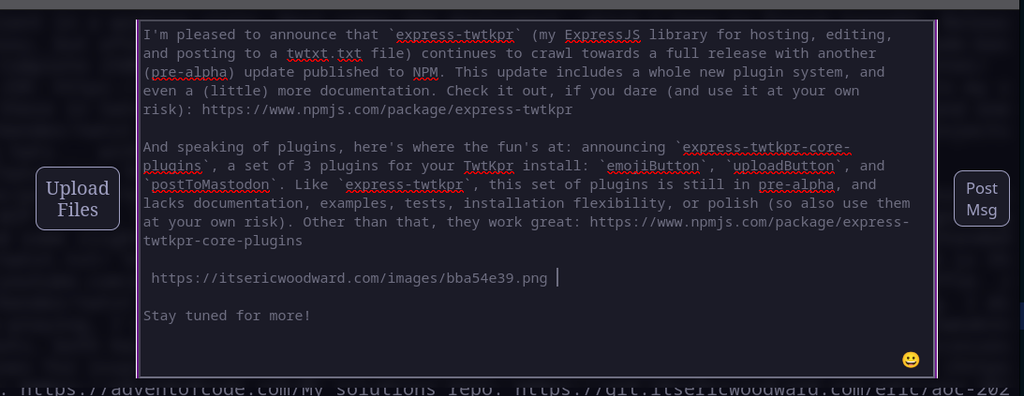
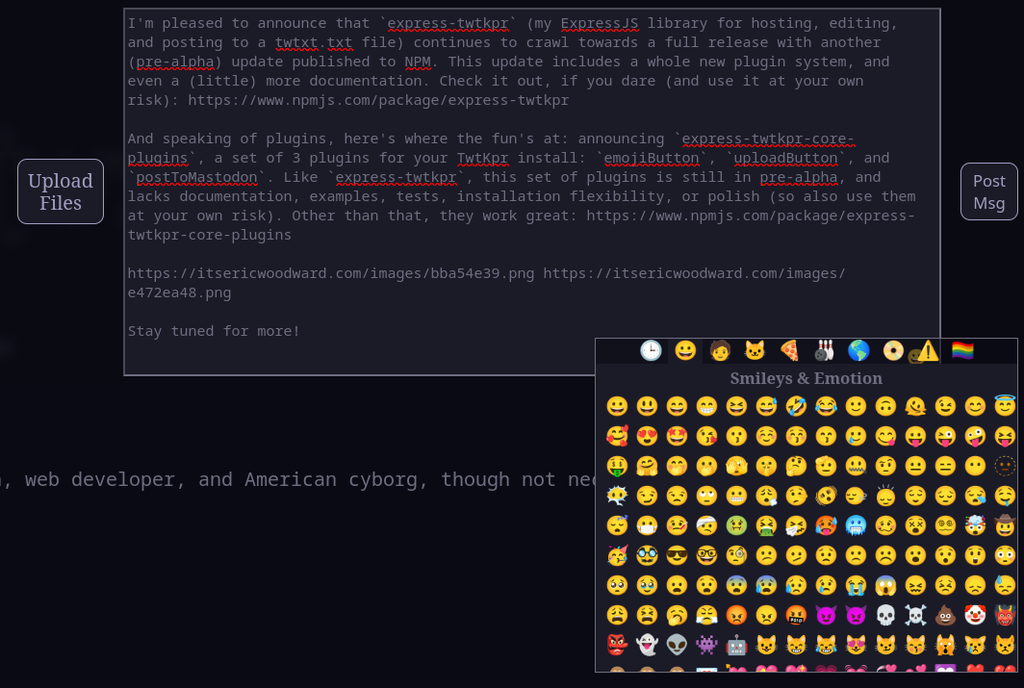
Stay tuned for more! 🤘
Hello, this is a test post.
testing weeks soon ^^ I’m so close to graduating
Just a test
↳
In-reply-to
»
@lyse easy come, easy go. They grow so fast! :-) Also, Azabache allows to be seeing when ready for it, you know, just like Gandalf “a wizard is never late, nor is he early, he arrives precisely when he means to”. :-D
⤋ Read More
Interesting. Another parsing issue? Let’s test: this should be italics. Then this also should be “italics”. End.